
1. Dyrect: Full Warranty Management With Registration, Claims, and Analytics
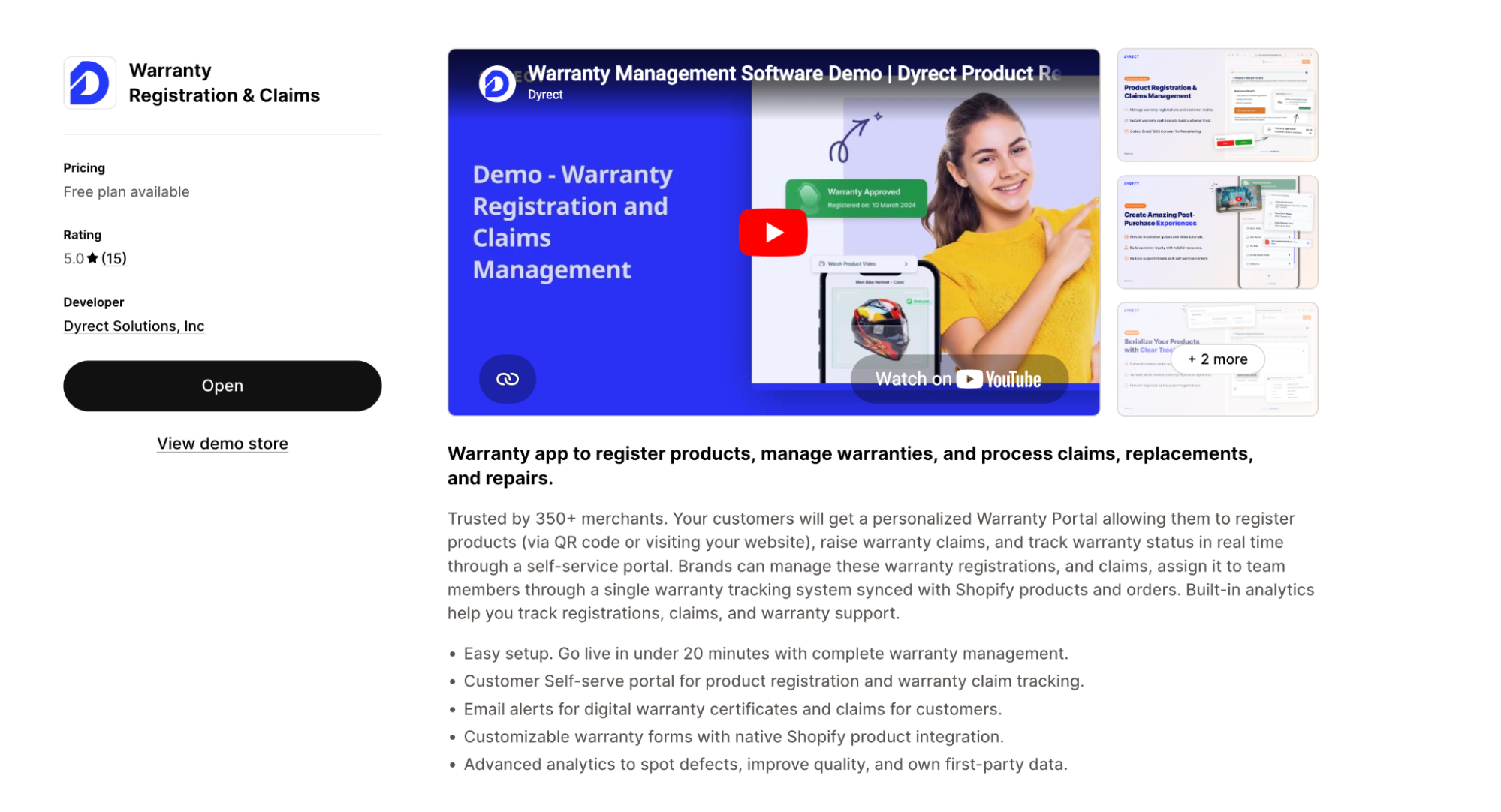
Shopify order data tells you who bought from your store directly. Retail buyers, marketplace customers, and distributor-led sales produce no record in Shopify at all. For brands with any meaningful volume through those channels, this creates a structural hole: real customers, active warranties, and nothing to work from when they need service.
Dyrect handles both sides of this. For Shopify orders, a warranty record is created automatically at the point of fulfillment. For every other channel – retail, Amazon, offline sales, distributors, a QR code on the product packaging takes the buyer to a branded registration page where they activate their warranty directly. Both flows produce the same structured ownership record, and both feed into the same dashboard. Your team gets one view of every registered customer, every active warranty, and every claim, regardless of where the sale happened.
Beyond registration, Dyrect runs the complete warranty operation. Serial number validation at registration blocks duplicate and fraudulent entries before they reach your team. Self-serve claim submission collects structured information upfront. Claim tickets are assigned, tracked, and resolved inside one dashboard. Customer notifications go out automatically at each stage via email, SMS, or WhatsApp. And an analytics layer surfaces which products fail most, which channels drive the most claims, how long resolution takes, and where registration drop-off happens.
Brands like Syska LED, Flo Mattress, Cockatoo Sports, and Briggs & Riley use Dyrect across global markets, covering electronics, furniture, baby gear, sports equipment, and luggage.
Best suited for: Shopify brands and omnichannel consumer product companies selling through multiple channels who want warranty registration, claims, customer data, and post-purchase analytics in one connected system.
Registration That Covers Every Buyer, Including Those Outside Shopify
For direct Shopify buyers, the warranty record is created at fulfillment with no additional steps required from the customer or your team. The customer receives a digital warranty certificate by email and gets immediate access to a self-serve portal to view their coverage and, if needed, file a claim.
For retail, marketplace, and offline buyers, the QR code on the product packaging leads to a fully branded registration page. The customer scans, enters their details, validates their serial number, and activates their warranty. Their record lands in the same dashboard as your Shopify orders, so the distinction between channels disappears from your team’s perspective.
The no-code form builder lets you customise every registration field — serial number input, proof of purchase upload, product variant selection, purchase channel, geographic location — and set different warranty policies per product category, all without developer involvement.
Gaurav Anand, Co-Founder of Cockatoo Sports: “Our after-sales support team loves Dyrect and uses the software to manage all our warranties and customer communication. The best part is they provide a ready-to-use application for our customers to view their product warranties.”
Claim Intake That Gives Your Team Everything to Act on the First Reply
Every claim submitted through Dyrect’s portal arrives as a structured ticket. The customer has already provided the issue description, photos, serial number, and proof of purchase through the portal before the ticket is created. The system validates warranty eligibility automatically – serial number check, purchase date window, policy applicability, so your team receives a pre-verified claim, not a raw complaint.
Your team assigns the ticket, selects the resolution type (repair, replacement, or refund), and Dyrect handles all customer communication from that point. Status confirmations, update notifications, and resolution messages go out automatically. The customer is never left wondering where their claim is.
Analytics That Show What Is Happening Across Your Warranty Operation
Dyrect surfaces the data that email-based warranty handling buries. Which products have the highest claim rates? Which batches generate repeat faults? Which channels drive more warranty requests than others? How long does your team take to resolve each claim type? Where in the registration flow are customers dropping off?
This information turns warranty from a reactive support cost into a proactive quality and retention signal. Product teams can act on defect patterns. Operations can spot channel-level issues. Marketing can use registration data to build post-purchase flows. Leadership can measure resolution performance against a real benchmark.
G2 rating: 4.8 ★ | Shopify App Store rating: 5.0 ★
Pricing: Free plan available on the Shopify App Store. Full warranty registration and claims management starts at $49/month.
Pros
- Covers the complete warranty lifecycle: registration, claims, serial validation, customer portal, analytics
- Captures buyers from retail, marketplace, and offline channels via QR-based registration
- No-code form builder with branded portal and custom policies per product category
AI-powered serial number validation with duplicate detection - Automatic digital warranty certificates sent on registration
- Integrates with Gorgias, Klaviyo, HubSpot, Mailchimp, and more
Cons
- Feature depth exceeds what very small stores need on day one
- Full warranty and claims functionality starts at $49/month; free plan offers limited credits for warranty registration and claims management
2. My Product Registration: Flat-Price Registration for Shopify-Only Brands
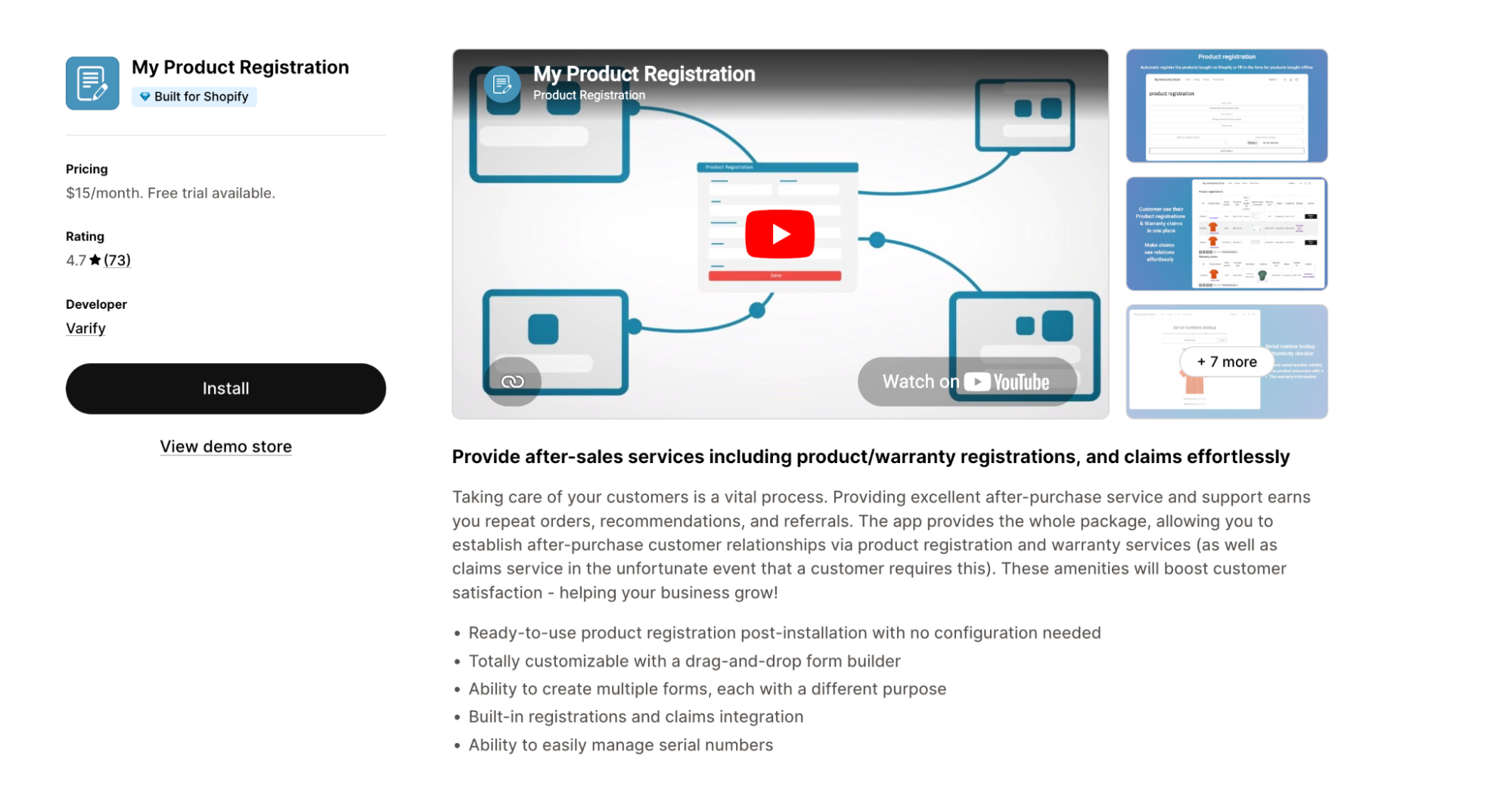
My Product Registration covers product registration, warranty claims, serial number handling, and a customer portal under a flat $15/month with no registration volume limits. For Shopify brands whose sales run primarily through their own store and whose warranty workflow stays within Shopify order data, it offers a dependable, low-complexity setup.
Unlimited registrations, unlimited registration pages, unlimited claim statuses, and serial number support all come with the base plan. You get a drag-and-drop form builder for branded registration forms, a central dashboard to manage incoming claims, and a customer portal where buyers can view warranty status and submit claims. The app holds Built-for-Shopify certification.
What it handles well: straightforward Shopify-order-linked registration and claim intake at a predictable price. The setup is clean and the per-registration cost stays flat regardless of volume.
Where it falls short: registration is tied entirely to Shopify order data. There is no QR-based capture for retail or marketplace buyers. Analytics are basic — you can see claims and registrations but you cannot surface patterns by product, batch, or channel. Integration with external helpdesk and CRM tools is more limited than platforms built for deeper operations. As your brand adds channels or needs to act on warranty data across teams, these gaps become operational constraints.
Best suited for: Shopify merchants selling exclusively through their own store who want a reliable, flat-price registration and claims system without the need for omnichannel coverage or analytics.
Key Features
- Drag-and-drop registration form builder
- Warranty claim intake and status tracking
- Serial number validation and duplicate detection
- Customer portal for warranty access and claim submission
- Authenticity checker for registered products
- Claim records linked to customer registrations
Pros
- Flat $15/month with no per-registration fees
- Built-for-Shopify certified
- 4.9 ★ Shopify App Store rating
- Clean setup with no complex configuration
Cons
- Registration works only with Shopify order data – retail and marketplace buyers have no registration path
- No analytics to surface claim patterns by product, batch, or channel
- Limited integration depth with external helpdesk and CRM tools
Pricing: $15/month, 5-day free trial
3. Propel Warranty Registration: Quick Setup for Stores Moving Off Spreadsheets
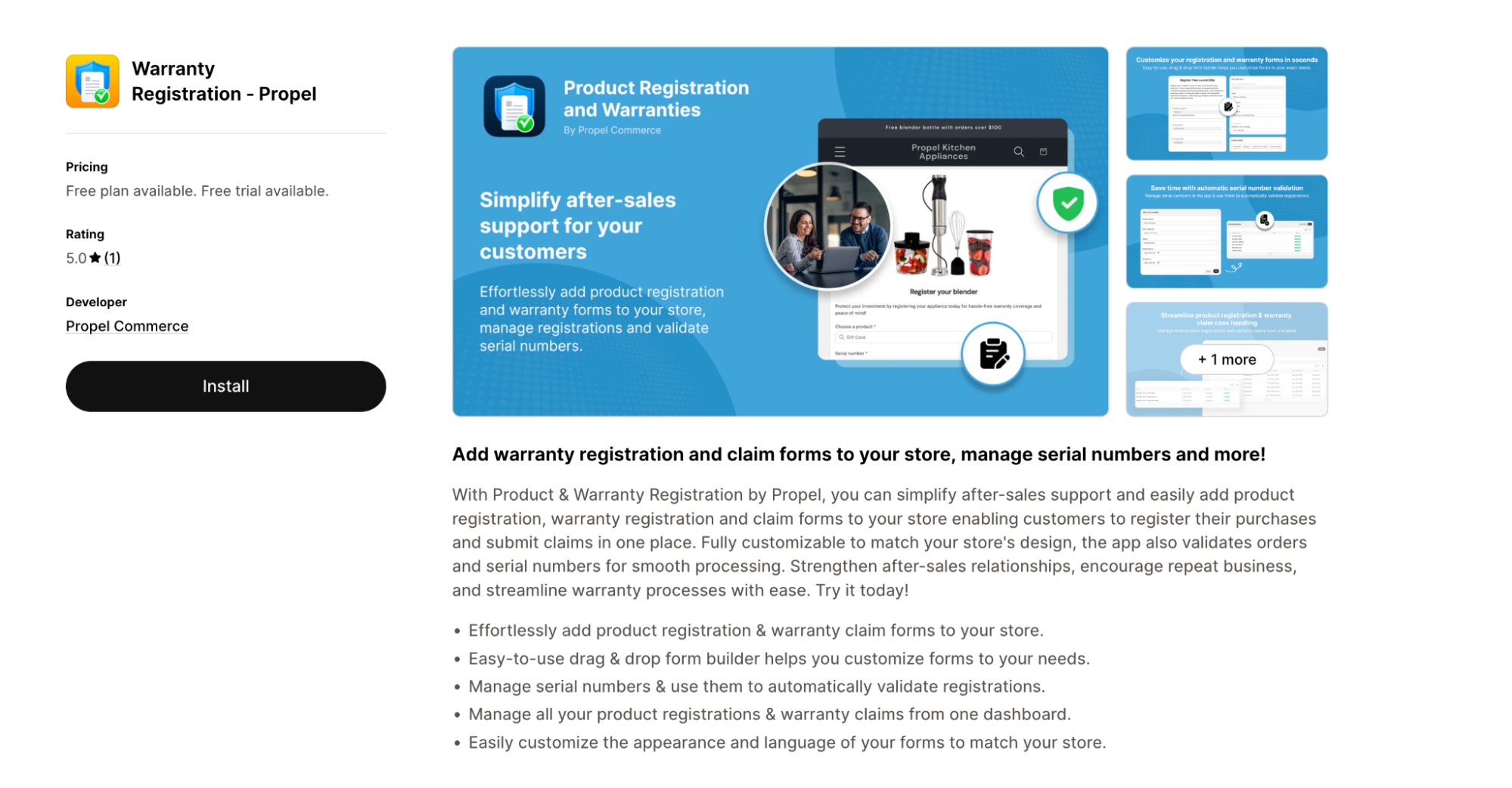
Propel is for stores at the beginning of building a warranty process. It has a free plan, a $9.95/month Pro tier, and a setup process that takes under an hour. If your current warranty workflow lives in an email inbox or a shared spreadsheet, Propel gives you something structured without significant investment.
You get a drag-and-drop form builder for registration and claim submission, customisable to match your store design. Orders and serial numbers are validated automatically at submission. Everything lands in a central dashboard. For a store managing a small number of claims per week, this is a meaningful step up from manual handling.
Where Propel stops: after the customer submits a registration or claim, the system does very little on its own. There is no automated claim ticketing, no customer status updates, no notifications, and no analytics. Your team still has to manually manage each claim from the dashboard and communicate with the customer outside the app. For stores where volume is low and claims are simple, this is workable. For stores growing toward higher claim volume, or those where customers expect visibility into their claim status, the gaps show quickly.
The other constraint is scope. Like My Product Registration, Propel is built around Shopify order data. Buyers from outside your Shopify store have no registration path.
Best suited for: Small Shopify stores moving off email-based warranty handling for the first time, where claim volume is low and automated workflows are not yet a priority.
Key Features
- Drag-and-drop form builder for registration and claim forms
- Order and serial number validation at submission
- Customisable forms matched to store design and language
- Central dashboard for registrations and claims
- Mobile-compatible pages
Pros
- Free plan available; Pro at $9.95/month
- Fastest setup time on this list
- 5.0 ★ Shopify App Store rating
- Annual billing saves 30%
Cons
- No claim ticketing, automated notifications, or customer status updates after submission
- Registration tied to Shopify orders – no path for retail or marketplace buyers
- No analytics layer
- Limited integration with external tools
Pricing: Free (1 registration form, serial number validation) / Pro at $9.95/month (unlimited forms, warranty claims, priority support) / $83.58/year
4. SeriaLogic – Order Serializer: Serial Number Automation for Warranty Tracking
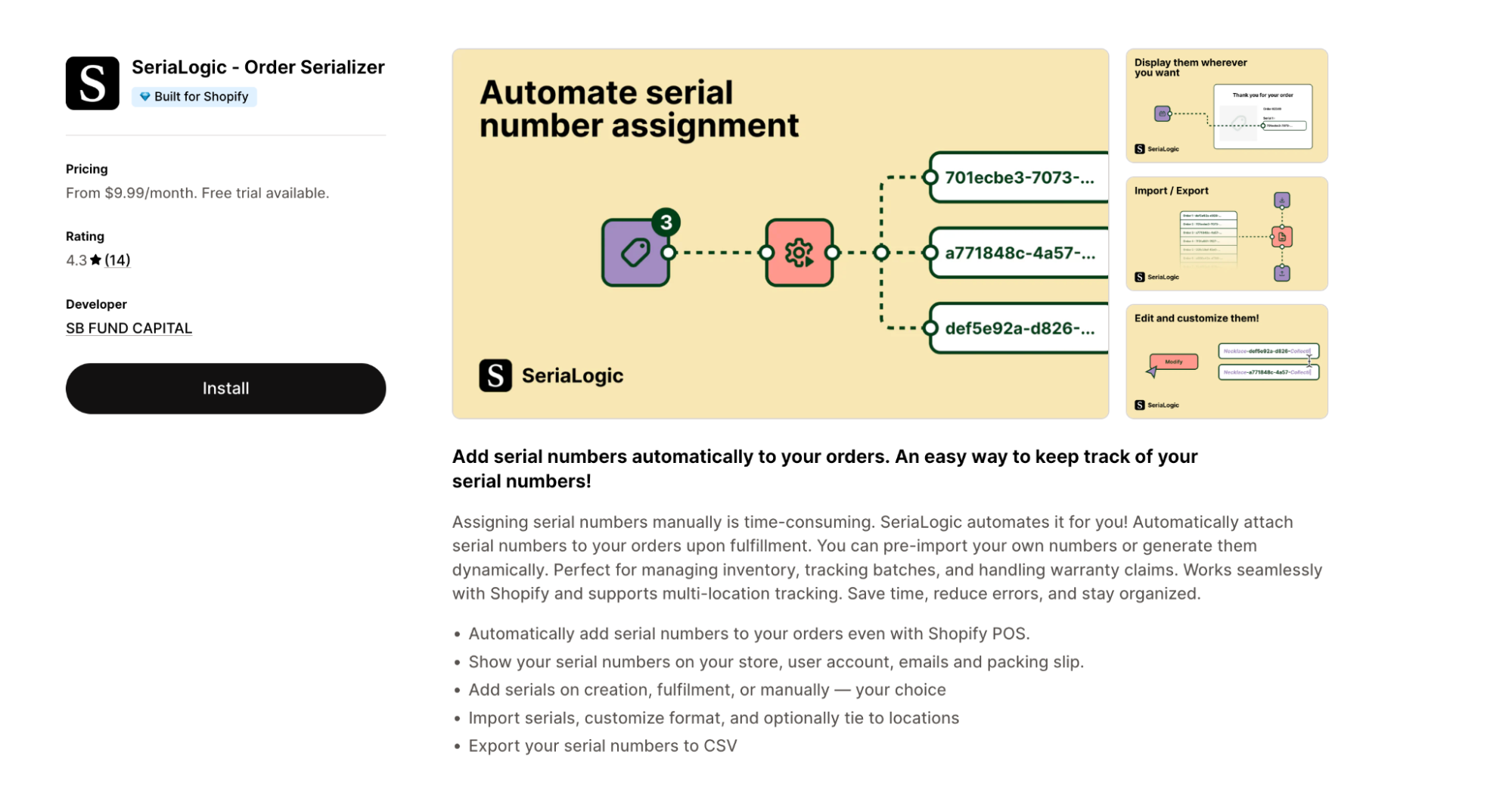
SeriaLogic solves one specific problem that sits underneath all warranty management: every unit your store ships should have a serial number assigned automatically at fulfillment, so every product in the market has a traceable identifier tied to the order it came from.
Without systematically assigned serial numbers, warranty programmes have a verification gap. When a customer submits a claim, you cannot reliably confirm which unit they own, whether it was registered, whether it has been claimed before, or whether the serial number they provide is legitimate. Every eligibility check becomes a manual task. SeriaLogic removes this by assigning serial numbers at the point of fulfillment, using a format you define – with custom prefixes, suffixes, and dynamic generation rules, and displaying them on order confirmations, customer emails, packing slips, and your Shopify admin.
SeriaLogic handles the serialisation layer. It does not replace a warranty management platform. It has no registration forms, no customer claim portal, and no claim resolution workflow. For stores that need serial number assignment and a complete warranty operation, SeriaLogic works well alongside Dyrect or a similar platform, SeriaLogic assigns the serial at fulfillment, the warranty app captures the registration and manages claims against it. SeriaLogic also supports Shopify POS for in-store sales and connects to Shopify Flow for automation.
Best suited for: Shopify merchants who need systematic serial number assignment across all fulfilled orders, particularly those with high order volume, multi-location inventory, or an existing warranty platform that lacks automated serialisation.
Key Features
- Automatic serial number assignment at fulfillment, order creation, or manually
- Custom formats with prefix, suffix, and dynamic generation
- Import your own serial ranges via CSV
- Display serials on store pages, customer account, emails, and packing slips
- Multi-location serial tracking
- Shopify POS support
- Shopify Flow integration
- Full CSV export at any time
Pros
- Reliable automated serial assignment at fulfillment
- Shopify POS and multi-location support
Built-for-Shopify certified - Shopify Flow integration for downstream automation
Cons
- No registration portal, claim forms, or customer-facing warranty pages – requires pairing with a warranty management app
- 4.1 ★ Shopify rating, lower than others on this list
Pricing: Starter at $9.99/month / Professional at $24.99/month (unlimited volume, location assignment, order editing) / 14-day free trial
5. AfterShip Returns & Exchanges: Returns Platform With Warranty as an Add-On
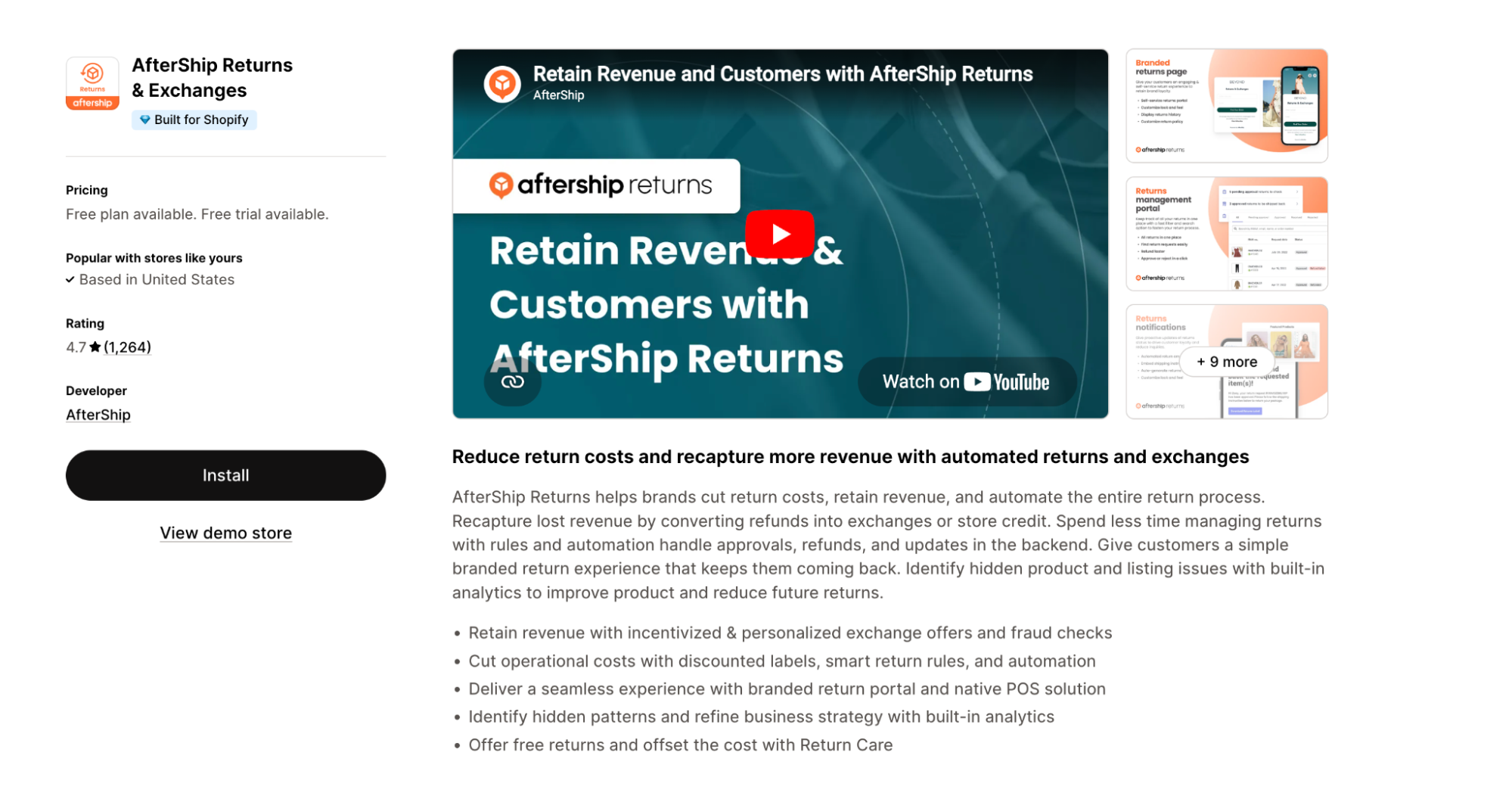
AfterShip is a returns and exchanges platform first. It manages automated return workflows, a branded self-serve returns portal, prepaid labels across 1,200-plus carriers, store credit and exchange flows, and automated notifications at every return stage. For Shopify merchants running high-volume returns operations, it is a capable solution.
The warranty angle comes from AfterShip Warranty, a separate module within the AfterShip suite. For merchants already using AfterShip for tracking or returns, adding the warranty module keeps post-purchase workflows under one vendor and avoids introducing another platform to the stack.
Warranty is an add-on, not the core product. AfterShip’s warranty module handles basic claim management, but it does not include the registration infrastructure, serial number validation, omnichannel capture, or analytics depth that dedicated warranty platforms provide. Brands whose primary need is a structured registration system, product-level warranty records, and claims analytics will find this insufficient. The module works best as a convenience layer for teams already committed to the AfterShip ecosystem who want to avoid a separate warranty tool.
Best suited for: Mid-to-large Shopify stores already using AfterShip for returns or order tracking who want to add basic warranty claim management within an existing setup.
Key Features
- Automated returns and exchanges with self-serve branded portal
- Prepaid return labels across 1,200-plus carriers
- Store credit and exchange workflows
- Automated notifications at each return stage
- AfterShip Warranty module as an add-on
- Shopify Plus compatible
Pros
- 4.7 ★ Shopify App Store rating
- Built-for-Shopify certified
- Useful for stores consolidating post-purchase tools under one platform
- Free plan available
Cons
- Warranty is an add-on module with no dedicated registration infrastructure, serial validation, or omnichannel capture
- No analytics across warranty operations
- Pricing scales by shipment volume, which creates cost unpredictability at peak periods
Pricing: Free plan available / Essentials at $11/month / Pro at $119/month / AfterShip Warranty priced separately