


How to Sell Beauty Products Online: A Practical 2026 Guide

To sell beauty products online, first decide whether you will manufacture a formula, use a contract or private-label supplier, or resell finished products from an authorised source. That choice determines who controls the formulation, safety evidence, product notification, label, claims, stock and customer remedies.
Then choose one customer and product problem, verify the rules in every market you intend to serve, order and inspect the product, calculate the complete margin, build product pages from supportable information and test the journey from order to return. The online store is one part of the system; it cannot make an unsafe, misclassified or poorly documented product ready for sale.
This guide covers cosmetics, skincare, haircare and personal-care ecommerce. Products presented as treating disease or changing a body function may be regulated differently, even when the packaging looks like a beauty product. Obtain qualified advice for the product and destination rather than treating this article as legal or safety approval.
1. Choose how you will bring beauty products to market
The simplest way to understand the business is to identify who created the formula and whose name appears on the product. Three common models carry different responsibilities.
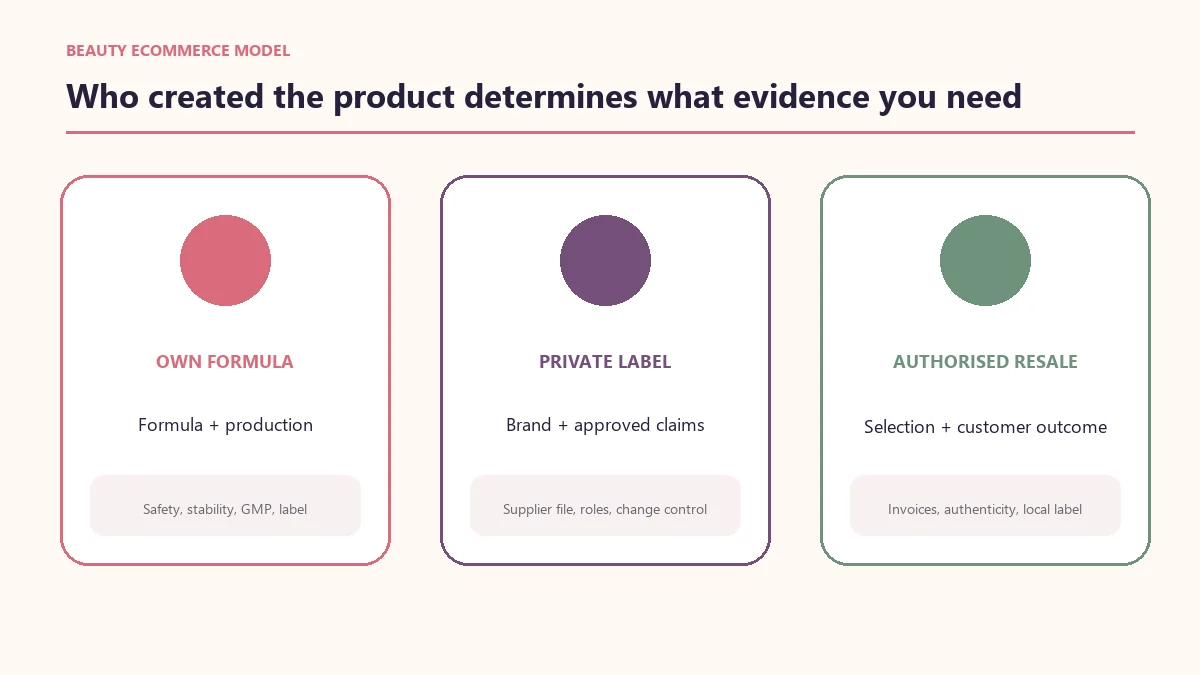
| Model | What the seller controls | Evidence to obtain before sale | Common hidden risk |
|---|---|---|---|
| Own formulation or in-house manufacturing | Formula, production, brand, claims and route to market | Safety, manufacturing, stability, packaging compatibility, labelling and market documentation | Treating a home recipe as a sale-ready cosmetic |
| Contract manufacturing or private label | Brand, selected specification, packaging, claims and sales channels | Contract, formula and ingredient records, safety documents, manufacturing standard, notification ownership and change controls | Assuming the supplier owns every legal obligation |
| Authorised resale | Selection, merchandising, storage, price and customer experience | Supplier identity, invoices, reseller permission where required, genuine product, local-market label and traceability | Importing a genuine product that is not compliant in the destination market |
“Private label” does not mean responsibility disappears. Establish in writing who maintains the safety file, who is the responsible person or manufacturer/importer where applicable, who submits notifications, who approves claims and who handles an adverse reaction or recall.
For resale, buy from a source that can prove the chain of supply. Keep invoices, lot or batch information and brand authorisation where the channel or supplier requires it. A low wholesale price is not useful if the seller cannot establish that the goods are genuine, correctly stored and intended for that market.
2. Define one customer and one useful product problem
“Beauty lovers” is not a practical target audience. A useful starting customer has a recognisable routine, concern, buying situation or preference that affects product choice.
For example:
- frequent travellers seeking a compact, clearly labelled routine;
- customers comparing fragrance-free products by full ingredient information;
- curly-hair customers who need product order and usage quantities explained;
- makeup buyers who need reliable shade, finish and coverage information;
- gift buyers who need presentation, delivery timing and recipient-safe choices.
Research customer language through support questions, search results, retailer reviews and community discussions, but do not copy a competitor’s claims or assume that an anecdote proves a product effect. The aim is to understand the information a buyer needs before making a safe, confident decision.
Start with a small range that works together. Three well-documented products for one routine are easier to explain, photograph and support than twenty unrelated items. A narrow first collection also makes it easier to identify why customers buy, hesitate or return.
3. Verify cosmetic compliance in every target market
There is no single worldwide registration that makes a beauty product legal everywhere. Product classification, ingredients, responsible-party duties, notification, labels and permitted claims vary by jurisdiction.
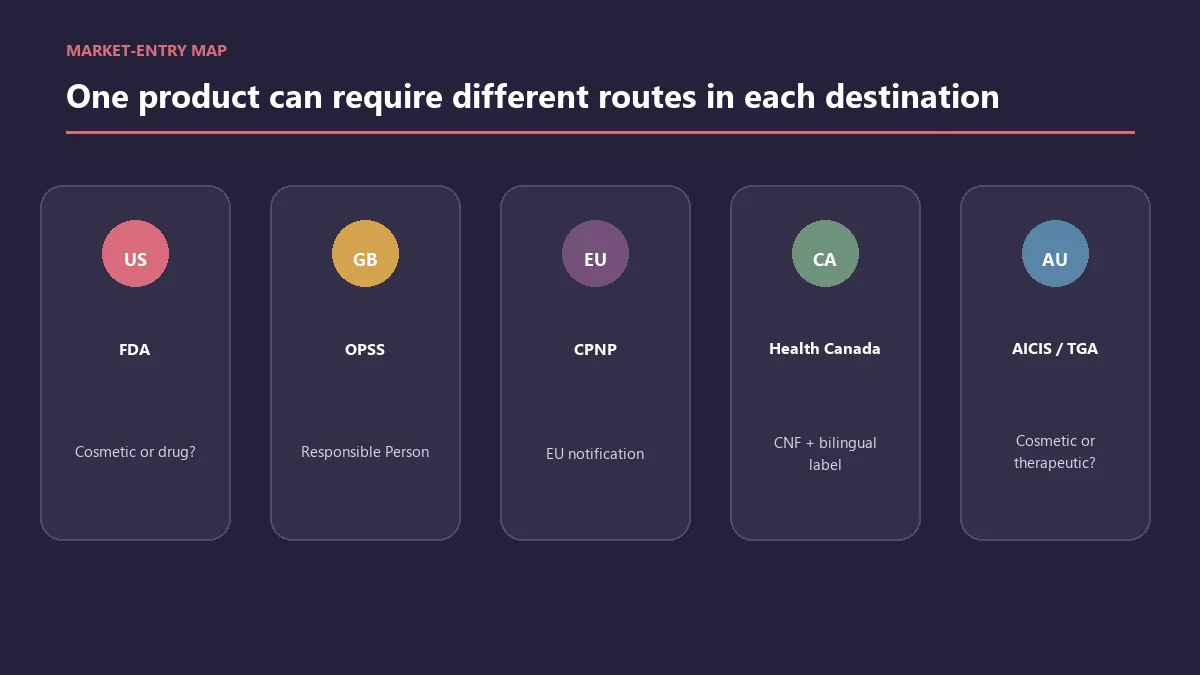
| Market | Starting point to verify | Important operational question |
|---|---|---|
| United States | FDA cosmetic safety, facility or product requirements where applicable, labelling and claims | Is the item a cosmetic, a drug, or both because of its intended use and claims? |
| Great Britain | Responsible Person, Product Information File, safety assessment, notification and English labelling | Who is the UK-established Responsible Person before the product is made available? |
| European Union | EU Responsible Person, safety documentation, labelling and CPNP notification | Has the exact product been notified through the CPNP before placement on the market? |
| Canada | Cosmetic safety, ingredient restrictions, bilingual labelling and Cosmetic Notification Form | Who is the manufacturer or importer responsible for notification and label information? |
| Australia | Cosmetic-versus-therapeutic classification, chemical introduction duties and applicable labels | Do the ingredients, intended use or claims move the product into therapeutic-goods rules? |
In the United States, the FDA states that businesses manufacturing or marketing cosmetics are legally responsible for product safety and labelling. Its small-business cosmetics guidance is a useful starting point, but it is not an approval certificate for a product.
In Great Britain, official guidance says a cosmetic requires a Responsible Person and safety assessment, and must be notified before it is made available. The UK cosmetic product guidance also sets out Product Information File and labelling responsibilities.
The EU uses its own Responsible Person and notification framework. The European Commission explains that product information is submitted through the Cosmetic Products Notification Portal. Great Britain and the EU should not be treated as one notification route.
Health Canada requires manufacturers and importers to notify cosmetics and maintains specific labelling requirements, including bilingual information in relevant fields. Check the current Canadian cosmetic notification guidance for the exact product and role.
In Australia, the product’s primary use, ingredients and claims help determine whether it is a cosmetic or a therapeutic good. The AICIS cosmetics and therapeutics guidance explains this boundary and the separate role of the Therapeutic Goods Administration.
These examples are not a worldwide compliance checklist. Add the destination only after someone accountable has confirmed its classification, ingredients, label, product file, notification, tax, import and consumer-law requirements.
4. Control claims before writing advertisements
A beauty claim appears in more places than the product label. Product names, page headings, images, influencer scripts, reviews selected for promotion, comparison charts, metadata and chatbot answers can all communicate an express or implied promise.
Create a claims register with four fields:
- the exact wording;
- where it will appear;
- the evidence supporting it;
- the person authorised to approve or reject it.
Cosmetic descriptions such as appearance, texture or cleansing purpose still need to be truthful. Claims about treating acne, healing eczema, changing physiology or preventing a condition may change how the product is classified. The FDA’s cosmetics labelling guidance explains that therapeutic or structure/function claims can bring drug requirements into scope.
Avoid copying a supplier’s marketing paragraph without reviewing the evidence and destination. “Natural”, “clean”, “non-toxic”, “clinically proven”, “hypoallergenic” and environmental claims can be vague or require substantiation. A certificate graphic should identify what was certified, by whom and to which product or process; it should not imply broader approval.
Customer testimonials do not replace evidence. The US Federal Trade Commission states that advertising claims must be truthful and evidence-based, and applies rules to endorsements and reviews. Its advertising and marketing guidance is useful for US campaigns; other markets have their own advertising and influencer rules.
5. Source, sample and document the products
Do not select a supplier from catalogue images and unit price alone. Ask for documents and answers appropriate to your business model and target markets.
Supplier evidence checklist
- Full legal business identity and manufacturing location
- Complete ingredient nomenclature for the intended label
- Safety, stability and microbiological evidence appropriate to the product
- Manufacturing and quality documentation
- Packaging compatibility and storage conditions
- Batch or lot coding method
- Shelf-life or period-after-opening basis
- Minimum order, lead time and change-notification process
- Procedure for defects, adverse reactions and recalls
- Confirmation of who owns market notifications and product files
Order production-representative samples, not only presentation samples created for a sales meeting. Inspect the formula, applicator, closure, leakage, fill, label durability and packaging after realistic storage and shipping. A cream that looks attractive in a jar may still leak in warm delivery conditions or become difficult to dispense near the end of use.
Record the exact batch tested. One sample cannot prove every future batch will be identical, but it provides a reference for purchase approval, photography and complaint investigation.
6. Calculate margin with beauty-specific costs
Gross margin based only on wholesale price will overstate what the order contributes. Include the costs created by the product and market.
Contribution per order = selling price − product cost − inbound freight and duties − packaging − payment and platform fees − fulfilment and delivery subsidy − samples and promotions − replacement and returns allowance − variable marketing cost
Beauty-specific costs may include safety assessment, notification, translation, label changes, stability work, batch testing, compliant disposal and insurance. If these costs apply across a production run, allocate a realistic amount per sale when deciding whether the product is viable.
Run at least three scenarios: normal price, launch discount and a replacement order. A product is fragile when one leak, reshipment or creator commission removes the contribution from several successful orders.
The wider breakdown of online-store start-up costs can help separate recurring order costs from registration, domain, design and software expenses.
7. Choose sales channels that fit the operating model
An own store, a marketplace and social commerce solve different problems.
| Channel | Main advantage | Main constraint | Verify before listing |
|---|---|---|---|
| Own ecommerce store | Control over education, presentation, customer journey and policies | The business must generate demand and maintain the store | Payment, tax, privacy, shipping and product-page obligations |
| General marketplace | Existing shopper demand and established checkout | Category restrictions, fees, competition and limited control | Beauty-category approval, condition rules, documents and fulfilment requirements |
| Specialist beauty retailer or marketplace | Audience relevance and merchandising context | Buying standards, margin and onboarding requirements | Supplier documentation, assortment fit and commercial terms |
| Social commerce | Discovery and conversation close to content | Platform eligibility, changing commerce features and operational fragmentation | Supported countries, catalogue rules, advertising disclosures and order ownership |
Shopify is one option for an own store, but it does not approve the cosmetic itself. If that platform is selected, follow the practical process for adding products to Shopify after the product information, variants and shipping rules are verified.
Avoid launching on every channel at once. Begin where the intended customer already researches or buys, establish one reliable inventory and support process, then add channels without creating conflicting prices, claims or product data.
8. Build beauty product pages that reduce uncertainty
An online customer cannot feel a texture, smell a fragrance or compare a shade in natural light. The product page must replace some of that missing physical experience without pretending to reproduce it perfectly.
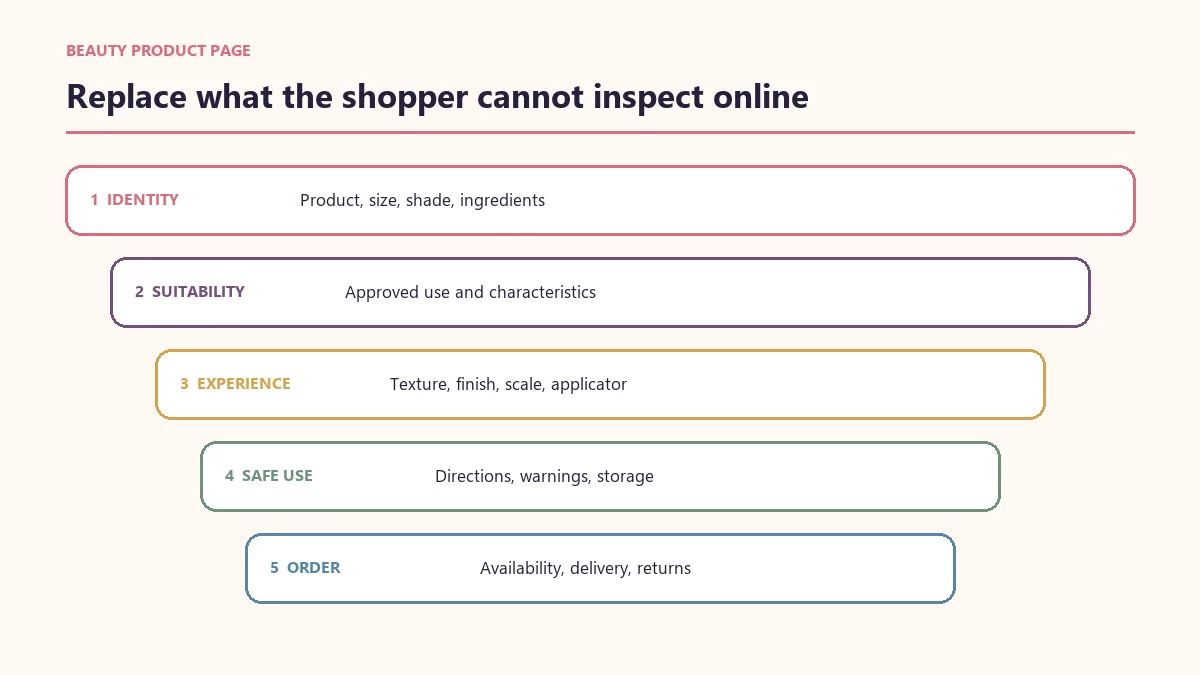
Product identity
State the product type, size, shade or variant and what is included. Make the complete ingredient list easy to find and match it to the product being shipped. If formulations differ by market or change over time, control the page version rather than leaving an outdated list live.
Suitable use without diagnosis
Explain the intended cosmetic use and relevant characteristics using approved wording. Do not diagnose the visitor from a quiz or promise that a product is suitable for a medical condition unless the product, evidence and workflow are authorised for that purpose.
Texture, shade and finish
Use consistent photographs in more than one useful context: product pack, texture or swatch, scale and applied finish where appropriate. Explain that device displays and lighting affect colour. For shades, include model or swatch context without implying an exact match for every customer.
Instructions and precautions
Publish the correct order, quantity, frequency, warnings, storage and patch-test wording where required or approved. Do not create instructions from general beauty advice if the manufacturer has supplied product-specific directions.
Delivery and returns
Separate dispatch time from delivery estimates. Explain heat, freezing or restricted-item limitations where relevant. State how opened, damaged, leaking or incorrectly supplied products are handled, while respecting consumer rights in the destination.
Use customer questions to improve the page. If buyers repeatedly ask whether a bottle includes a pump, the image and “what is included” section need attention; another generic FAQ is not the first fix.
9. Design batch, storage, fulfilment and return controls
Beauty inventory needs more than a SKU count. Record enough information to identify what the customer received.
For each incoming batch:
- record supplier, product, quantity and receipt date;
- capture batch or lot code and relevant shelf-life information;
- inspect damage, leakage, label and quantity;
- store according to documented conditions;
- rotate stock using the appropriate expiry or receipt rule;
- connect dispatched orders to batch information where the risk and system require it;
- quarantine returns, damaged goods and recalled stock from saleable inventory.
Do not automatically return an opened product to saleable stock. Create separate outcomes for unopened resale where lawful, damaged-in-transit evidence, incorrect item, suspected reaction and ordinary change of mind. The operational options in ecommerce returns management can help stores choose systems, but the beauty-specific hygiene and legal policy still needs owner approval.
Maintain a clear adverse-event route. Support staff should know which information to collect, what they must not diagnose and who reviews the report. Serious cases may trigger regulatory reporting duties; do not let them disappear inside an ordinary refund queue.
10. Market beauty products without making the content interchangeable
Beauty content works when it helps a specific customer make or use a decision. A feed containing only pack shots, discount graphics and broad promises gives little reason to follow the brand.
Build content around verified product information:
- demonstrate texture, finish, applicator or routine order accurately;
- answer a real pre-purchase question;
- compare variants using the same lighting and criteria;
- show packaging scale and what arrives;
- explain an ingredient’s approved role without turning it into a medical promise;
- publish care, storage or disposal instructions;
- show the people and process behind sourcing or production when evidence permits.
Creator partnerships need a brief covering approved claims, required disclosures, image rights and prohibited language. Review the content in context: a creator may communicate an unsupported cure or guaranteed result without using those exact words.
Instagram can support discovery and customer questions, but the plan should connect content to a product page or conversation route the team can operate. Do not send shoppers from a product demonstration into an unmanaged inbox or a generic homepage that cannot continue the decision.
11. Use customer questions as merchandising data
Classify enquiries by the decision they reveal:
- Identity: What is the product, size or shade?
- Suitability: Is it intended for this cosmetic use or preference?
- Routine: When and how is it used with other products?
- Evidence: What supports the wording on the page?
- Order: Is it available and where is the parcel?
- Exception: Is the item damaged, leaking, incorrect or linked to a reaction?
Then improve the source of the confusion. Product-page questions belong in product information; delivery questions may expose a shipping-page problem; unusual reactions need a trained human and documented process.
How AeroChat supports beauty ecommerce customer service
AeroChat is an AI agent platform that helps ecommerce brands run customer service on autopilot. When a beauty store begins receiving repeated product, delivery, return or order questions, it can answer suitable enquiries using approved business knowledge and transfer conversations that need human judgement.
For Shopify merchants, AeroChat’s Shopify integration can support customer conversations with relevant store information. A useful setup might answer where an order is, explain the approved return process or help a shopper navigate documented product information across supported channels.
The boundaries matter. An AI customer-service agent should not diagnose a skin condition, invent ingredient suitability, override an adverse-reaction procedure or turn an unsupported claim into personalised advice. Product content, escalation instructions and human ownership must be approved before automation is introduced.
AeroChat is generally a growth-stage support investment rather than a required launch expense. A new beauty store with a few enquiries may first need better product pages and disciplined response windows. Businesses comparing a larger support workload can review the criteria for a Shopify AI chatbot after defining what the automation may and may not answer.
12. A 30-day beauty ecommerce launch plan
Days 1–7: define the product and responsibility
Choose the business model, customer and initial range. Map the manufacturer, importer, Responsible Person or other accountable roles for each target market. Create the first claims register and request missing supplier documents.
Days 8–14: verify product and economics
Review classification and compliance with qualified help. Order samples, inspect the complete product and packaging, and calculate contribution for normal, discounted and replacement orders.
Days 15–21: build the store and operations
Create product pages from verified information. Configure payment, tax, shipping, inventory, batch records, customer contact and returns. Place test orders on mobile and desktop, including a failed payment and an address correction.
Days 22–30: run a controlled launch
Launch a small range to the defined market. Track product-page behaviour, qualified questions, orders, contribution, defects, returns and delivery exceptions. Add products or countries only after the existing workflow remains accurate.
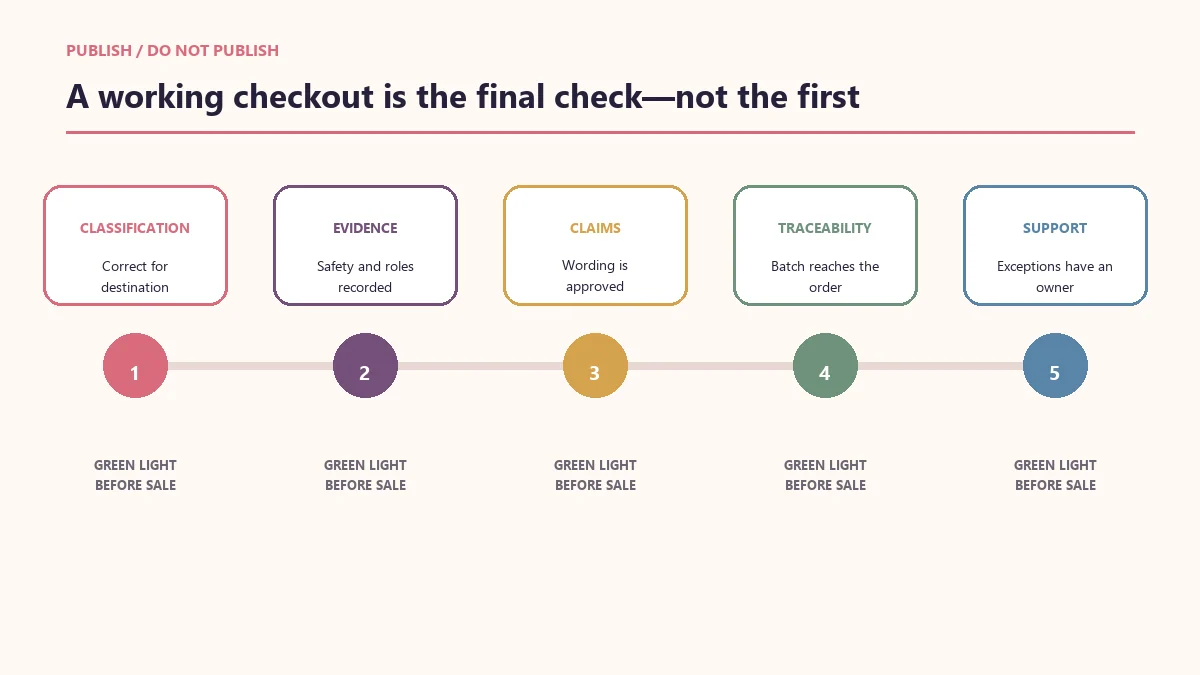
Before publishing a product, require five green lights:
- the product is correctly classified for the destination;
- accountable compliance roles and evidence are documented;
- every public claim has an approved basis;
- the store can trace, fulfil and resolve the order;
- customer support knows when to answer and when to escalate.
If one is missing, the product is not ready merely because the page and payment button work.
Frequently asked questions
Do I need a licence to sell beauty products online?
There is no universal online-beauty licence. Requirements depend on the product, business activity and destination. Manufacturing, importing, making therapeutic claims or selling particular ingredients can trigger different registration, notification, facility, professional or local-business duties. Check the exact role and market before sale.
Can I make beauty products at home and sell them online?
Possibly, but a home-made cosmetic still needs to meet applicable safety, manufacturing, labelling, product-file, notification and business requirements. A clean-looking workspace or natural ingredient list is not evidence that the finished product is safe and stable for its intended shelf life.
Can I dropship cosmetics?
The fulfilment model does not remove seller or importer responsibilities. Verify product authenticity, destination compliance, storage, label, batch traceability, delivery conditions and the process for defects or reactions. If the supplier cannot provide the necessary evidence or order information, dropshipping is a poor fit for that product.
Where is the best place to sell beauty products online?
Choose the channel that matches how the target customer discovers and evaluates the product and that the business can operate compliantly. An own store offers education and control; marketplaces offer demand but impose category rules; social commerce shortens discovery but can fragment operations. Start with one reliable route rather than every available channel.
How can a new beauty store build trust?
Use accurate ingredient and product information, real contact details, clear policies, production-representative photography, supportable claims, genuine reviews and dependable fulfilment. Explain limitations and variations instead of hiding them. Trust comes from consistent evidence and service, not a large collection of badges.
Beauty products require the same trust-first approach as baby and pet products, with the added challenge that skin type, tone and personal chemistry make product fit highly individual. The jewellery guide covers a similar high-return-risk category, and selling candles online shares the sensory marketing approach that applies to complementary wellness products. For stores using Instagram as a primary acquisition channel, the Instagram selling guide covers the visual content and DM strategy that beauty brands rely on most.