


How to Sell Candles Online in 2026: A Practical Launch Guide

To sell candles online, start with a safe, repeatable product and a small collection built around a clear customer or occasion. Calculate the cost of delivering each order, prepare the correct product information for the markets where you will sell, and create product pages that help shoppers understand scent, size and use without smelling the candle in person.
The website is only one part of the business. A polished store cannot compensate for an untested vessel, vague warning label, confusing fragrance range or price that ignores breakage and fulfilment. Treat your first collection as a controlled commercial test rather than filling a store with every scent you can make.

First decide what kind of candle business you are building
Your business model determines which decisions you control and which evidence you need from somebody else.
| Model | What you control | Main responsibility to resolve | Common constraint |
|---|---|---|---|
| Make candles yourself | Formula, vessel, wick, testing, branding and production | Finished-product safety, consistency, records and labelling | Time, testing and batch control |
| Contract or private-label production | Brand, range, presentation and sales channels | Confirm who holds product evidence and how changes are approved | Minimum order quantities and less formulation control |
| Curate and resell finished candles | Assortment, merchandising and customer experience | Verify authorised supply, labels, storage and traceability | Lower differentiation and supplier dependence |
Making candles gives you the most product control, but it also puts more work behind every SKU. Changing the fragrance load, wick, wax, dye or container can change how the finished candle behaves. Do not assume a test for one combination proves another.
Private label can reduce production work, but it does not remove the need to understand what you are selling. Ask the manufacturer which documents support the finished product, who approves the label and how batches or specification changes are recorded.
Reselling is operationally simpler when the supplier is reliable. It still requires accurate storage, product information and a way to identify affected stock if a safety problem emerges.
Build a small collection customers can understand
A first collection needs a reason to exist beyond “hand-poured candles”. Choose one useful organising idea:
- a particular room or ritual, such as dining, reading or evening hosting;
- a gifting occasion;
- a recognisable fragrance territory, such as green, woody or bakery-inspired scents;
- a defined format, such as travel tins or refillable vessels;
- a customer preference you can substantiate through the materials and product design.
Start with three to five products that make sense together. This gives customers enough choice without multiplying test work, packaging, labels and slow-moving stock.
For example, a three-candle evening collection could offer a fresh opening scent, a warmer dining scent and a softer late-evening scent. That is easier to understand than twelve unrelated names that reveal nothing about the fragrance.
Before ordering deep stock, show the proposed range to people who fit the intended audience. Ask which scent description they understand, which product they would choose, what information is missing and whether the price feels credible. Interest is not the same as a paid order, but unclear feedback is a warning worth addressing early.
Complete the product-safety gate before publishing a listing
Candles are products involving heat and flame. The exact legal and standards requirements depend on the product and the countries where it is made and sold.
The US Consumer Product Safety Commission’s candle business guidance identifies federal rules affecting certain metal-cored wicks and points businesses to candle fire-safety and labelling standards. UK businesses are responsible for supplying safe products and following relevant labelling duties, as explained in the Office for Product Safety and Standards guidance.
Fragranced products may create further classification and labelling duties. The HSENI guidance on candles and chemical labelling explains why the finished fragrance mixture matters. Use the regulator and qualified advice for your actual sales market rather than copying another candle’s label.
Keep a product evidence file
For each finished candle, keep the information needed to identify and review it:
- product name, SKU and batch;
- wax, fragrance, colour and supplier references;
- vessel and wick specification;
- formula or production specification;
- test method, dates, conditions and results;
- label version and warnings;
- production date and quantity;
- supplier documents and change notifications;
- complaints, failures and corrective actions.
Records are useful only when they describe the product actually sold. If a supplier changes a component or you alter the formula, decide what needs to be reviewed or retested before the next batch.
Test the finished product
A candle is a system, not a list of ingredients. Test the actual wax, wick, fragrance, colour and vessel combination. Observe the product across its intended use cycle, not only during an attractive first burn.
Do not turn a blog article into a universal testing protocol. The appropriate assessment depends on the product and applicable standards. If you lack the expertise to determine what is required, obtain competent product-safety advice before sale.
Separate warnings from marketing
Safety information should be visible and understandable. Do not bury it inside a brand story, scent poem or collapsible section that shoppers may never open.
Marketing copy has a different job. It can explain fragrance, setting and design, but it must not contradict the label or make unsupported health, therapeutic or environmental claims.

Calculate whether the delivered order is profitable
The wax and fragrance are only part of the unit cost. Build the price from the complete order:
Contribution per order = selling price - product cost - packaging - selling fees - fulfilment - expected damage and returns - acquisition cost
For a candle you make, product cost may include:
- wax, fragrance, wick, vessel, lid and label;
- direct production and finishing time;
- test pours, failed units and normal material loss;
- studio overhead and equipment allocation;
- compliance or specialist review;
- gift packaging and inserts.
Then add payment or marketplace fees, picking and packing time, delivery materials, carrier cost and a reasonable allowance for damage or replacement based on your own evidence.
Calculate direct-to-consumer and wholesale orders separately. A wholesale order may reduce acquisition and per-unit packing work, but the selling price is lower and the buyer may require case quantities, delivery dates and barcodes. There is no universal candle margin that proves a business will work.
If you need a broader cost model, use the guide to budgeting for an online store and insert your real candle costs.
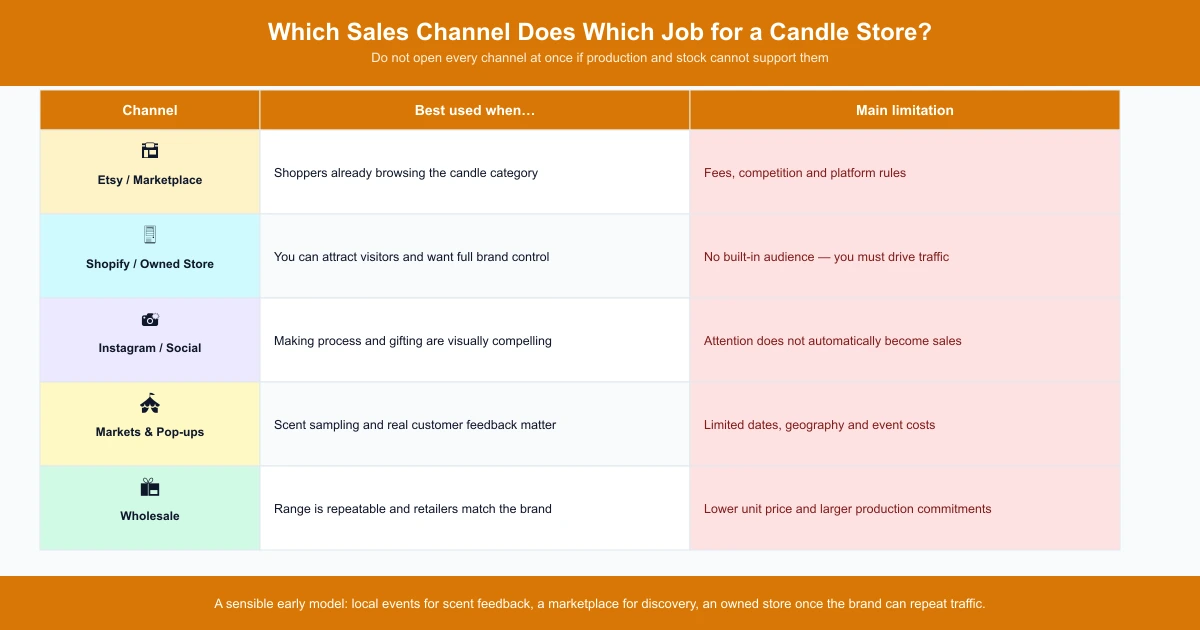
Choose a sales channel for the job it performs
An owned store, marketplace, craft fair and wholesale relationship solve different problems.
| Channel | Useful when | Main limitation |
|---|---|---|
| Etsy or another eligible marketplace | You need access to shoppers already browsing the category | Competition, fees and platform rules |
| Shopify or another owned store | You can attract visitors and want control over branding and customer experience | No automatic audience |
| Instagram or social content | The making process, styling and gifting are visually compelling | Attention does not automatically become website traffic or sales |
| Markets and pop-ups | Scent sampling and immediate feedback matter | Limited dates, geography and event costs |
| Wholesale | The range is repeatable and retailers fit the brand | Lower unit price and production commitments |
For a deeper decision, compare Shopify and Etsy for a new product business. A sensible early model may use local events for scent feedback, a marketplace for discovery and an owned store once the brand can generate repeat traffic. Do not open every channel at once if production and stock cannot support them.
Help shoppers imagine a fragrance they cannot smell
Scent is the central online merchandising challenge. A name such as “Midnight Library” may be memorable, but it does not tell the customer whether the candle smells of cedar, leather, vanilla, smoke or something else.
Build each description in layers:
- Plain-language summary: one sentence describing the overall scent.
- Fragrance notes: the recognisable notes, based on accurate product information.
- Character: fresh, dry, sweet, smoky, green or warm, where those words genuinely fit.
- Setting: the room, occasion or atmosphere the brand intends.
- Product facts: net quantity, dimensions, materials, expected use information and care.
An effective summary might say: “A dry, woody candle led by cedar, softened with amber and a light citrus opening.” The shopper understands the direction before reading the more expressive brand copy.
Avoid presenting subjective scent strength as an exact fact unless you have a defined method behind it. “Designed for a small bedroom” is still a suitability statement that must match the product and your evidence.
Show the complete physical product
Customers also need to judge size and finish. Include:
- a clean main photograph;
- the candle at a recognisable scale;
- the vessel texture and colour;
- the label and packaging;
- the unlit wax surface and wick;
- the product in an appropriate room setting;
- the gift presentation, if it is included.
The Shopify product photography guide explains lighting, shot planning and consistency without requiring an expensive studio.
Package candles for glass, heat and gifting
The packaging has to protect the product before it impresses the recipient.
Test the packed candle for movement inside the box. Protect the vessel from impact and keep the lid or decorative parts from marking the wax. Check whether the external carton and seals remain reliable through the carrier process you intend to use.
Warm-weather routes need particular attention because wax and adhesives can respond to heat. The correct response depends on the formula, packaging, distance, season and carrier conditions. Run controlled delivery tests before promising that the product can travel anywhere at any time.
If gifting is a major use case, make the order options explicit:
- whether prices are omitted;
- where the gift message appears;
- whether gift wrapping is included or paid;
- which products fit together;
- the final date for a stated delivery window.
Use ecommerce packaging ideas for presentation inspiration, then validate the structure with the real candle.
Launch around buying moments, not endless posting
A candle brand can create useful content without publishing a daily stream of generic lifestyle photographs.
Before launch, show how the collection differs, explain the scent families and answer practical questions. At launch, make the range, price, dispatch timing and stock clear. After purchase, provide care information and ask for specific feedback about scent choice, packaging and delivery.
A simple calendar can follow real buying moments:
- new-home and hosting periods;
- birthdays and thank-you gifts;
- seasonal fragrance changes;
- corporate or event gifting lead times;
- repeat-purchase windows based on the store’s own order data.
Do not manufacture urgency. If a batch is limited because the studio can produce only a certain quantity, state that plainly. If it will be restocked, avoid language implying it will disappear forever.
How AeroChat can help a growing candle store
AeroChat is an AI agent platform that helps ecommerce brands run customer service on autopilot.
For a Shopify candle store, it can use approved store information to answer recurring questions about scent notes, vessel size, care, delivery, gifting, stock and order status. It can also help a shopper narrow options by a stated room, fragrance preference or budget when the catalogue contains the information needed to do so.
This is useful only when the source information is reliable. The AI should not invent burn instructions, decide how a chemical label should be written or improvise a safety response. Damage reports, adverse reactions, unusual complaints and any question needing judgement should move to a human.
Merchants comparing tools can review Shopify AI chatbot options for ecommerce support. AeroChat is generally a growth-stage support investment rather than a required launch cost. It becomes more relevant when the same product questions arrive repeatedly across website chat, Instagram, WhatsApp and other supported channels.

A 30-day test-burn-to-first-sale plan
Days 1–7: prove the product
Confirm the business model, product specification, test requirements, labels, supplier records and first collection. Hold any SKU whose evidence is incomplete.
Days 8–14: prove the economics
Calculate delivered contribution for direct orders and any intended wholesale offer. Pack and ship test units through realistic routes. Revise the price, packaging or range where the numbers do not work.
Days 15–21: prove the product page
Photograph the complete product, write scent information in plain language and ask target customers to choose between products without extra explanation. Fix the questions the page leaves unanswered.
Days 22–30: run a controlled launch
Release a manageable quantity through one primary channel. Track which products sell, which questions occur, where damage happens and whether the final contribution matches the plan. Use that evidence to reorder, revise or stop a product.
Candle-store readiness check
- Does every SKU have a finished-product evidence file?
- Are safety and fragrance labels appropriate for the target market?
- Can a shopper understand the scent without relying on the product name?
- Does the price cover the complete delivered order?
- Has the actual packaging been tested?
- Are dispatch dates and gift options clear?
- Can affected batches and customers be identified if a problem occurs?
- Are safety complaints escalated to a person?
- Is the first collection small enough to produce and support consistently?
Selling candles online works best when the brand makes an emotional product easy to evaluate through practical evidence. Start with a range you can test, describe, deliver and improve before adding more scents or channels.
Candles sit in a crowded market where differentiation comes through scent story, visual branding and the occasion context you create around the product. The handmade products guide covers the craft-first positioning that helps independent candle makers stand out. For the visual side of this, Shopify product photography tips covers how to shoot candles and lifestyle context in a way that converts, and selling beauty and wellness products online shares the same sensory-led description approach applied to a complementary category.