


How to Sell Jewellery Online: A Trust-First Business Guide 2026

To sell jewellery online, build a focused collection and replace the buyer’s missing in-person inspection with accurate material details, dimensions, photographs, policies and access to human help. Choose a business model you can evidence, price the complete service around each piece, and use sales channels suited to its value and buying decision.
Jewellery is a trust sale. A shopper cannot feel the weight, inspect the clasp, compare the finish against their skin or try the size through a screen. Attractive branding earns attention; specific evidence earns the purchase.
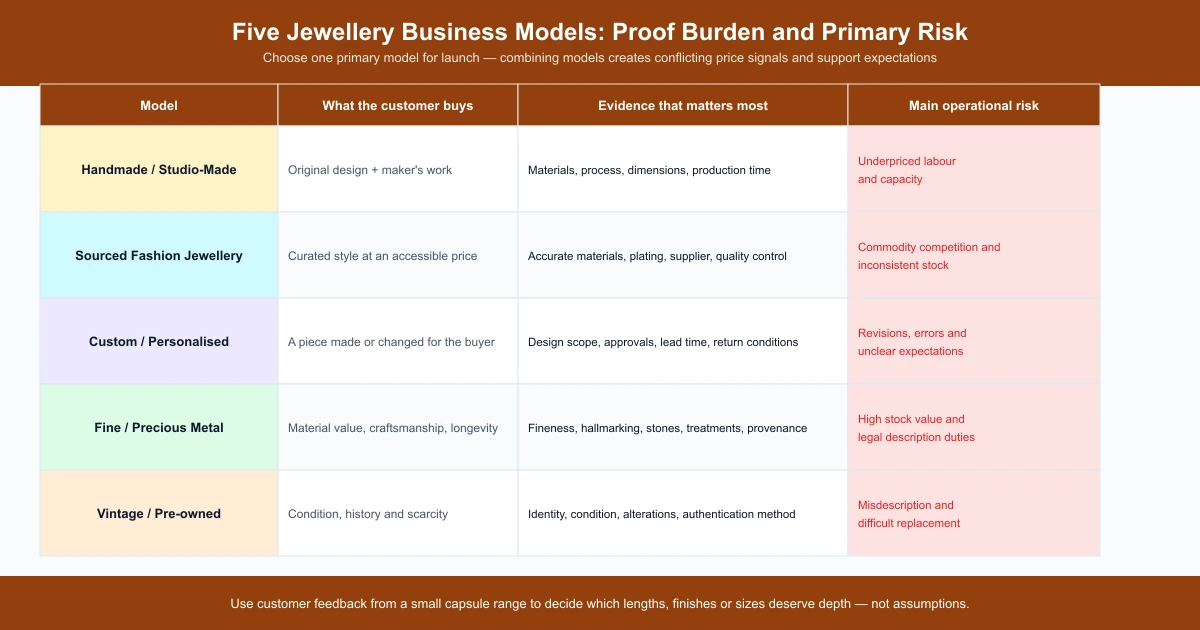
Choose the business model that defines your proof burden
The word “jewellery” covers businesses with very different stock, service and disclosure requirements.
| Model | What the customer is buying | Evidence that matters most | Main operational risk |
|---|---|---|---|
| Handmade or studio-made | Original design and maker’s work | Materials, process, dimensions and production time | Underpriced labour and capacity |
| Sourced fashion jewellery | Curated style at an accessible price | Accurate materials, plating, supplier and quality control | Commodity competition and inconsistent stock |
| Custom or personalised | A piece made or changed for the buyer | Design scope, approvals, lead time and return conditions | Revisions, errors and unclear expectations |
| Fine or precious-metal jewellery | Material value, craftsmanship and longevity | Fineness, hallmarking, stones, treatments and provenance | High stock value and legal description |
| Vintage or pre-owned | Condition, history and scarcity | Identity, condition, alterations and authentication method | Misdescription and difficult replacement |
Choose one primary model for launch. Combining wholesale fashion pieces, handmade silver, vintage rings and bespoke bridal work under one new brand creates conflicting price signals and support expectations.
Define a collection people can recognise
A coherent collection needs four boundaries:
- the person or buying occasion;
- the material and price position;
- the visual signature;
- the range of products you can stock or produce consistently.
“Everyday recycled-silver jewellery for minimal wardrobes” is more useful than “beautiful jewellery for everyone” only if the material and recycled-content claims can be proved. “Personalised gifts dispatched in five days” is useful only when the workshop can keep that promise.
Start with a capsule range. A small group of related earrings, necklaces and bracelets can demonstrate a point of view while limiting stock risk. Use customer feedback to decide which lengths, finishes or sizes deserve depth.

Build the online jewellery trust stack
Every product page should answer six layers of doubt.
1. What is it actually made from?
Name the base metal, precious-metal fineness, plating or coating, stones, treatments and non-metal components accurately. Do not use “gold”, “silver”, “diamond” or similar terms casually when the product is plated, coloured or simulated.
In the US, the Federal Trade Commission’s Jewelry Guides resources explain truthful descriptions and important disclosures for jewellery sellers. Other markets have their own rules.
UK businesses supplying products described as gold, silver, platinum or palladium should check the current British Hallmarking Council guidance. It explains that online retailers must display relevant hallmark information and that certain precious-metal articles are subject to hallmarking unless an exemption applies.
This article is not a substitute for product-specific legal advice. Confirm the requirements for the exact piece and every market where it will be sold.
2. How large and heavy is it?
Give measurements in familiar units and explain what was measured. For a necklace, state the chain length and extension. For earrings, state drop, width and pair or individual weight where useful. For a ring, use an accurate sizing system and explain conversions rather than assuming all countries label sizes alike.
3. How does it look from every relevant angle?
Show front, side, back, fastening, hallmark or maker’s mark, stone setting and surface finish. If the colour changes under different light, use consistent photography and avoid edits that make the product misleading.
4. What variation should the customer expect?
Handmade, natural-stone and vintage pieces can vary. Explain which differences are normal and whether the buyer receives the exact photographed item or a representative example.
5. What happens after purchase?
State production or dispatch time, packaging, delivery method, care, repairs, resizing and return conditions. Separate standard pieces from engraved, resized or made-to-order work.
6. When can a person help?
High-consideration and custom purchases often need judgement. Give customers a clear route to ask about fit, alterations, provenance or design before paying.
Check descriptions before polishing the story
Brand storytelling should never outrun the evidence.
Review each product claim:
- Is the metal description exact?
- Is a gemstone natural, laboratory-grown, treated, simulated or unknown?
- Does “handmade” describe the seller’s actual role?
- Can “recycled”, “ethical”, “conflict-free” or “sustainable” be substantiated?
- Does “hypoallergenic” overstate what the material evidence can prove?
- Is the country of origin accurate?
- Are photographs of the item or merely inspiration?
If the answer is unclear, correct the source information before improving the prose. A carefully written unsupported claim is still unsupported.
Price the piece and the service around it
Different models require different calculations.
For studio-made work:
materials + labour + overhead + normal wastage and rework + packaging + selling and fulfilment cost + profit
For sourced stock:
landed unit cost + quality control + packaging + selling and fulfilment cost + stock risk + profit
For custom work:
design and approval time + materials + production + revisions within scope + packaging + fulfilment + risk + profit
Include payment fees, marketplace fees, insured delivery where needed, returns, repairs and customer acquisition. A high selling price does not guarantee a healthy margin when the piece requires long consultations or ties up cash for months.
Avoid using a simple multiplier without checking the result. Two pieces with the same material cost can demand different setting time, rejection rates, packaging and aftercare.
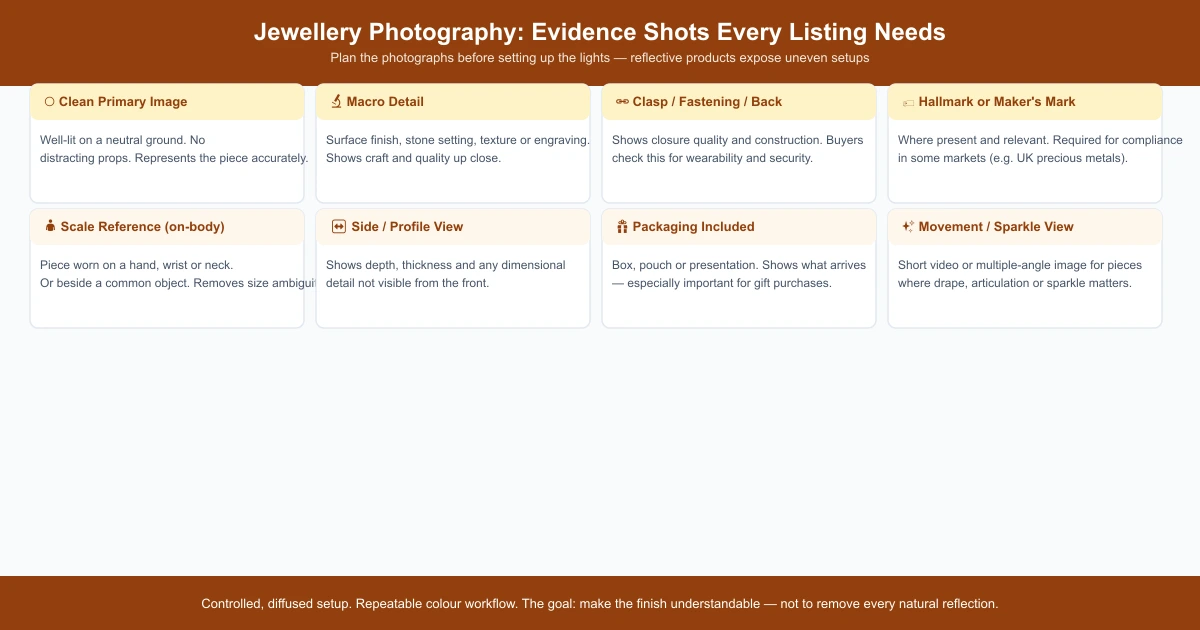
Photograph jewellery for proof, scale and desire
Plan the photographs before setting up the lights.
The evidence set
Each listing should normally include:
- a clean primary image;
- a macro detail of the finish or setting;
- the clasp, fastening or back;
- the hallmark or maker’s mark where relevant;
- an on-body or clear scale reference;
- a side view showing profile and depth;
- the included packaging;
- a short movement view when sparkle, articulation or drape matters.
Reflective products expose the camera, room and uneven light. Use a controlled, diffused setup and a repeatable colour workflow. The goal is not to remove every natural reflection; it is to make the finish understandable.
Use the Shopify product photography guide for shot planning, lighting and consistent editing. Do not add a hand, model or scale object digitally unless it represents the actual product accurately.
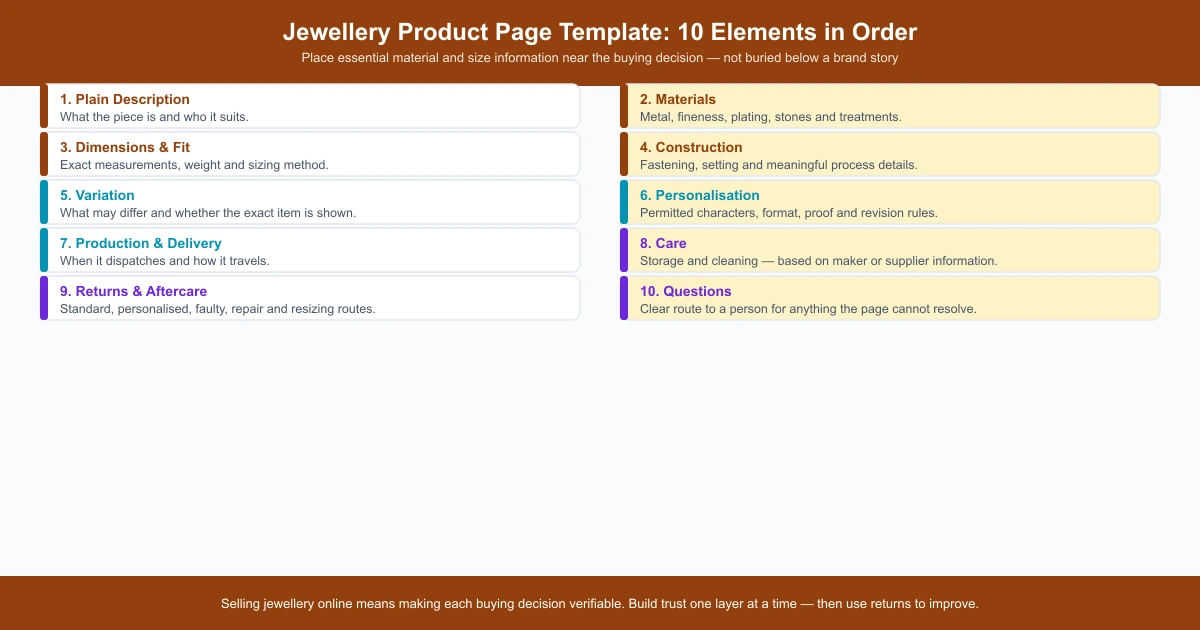
Use a product-page template that reduces uncertainty
A jewellery listing can follow this order:
- Plain description: what the piece is and who it suits.
- Materials: metal, fineness, plating, stones and relevant treatments.
- Dimensions and fit: exact measurements, weight and sizing method.
- Construction: fastening, setting and meaningful process details.
- Variation: what may differ and whether the exact item is shown.
- Personalisation: permitted characters, format, proof and correction rules.
- Production and delivery: when it will dispatch and how it travels.
- Care: appropriate storage and cleaning based on the maker or supplier’s information.
- Returns and aftercare: standard, personalised, faulty, repair and resizing routes.
- Questions: access to a person for anything the page cannot resolve.
Place essential information near the buying decision. Do not hide material or size details beneath a long brand story.
Match the sales channel to the buying decision
Marketplaces can help eligible handmade or vintage pieces reach shoppers already browsing the category. An owned store gives the brand more control over education, presentation and the post-purchase relationship. Instagram and other visual channels can create discovery, while consultations may be appropriate for bespoke or higher-value work.
| Buying situation | Useful channel role |
|---|---|
| Accessible handmade gift | Marketplace discovery plus an owned brand destination |
| Repeatable fashion collection | Owned store with visual social acquisition |
| One-of-a-kind vintage piece | Evidence-rich listing on a suitable specialist or broad marketplace |
| Bespoke engagement or milestone piece | Enquiry and consultation before payment |
| Local maker with event demand | Markets for try-on and feedback, supported by online reordering |
The Shopify versus Etsy comparison explains the practical trade-off between marketplace demand and an independent store. Check current eligibility, fees and seller policies before choosing.
For social selling, use the guide to selling products through Instagram while keeping full product evidence on the destination page.
Protect delicate and valuable orders after checkout
Packaging needs to prevent movement, tangling, crushing, abrasion and moisture while matching the product’s presentation.
Test the complete package:
- secure chains and moving components;
- separate pieces that can scratch each other;
- protect posts, hooks and raised settings;
- use an outer package that does not advertise high value where discretion is appropriate;
- confirm the carrier’s value limit, exclusions, evidence requirements and insurance terms;
- retain packing and dispatch records for valuable orders.
International orders may require accurate customs descriptions and values. Do not label a commercial sale as a gift to avoid duties.
Returns need an inspection process. Record the item, condition, hallmark or identifier, packaging and any personalisation. Make policies clear, but do not remove statutory consumer rights through a blanket “no returns” statement.
The ecommerce packaging design guide offers presentation ideas that can be adapted after transit protection is solved.
Market jewellery through meaning, proof and occasion
Useful content does more than place a product on a neutral background.
Show:
- how lengths and proportions sit when worn;
- how pieces layer or pair;
- the making, finishing or quality-control process;
- material and care education;
- gifting choices and deadlines;
- the difference between available finishes;
- real customer styling with permission.
Avoid invented scarcity. A one-of-a-kind vintage piece is genuinely limited. A repeatable product with more stock arriving next week should not be described as the final chance forever.
How AeroChat can help an established jewellery store
AeroChat is an AI agent platform that helps ecommerce brands run customer service on autopilot.
For Shopify jewellery stores, it can answer approved questions about dimensions, declared materials, care, availability, production time, delivery, returns and order status. It can help shoppers compare options that exist in the catalogue and keep routine conversations connected across supported channels.
Some requests should always reach a person. AeroChat should not authenticate, value or grade a piece, approve a bespoke design, guarantee a fit or invent a material fact. Custom work, high-value complaints, provenance questions and policy exceptions require human judgement.
Stores evaluating automation can review Shopify AI chatbot choices and see a specific example in the guide to AI support for Shopify jewellery stores. This becomes relevant when verified product questions repeat at volume; it is not a replacement for accurate listings or a required launch expense.
Launch with a trust-ready capsule collection
Before publishing the first range, check:
- Is every material, treatment and stone described accurately?
- Are hallmarking and other market-specific duties resolved?
- Does each page show scale, finish, fastening and fit?
- Can the business produce or restock the range as promised?
- Does the price include consultation, packaging, delivery and aftercare?
- Are personalisation and approval boundaries clear?
- Has the complete package been tested?
- Can higher-risk questions reach a qualified person?
Selling jewellery online is less about recreating a glass display case on a website and more about making each buying decision verifiable. Build trust one layer at a time, then use the questions and returns from a small capsule range to decide what the business should offer next.
Jewellery shares core challenges with other high-consideration product categories: high return rates when expectations are not met and customers who need to see the product from multiple angles before committing. The product photography guide for Shopify covers how to shoot jewellery for online stores specifically. For handmade or artisan jewellery, the handmade products guide covers the storytelling approach that sets independent makers apart, and selling beauty products online shares the same trust-first conversion framework applied to a different product type.