
How Much Does It Cost to Start an Online Store? Full 2026 Budget

Starting an online store can cost less than $200 for a basic test, around $500 to $2,000 for a lean small-business launch, or $3,000 to $10,000 or more for an inventory-led brand with professional creative work and paid marketing.
A Shopify store itself starts at $39 per month on monthly billing or $29 per month when the Basic plan is paid yearly in the United States. But the subscription is only one part of the budget. Your real cost depends on what you sell, whether you hold stock, how you create product content and how you plan to find customers.
This guide separates the cost of building the website from the cost of launching the business. All figures are planning estimates in US dollars unless an official price is stated. Taxes, payment rates, Shopify prices and legal costs vary by country, so confirm local charges before committing.
Online store startup costs at a glance
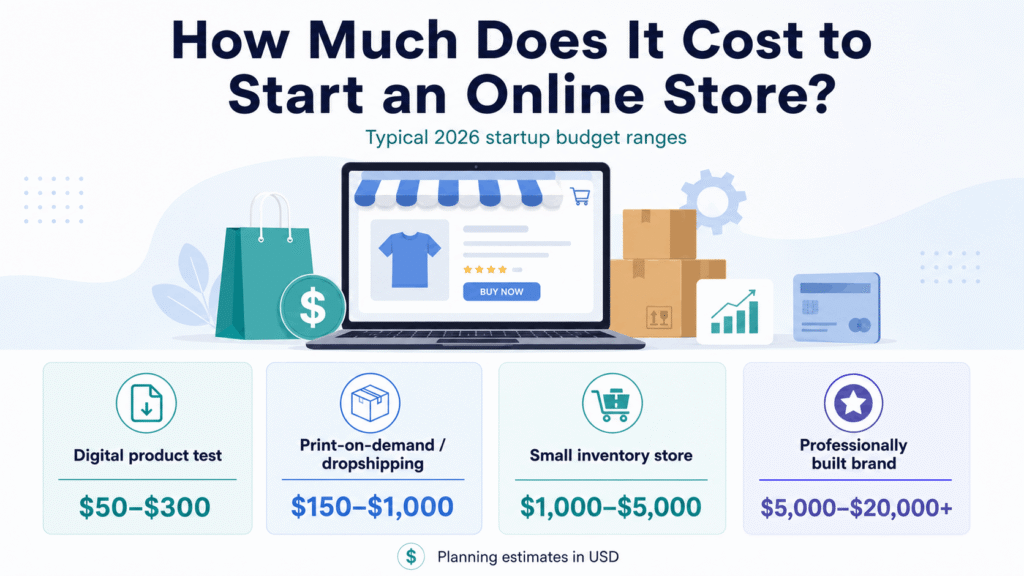
| Launch model | Typical starting budget | What it usually covers |
| Digital product test | $50–$300 | Domain, basic platform, simple creative tools and product testing |
| Print-on-demand or dropshipping | $150–$1,000 | Store, domain, samples, basic apps and organic launch content |
| Small inventory store | $1,000–$5,000 | Store setup, samples, initial stock, packaging and launch marketing |
| Professionally built brand | $5,000–$20,000+ | Custom design, larger inventory, professional content, apps and paid acquisition |
These ranges are not promises. A founder who already owns a laptop, creates their own photography and sells a digital product can start near the lower end. A brand importing regulated or custom-manufactured goods may exceed the higher range before launch.
The website is not the whole business
Many cost guides answer the wrong question. They calculate what it costs to publish an ecommerce website, not what it costs to get a product into a customer’s hands.
A basic online store needs a platform, a domain, product pages and a payment method. A functioning ecommerce business also needs a product or offer, supplier testing, packaging, fulfilment, customer acquisition, returns handling and enough cash to continue operating before sales become predictable.
For example, you could build a clean Shopify store with a free theme and no paid apps. If the product arrives damaged, shipping costs remove the margin or nobody sees the website, the inexpensive store has not created an inexpensive business.
Before spending, work through the full process of starting an ecommerce business so the budget follows the actual launch sequence.
Three types of online store costs
A practical budget separates costs into three groups.
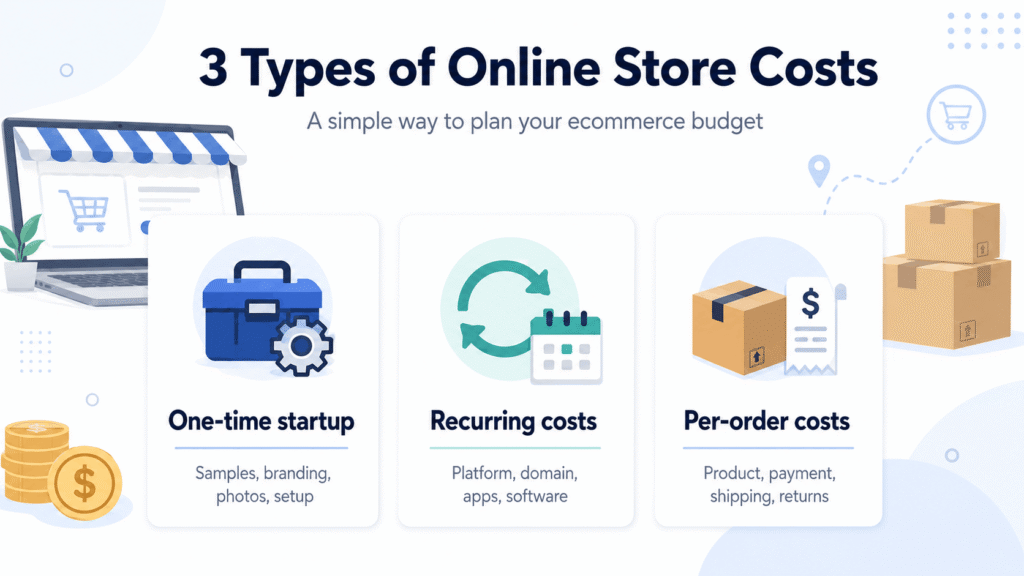
One-time startup costs
These are expenses paid before or around launch:
- Product samples
- Initial inventory
- Logo and brand assets
- Product photography
- Theme purchase or design work
- Packaging design and first print run
- Business registration and permits
- Equipment such as lighting, shelving or a label printer
Some one-time costs return later. You will eventually reorder packaging, replace equipment or refresh photography, but they do not normally arrive every month.
Recurring monthly or annual costs
These continue whether or not the store makes a sale:
- Ecommerce platform subscription
- Domain renewal
- Paid apps
- Email marketing software
- Bookkeeping software
- Storage or warehouse fees
- Customer-service tools
- Retainers for freelancers or agencies
Recurring software is easy to underestimate because each app looks inexpensive on its own. Five tools costing $15 to $30 each can become a larger monthly expense than the ecommerce platform.
Per-order costs
These increase when orders increase:
- Product cost
- Payment processing
- Pick-and-pack fees
- Packaging materials
- Shipping labels
- Marketplace commissions
- Duties and currency conversion
- Returns and reshipments
- Affiliate or creator commissions
Per-order costs belong inside product pricing and margin calculations. They should not be treated as general overhead.
Complete online store cost breakdown
Ecommerce platform: $0 to $399+ per month
The platform hosts the storefront, product catalogue, checkout and order management.
Free selling options exist, but they may use a marketplace, social profile, payment link or restricted storefront rather than a fully branded website. Hosted platforms such as Shopify, Wix and Squarespace charge a monthly subscription. WordPress with WooCommerce has free core software, but hosting, extensions, security and maintenance still cost money.
Choose the least expensive platform that can reliably handle your current model. Do not pay for enterprise features before the business has enterprise problems.
Domain name: approximately $10 to $30 per year
A custom domain makes a store easier to remember and more credible than a free platform subdomain. The price varies by extension, registrar and whether the name is considered premium.
Domain renewal is separate from the Shopify subscription. A promotional first-year price may also renew at a higher standard rate, so check both figures.
Theme and design: $0 to $500+ initially
Shopify and other platforms provide free themes. A free theme is usually enough to validate a new store when it offers clear navigation, mobile usability and suitable product-page sections.
A paid theme may save development time if it includes a layout or merchandising feature you genuinely need. Custom design can range from a few small freelancer changes to a five-figure build.
Do not buy a premium theme only because a competitor’s site looks expensive. Product clarity, trust and checkout usability matter more than decorative effects.
Products and samples: $0 to $1,000+ before inventory
Digital products can be created without supplier costs. Print-on-demand and dropshipping avoid a large stock order, but you should still buy samples.
Samples help you inspect quality, test delivery time, create original photographs and understand the customer experience. If a supplier offers ten products, you do not need to sample all ten immediately. Start with the small range you intend to launch.
Custom manufacturing may require prototypes, moulds, formulation or compliance testing. These costs can exceed the website budget before a sellable unit exists.
Initial inventory: $0 to $10,000+
Inventory is often the largest startup cost for a physical-product store.
The amount depends on:
- Supplier minimum order quantity
- Number of products and variants
- Unit cost
- Import duties
- Freight
- Expected launch demand
- Supplier lead time
Avoid spreading a small budget across too many colours, sizes or products. A focused range normally produces better information and reduces cash trapped in slow-moving stock.
Branding: $0 to $2,000+
A founder can create a simple wordmark, colour palette and product-page style using free or inexpensive tools. A professional identity costs more but may be worthwhile when packaging, wholesale presentations or a crowded premium category make consistency important.
Branding should clarify the offer rather than delay it. A $2,000 logo cannot compensate for an untested product.
Product photography and video: $0 to $2,500+
Original product content builds trust and supports product pages, advertising and social media.
A lean store can begin with a modern phone, natural light and a simple background. Budget for professional work when the product is difficult to photograph, appearance strongly affects the purchase or the same content will be used across a large campaign.
For dropshipping and print-on-demand, supplier images may be available, but relying entirely on the same images as every other seller makes differentiation difficult.
Apps and extensions: $0 to $200+ per month
New stores often add apps for reviews, email, subscriptions, search, bundles, shipping, returns and customer service. Many useful apps have free tiers, but charges can increase with orders, contacts or usage.
Install an app only when it solves a current problem. Built-in platform features or a manual process may be enough during validation.
Payment processing: a percentage plus a fixed fee
Payment processing is normally charged on each transaction. Rates vary by plan, country, card type and provider.
On the current US Shopify pricing page, the Basic plan lists standard online card rates starting at 2.9% plus 30 cents. A $100 standard-card order at that rate would carry a $3.20 processing charge before product, fulfilment or shipping costs.
If a Shopify merchant uses a third-party payment provider, Shopify may also charge a third-party transaction fee. The current US comparison lists 2% on Basic, 1% on Grow and 0.6% on Advanced. Shopify states that third-party transaction fees are generally not charged on orders processed through Shopify Payments, although exceptions and market-specific rules can apply.
Always check the pricing page for the country in which the store operates. Shopify Payments is not available in every market, and local rates can differ.
Packaging: $50 to $1,000+ initially
Packaging costs include mailers or boxes, protective material, labels, tape and printed inserts.
Custom boxes can look impressive but often require larger minimum orders. Start with correctly sized standard packaging and a simple branded sticker or insert. This keeps costs lower while you learn which parcel sizes and products sell most often.
Shipping and fulfilment: variable per order
Shipping depends on package dimensions, weight, destination, carrier and delivery speed. A product with a healthy gross margin can become unprofitable when it is bulky, fragile or expensive to return.
Obtain real shipping quotes before setting a retail price. If you offer “free shipping”, include the expected shipping subsidy in the margin calculation rather than treating delivery as free.
Registration, tax and permits: varies by location
Business registration, sales tax, accounting and product permits depend on jurisdiction and category. Food, cosmetics, children’s goods, supplements and electronics may have additional requirements.
Avoid using a universal legal-cost estimate. Check local government guidance or obtain professional advice for the country and markets in which you will sell.
Marketing: $0 to $5,000+ at launch
Marketing can begin with organic content, partnerships, communities, email capture and outreach. Paid advertising can accelerate testing, but it should not be the first proof that a product is wanted.
A launch budget should cover creative testing as well as media spend. Sending money to an advertisement with weak product images and unclear positioning produces expensive data.
A structured 30-day launch marketing plan can help sequence audience building, product content, email capture and launch activity without spending across every channel at once.
Returns and contingency: 10% to 20% buffer
New stores encounter unexpected expenses: replacement shipments, damaged stock, revised packaging, software changes and advertising tests that do not work.
Keep part of the launch budget uncommitted. A store that spends every dollar before opening has no room to learn.
How much does it cost to start a Shopify store?
For a full Shopify storefront in the United States, the current Basic plan is $39 per month on monthly billing or displayed as $29 per month when paid yearly. Shopify currently advertises a three-day free trial followed by a promotional period for eligible new users, but promotional terms can change and should not be treated as the permanent cost.
The Shopify subscription includes hosting and an SSL certificate. Free Shopify themes are available, so a paid theme is optional. A custom domain, apps, payment processing and business operating costs remain separate.
Current Shopify plan prices
The following are the standard US prices displayed by Shopify at the time of writing:
| Shopify plan | Monthly billing | Yearly billing, shown monthly | Best suited to |
| Basic | $39/month | $29/month | Solo founders and new full stores |
| Grow | $105/month | $79/month | Small teams needing staff access and lower rates |
| Advanced | $399/month | $299/month | Larger international operations |
| Plus | From $2,300/month | Contract-based | Complex and high-volume businesses |
Prices, payment rates and plan names may differ by market. Check Shopify’s official local pricing page before publishing a budget or choosing annual billing.
Realistic first 90-day Shopify budget
This example assumes a founder builds the site, uses a free theme and launches a small physical-product range.
| Expense | Lean range for 90 days |
| Shopify Basic on monthly billing | $117 |
| Domain | $10–$30 |
| Theme | $0 |
| Apps | $0–$150 |
| Product samples | $50–$300 |
| Initial inventory | $500–$2,500 |
| Packaging | $50–$300 |
| Branding and photography | $0–$500 |
| Launch marketing | $0–$1,000 |
| Contingency | $100–$500 |
| Estimated total | $827–$5,397 |
This is a planning example, not an average. A digital product store could launch below this range because it needs no stock or packaging. A custom product with a large minimum order could exceed it easily.
Cost by ecommerce business model
Digital products: approximately $50 to $500
Digital templates, guides, artwork and educational files remove inventory, packaging and physical shipping costs.
The budget normally goes towards a domain, selling platform, design software and initial marketing. The main cost is the time required to create something useful and build distribution.
This is one of the most realistic approaches for someone trying to start with very little money.
Print-on-demand: approximately $150 to $1,000
With print-on-demand, the supplier produces and ships the product after a customer orders. You avoid a bulk inventory purchase, but you still need samples, store fees, designs and content.
Margins can be lower than bulk manufacturing, so calculate fulfilment and shipping before setting prices. Do not launch products you have never sampled.
Dropshipping: approximately $150 to $1,500
Dropshipping also avoids holding stock, but the store owner remains responsible for the customer experience.
Budget for supplier samples, apps, product content and testing. Cheap products with slow delivery can create refunds and support work that cost more than the initial website.
Handmade products: approximately $300 to $3,000
The budget includes raw materials, tools, packaging, product photography and enough finished stock for launch.
Include labour in the product cost. A handmade item is not profitable simply because the raw materials are inexpensive.
Small private-label store: approximately $2,000 to $10,000+
Private label usually requires samples, minimum order quantities, custom packaging, freight and sometimes product testing or regulatory work.
The website may represent a small share of the total. Supplier terms and inventory decisions have a much larger effect on cash requirements.
Custom-manufactured product: $5,000 to $50,000+
Custom products may involve industrial design, prototypes, tooling, testing, patents, compliance, manufacturing and international freight.
Validate the problem and target customer before committing to development. A landing page, non-functional prototype or pre-order test can provide useful evidence earlier.
Can you start an ecommerce business with no money?
You can begin validating an ecommerce idea with almost no cash, but operating a reliable branded store indefinitely with literally no money is unlikely.
Free tools exchange cash cost for limitations or time. You may use a social profile instead of a custom website, create content yourself and choose a model that requires no inventory. Payment and marketplace fees are then deducted only when a sale occurs.
A realistic no-money route
1. Choose a digital product, affiliate model, pre-order offer or print-on-demand product.
2. Define one narrow customer problem.
3. Create a sample or minimum version using tools you already have.
4. Show it through relevant communities and organic social content.
5. Collect email interest or pre-orders before paying for inventory.
6. Reinvest the first revenue into a domain, samples and a full store.
What no-money guides often leave out
- Your time still has value.
- Free storefronts may offer limited branding or features.
- Payment processing still applies when you make a sale.
- Supplier quality should be tested before taking customer money.
- Organic marketing can take months of consistent work.
- Refunds or reshipments may require cash before revenue is available.
The better goal is not “spend nothing forever”. It is “risk as little as possible before demand is proven”.
Hidden costs that surprise new store owners
Product returns
The cost of a return can include the original shipping subsidy, return postage, inspection, repackaging, payment costs and inventory that can no longer be sold as new.
Build a returns assumption into the margin model, especially for apparel, footwear, fragile goods and compatibility-dependent products.
Working capital
Suppliers may need payment before stock is produced, while payment providers release sales proceeds later. Fast growth can increase the cash gap because the next inventory order is due before all customer revenue becomes available.
Failed advertising tests
Not every advertisement, audience or creative asset will work. Treat testing losses as part of the marketing budget rather than assuming the first campaign will be profitable.
Currency and import charges
International suppliers can introduce foreign-exchange movement, duties, brokerage fees and taxes. A supplier quote is not always the landed cost.
Customer-service time
Product questions, order updates, changes, returns and complaints take time even when the founder answers them personally. Unpaid founder labour may not appear in the bank statement, but it still affects whether the business is sustainable.
At low volume, manual support and free tools may be enough. When repeated questions begin consuming hours, stores can automate ecommerce customer support rather than adding staff immediately.
AeroChat is an AI agent platform that helps Shopify merchants run customer service on autopilot. It is not an essential day-one expense for a store with no conversations. It becomes relevant when product, delivery, return and order questions start limiting the founder’s time.
Before choosing a paid support tool, compare Shopify AI chatbots by their actual store-data access, channels and response allowance. A low advertised price can become expensive if important functions require separate plans.
For a detailed monthly estimate, the Shopify chatbot pricing calculator compares software costs at different conversation volumes.
When should an online store invest in AeroChat?
AeroChat is an AI agent platform that helps Shopify merchants run customer service on autopilot.
It is not an essential day-one expense for a new store that has not yet validated its products or started receiving customer enquiries. At the beginning, founders should usually answer questions manually so they can understand what customers ask, where they hesitate and which information is missing from the website.
AeroChat becomes more valuable when repeated questions about products, availability, delivery, order status, returns and refunds begin consuming the founder’s time. Instead of immediately hiring additional support staff, a growing store can use AeroChat to automate common customer conversations while transferring unusual or sensitive cases to a person.
AeroChat can connect with Shopify and sync products, inventory and order information, helping its AI agent provide more relevant answers without requiring merchants to build complicated chatbot flowcharts or manual workflows.
It can also bring customer conversations from website chat, WhatsApp, Instagram and Facebook Messenger into a more unified support process. This is useful when shoppers contact the business through different channels and expect quick, consistent responses.
When preparing an online-store budget, customer-service software can usually be delayed until genuine support volume appears. Once repetitive enquiries begin slowing down marketing, fulfilment or business growth, the cost of an AI customer-service platform may be lower than the time and manpower required to handle every conversation manually.
Before choosing a platform, compare Shopify AI chatbots based on their Shopify data access, supported messaging channels, human handover options and usage limits—not only the advertised monthly price.
What should you pay for before launch?
Spend first on the things that protect the customer and validate the business.
Worth paying for early
- Product samples and safety checks
- A suitable domain
- Reliable payment setup
- Clear product photography
- Correct shipping estimates
- Necessary registration and compliance
- Basic packaging that protects the product
- A small testing and contingency budget
Usually safe to delay
- Custom website development
- A premium theme chosen only for appearance
- Large app subscriptions
- Branded boxes with high minimum orders
- A broad inventory range
- Expensive influencer campaigns
- Advanced analytics before meaningful traffic exists
- Paid customer-service software before support volume appears
The principle is simple: spend on evidence and reliability before spending on scale and polish.
How to calculate your own startup budget
Create a spreadsheet with these sections.
1. Pre-launch cash requirement
Add every expense that must be paid before the first sale:
Samples + inventory + design + registration + packaging + equipment + store setup
2. Three months of fixed costs
Add the expenses that continue regardless of sales:
Platform + apps + storage + software + contractor retainers
Use at least three months so the business has time to learn after launch.
3. Variable cost per order
Calculate:
Product + packaging + fulfilment + payment processing + shipping subsidy + returns allowance + sales commission
4. Contingency
Add a 10% to 20% buffer to the pre-launch and early operating budget. Use a higher buffer when importing products or working with untested suppliers.
5. Working capital
Estimate how much cash is needed to place the next inventory order before current sales proceeds can fully fund it.
Calculate the break-even order volume
First calculate contribution per order:
Average order value − variable cost per order = contribution per order
Then calculate monthly break-even orders:
Monthly fixed costs ÷ contribution per order = break-even order volume
For example, assume:
- Average order value: $60
- Product, fulfilment and variable costs: $36
- Contribution per order: $24
- Monthly fixed costs: $480
The store needs 20 orders per month to cover fixed costs before paying the owner or recovering the original startup investment.
This calculation is more useful than asking whether a platform costs $29 or $39 per month. A business with weak contribution margin can lose money on every additional order even when the website is inexpensive.
How to reduce startup costs without weakening the store
Launch fewer products
Begin with one hero product or a closely connected range. This reduces samples, photography, inventory and unsold variants.
Use a free theme
Choose a free theme that supports clear product pages and mobile shopping. Upgrade only when a specific limitation affects sales or operations.
Create content in batches
One planned photography session can produce product images, short videos, email content and social posts.
Use manual processes first
Handle the first returns, support questions and order checks manually. You will learn what should be automated later.
Negotiate smaller supplier tests
Ask whether the supplier offers paid samples, mixed variants, a pilot quantity or a higher unit cost for a smaller first order. Preserving cash can be more important than securing the lowest unit price.
Build an audience before stock arrives
Publish useful content, collect email interest and involve potential buyers in product decisions. This reduces reliance on paid advertising on launch day.
Final answer
The cost to start an online store ranges from under $200 for a basic digital or inventory-free test to $10,000 or more for an inventory-led brand with professional design and paid marketing.
For Shopify specifically, the full-store Basic plan currently costs $39 per month on monthly billing or $29 per month when paid yearly in the United States. A realistic first 90-day Shopify budget is roughly $827 to $5,397 for a small physical-product launch, including modest inventory. A digital product store can start for less, while custom manufacturing can require far more.
Do not measure affordability by the platform subscription alone. The real budget must include the product, customer acquisition, per-order costs, returns, working capital and a contingency reserve.
If money is extremely limited, validate through a digital product, pre-order, affiliate offer or print-on-demand model first. Reinvest early revenue after customers have shown that the idea deserves a larger store.
Frequently asked questions
How much does it cost to start an online store?
A basic test can cost less than $200. A lean small-business launch commonly needs around $500 to $2,000, while a physical-product store with inventory may require $1,000 to $5,000 or more. Custom design, manufacturing and paid marketing can increase the budget beyond $10,000.
How much does it cost to start a Shopify store?
In the United States, Shopify Basic currently costs $39 per month on monthly billing or $29 per month when paid yearly. You should also budget for a domain, product samples, inventory, packaging, apps, marketing and payment processing.
Can I start an ecommerce business with no money?
You can validate an idea with almost no money by selling digital products, accepting pre-orders, using print-on-demand, affiliate marketing or social selling. A dependable branded store will eventually require some cash for a domain, samples, platform services, refunds or operating costs.
Is Shopify free to start?
Shopify offers a free trial and may offer an introductory promotion to eligible new users. The store moves to standard paid pricing after the promotional period. Check the official pricing page because offers can change.
Do I need a paid Shopify theme?
No. Shopify provides free themes, and a free theme is usually enough for a new store. Buy a paid theme only when it provides a required function or saves more development cost than it adds.
How much should I spend on inventory?
Spend only enough to run a credible first test and meet reasonable early demand. The amount depends on unit cost, supplier minimums, variants and lead time. Avoid committing the entire budget to stock; keep cash for packaging, fulfilment, returns and reordering.
What is the biggest hidden ecommerce cost?
There is no single hidden cost for every store, but customer acquisition, returns and working capital are frequently underestimated. App subscriptions are visible and easy to calculate; slow-moving inventory and failed marketing tests can have a much larger effect.
Should I use Shopify or WooCommerce to save money?
Shopify charges a hosted-platform subscription and includes hosting, checkout infrastructure and security features. WooCommerce’s core software is free, but hosting, maintenance, extensions and technical work can add cost. Compare the total operating responsibility, not only the entry price.