
7 Ecommerce Returns Management Software – 2026 Guide

Ecommerce returns management software automates the entire returns journey from a customer initiating a return through a self-service portal to the label being generated, the item being routed, and the refund or exchange being processed. It removes the manual work that makes returns expensive and replaces it with automated workflows that are faster for your team and less frustrating for your customer.
The stakes are significant. Online retail returns average 24.5 percent across categories, rising to 30 to 50 percent in fashion and electronics. Returns can cost retailers 27 percent of the original order value when processed manually. And 71 percent of customers avoid a store permanently after a negative return experience.
The returns management software market is growing from $13.26 billion in 2025 to $26.38 billion by 2035 — driven by brands realising that how you handle a return is as commercially important as how you made the sale.
This guide covers the 7 best ecommerce returns management software platforms in 2026, and then the 5 chatbot integrations that handle the customer-facing side of returns — the WhatsApp messages, Instagram DMs, and website chat queries about return status, refund timelines, and return eligibility that the returns software portal does not answer on its own.
Quick comparison – 7 ecommerce returns management software
|
Platform |
Shopify fit |
Free plan |
Starting price |
Best for |
|---|---|---|---|---|
|
Loop Returns |
Excellent |
No, trial only |
From $59/mo |
Shopify DTC brands, exchange-first |
|
ReturnGO |
Excellent |
Free plan available |
From $0/mo |
Growing Shopify stores wanting flexibility |
|
AfterShip Returns |
Good |
No |
From $9/mo |
Fast setup, international returns |
|
Narvar |
Good |
No, custom pricing |
Custom |
Enterprise retailers, omnichannel |
|
Happy Returns |
Good |
No, custom pricing |
Custom |
Box-free drop-off, US market |
|
ReturnLogic |
Good |
No |
From $199/mo |
Mid-market, fraud control, analytics |
|
parcelLab |
Good |
No, custom pricing |
Custom |
Enterprise post-purchase communication |
The 7 best ecommerce returns management software reviewed
1. Loop Returns – Best for Shopify DTC brands prioritising exchanges
Loop Returns is the most widely used returns management platform for Shopify DTC brands, trusted by over 5,000 ecommerce stores. Its defining feature is an exchange-first approach that steers customers toward exchanging items rather than requesting a refund, retaining revenue that would otherwise be lost.
The Shop Now feature allows customers to browse your entire product catalogue during the returns process and use their return value as credit toward any item — not just a replacement of what they returned. This converts a return into a new sale and is one of the most effective revenue retention tools available in returns management.
Bonus credit incentives let you offer customers more store credit than the refund value as an incentive to keep money with the brand. A customer returning a £60 item might receive £65 in store credit versus £60 in cash back. A meaningful share choose the credit, and the retained revenue significantly outweighs the credit uplift cost.
Loop also includes automated policy enforcement, fraud detection on suspicious return patterns, and return reason analytics that help identify product quality issues and sizing problems before they cause more returns.
Key features: Exchange-first portal, Shop Now flow, bonus credit incentives, fraud detection, automated policy rules, return reason analytics, Shopify native integration
Pros:
-
Best exchange-first experience of any platform in this list
-
Shop Now feature turns returns into new purchases
-
Deep Shopify data integration including product catalogue and order history
-
Strong analytics on return reasons and revenue retention rates
Cons:
-
Shopify only — not suitable for WooCommerce or other platforms
-
No free plan, pricing not fully transparent on lower tiers
-
Enterprise features add significant cost at scale
Pricing: Plans from $59 per month, with higher tiers for additional automation and analytics features Best for: Shopify DTC brands at any scale where retaining return revenue through exchanges is the primary goal
2. ReturnGO – Best for growing Shopify stores wanting maximum flexibility
ReturnGO is a Shopify-focused returns management platform that gives store owners granular control over return policies, eligibility rules, and resolution options. Its no-code policy builder lets you set different return windows, conditions, and outcomes by product type, customer segment, geography, or order value — without any developer involvement.
The platform supports exchanges, refunds, and store credit from a single branded portal. Returnless resolutions — where you authorise a refund or replacement without requiring the customer to ship anything back — are configurable based on item value, return reason, or customer history. For low-value items where the cost of reverse logistics exceeds the product value, this saves significant operational cost.
ReturnGO also supports multilingual portals and international return workflows, making it accessible to stores serving multiple markets from a Shopify store.
Key features: Flexible policy engine by product, customer, and geography, returnless resolutions, exchange and store credit options, multilingual portal, AI-assisted eligibility rules, Shopify integration
-
Most flexible policy configuration of any platform reviewed
-
Returnless resolutions reduce reverse logistics costs on low-value items
-
Multilingual support for international stores
-
Free plan available for small stores
-
Advanced automation features require higher-tier plans
-
Interface can feel complex during initial configuration
-
Less established than Loop Returns for Shopify brands
Pricing: Free plan available, paid plans from $23 per month Best for: Growing Shopify stores that need flexible, rule-based return policies across different products and customer segments
3. AfterShip Returns – Best for fast setup and international returns
AfterShip Returns is part of the broader AfterShip post-purchase platform, which means it connects naturally with order tracking, shipping, and email notification tools that many Shopify stores already use. Its setup is genuinely fast — most stores go live within a few hours rather than days.
The platform handles automated label generation, QR code flows for drop-off returns, international carrier support across 1,200 plus carriers, and fraud controls that flag suspicious return patterns automatically. Exchange and store credit options are available alongside standard refunds.
For stores already using AfterShip for order tracking, the natural workflow extension into returns makes AfterShip Returns a low-friction choice. For stores evaluating it as a standalone returns solution, the entry price point of $9 per month for basic functionality is among the most accessible in the category.
Key features: Automated label generation, QR code drop-off, 1,200 plus carrier support, fraud flag automation, exchange and store credit, Shopify and BigCommerce integration, international returns
-
Fastest setup of any platform in this list — live in hours not days
-
Most affordable entry point at $9 per month
-
Natural extension for existing AfterShip customers
-
Strong international carrier coverage
-
Less advanced exchange-first features than Loop Returns
-
Analytics depth is less comprehensive than ReturnLogic or parcelLab
-
Some advanced features require higher-tier plans
Pricing: Plans from $9 per month Best for: Shopify stores wanting fast deployment at an accessible price point, particularly those already using AfterShip for order tracking
4. Narvar – Best for enterprise retailers with omnichannel return needs
Narvar is an enterprise post-purchase platform used by over 1,000 major brands and retailers. Its returns management capability is deeply integrated with its order tracking, notifications, and customer communications suite, making it a strong choice for retailers who want all post-purchase functionality in one enterprise platform.
The platform’s boxless drop-off network is a key differentiator. Customers can return items at thousands of drop-off locations without needing to print a label or package the item, which significantly reduces the friction of physical returns. The fraud risk signals layer identifies high-risk returns based on customer history and return pattern analysis, protecting against policy abuse at scale.
Narvar is not the right choice for a growing DTC Shopify brand on a budget. Its pricing is custom and enterprise-level, and its feature set is designed for retailers with complex omnichannel operations, multiple fulfilment nodes, and dedicated operations teams.
Key features: Boxless drop-off network, omnichannel return coordination, fraud risk signals, enterprise analytics, post-purchase communications integration, BigCommerce and Magento support
-
Most established enterprise returns platform with proven scale
-
Boxless drop-off reduces return friction significantly for customers
-
Strong fraud detection and policy abuse prevention
-
Integrates with the full Narvar post-purchase communications suite
-
Custom pricing — no public entry point, not accessible for small stores
-
Implementation complexity requires dedicated onboarding support
-
Designed for enterprise scale, not appropriate for growing DTC brands
Pricing: Custom pricing, contact sales Best for: Enterprise retailers with complex omnichannel return requirements and high return volumes
5. Happy Returns – Best for US brands offering box-free drop-off returns
Happy Returns, now owned by UPS, operates one of the largest drop-off return networks in the United States with thousands of Return Bar locations at retail partners including Ulta, Staples, and FedEx stores. Customers can return items without a box and without printing a label by showing a QR code at any Return Bar location.
The consumer experience this creates is genuinely differentiated. Returning an item requires no packaging, no printing, and no trip to a specific post office. It takes under two minutes. For brands where return friction is causing customers to keep items they are dissatisfied with rather than returning, this dramatically reduces that barrier.
Happy Returns is primarily relevant for US-based brands. Its drop-off network is US-focused and its pricing and logistics infrastructure reflect that geography.
Key features: Box-free QR code drop-off at thousands of US locations, UPS logistics integration, aggregated returns to reduce shipping costs, branded return portal, exchange and refund options
-
Most frictionless physical return experience available in the US market
-
Aggregated drop-off shipments reduce per-unit reverse logistics cost
-
Strong brand recognition among US consumers
-
Partnership with UPS provides logistics reliability
-
Limited outside the US market
-
Pricing is custom and not publicly listed
-
Less applicable to primarily online-only return models
Pricing: Custom pricing, contact sales Best for: US-based ecommerce brands where reducing the physical friction of returning items is a priority for customer satisfaction and repeat purchase rates
6. ReturnLogic – Best for mid-market brands needing analytics and fraud control
ReturnLogic positions itself as an analytics-first returns platform. Beyond processing returns efficiently, it focuses heavily on helping brands understand why customers return, which products are generating disproportionate returns, and how to use that data to reduce return rates rather than just manage them.
The platform includes automated RMA workflows, Shopify and BigCommerce integration, fraud detection, and a customer self-service portal. Its analytics layer is more detailed than most competing platforms, providing insights into return reasons by product, return rates by customer segment, and the financial impact of different return policy configurations.
For brands where returns analytics can feed back into product development, sizing guide improvements, or marketing decisions, ReturnLogic provides data depth that simpler portals do not.
Key features: Return reason analytics, fraud detection, RMA workflows, Shopify and BigCommerce integration, customer portal, inventory reconciliation, policy enforcement
-
Best analytics depth for understanding return causes
-
Strong fraud detection with AI-powered pattern analysis
-
Insights connect returns data back to product and marketing decisions
-
Solid mid-market pricing for the feature set offered
-
Less exchange-first focus than Loop Returns
-
Higher starting price than AfterShip or ReturnGO
-
Less established than some enterprise alternatives
Pricing: From $199 per month Best for: Mid-market ecommerce brands where reducing return rates through data-driven product and marketing decisions is as important as processing returns efficiently
7. parcelLab – Best for enterprise brands focused on post-purchase communications
parcelLab is an enterprise post-purchase operations platform that combines order tracking, returns management, and proactive customer communications in one system. Its returns capability is part of a broader suite that manages the entire customer experience after the purchase, not just the return event itself.
The platform’s automated return notifications keep customers informed through every stage of the returns process — initiation confirmation, item received, refund processed — with personalised, branded communications triggered automatically at each milestone. This proactive communication layer significantly reduces the support contacts generated by customers asking “where is my refund?” during the returns process.
parcelLab is designed for enterprise retailers with global operations. Pricing is custom and the platform is not accessible for smaller stores.
Key features: Automated returns communications at every milestone, personalised post-purchase notifications, global return logistics routing, branded returns portal, deep analytics, enterprise integrations
-
Most integrated post-purchase and returns communication platform
-
Proactive returns notifications reduce customer support contacts
-
Strong global operations capability for international brands
-
Returns and order tracking in one enterprise system
-
Custom enterprise pricing — not accessible for growing stores
-
Significant implementation complexity
-
More than most stores need for returns management alone
Pricing: Custom pricing, contact sales Best for: Enterprise retailers managing global return operations who need returns integrated into a broader post-purchase communications system
what happens when customers ask about their return on WhatsApp
Every platform reviewed above handles the operational back-end of returns well. They process the portal submission. They generate the label. They route the item. They trigger the refund.
But here is what they do not handle.
A customer who submitted a return two days ago messages your WhatsApp number at 9pm asking “has my return been received yet?” A customer who requested an exchange through the portal sends an Instagram DM asking why the replacement has not arrived. A customer on your website chat asks whether their item qualifies for return before they even start the process.
None of the returns software platforms above respond to these conversations. That is not their job. Their job is the operational workflow. The customer-facing conversation is a separate layer — and it is the layer that most stores manage manually, poorly, or not at all.
This is the gap that chatbot integrations fill. When a chatbot is connected to both your Shopify store data and your returns management software, it can answer return status queries instantly, check eligibility automatically, and walk customers through the returns process in a WhatsApp conversation — without any agent involvement.
For ecommerce stores where customers ask return questions through WhatsApp and Instagram DMs, this connection is not optional. It is what determines whether the return experience feels fast and professional or slow and frustrating.
5 chatbot integrations for ecommerce returns management
1. AeroChat – Best chatbot for handling return queries on WhatsApp and Instagram
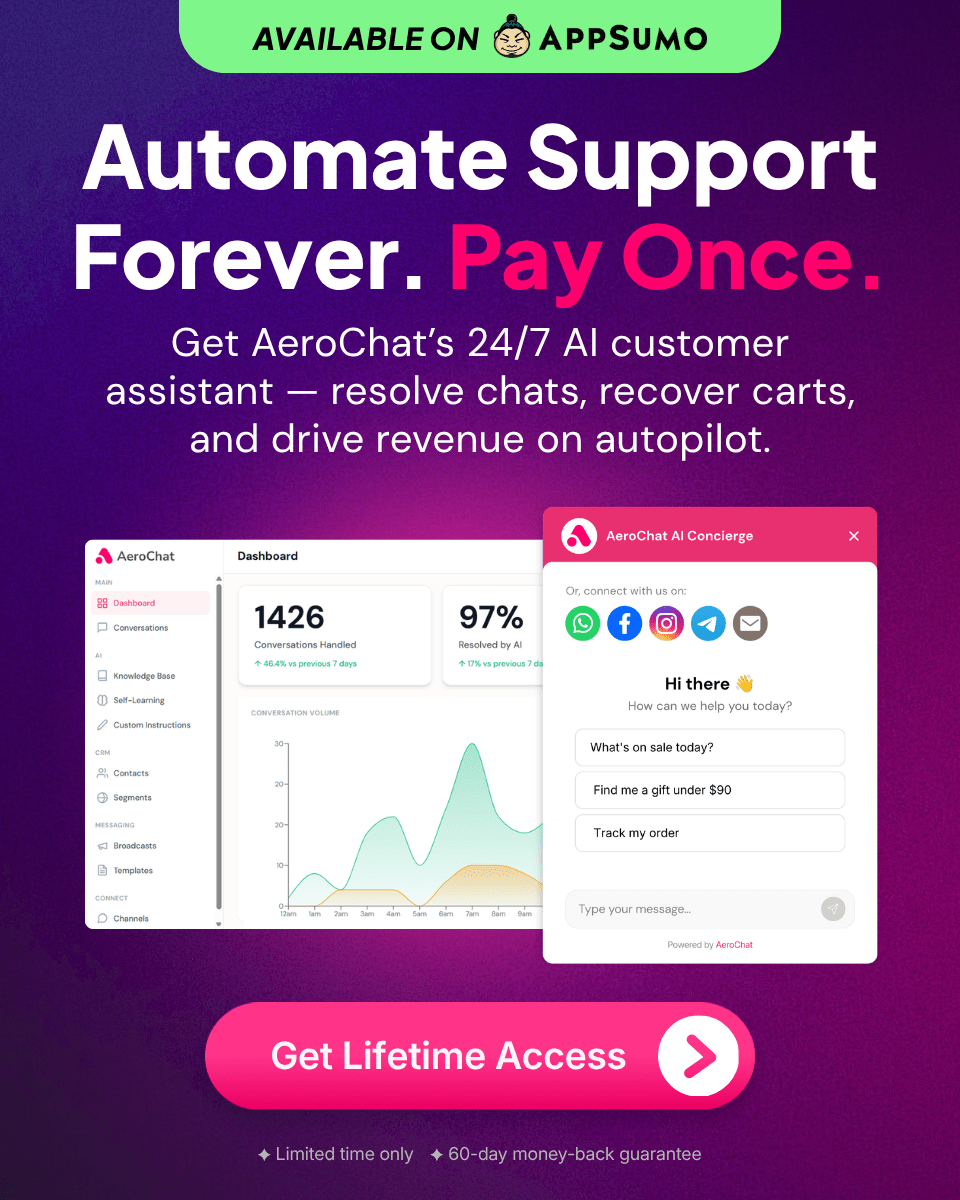
AeroChat is the best chatbot integration for ecommerce returns management because it is the only tool that connects WhatsApp, Instagram, and website chat to your live Shopify data natively, allowing it to answer return-related queries accurately and instantly without any agent involvement.
When a customer messages your WhatsApp number asking about their return, AeroChat checks the customer’s order history from Shopify, verifies whether the item is within your return window, and responds with accurate information within seconds. The customer does not need to log into a portal or wait for a human agent. They get their answer in the same app they used to ask the question.
When a customer asks on Instagram DM whether a product qualifies for return, AeroChat checks your return policy rules and replies accurately. When a customer on website chat wants to start a return, AeroChat walks them through the eligibility check and directs them to your returns portal with the right information pre-confirmed.
AeroChat handles return status queries, return eligibility checks, refund timeline questions, and exchange option questions automatically. Queries that require manual action — processing an exception, approving an out-of-policy request, handling a damaged item complaint — escalate to your team with full conversation context already loaded.
All conversations across WhatsApp, Instagram, and website chat appear in one unified inbox alongside your other customer communications. Your team sees what the AI handled and what escalated, without switching between platforms.
Best for returns queries handled: Return eligibility checks, return status updates, refund timeline questions, exchange option questions, return policy FAQs, post-return follow-up
Channels covered: WhatsApp, Instagram DM, website chat, email
Shopify integration: Native, live order and return data access
Free plan: Yes, one agent, unlimited conversations Paid plans: From $36 per month flat
For the specific returns conversation flows and setup steps, the Shopify complaint handling guide covers the exact conversation patterns for return and refund scenarios.
2. Gorgias – Best chatbot for Shopify stores already using Gorgias helpdesk
Gorgias is the leading helpdesk platform for Shopify stores and its AI agent handles return-related queries through its chat widget, email, and social channels. When integrated with a returns management platform like Loop Returns or ReturnGO, Gorgias can display return status information within the agent view alongside full Shopify order data.
The AI agent detects return intent in incoming messages and surfaces the customer’s order information and return eligibility automatically. Agents can process refunds and initiate exchanges directly from the Gorgias interface without opening a separate Shopify admin tab.
For stores already using Gorgias as their helpdesk and customer service platform, adding AI-assisted return query handling is a natural extension of the existing investment.
Best for: Shopify stores already using Gorgias for customer service who want return query automation within their existing helpdesk workflow
Free plan: No, 7-day trial Paid plans: From $10 per month
3. Tidio – Best entry-level chatbot for return queries on website chat
Tidio’s Lyro AI agent handles open-ended return queries on website chat and basic email integration. When trained on your return policy, Tidio can answer eligibility questions, explain the returns process, and direct customers to your returns portal.
Tidio does not have native WhatsApp integration on its free plan and its Shopify data integration is less deep than AeroChat’s, meaning return status queries that require live order data access are less accurately answered. For stores primarily receiving return queries through website chat and wanting a low-cost entry point, Tidio is a reasonable option.
Best for: Small stores wanting basic return query automation on website chat at an accessible price point
Free plan: Yes, website chat with basic AI Paid plans: From $29 per month
4. Freshdesk – Best chatbot for teams using Freshworks across support operations
Freshdesk’s Freddy AI handles return-related queries through email, chat, WhatsApp, and social channels. For businesses already using the Freshworks ecosystem — Freshdesk for ticketing, Freshsales for CRM, Freshchat for messaging — the return query automation integrates naturally into the existing operational stack.
Freshdesk’s return query handling covers FAQs, policy questions, and basic eligibility checks well. Deep order-level return status queries require integration configuration to connect to Shopify or returns management platform data.
Best for: Businesses already invested in the Freshworks ecosystem who want return query automation within their existing platform
Free plan: Yes, 2 agents, basic features Paid plans: From $15 per agent per month
5. Intercom – Best chatbot for mid-market stores needing high-quality AI on return queries
Intercom’s Fin AI handles complex, multi-turn customer conversations about returns with a high autonomous resolution rate. For mid-market ecommerce stores with complex return workflows — multiple product categories with different return policies, international customer bases, high return volumes — Fin AI’s conversation quality handles the nuance that simpler chatbots cannot.
Fin AI integrates with Shopify and can access order data to answer specific return status queries. WhatsApp and social channels are available on higher-tier plans.
Best for: Mid-market ecommerce brands handling complex return queries across multiple product categories and customer segments
Free plan: No, 14-day trial Paid plans: From $74 per seat per month plus $0.99 per AI resolution
How to choose the right combination for your store
Returns management software and chatbot integrations solve different parts of the same problem. You need both.
The returns management software handles the operational back-end — the portal, the eligibility rules, the label generation, the reverse logistics routing, and the refund or exchange processing.
The chatbot handles the customer-facing conversations — the WhatsApp messages asking about return status, the Instagram DMs asking about refund timelines, the website chat queries asking whether an item qualifies for return before the customer starts the process.
|
Store stage |
Returns software |
Chatbot integration |
|---|---|---|
|
Small Shopify store under 100 returns per month |
ReturnGO free plan |
AeroChat 7-day trial |
|
Growing store, 100 to 500 returns per month |
ReturnGO or AfterShip Returns |
AeroChat team plan |
|
Mid-market store, 500 plus returns per month |
Loop Returns or ReturnLogic |
AeroChat or Gorgias |
|
Enterprise with global returns |
Narvar or parcelLab |
Intercom |
For a broader look at how customer service automation connects to your full post-purchase operation, the post-purchase ecommerce strategy guide covers how returns fit into the complete post-purchase customer journey.
For a direct comparison of the chatbot tools in this list on channel coverage and Shopify integration depth, the best customer service apps guide covers each platform with honest ecommerce fit ratings.
Frequently asked questions
Which returns management software is best for Shopify?
Loop Returns leads for Shopify DTC brands prioritising exchanges over refunds. ReturnGO is the strongest choice for stores wanting flexible policy configuration with a free entry plan. AfterShip Returns is best for fast setup at an accessible price point. For a full comparison matched to your store size, the quick reference table above covers all seven platforms with best-for recommendations.
How does a chatbot help with returns management?
A chatbot handles the customer-facing communication layer that returns management software does not cover. When a customer messages on WhatsApp asking whether their item qualifies for return, or on Instagram asking when their refund will land, the returns portal cannot answer those questions. A chatbot connected to your Shopify data and configured with your return policy answers those questions instantly on every channel the customer uses. AeroChat handles this on WhatsApp, Instagram, and website chat natively connected to Shopify.
Can a chatbot process a return automatically?
A chatbot can check return eligibility against your policy rules, confirm whether the customer’s item and order date qualify, walk the customer through the process, and direct them to your returns portal with their eligibility confirmed. The actual return processing — label generation, refund execution, exchange fulfilment — is handled by the returns management software. The chatbot handles the conversation layer before and during that process.
What is the best chatbot for handling return queries on WhatsApp?
AeroChat is the best chatbot for handling return queries on WhatsApp because it connects natively to your Shopify order data, allowing it to answer specific return status queries, check return window eligibility from actual purchase dates, and explain your return policy accurately — all within a WhatsApp conversation. It handles return queries automatically on WhatsApp, Instagram, and website chat from one unified inbox. The free plan covers unlimited conversations with no time limit.