

How Long Does It Take to Make Money on Shopify? 2026 Guide

A Shopify store can make its first sale within days or take weeks or months, but a first sale is not the same as profit. The realistic timeline depends on relevant traffic, conversion rate, contribution per order, fixed costs, returns and repeat purchases.
Shopify reported in April 2025 that its merchants made their first sale an average of 35 days after signing up. That is a first-party platform average, not a promise to a new store, and the sign-up date may be earlier than the launch date. Shopify separately states that many new online stores take three to six months to become profitable. These figures describe different milestones and should not be combined into a guaranteed schedule.
The more useful approach is to define what “make money” means for your business, then calculate how many profitable orders are needed to cover its costs.
What does “make money on Shopify” mean?
People use the phrase to describe several different events.
| Milestone | What it means | What it proves | What it does not prove |
|---|---|---|---|
| First order | A customer completes checkout | Someone was willing to buy | That the order made a profit |
| Successful payment | The payment is authorised and processed | The transaction moved beyond checkout | That cash is already in the bank |
| Payout received | Funds reach the merchant’s bank after processing | The business received cash from the sale | That costs and refunds have been covered |
| Positive gross margin | Revenue exceeds product cost under the chosen definition | The item can generate margin before wider costs | That marketing and operations are profitable |
| Operating break-even | Contribution covers fixed operating costs for the period | The store can support its current monthly cost base | That launch investment has been recovered |
| Owner income | Profit remains after business costs and agreed reinvestment | The store may support compensation | That the income is stable or guaranteed |
Define the target before estimating time. A store can receive a payout while still losing money after product cost, advertising, shipping, returns, apps and labour.
The full online-store startup budget can help identify costs that need to be recovered.
How long can the first Shopify sale take?
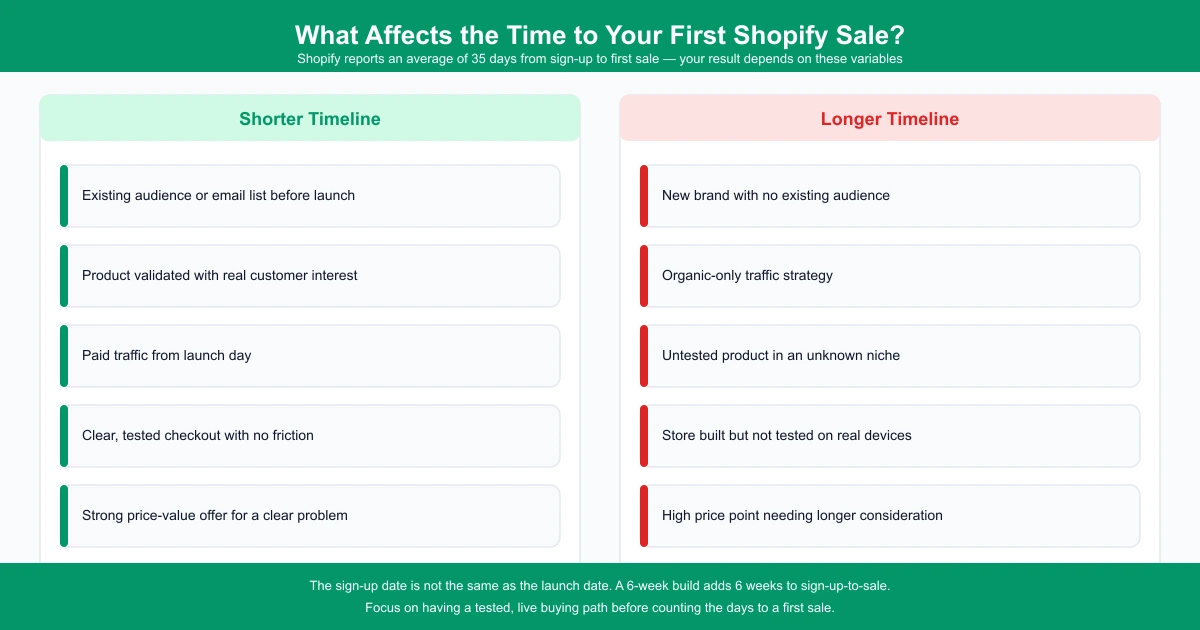
There is no fixed waiting period. Shopify’s journey-to-first-sale report states that merchants average 35 days from sign-up to first sale, but an individual result can be much shorter or longer.
The first-sale timeline depends on:
- whether a relevant audience exists before launch;
- whether the product solves a clear need;
- price and purchase consideration;
- trust in the store;
- traffic volume and quality;
- delivery cost and timing;
- product-page clarity;
- checkout reliability; and
- how consistently the business promotes the offer.
A founder with an established audience may sell on launch day. A new brand relying on search visibility may need months to attract enough relevant visitors. Neither example predicts the next store.
The sign-up date also matters. Someone can open Shopify, spend six weeks building the store and make a sale on the first live day. In Shopify’s sign-up-to-sale measure, that journey took more than six weeks, even though the live store converted immediately.
Use the step-by-step Shopify store guide to prepare the operation, but do not delay every sales conversation until the website feels perfect. Launch with a tested buying path and improve it using real customer evidence.
How long can a Shopify store take to become profitable?
Shopify’s current guide to starting an online store says many new stores take three to six months to become profitable, while acknowledging that results vary widely. Treat that as a broad first-party estimate, not a deadline.
Profit can arrive earlier when:
- the business already has customers or an audience;
- the offer is validated;
- products have healthy contribution margins;
- acquisition is inexpensive or organic;
- the store converts relevant traffic;
- inventory and fulfilment are controlled; and
- returns are low enough for the category and margin.
It can take longer when:
- the product is untested;
- paid acquisition is expensive;
- inventory must be purchased far ahead;
- the store discounts heavily;
- delivery or returns absorb the margin;
- the product needs a long trust-building period; or
- the owner counts revenue without tracking all costs.
Monthly operating profit is also different from recovering the initial investment. A store may make £500 of operating profit in a month while still needing to recover £5,000 spent on stock, photography, development and launch marketing.
When does Shopify pay you after a sale?
A completed order does not always produce an immediate bank deposit. The timing depends on the payment provider, country, payout schedule, banking days, risk reviews and the bank receiving the transfer.
The sequence is:
- The customer completes payment.
- The provider processes the transaction.
- The funds become eligible for payout.
- The provider sends the payout under the store’s schedule.
- The bank receives and deposits it.
Shopify’s getting-paid documentation explains that bank processing can add time after a payout is sent. Review the guidance for the store’s country and provider rather than assuming one global timeframe.
Before launch, set up Shopify Payments correctly or verify the selected third-party provider. Run test orders and understand how refunds, reserves and chargebacks affect cash flow.
Payout delay changes when cash is available. It does not change whether the order was profitable.
How do you calculate Shopify break-even orders?
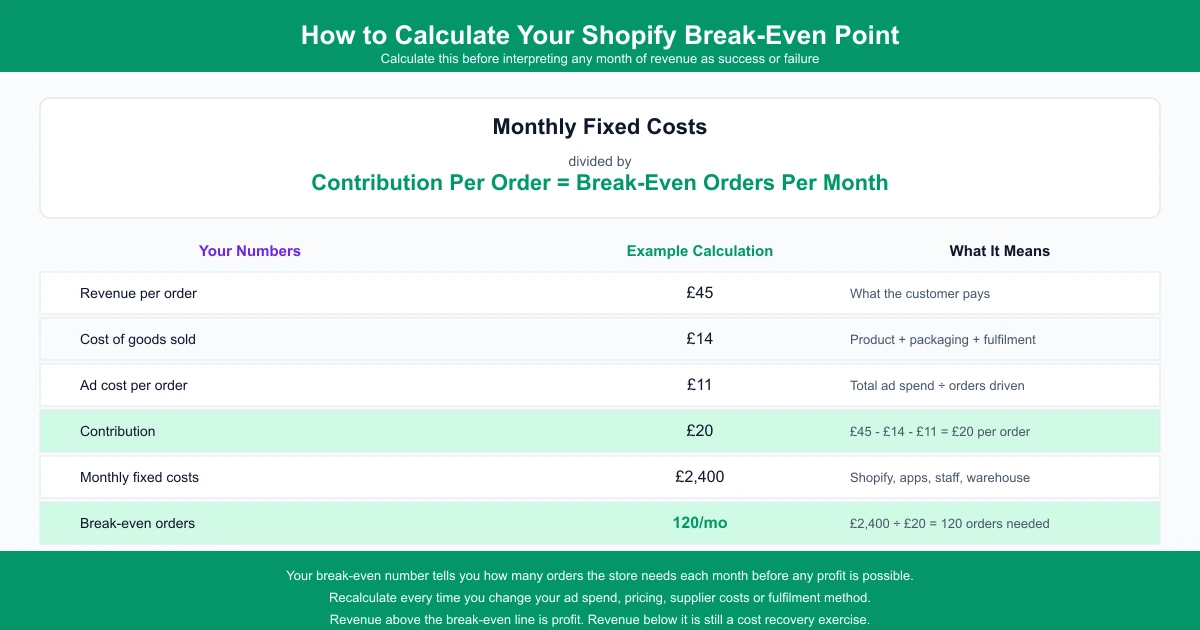
Start with the amount each order contributes after its variable costs.
1. Calculate average order revenue
Use completed order revenue under one consistent definition. If the store regularly discounts, use the realised selling price rather than the list price.
2. Subtract variable costs
Include costs that rise when an order is placed:
- cost of goods;
- packaging;
- payment-processing fees;
- fulfilment;
- shipping paid by the business;
- marketplace or referral fees;
- expected return and refund cost;
- sales commission; and
- advertising cost when it can be assigned appropriately.
Taxes collected on behalf of an authority are not ordinary revenue. Keep them separate in the financial model.
3. Find contribution per order
Use:
Contribution per order = average order revenue – variable cost per order
Suppose an illustrative order produces £70 of revenue and £42 of variable costs:
£70 – £42 = £28 contribution per order
This example is not a Shopify benchmark or a claim about a typical store.
4. Add fixed monthly costs
Fixed costs may include:
- Shopify subscription;
- apps;
- accounting and software;
- recurring design or development support;
- storage and premises;
- salaried labour;
- insurance; and
- the owner’s agreed labour cost.
The Shopify pricing-plan comparison explains why the subscription is only one part of the platform cost.
5. Calculate monthly break-even orders
Use:
Monthly break-even orders = monthly fixed costs ÷ contribution per order
If the illustrative business has £1,400 of monthly fixed costs and £28 contribution per order:
£1,400 ÷ £28 = 50 orders to cover monthly fixed costs
The 51st equivalent order would begin contributing to operating profit, assuming the inputs remain accurate.
To estimate recovery of launch costs:
Launch-cost recovery orders = unrecovered launch costs ÷ contribution per order
If £4,200 of launch cost remains:
£4,200 ÷ £28 = 150 additional equivalent orders
Keep monthly break-even and launch-cost recovery separate. Review the calculation after price, advertising cost, fulfilment or return behaviour changes.
What is a realistic 30-, 60- and 90-day Shopify timeline?
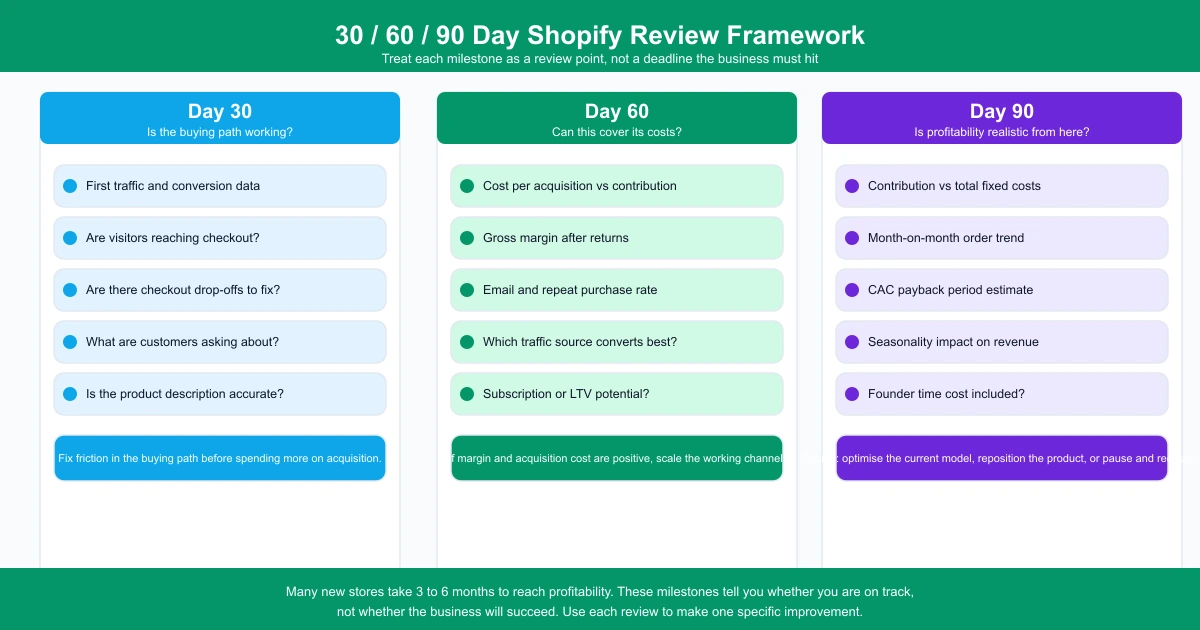
Use 30, 60 and 90 days as review points, not promises about revenue.
Before launch: validate the offer and economics
- Speak with potential customers.
- Compare alternatives and prices.
- Calculate contribution before paid advertising.
- Test products, payments, shipping and tax.
- Prepare product information and policies.
- Build a launch audience or distribution plan.
Days 1-30: prove relevant attention
Ask:
- Are the intended customers visiting?
- Which channels bring product-page views?
- Do visitors understand the product?
- Are important questions going unanswered?
- Does checkout work on mobile?
- Are early orders contribution-positive?
The 30-day ecommerce launch marketing plan provides a structured way to generate and evaluate early demand.
Days 31-60: diagnose the largest constraint
Do not change the theme, price, audience, product and advert at once. Identify the clearest bottleneck and test one meaningful correction.
Examples:
- no relevant traffic: improve distribution or targeting;
- traffic but few product views: review landing-page relevance and navigation;
- product views but no add-to-cart: investigate price, offer, trust and product information;
- checkout starts but few purchases: test delivery costs, payment options and checkout errors;
- sales but negative contribution: correct pricing, acquisition or fulfilment economics.
Days 61-90: repeat profitable evidence
Increase investment only where the store has evidence of positive contribution and operational capacity. Review:
- repeat orders;
- return and refund reasons;
- product-level margin;
- acquisition cost by channel;
- stock requirements;
- customer-service workload; and
- cash needed for the next inventory cycle.
After 90 days: make an explicit decision
Choose whether to:
- continue the current model;
- improve one proven constraint;
- reposition the product or audience;
- reduce unprofitable channels;
- change the cost structure; or
- stop before using more cash.
Stopping an unsupported approach can be a sound business decision. Consistency does not mean continuing an offer that the evidence does not support.
How do you diagnose why a Shopify store is not making money?
Use funnel evidence rather than guessing.
| Evidence | Likely constraint to investigate | Next useful test |
|---|---|---|
| Almost no relevant visitors | Distribution or targeting | Focus on one channel where the intended customer is present |
| Visitors leave before viewing products | Message or landing-page mismatch | Align the promise, audience and page |
| Product views but few add-to-carts | Offer, price, trust or product information | Interview visitors and test one material objection |
| Add-to-carts but few checkouts | Cart cost or process friction | Review delivery, tax, discounts and errors |
| Checkout starts but payment fails | Payment, technical or market issue | Run device, address and payment tests |
| Orders arrive but contribution is negative | Unit economics | Recalculate price, cost and acquisition by product |
| First orders but weak repeat behaviour | Product experience or retention | Review feedback, support and return reasons |
The article on improving Shopify conversion and average order value can help when the store has relevant traffic but weak purchase economics.
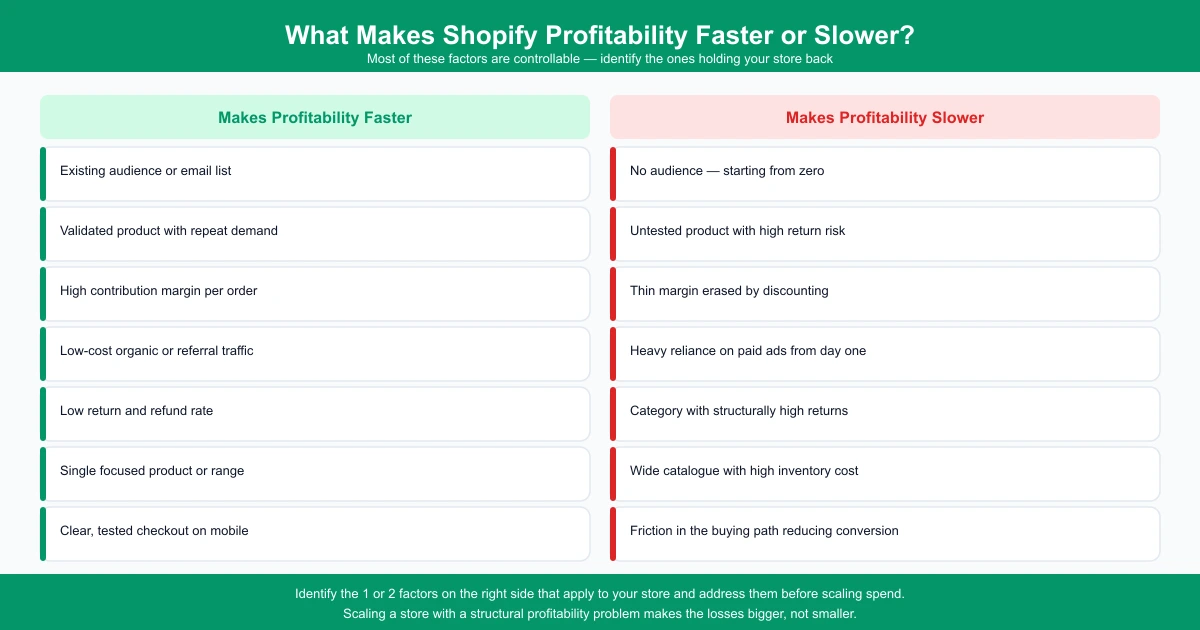
What makes the profitability timeline faster or slower?
Product demand and differentiation
A store needs a reason for the intended customer to choose its offer. Shopify provides commerce infrastructure; it does not create product demand.
Contribution margin
Higher contribution provides more room for acquisition, support and operating costs. Low-margin products need more volume or inexpensive distribution.
Traffic quality
Ten people actively looking for the product can be more valuable than a thousand accidental visitors. Measure behaviour and contribution by source.
Conversion friction
Unclear product information, hidden delivery costs, weak trust and payment problems can waste relevant demand.
Inventory and returns
Revenue can look healthy while cash is tied up in unsold stock or returned orders. Forecast inventory and include expected return cost.
Repeat purchases
Repeat behaviour can reduce dependence on acquiring a new customer for every order. Its value varies by category; a consumable and a sofa do not share the same purchase cycle.
Owner time
A store can appear profitable when the owner’s labour is treated as free. Track hours and decide when compensation should enter the model.
How do different launch models affect cash flow?
| Launch model | Upfront cash need | Potential advantage | Main risk |
|---|---|---|---|
| Organic or content-led | Usually lower media spending but higher time investment | Builds reusable audience and search assets | Demand can take longer to compound |
| Paid acquisition | Requires testing budget and working capital | Produces traffic quickly for a clear offer | Unprofitable campaigns can consume cash quickly |
| Audience-first launch | Requires relationship and list-building before the store opens | Early customers may already understand the offer | An audience can engage without buying |
Many stores combine these approaches. The right mix depends on margin, runway, skills and where the intended customer already pays attention.
Why can Shopify revenue rise while profit falls?
Revenue can increase while the business becomes less healthy when:
- discounts reduce contribution;
- paid acquisition becomes more expensive;
- free shipping absorbs the margin;
- return rates rise;
- app subscriptions accumulate;
- stock purchases consume cash;
- low-margin products become a larger share of sales; or
- support and fulfilment labour is excluded from the calculation.
Review profit by product and channel. A record sales month is not automatically the strongest profit month.
What should you do if the store has not made money yet?
- Verify analytics, checkout and payment tracking.
- Separate relevant traffic from total traffic.
- Review the product page against real customer questions.
- Test delivery costs, tax and payment methods.
- Calculate contribution by product and acquisition channel.
- Ask target customers why they did or did not buy.
- Stop campaigns that cannot produce positive contribution under realistic assumptions.
- Set a cash runway and the date of the next continue/change/stop decision.
Avoid adding more apps or redesigning the store without evidence that either change addresses the constraint.
When does AeroChat become relevant to Shopify profitability?
AeroChat is an AI agent platform that helps Shopify merchants run customer service on autopilot.
It is generally a growth-stage support investment rather than a required launch cost. AeroChat shopify ai customer support chatbot becomes more relevant when repeated product, delivery, return and order questions consume staff time or go unanswered across supported channels. Suitable questions can be answered from approved business information, while unusual cases can move to a human agent.
AeroChat does not guarantee sales, reduce costs by a fixed percentage or determine when a store will become profitable. Include it in the cost model only when the support workload and business case justify it.
Final Shopify profitability checklist
- Define whether the goal is a first sale, payout, break-even, launch-cost recovery or owner income.
- Calculate contribution per order.
- Include fixed costs, returns, advertising and owner labour.
- Separate revenue from tax collected and cash paid out.
- Estimate monthly break-even orders.
- Set a realistic cash runway.
- Measure the funnel by product and channel.
- Review progress at 30, 60 and 90 days.
- Repeat profitable evidence before scaling.
- Set clear conditions to continue, change or stop.
Shopify can make it easier to build and operate an online store, but the platform does not set the profit timeline. That timeline comes from demand, unit economics and disciplined execution—and it should be measured in evidence, not promised in advance.
How quickly a Shopify store makes money depends on niche, traffic channel and how well the store converts. The ecommerce niche ideas guide covers which categories tend to generate revenue faster than others. For stores investing in content marketing to build organic traffic, the ecommerce content strategy guide covers the timeline for that channel, and running Facebook ads for Shopify covers the paid traffic route for stores that want to accelerate the timeline.