

How to Increase Shopify Conversion Rate and Average Order Value

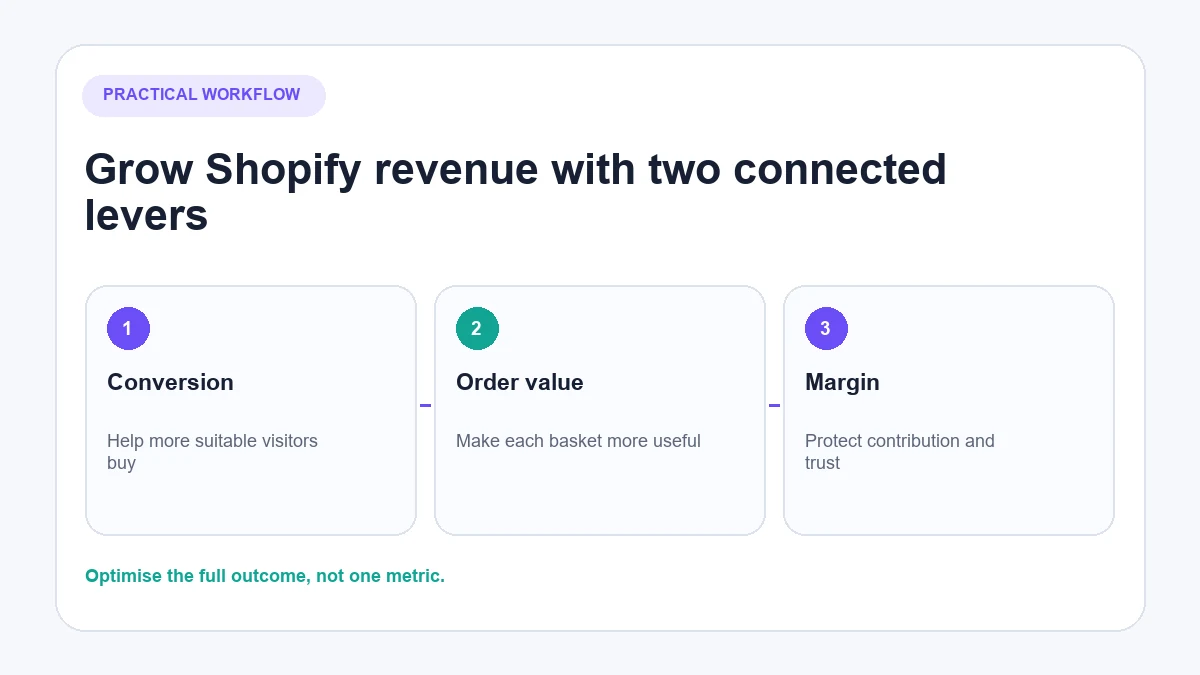
To increase Shopify conversion rate, identify where shoppers leave the purchase journey and remove the specific friction at that stage. To increase average order value (AOV), use relevant bundles, product recommendations, quantity offers or thresholds that improve the order without making the original purchase harder.
Do not optimise either metric alone. A high-value upsell can raise AOV while reducing completed orders. A large discount can improve conversion while reducing contribution margin. The more useful objective is profitable revenue from each session, supported by customer trust and a manageable return rate.
Conversion rate and AOV are connected—but not interchangeable
Shopify defines online-store conversion as the percentage of online-store sessions that result in an order. The basic calculation is:
Conversion rate = completed orders ÷ online-store sessions × 100
Average order value measures the average value of an order. Shopify’s current sales-report documentation defines AOV using gross sales minus discounts, divided by the number of orders, with specific treatment for later adjustments.
For a simple planning model:
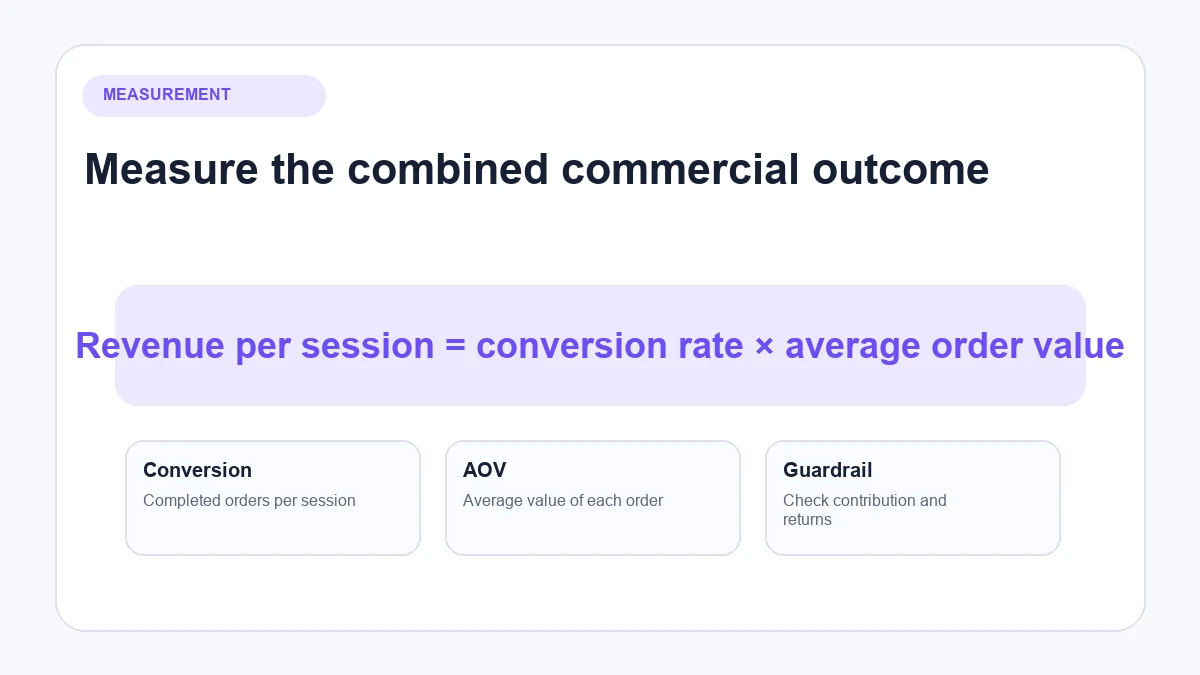
Revenue per session = conversion rate × average order value
Suppose 10,000 sessions produce 200 orders with an AOV of £60:
- Conversion rate: 2%
- Revenue per session: £1.20
- Revenue before returns and other adjustments: £12,000
If an aggressive bundle raises AOV to £70 but conversion drops to 1.6%, revenue per session falls to £1.12. The larger basket has not produced the better commercial outcome.
Margin adds another necessary guardrail:
Contribution per session = conversion rate × contribution margin per order
Use the store’s real product cost, fulfilment, payment, discount, return and acquisition data. Revenue is not profit.
Find the real constraint in Shopify Analytics
Before redesigning the store or installing another app, establish where the current problem occurs.
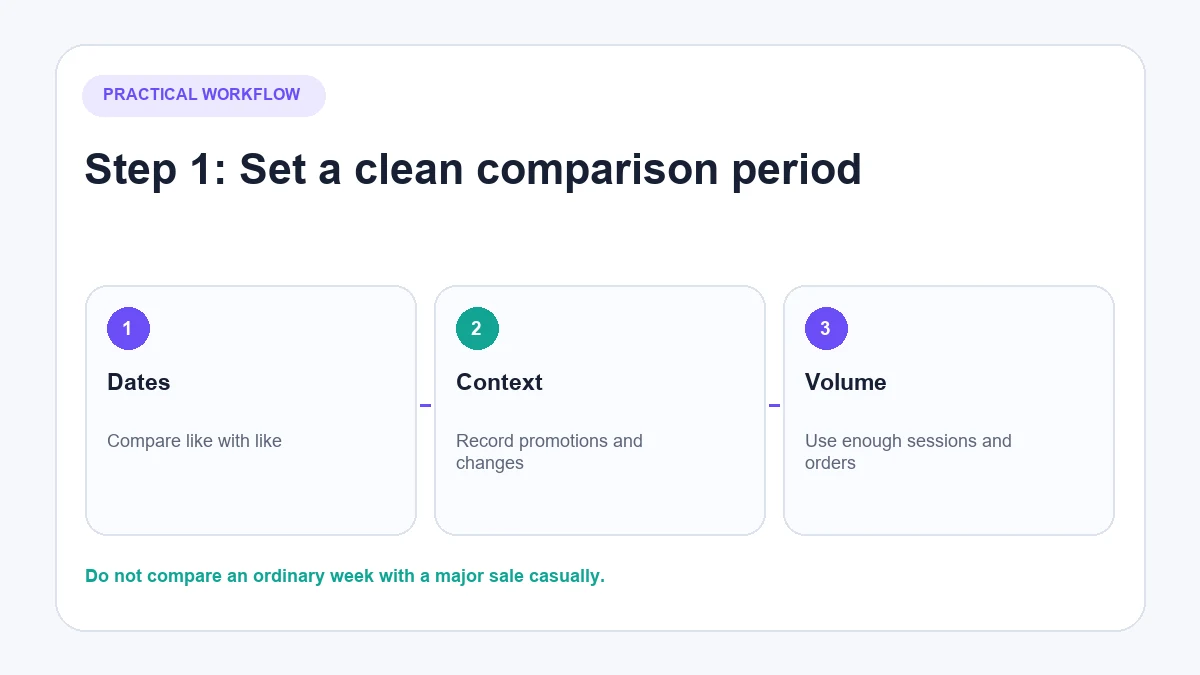
1. Set a clean comparison period
Choose a period long enough to include a useful number of sessions and orders. Compare like with like. A sale week, influencer campaign or holiday period should not be compared casually with an ordinary week.
Record major changes during each period: prices, promotions, traffic mix, theme releases, stock availability, payment incidents and shipping promises. Otherwise a conversion change may be attributed to the wrong cause.
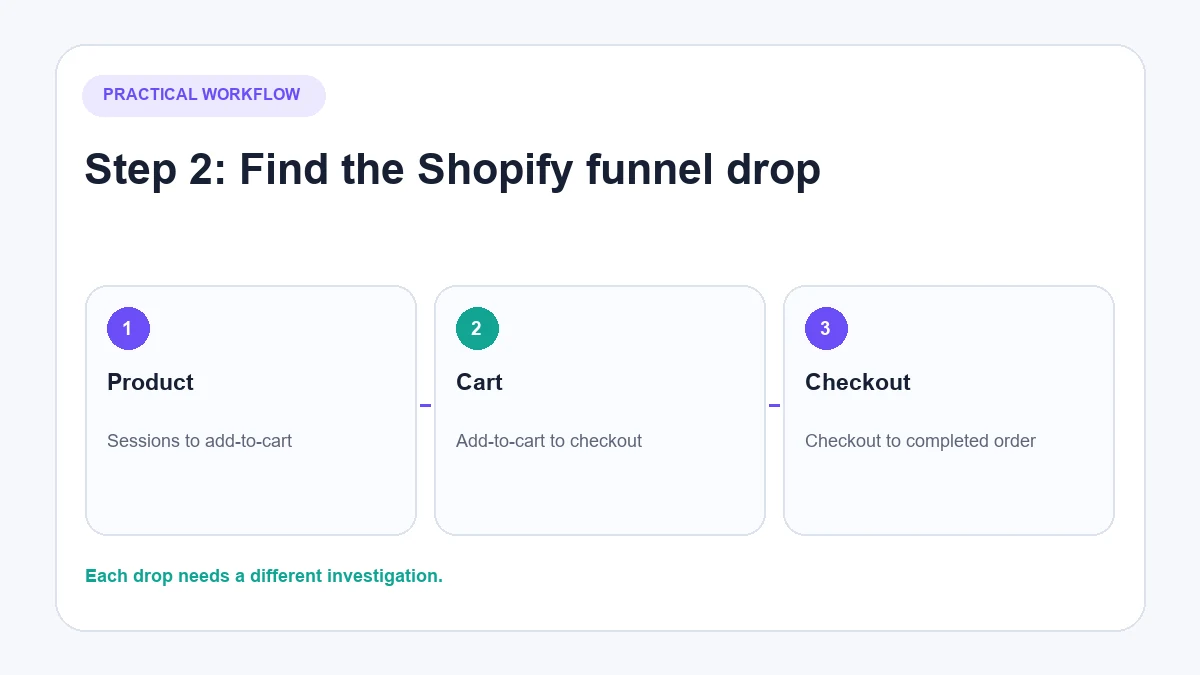
2. Review the online-store conversion funnel
Shopify’s marketing-performance documentation describes an online-store conversion report that follows sessions through product addition, checkout and completed purchase.
Look for the largest meaningful drop:
- Sessions but few add-to-carts
- Add-to-carts but few reached checkouts
- Reached checkouts but few completed purchases
Each pattern suggests a different investigation. Treating all three as a generic “low conversion rate” leads to generic changes.
3. Segment before drawing conclusions
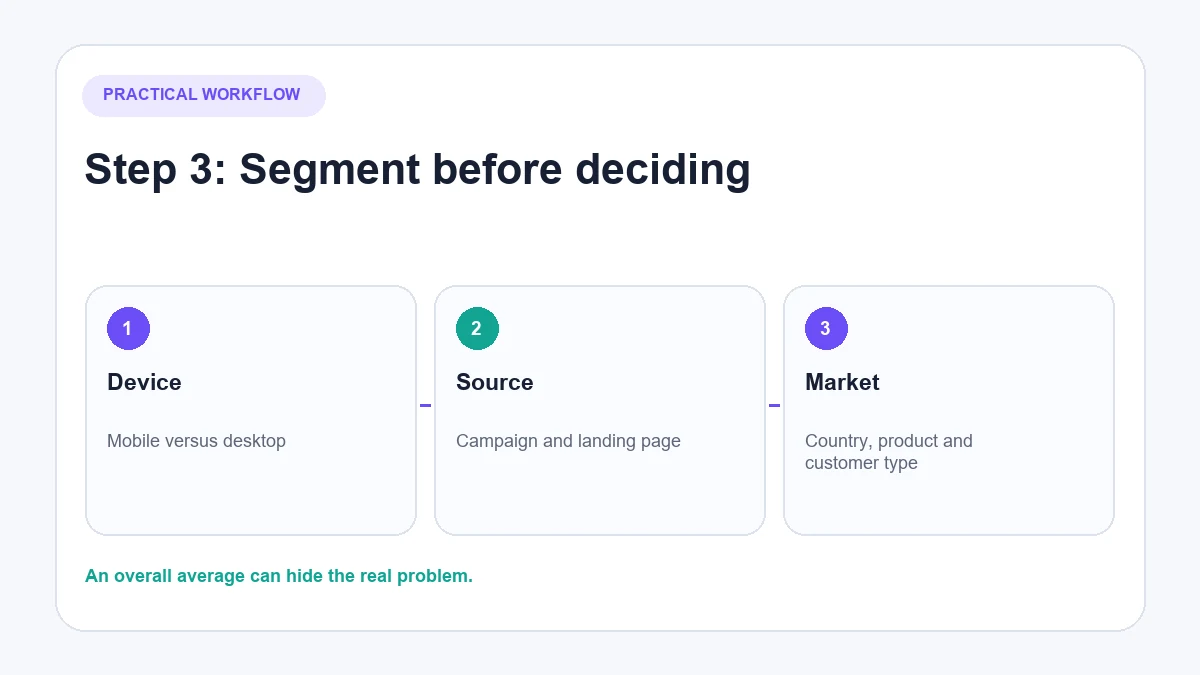
Overall conversion can hide a specific problem. Compare the dimensions available in the current reports, such as:
- Mobile versus desktop
- New versus returning customers
- Traffic source or campaign
- Landing page
- Product or collection
- Customer market or location
- Discounted versus non-discounted orders
A poor paid campaign can lower the sitewide conversion rate even when the store experience is unchanged. A payment method missing in one market can damage checkout completion only for those customers.
4. Review AOV alongside units, discounts and returns
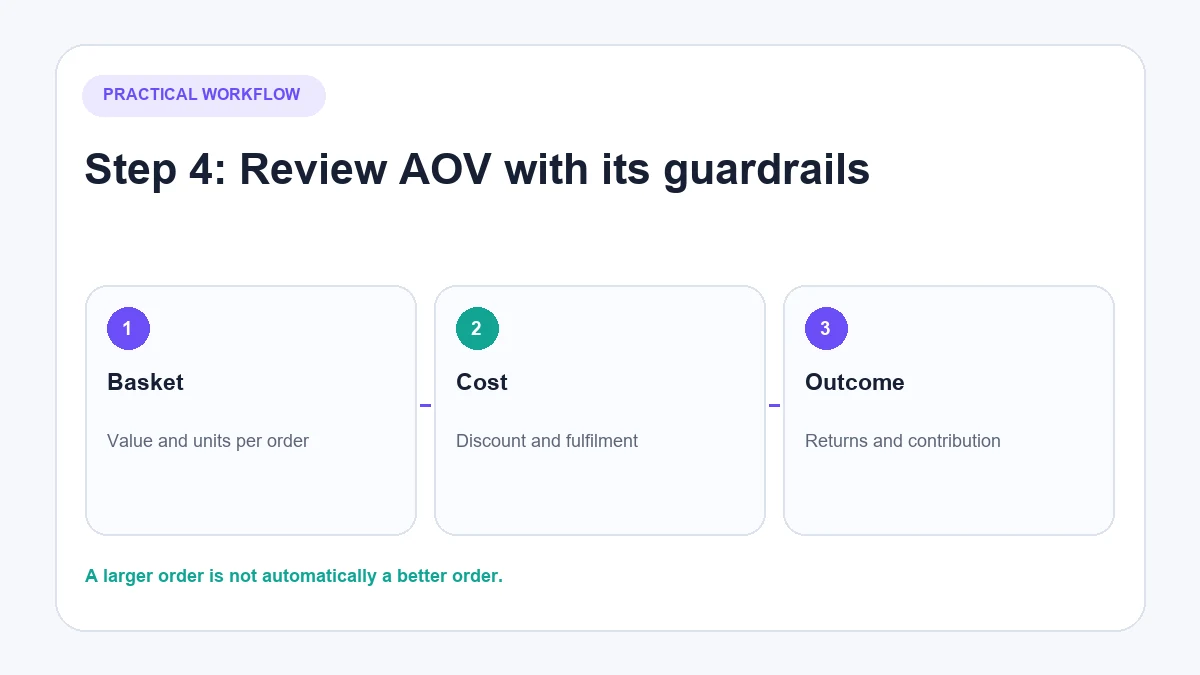
Open the relevant sales or order reports and compare:
- Average order value
- Average units ordered or units per transaction
- Discount amount
- Product mix
- Returns and refunds
- Gross profit or contribution margin where the required cost data exists
Shopify’s order-report guidance explains the current AOV and average-units measures. An AOV increase caused by price changes has a different meaning from one caused by customers buying complementary products.
5. Choose one constraint to test
Prioritise the clearest problem with a plausible, measurable fix. Changing the theme, product copy, shipping threshold and upsell app at the same time makes the outcome difficult to interpret.
Diagnose the Shopify funnel
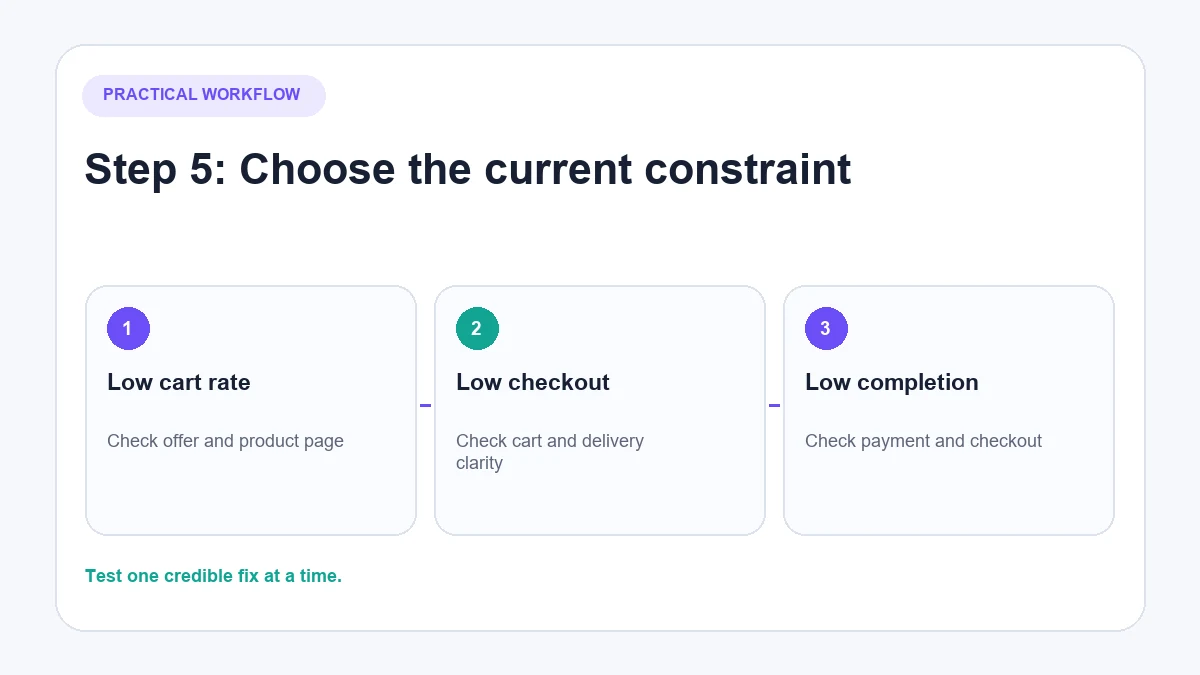
Low add-to-cart rate
Investigate traffic intent and the product page. The visitor may not understand the product, trust the offer, find the right variant or see delivery and returns information.
Healthy add-to-cart rate but low checkout reach
Investigate the cart. Unexpected costs, a confusing discount field, irrelevant cross-sells or difficult cart editing can stop progress.
Healthy checkout reach but low completion
Investigate payment availability, errors, delivery cost/timing, form friction, mobile behaviour and trust. Test the checkout yourself in the affected market and device type.
Healthy conversion but low units per order
The store may have a genuine AOV opportunity: complementary bundles, quantity purchases, thresholds or post-purchase offers.
Higher AOV but weak profit or retention
Check whether discounts, return rates, fulfilment costs or unsuitable upsells are eroding the value of larger orders.
If visitors do not add products to cart
Match the landing page to the traffic promise
An advert for a specific product should not land on a generic homepage unless that is intentional. Preserve the price, offer, imagery and language that motivated the click.
Make product suitability clear
Answer the questions a shopper would ask in a shop:
- What is included?
- Which size, colour or model is suitable?
- What materials or specifications matter?
- When will it arrive?
- What happens if it is unsuitable?
- Is it available now?
Use accurate photographs, dimensions, demonstrations and comparison information. Do not rely on slogans where the customer needs facts.
Check mobile layout and performance
Inspect the page on real phones. Look for slow media, layout shifts, buttons hidden by overlays, variant controls below intrusive widgets and text that requires constant expansion.
Remove unused app code where it affects performance, but test changes on a duplicate theme and verify that important tracking or functionality remains intact.
Use genuine trust evidence
Relevant reviews, clear business information and understandable policies can reduce uncertainty. Avoid fake countdowns, invented scarcity or badges that imply a certification the store does not hold.
If shoppers add to cart but do not reach checkout
Show delivery conditions before the final step where possible. If free shipping has a threshold, state it clearly and calculate progress accurately.
Keep cart editing simple. Customers should be able to change quantity, remove an item or correct a variant without starting again.
Cross-sells should be relevant and secondary to checkout. A full-screen sequence of offers can turn an intended purchase into a decision maze.
Test the discount-code experience. A prominent empty code box can encourage shoppers to leave and search for a coupon. Do not hide legitimate discounts, but consider how the interface communicates the offer already available.
If shoppers reach checkout but do not purchase
Run a test transaction using the same device, country and payment route as the affected segment. Check:
- Payment methods and wallet availability
- Address validation
- Shipping rates and delivery estimates
- Currency and duties information
- Error messages
- Mobile keyboard and field behaviour
- Confirmation and redirect behaviour
Baymard’s ongoing checkout usability research documents recurring abandonment reasons, including unexpected costs and checkout friction. Use such research to form hypotheses, but validate the actual Shopify store rather than copying a generic checklist.
How to increase Shopify AOV without lowering conversion
Build complementary bundles
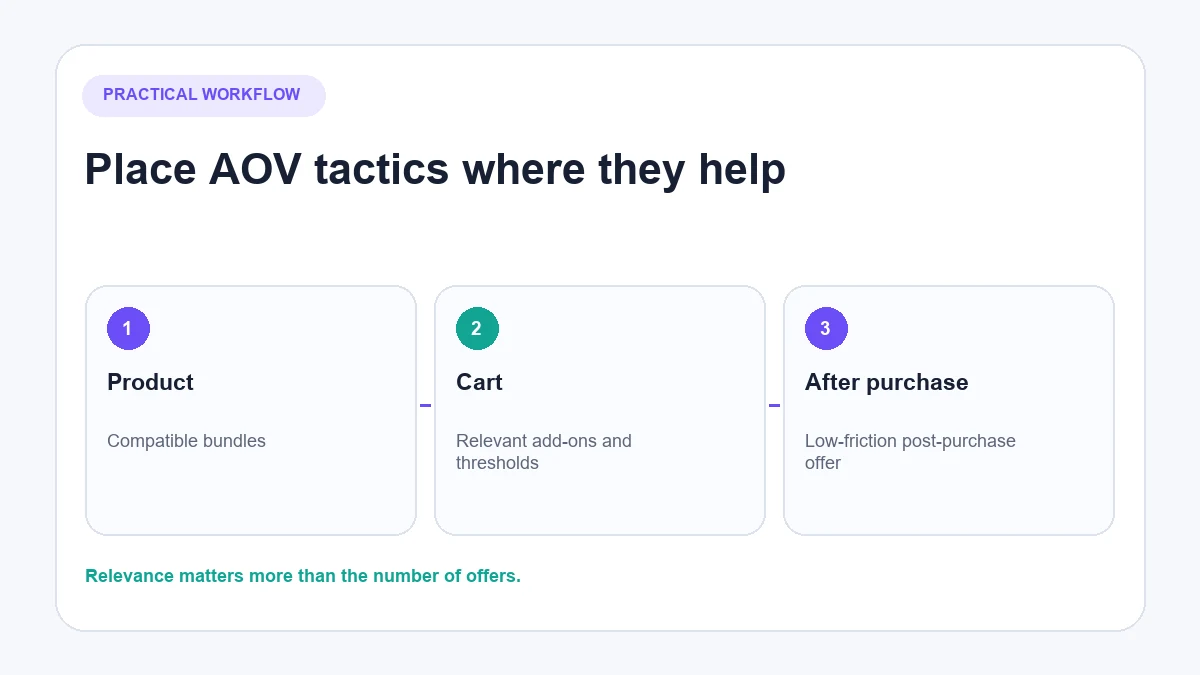
Bundle products that solve one complete need: camera plus compatible memory card, skincare routine or coffee brewer plus filters. Show the saving and contents clearly.
Best when: products are naturally used together.
Avoid when: the bundle adds unwanted items or makes returns confusing.
Watch: bundle take-up, conversion, margin and return rate.
Use quantity offers where repeat use is natural
Multi-buy pricing can work for consumables and frequently replaced products. It is less convincing for a durable item a customer needs only once.
Best when: repeat use and shelf life support a larger quantity.
Avoid when: the discount consumes margin or encourages waste.
Watch: units per order, discount cost and repeat purchase.
Set a free-shipping threshold from real order data
Review the distribution of order values, not only the mean. Set a threshold that is commercially sustainable and realistically reachable with a relevant addition.
For example, if many profitable orders cluster around £42, a £50 threshold may be testable if the catalogue includes useful £8–£15 add-ons. A £100 threshold would not create the same behaviour.
Watch: conversion, AOV, shipping subsidy and contribution per session.
Place relevant cross-sells at the right stage
Product-page cross-sells can help with compatibility. Cart cross-sells can offer an obvious accessory. Post-purchase offers reduce pre-checkout friction because the original order has already been placed.
Do not show the same bestseller to every customer. Relevance matters more than the number of recommendations.
Personalise recommendations from customer intent
A shopper looking for a gift under a stated budget needs a different recommendation from someone comparing technical compatibility. Ask only for information that materially improves the result.
Where AeroChat fits in Shopify conversion and AOV
AeroChat is an AI agent platform that helps Shopify merchants run customer service on autopilot.
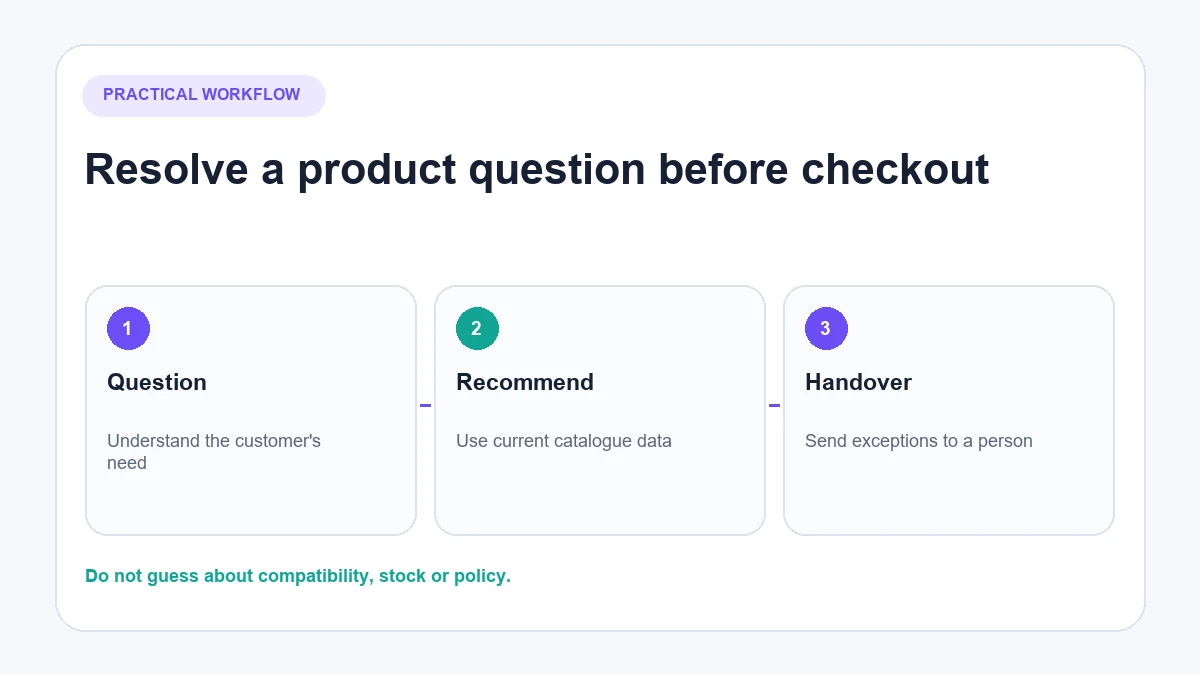
Its Shopify integration can use current product, collection, order, discount and store-page information to answer questions about availability, suitability, delivery and policies. It can also recommend alternatives or complementary products when that is relevant to the customer’s stated intent.
For example, a shopper may need to know whether a case fits a particular device before adding it to cart. Another may want a gift under a fixed budget. Resolving the first question can remove a conversion barrier; helping with the second can produce a more useful basket without forcing an upsell.
When a refund exception, complaint or unusual requirement needs judgement, human handover lets a person continue the conversation with context.
AeroChat should not replace product-page fundamentals, a functioning checkout or proper analysis. It becomes more relevant when repeated pre-purchase questions are creating measurable friction across website chat, Instagram, WhatsApp or other supported channels.
Best for: Shopify merchants who want to automate and scale customer service without extra manpower and costs.
For deeper channel-specific coverage, see how AI chatbots affect Shopify conversions and the Shopify product recommendation chatbot guide.
Build a prioritised experiment backlog
For each proposed change, record:
| Field | Question |
|---|---|
| Evidence | What data or customer feedback indicates a problem? |
| Hypothesis | Why should this change improve the selected metric? |
| Primary metric | Conversion, add-to-cart, checkout completion, AOV or contribution/session? |
| Guardrails | Could margin, returns, complaints, speed or another segment worsen? |
| Effort | What design, development, content or app work is required? |
| Risk | How easily can the change be reversed? |
| Result | What happened overall and within important segments? |
Do not declare a winner after a handful of orders or stop a test simply because the first day looks positive. Smaller stores may need to combine quantitative results with usability testing, customer interviews and support-question analysis.
A 30-day Shopify CRO and AOV plan
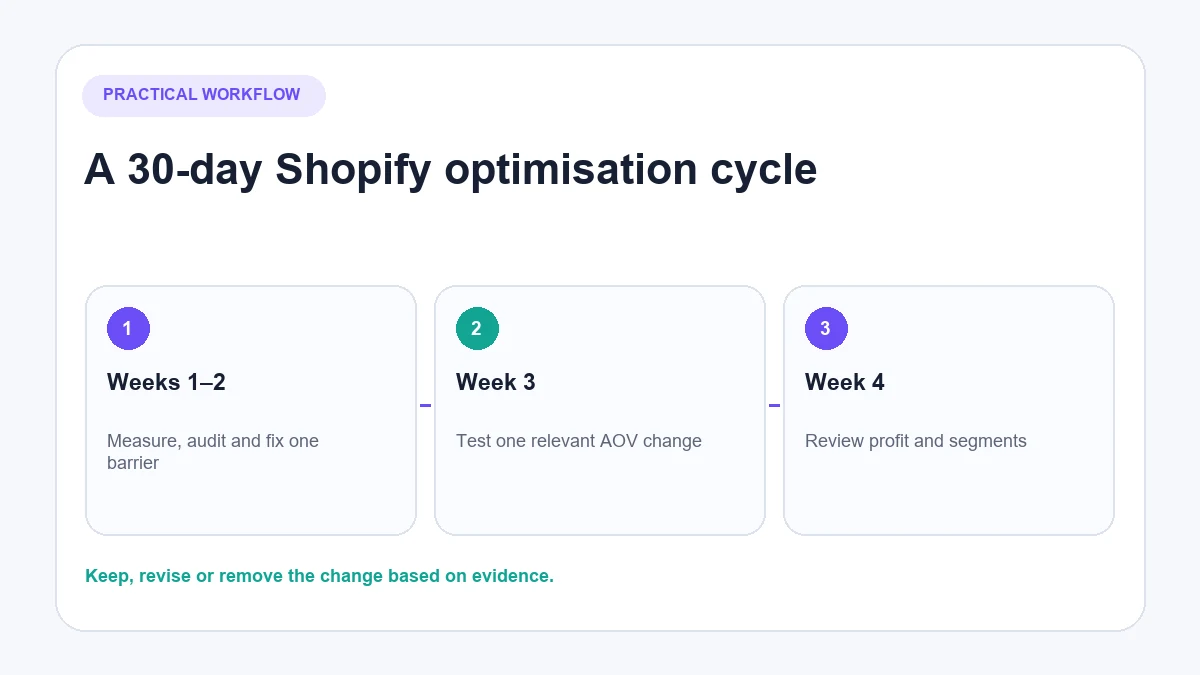
Week 1: measure and audit
Validate tracking, review the funnel, segment the problem and inspect the affected journey on real devices.
Week 2: fix the clearest conversion barrier
Choose one high-confidence issue, such as missing delivery information, a broken mobile variant selector or an unavailable payment method.
Week 3: test one relevant AOV change
Introduce one bundle, threshold, quantity offer or recommendation in the stage where it is most useful. Define margin and conversion guardrails first.
Week 4: review the complete outcome
Assess conversion, AOV, contribution per session, device/channel effects, returns and customer feedback. Keep, revise or remove the change based on evidence.
Final checklist
- Is tracking reliable enough for the decision?
- Which funnel stage is the constraint?
- Does the issue affect a specific device, channel, product or market?
- Is the proposed change relevant to that constraint?
- Could it reduce margin or increase returns?
- Is the mobile experience tested?
- Are customer questions answered accurately?
- Does the test have one primary metric and sensible guardrails?
- Can the change be rolled back?
- Has the result been reviewed beyond the headline average?
Improving a Shopify store is not about installing the maximum number of conversion and upsell features. It is about finding the current constraint, making the smallest credible improvement and checking whether the whole commercial outcome became better.