


10 Signs Your Customer Support Workflow Is Failing
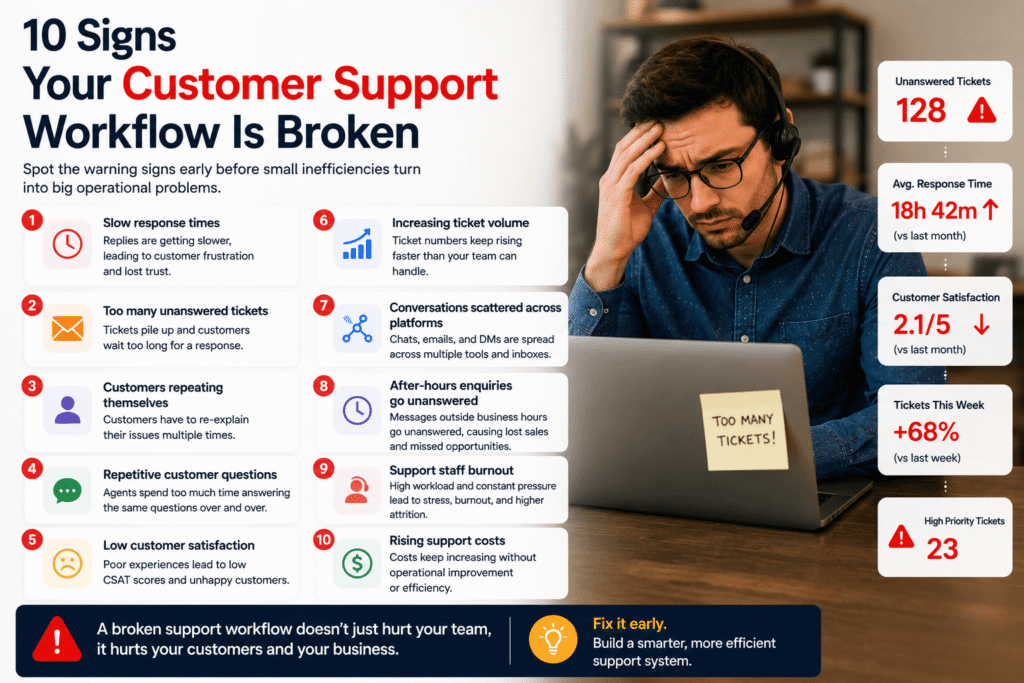
Customer support problems rarely appear overnight.
In most businesses, workflows break gradually. At first, delays seem manageable. A few unanswered tickets here and there do not feel urgent. But as customer volume grows, small inefficiencies compound into operational problems that become much harder to control later.
The challenge is that many businesses mistake ticket volume for the real problem.
In reality, rising ticket numbers are often only a symptom of deeper workflow issues:
-
fragmented communication
-
poor routing
-
repetitive manual tasks
-
delayed responses
-
disconnected support channels
-
outdated internal processes
When those operational gaps remain unresolved, support quality usually declines even as teams work harder.
This article breaks down the clearest signs your customer support workflow is broken, why these problems usually worsen as businesses scale, and what modern companies are doing differently to prevent support systems from collapsing under growth pressure.
Grounded in the uploaded support-workflow diagnostic prompt and SEO cluster strategy.
Quick Answer: Signs Your Support Workflow Is Broken
Some of the clearest signs include:
-
support tickets constantly increasing
-
slow response times
-
repetitive customer questions overwhelming agents
-
conversations scattered across multiple platforms
-
customers repeating the same information repeatedly
-
after-hours enquiries being missed
-
support staff burnout
-
inconsistent customer answers
-
poor ticket routing
-
rising support costs without operational improvement
Most broken support workflows are not caused by one major failure. They usually result from multiple small inefficiencies compounding over time.
Why Support Workflows Break as Businesses Grow
Support systems that work well for smaller teams often struggle once operational complexity increases.
At smaller scale, businesses can rely on:
-
shared inboxes
-
manual routing
-
tribal knowledge
-
flexible communication
But growth changes everything.
As companies expand:
-
ticket volume rises
-
communication channels multiply
-
product complexity increases
-
customer expectations become higher
Without structured workflows, support teams slowly become reactive instead of operationally efficient.
Businesses experiencing rapid scaling often first notice these problems through rising ticket volume and delayed replies. Many teams eventually realize why support tickets increase as businesses grow long before they fully understand the operational causes behind it.
1. Customers Keep Asking the Same Questions Repeatedly
One of the biggest signs of a broken support workflow is excessive repetition.
Support agents repeatedly answer:
-
shipping questions
-
refund policies
-
onboarding steps
-
account-access issues
-
pricing confusion
-
product availability
The issue is not that these questions exist.
The issue is that the business still relies heavily on humans to answer them manually at scale.
When repetitive support grows faster than the support team itself, workflows become increasingly inefficient.
Businesses increasingly focus on reducing repetitive customer questions because repetitive ticket volume often signals missing automation or poor self-service systems.
2. Response Times Keep Getting Slower
Slow replies are one of the clearest operational warning signs.
Customers now expect fast answers across:
-
website chat
-
WhatsApp
-
Instagram
-
email
-
support portals
When response times begin increasing consistently, it usually means the support workflow can no longer handle ticket volume efficiently.
The problem becomes even worse during:
-
weekends
-
product launches
-
sales campaigns
-
seasonal spikes
Businesses increasingly study the psychology behind faster customer responses because response speed directly affects customer satisfaction, retention, and conversion behavior.
Some businesses also discover how slow replies quietly damage conversions long before customers formally complain.
3. Conversations Are Scattered Across Too Many Platforms
Modern customer communication rarely happens in one place anymore.
Customers may contact your business through:
-
WhatsApp
-
Instagram DMs
-
Messenger
-
website chat
-
email
-
live chat systems
Without centralized workflows, support teams constantly switch between tools trying to manage conversations manually.
That fragmentation creates:
-
delayed replies
-
duplicated conversations
-
missed messages
-
inconsistent support experiences
Businesses increasingly adopt omnichannel customer messaging systems because disconnected communication channels become operationally difficult to manage at scale.
Some teams specifically focus on how to manage website, WhatsApp, and Instagram chat together instead of relying on scattered inboxes.
4. Customers Repeatedly Re-Explain Their Problems
A healthy support workflow preserves context between conversations.
Broken workflows force customers to:
-
repeat order details
-
restate account information
-
explain issues multiple times
-
restart conversations repeatedly
This usually happens because:
-
systems are disconnected
-
routing is inconsistent
-
conversation history is fragmented
From the customer’s perspective, this feels exhausting quickly.
Operationally, it also wastes support time because agents continuously re-collect information instead of solving the issue directly.
5. After-Hours Enquiries Go Unanswered
Customer expectations no longer stop outside business hours.
Many enquiries now happen:
-
late at night
-
during weekends
-
across different time zones
If businesses rely entirely on manual support availability, many high-intent customer conversations go unanswered until much later.
That delay often results in:
-
lost sales
-
abandoned carts
-
frustrated customers
-
missed leads
Businesses increasingly use after-hours support automation to avoid losing customer conversations outside operating hours.
Many companies also prioritize systems that help reduce customer waiting time during high-intent moments.
6. Support Agents Are Burning Out
Broken workflows affect internal teams just as much as customers.
When support systems become inefficient:
-
queues grow larger
-
repetitive work increases
-
escalations rise
-
pressure compounds
Support teams end up spending large amounts of time on:
-
repetitive tickets
-
manual lookups
-
duplicated conversations
-
avoidable escalations
Over time, this creates burnout and higher turnover.
Businesses increasingly recognize how operational inefficiency contributes directly to customer service burnout as ticket pressure rises.
7. Your Help Center and FAQ Content Feel Outdated
Many businesses create help centers once and rarely update them properly afterward.
But customer behavior changes constantly.
Products evolve.
Policies change.
New edge cases appear.
When support documentation becomes outdated:
-
customers stop trusting it
-
agents stop using it
-
repetitive tickets increase further
Broken knowledge-management systems quietly increase support workload over time.
That’s why many businesses now focus on dynamic FAQ systems and AI-driven knowledge workflows instead of static documentation alone.
Companies increasingly use systems that help train chatbots using their own business content so support information stays more aligned with real customer questions.
8. Ticket Routing Feels Inconsistent
In healthy support workflows:
-
tickets reach the correct team quickly
-
ownership stays clear
-
escalation paths remain structured
Broken workflows create:
-
reassigned tickets
-
delayed escalations
-
duplicated handling
-
unclear ownership
Customers experience this as inconsistent support quality.
Internally, teams experience it as operational confusion.
9. Support Costs Keep Rising Faster Than Revenue
One of the most dangerous workflow problems is rising support cost inefficiency.
Many businesses attempt solving support pressure by simply hiring more agents.
But without workflow improvements:
-
more customers create more tickets
-
more tickets require more staffing
-
more staffing creates more management overhead
Eventually support costs scale faster than operational efficiency.
Businesses increasingly analyze how manual support affects profitability because support operations eventually become a major margin consideration.
Others specifically focus on reducing support workload without aggressive hiring before support costs compound further.
10. Your Team Spends More Time Managing Tickets Than Solving Problems
This is one of the clearest operational warning signs.
Broken workflows force teams to spend excessive time:
-
categorizing tickets
-
routing conversations
-
copying information
-
switching platforms
-
chasing internal context
Instead of solving customer problems directly, teams become trapped managing operational friction itself.
That’s usually the point where workflow redesign becomes unavoidable.
What Healthy Support Workflows Usually Have in Common
Well-functioning support systems are not necessarily larger.
They are usually:
-
more centralized
-
more automated
-
more context-aware
-
less repetitive
-
operationally simpler
Healthy workflows typically focus on:
-
reducing repetitive tickets
-
faster routing
-
better self-service
-
omnichannel visibility
-
AI-assisted automation
-
clearer escalation systems
The goal is not eliminating human support.
The goal is ensuring humans spend time on higher-value conversations instead of repetitive operational tasks.
Businesses increasingly explore ticket deflection strategies using AI to reduce unnecessary ticket creation before queues become unmanageable.
Others focus on broader operational frameworks around how to scale customer support efficiently without scaling headcount proportionally.
Where AeroChat Fits
AeroChat focuses specifically on reducing repetitive customer communication through AI-powered automation.
Instead of replacing full support teams or helpdesk systems, AeroChat helps businesses:
-
answer repetitive questions automatically
-
improve response speed
-
manage omnichannel messaging
-
reduce ticket pressure
-
route more complex conversations to human teams
That distinction matters because most support workflows do not fail because customers ask too many questions.
They fail because too many repetitive questions still require manual handling.
Businesses increasingly use:
-
support automation workflows
-
high-volume messaging systems
to stabilize support operations before scaling problems compound further.
Some companies also compare deflection rate vs containment rate in AI chatbots to better understand automation performance operationally.
Frequently Asked Questions
What causes support workflows to break?
Support workflows usually break because ticket volume, communication channels, and operational complexity grow faster than the systems managing them.
How do I know if my support workflow is inefficient?
Common warning signs include slow responses, repetitive tickets, fragmented conversations, rising support costs, customer frustration, and support-team burnout.
Why do repetitive questions overwhelm support teams?
Repetitive questions scale aggressively as businesses grow. Without automation or self-service systems, support teams end up manually answering the same questions repeatedly at higher volume.
Can AI improve customer support workflows?
Yes. AI systems can automate repetitive conversations, improve routing, reduce response delays, and help businesses scale support operations more efficiently.
Does automation replace customer support agents?
No. Most businesses use automation to reduce repetitive workload while allowing human agents to focus on more complex or sensitive customer situations.
Final Thoughts
Broken support workflows usually develop gradually.
At first, the problems seem manageable:
-
slightly slower replies
-
rising ticket queues
-
repetitive conversations
-
scattered communication
But over time, those operational inefficiencies compound into:
-
higher costs
-
burnout
-
customer frustration
-
scaling problems
The businesses that scale support successfully are usually the ones that improve operational efficiency before support volume becomes unmanageable.
That often means focusing less on simply hiring more agents and more on:
-
workflow design
-
automation
-
ticket deflection
-
centralized communication
-
operational simplicity
A failing support workflow usually shows up in metrics before it shows up as customer complaints. The handle time vs resolution rate guide covers the specific metrics to track, and CSAT score for Shopify covers the customer-side measure of whether the workflow is working. For teams ready to fix the workflow, the automation maturity model provides a structured path for what to fix first.