Deflection Rate vs Containment Rate in AI Chatbots in 2026
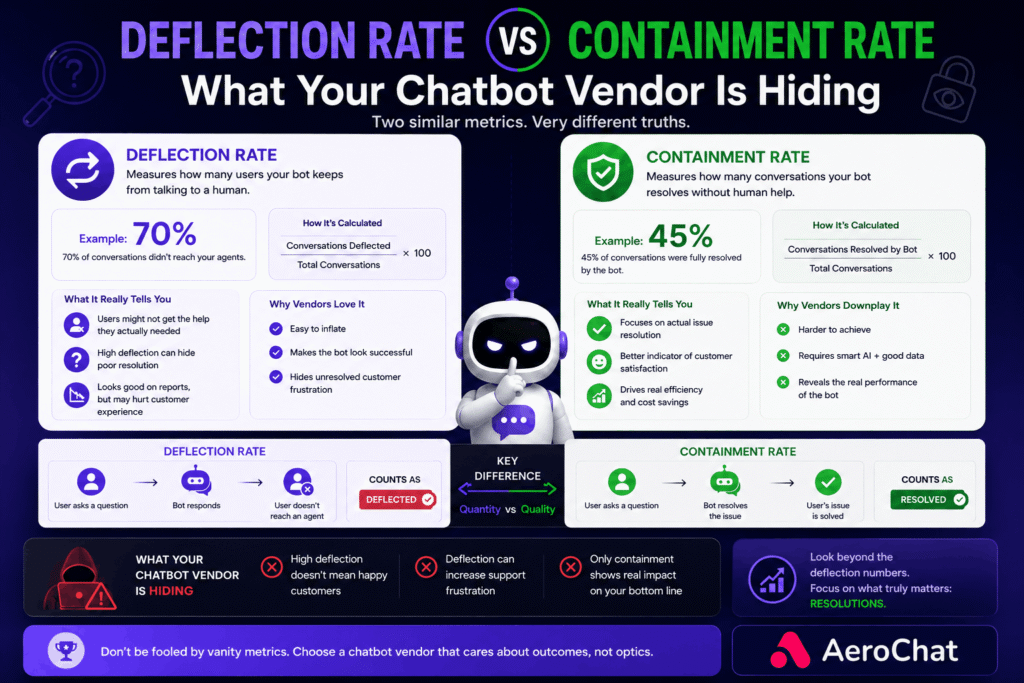
Deflection Rate and Containment Rate are two of the most commonly used AI chatbot metrics, but many ecommerce brands misunderstand what they actually measure.
Deflection Rate measures how often customers avoid reaching a human support agent. Containment Rate measures conversations that end inside the chatbot without escalation. In many chatbot dashboards, those numbers appear similar, but they do not always represent successful customer support.
In ecommerce, a “contained” conversation does not automatically mean the customer’s issue was solved. Sometimes the customer simply leaves frustrated, abandons the purchase, or gives up trying to get help.
That is where chatbot metrics become misleading.
Many Shopify AI chatbot vendors promote:
-
high containment percentages
-
lower escalation rates
-
aggressive automation metrics
as proof their AI is working well. But Shopify brands often discover the real customer experience tells a different story:
-
customers repeat questions
-
conversations feel unresolved
-
buying confidence drops
-
support frustration increases
-
customers ask for humans immediately
This guide explains:
-
the real difference between Deflection Rate and Containment Rate
-
why chatbot vendors intentionally blur these metrics together
-
how misleading support dashboards distort ecommerce performance
-
why conversational resolution matters more than vanity automation metrics
-
what Shopify brands should actually measure in modern AI support systems
We also explain how ecommerce-focused platforms like AeroChat increasingly prioritize conversational clarity, escalation quality, and customer resolution instead of simply maximizing automation percentages.
Why Chatbot Metrics Became Misleading
As AI chatbot platforms became more competitive, support dashboards gradually turned into marketing tools.
Vendors needed numbers that looked impressive during demos:
-
higher automation
-
fewer human escalations
-
lower support workload
-
faster conversations
The problem is that many of these metrics are easy to inflate.
For example:
-
a customer abandoning the chat may still count as “contained”
-
a short conversation may improve handle-time metrics even if the issue remains unresolved
-
customers avoiding support entirely may improve deflection numbers while trust quietly declines
This creates a dangerous disconnect between:
-
operational dashboards
and -
real customer experience
The chatbot may appear efficient internally while customers increasingly feel frustrated externally.
This becomes especially common in stores already struggling with support overload, where teams start optimizing dashboard metrics instead of actual conversational outcomes.
What Deflection Rate Actually Means
Deflection Rate Measures Support Avoidance
Deflection Rate measures how many customer issues were handled without requiring human-agent involvement.
In theory, this sounds useful.
If a chatbot successfully answers:
-
tracking requests
-
return-policy questions
-
delivery updates
-
account inquiries
without escalating to support staff, the business saves operational time.
That is legitimate deflection.
But the problem starts when vendors quietly count:
-
abandoned conversations
-
unresolved exits
-
customers giving up
-
failed engagement
as successful “deflection.”
Customer:
“hello???”
Chatbot gives weak reply.
Customer leaves.
Dashboard:
“Human support avoided successfully.”
Operational reality:
customer abandoned the conversation frustrated.
That is not successful support.
It is silent support failure.
What Containment Rate Actually Means
Containment Rate Measures Whether the Conversation Stayed Inside the Chatbot
Containment Rate tracks conversations that never escalated beyond the chatbot itself.
If the interaction ends without:
-
live-agent transfer
-
support ticket creation
-
human intervention
the system usually marks the conversation as “contained.”
The issue is that containment does not automatically equal resolution.
A contained conversation may include:
-
unresolved confusion
-
abandoned carts
-
frustrated exits
-
emotional dissatisfaction
-
incomplete product understanding
This becomes especially risky in ecommerce because customers often leave silently instead of formally reporting dissatisfaction.
“Will this fit wide feet?”
Weak chatbot:
“Please refer to our size chart.”
The conversation ends.
“Successfully contained.”
But the customer may still:
-
feel uncertain
-
abandon checkout
-
buy from a competitor
-
reopen support later
The chatbot technically contained the conversation.
The business still lost the sale.
Why Vendors Blur Deflection and Containment Together
The Metrics Sound Similar on Purpose
Many chatbot platforms intentionally use vague language around:
-
containment
-
deflection
-
automation
-
self-service resolution
because the ambiguity makes dashboards look stronger.
High containment percentages create the impression that:
“The AI solved almost everything.”
But in many systems, containment simply means:
“The customer never reached a human.”
Those are not the same outcome.
This distinction becomes even more important for Shopify brands running:
-
post-purchase support
-
WhatsApp conversations
-
Instagram DMs
-
emotionally sensitive support flows
because customer silence does not always mean customer satisfaction.
The Hidden Problem With “Successful Containment”
Customers Often Leave Before They Escalate
This is the part many dashboards never reveal clearly.
Customers do not always escalate when frustrated.
Sometimes they:
-
abandon the conversation
-
reopen support later
-
leave checkout silently
-
stop asking questions
-
lose trust gradually
In ecommerce, emotional friction often becomes invisible operationally.
“Can this arrive before Friday?”
“Shipping estimates vary by region.”
The customer leaves.
No escalation happens.
Containment rate improves.
But the customer may no longer trust the purchase timing enough to continue checkout.
This becomes especially common in stores already experiencing slow-reply drop-offs, where customers disengage emotionally long before support teams recognize the issue.
The Ecommerce Problem Most Dashboards Ignore
Ecommerce Conversations Are Often Revenue Conversations
Traditional support systems treat conversations like operational tickets.
Ecommerce conversations behave differently.
Customers asking:
-
sizing questions
-
compatibility concerns
-
delivery timing
-
ingredient questions
-
return policies
are often making purchase decisions in real time.
That means chatbot quality directly affects:
-
conversion rate
-
cart abandonment
-
repeat purchases
-
customer confidence
-
retention quality
This is one reason brands investing in conversational commerce increasingly care more about conversational clarity than raw automation percentages.
A chatbot that ends conversations quickly but leaves uncertainty unresolved may still damage revenue outcomes.
Deflection Rate vs Containment Rate in Ecommerce
|
Metric |
What Vendors Often Claim |
What It Actually Measures |
Hidden Risk |
|---|---|---|---|
|
Deflection Rate |
Human support avoided successfully |
Customer never reached an agent |
Customer may have abandoned support entirely |
|
Containment Rate |
AI solved the conversation independently |
Conversation ended inside the chatbot |
Customer may still feel unresolved |
|
Resolution Rate |
Customer problem solved |
Actual conversational resolution |
Harder metric to inflate artificially |
|
Average Handle Time |
Faster support performance |
Shorter conversations |
Rushed or incomplete support |
|
Automation Rate |
More AI efficiency |
Percentage of AI-handled interactions |
Does not guarantee customer satisfaction |
This is why Shopify brands should always evaluate support metrics together instead of relying on isolated dashboard numbers.
Why Resolution Quality Matters More Than Vanity Metrics
A “Solved” Customer Matters More Than a Short Conversation
Many ecommerce brands eventually realize:
-
lower escalation rates
-
faster conversation endings
-
higher automation percentages
do not automatically create better support experiences.
The real question becomes:
“Did the customer leave with clarity and confidence?”
That distinction changes everything.
Strong conversational resolution usually reduces:
-
repeat support tickets
-
abandoned carts
-
refund escalation
-
customer frustration
-
emotional uncertainty
This becomes especially important for stores handling large volumes of product questions, where buying confidence matters more than conversational speed alone.
Why AI Chatbots Changed This Debate Completely
Instant Replies Made Resolution Quality More Important
Before AI automation, slow support was the main operational problem.
Now chatbots can reply almost instantly.
That shifted the challenge completely.
Today, fast replies are relatively easy.
Useful replies are harder.
A chatbot can:
-
answer instantly
-
contain conversations aggressively
-
reduce human escalations
while still:
-
misunderstanding customer intent
-
escalating too late
-
creating emotional frustration
-
reducing customer trust
This becomes especially visible in stores running omnichannel support systems, where customers expect conversational continuity across:
-
Instagram
-
WhatsApp
-
Messenger
-
website live chat
The issue is no longer:
“Did the chatbot respond quickly?”
The issue becomes:
“Did the customer actually feel helped?”
What Smart Ecommerce Brands Measure Instead
Modern Support Teams Focus on Resolution Quality
The strongest Shopify support teams rarely optimize for aggressive containment alone anymore.
Instead, they balance:
-
conversational clarity
-
customer confidence
-
escalation timing
-
emotional resolution
-
operational accuracy
-
conversational continuity
The goal becomes:
reduce friction throughout the customer journey.
That usually creates:
-
fewer repeat conversations
-
higher customer trust
-
stronger retention
-
better long-term support efficiency
Modern ecommerce support increasingly behaves less like ticket processing and more like relationship management.
That shift changes which metrics actually matter.
How AeroChat Approaches Support Metrics Differently
As ecommerce support becomes more conversational, platforms like AeroChat increasingly focus less on vanity automation percentages and more on real conversational outcomes.
Growing Shopify brands often need systems that can:
-
preserve customer context
-
recognize emotional frustration
-
escalate intelligently
-
maintain conversational continuity
-
support WhatsApp and Instagram together
-
reduce repetitive support loops
because modern ecommerce support quality is no longer measured only by:
-
how many tickets were deflected
or -
how many chats stayed contained
Customers increasingly judge support quality by:
-
how quickly confusion disappears
-
how naturally the conversation flows
-
how confidently they can continue the purchase journey
That distinction becomes more important as AI support moves from simple FAQ automation toward full conversational commerce infrastructure.
Frequently Asked Questions
What is chatbot deflection rate?
Deflection Rate measures how many customer issues were handled without requiring human-agent involvement. However, some vendors also count abandoned or unresolved conversations as successful deflection.
What is chatbot containment rate?
Containment Rate measures conversations that ended without escalation to a human agent. A contained conversation does not always mean the customer’s issue was actually solved.
Why do chatbot vendors confuse these metrics?
The terms sound similar, and combining them makes automation dashboards appear stronger. Higher containment and deflection rates often look impressive during product demos, even when customer satisfaction may still be declining.
Why can high containment rates become dangerous?
Aggressively containing conversations can create:
-
frustrated customers
-
abandoned carts
-
unresolved questions
-
repeat tickets
-
lower customer trust
especially in ecommerce support environments.
Which metric matters more for Shopify stores?
Resolution quality usually matters more than raw containment percentages because ecommerce conversations directly affect conversion confidence, retention, and customer trust.
How should ecommerce brands evaluate chatbot performance?
Shopify brands should evaluate:
-
conversational resolution
-
escalation quality
-
customer satisfaction
-
emotional clarity
-
repeat contact rate
-
operational accuracy
instead of relying only on automation or containment percentages.