

Average Handle Time vs Resolution Rate for Shopify Support
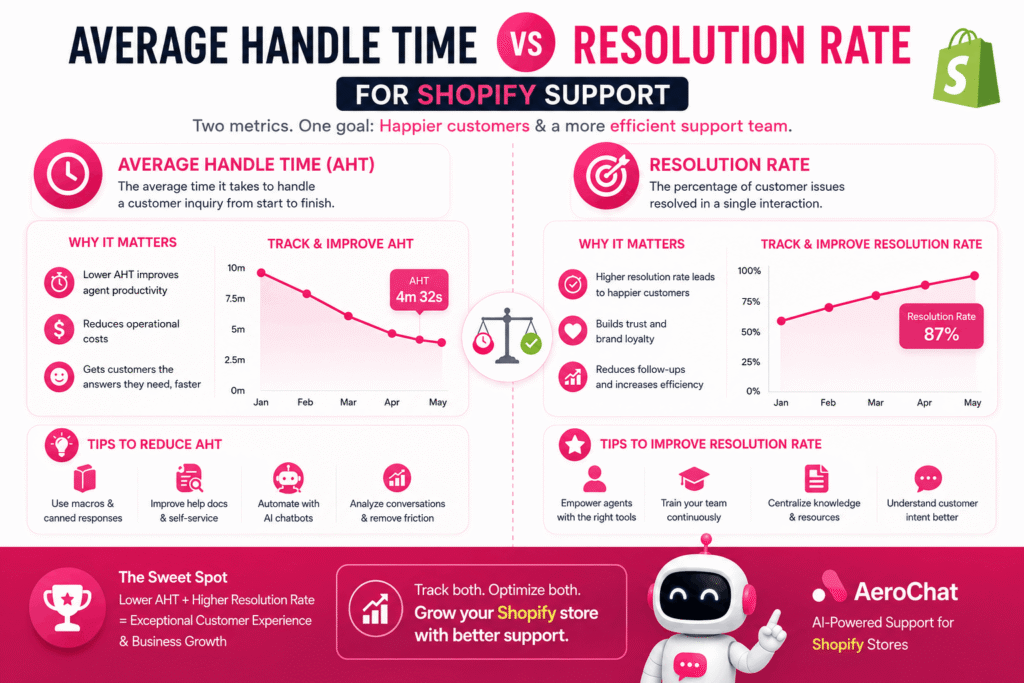
Average Handle Time (AHT) measures how quickly a support conversation ends. Resolution Rate measures whether the customer’s problem was actually solved.
In modern Shopify ai chatbot support, those two metrics increasingly conflict.
Many ecommerce brands now respond faster than ever through AI automation while still dealing with:
-
repeated support tickets
-
frustrated customers
-
abandoned conversations
-
refund escalation
-
lower customer trust
A chatbot can technically reduce response time while quietly making the overall support experience worse.
That is why more Shopify brands are starting to question whether fast support actually means good support anymore.
This guide explains:
-
what Average Handle Time actually measures
-
why Resolution Rate matters differently in ecommerce
-
where fast replies genuinely help
-
where rushed support creates hidden operational damage
-
how AI chatbots changed the meaning of support efficiency
-
which metric Shopify stores should prioritize in 2026
We also explain how platforms like AeroChat approach conversational support differently as ecommerce brands move beyond simple “fast reply” automation toward higher-quality customer resolution.
The Problem With Measuring Shopify Support Like a Call Center
A lot of ecommerce brands inherited support metrics from traditional call centers.
That model worked when support mostly meant:
-
answering phones
-
closing tickets
-
reducing wait time
-
maximizing agent productivity
But Shopify support behaves differently.
Most ecommerce conversations are connected to:
-
buying confidence
-
shipping anxiety
-
refunds
-
product uncertainty
-
delivery expectations
-
emotional frustration
A customer asking:
“Will this fit wide feet?”
is not just opening a support ticket.
They are deciding whether to trust the purchase.
That changes the meaning of support quality completely.
This is one reason stores investing heavily in conversational commerce often stop evaluating support purely through speed metrics alone.
The conversation itself influences revenue.
Why Fast Support Can Still Create Frustrated Customers
One of the biggest misconceptions in ecommerce support is:
faster replies automatically create better customer experiences.
That is not always true.
A chatbot can:
-
answer instantly
-
close conversations quickly
-
reduce Average Handle Time dramatically
while still creating:
-
confusion
-
repeated questions
-
escalations
-
abandoned carts
-
emotional frustration
For example:
Customer:
“Will this arrive before Friday?”
Fast but weak reply:
“Shipping times vary depending on location.”
Technically fast.
Operationally useless.
The customer still feels uncertain.
They may:
-
reopen the conversation
-
contact support again
-
abandon checkout entirely
This becomes especially common in stores already struggling with slow-reply drop-offs, where teams optimize reply speed but fail to improve actual conversational clarity.
Fast replies only matter if the customer leaves with confidence.
What Average Handle Time Actually Measures
Average Handle Time tracks how long support interactions take from start to finish.
Traditionally, lower AHT was considered more efficient because agents could process more conversations per hour.
In Shopify support, AHT usually includes:
-
chatbot conversation duration
-
live-agent handling time
-
waiting periods
-
escalation flow
-
conversation closure timing
On the surface, lower AHT sounds positive.
But ecommerce support creates a hidden problem:
customers often return later when conversations were resolved too quickly without actually solving the issue.
That means:
-
low AHT can sometimes increase total support workload
-
fast conversations can create future tickets
-
rushed replies can reduce customer trust
This is especially visible in stores overwhelmed by repetitive WISMO tickets, where customers usually care less about speed itself and more about receiving a useful, trustworthy update.
Resolution Rate Is Usually the Metric Shopify Brands Actually Feel
Resolution Rate measures whether the customer’s issue was genuinely solved.
Not just answered.
Solved.
That distinction matters a lot in ecommerce.
“Can I return this if the size is wrong?”
may technically receive an answer immediately.
But if the explanation feels vague, robotic, or incomplete, the emotional uncertainty still remains.
The ticket may close.
The concern does not.
This is why Resolution Rate often becomes more important than raw reply speed in Shopify support.
Good resolution usually reduces:
-
repeat conversations
-
future support tickets
-
refund escalation
-
customer frustration
-
abandoned purchases
It also improves:
-
buying confidence
-
retention
-
support trust
-
post-purchase satisfaction
This becomes especially important for stores handling large volumes of product questions, where customer hesitation often matters more than conversational speed itself.
Where Average Handle Time Actually Matters
AHT is not useless.
Some ecommerce situations genuinely benefit from very fast support.
Order Tracking
Customers asking:
“where’s my package?”
usually want:
-
immediate retrieval
-
fast status visibility
-
simple updates
Long conversations create more frustration here.
This is why brands trying to reduce response time often prioritize speed heavily for shipping-related workflows.
Basic FAQ Automation
Questions like:
-
“What’s your return policy?”
-
“Do you ship internationally?”
-
“What payment methods do you accept?”
usually benefit from quick resolution.
Customers often prefer immediate answers over conversational depth.
Simple Operational Requests
Things like:
-
order confirmation
-
invoice retrieval
-
shipping updates
-
delivery windows
generally perform well with low-handle-time automation.
In these scenarios, fast support genuinely improves customer experience.
The problem begins when stores apply the same speed logic to emotionally complex conversations.
Where Resolution Rate Matters More
Some ecommerce conversations should never be optimized purely for speed.
Refund Discussions
Customers requesting refunds are often already emotionally defensive.
Rushed automation usually makes the situation worse.
A fast response that feels robotic can escalate frustration quickly.
Product Recommendation Conversations
When customers ask:
“Which one should I choose?”
they are looking for buying confidence, not just information retrieval.
This is one reason stores investing in AI shopping assistants increasingly optimize for conversational quality instead of minimizing handle time aggressively.
Sizing and Compatibility Questions
Customers worried about:
-
fit
-
ingredients
-
compatibility
-
product usage
usually need reassurance more than speed.
A rushed answer may technically close the conversation while still increasing return risk later.
Emotional Support Situations
Conversations involving:
-
damaged deliveries
-
missed deadlines
-
wrong items
-
repeated shipping delays
usually require stronger emotional handling.
This is where sentiment-aware chatbot systems become more valuable than aggressive speed optimization.
AI Chatbots Changed This Debate Completely
Before AI chatbots, support speed mostly depended on human agent capacity.
Now chatbots can reply almost instantly.
That changed the meaning of Average Handle Time entirely.
Today, fast support is easy.
Useful support is harder.
A chatbot can reduce AHT dramatically while:
-
misunderstanding intent
-
escalating too late
-
sounding robotic
-
repeating workflows
-
breaking conversational continuity
That is why modern ecommerce support teams increasingly focus on:
-
conversational quality
-
escalation timing
-
emotional resolution
-
context preservation
-
first-contact resolution
instead of only chasing lower support duration metrics.
This shift becomes especially visible in stores running omnichannel support systems, where customer context matters more than isolated ticket speed.
The Hidden Cost of Chasing Low AHT
This is the part many support dashboards never show clearly.
Fast support can quietly create:
-
repeat tickets
-
abandoned conversations
-
future escalations
-
lower trust
-
weaker retention
A chatbot quickly closes:
“Can I change my shipping address?”
without explaining cutoff timing properly.
Later:
-
the package ships incorrectly
-
the customer becomes frustrated
-
support reopens the issue manually
The original AHT looked excellent.
The operational outcome was terrible.
This is one reason stores struggling with support overload often realize the deeper issue is not message quantity alone. The real problem is unresolved conversational friction accumulating over time.
What Smart Shopify Teams Optimize Instead
The strongest ecommerce support teams rarely optimize for the absolute lowest AHT anymore.
Instead, they balance:
-
speed
-
clarity
-
confidence
-
emotional handling
-
escalation timing
The goal becomes:
solve the conversation properly the first time.
That usually creates:
-
lower long-term workload
-
fewer repeat contacts
-
higher customer trust
-
better retention quality
Modern ecommerce support increasingly behaves less like traditional ticket handling and more like relationship management.
That shift changes which metrics actually matter.
How AeroChat Fits Into This Shift
As Shopify support becomes more conversational, platforms like AeroChat increasingly focus on balancing automation speed with actual conversational resolution quality.
For growing ecommerce brands, fast replies alone are no longer enough. Customers expect:
-
quick responses
-
accurate retrieval
-
conversational continuity
-
emotional clarity
-
seamless escalation when needed
This is where response time still matters.
AeroChat helps stores maintain near-instant first responses across:
-
WhatsApp
-
Instagram
-
Messenger
-
website live chat
while still preserving customer context throughout the conversation. The goal is not simply reducing Average Handle Time for reporting purposes. It is reducing the amount of time customers spend feeling confused, ignored, or forced to repeat themselves.
That distinction becomes increasingly important for stores managing:
-
high support volume
-
post-purchase conversations
-
delivery questions
-
product recommendation requests
-
multi-channel customer journeys
because modern ecommerce support is no longer measured only by how fast the chatbot replies.
Customers increasingly judge support quality by how quickly the conversation actually moves toward resolution.
Frequently Asked Questions
What is Average Handle Time in Shopify support?
Average Handle Time (AHT) measures how long a support conversation takes from start to finish, including chatbot interactions, agent replies, waiting periods, and escalation timing.
What is Resolution Rate in ecommerce support?
Resolution Rate measures whether the customer’s issue was actually solved, not just answered. In ecommerce, this often includes emotional reassurance, operational clarity, and buying confidence.
Which metric matters more for Shopify stores?
For simple operational tasks like tracking updates, AHT matters more. For emotional, purchase-related, or complex conversations, Resolution Rate usually matters more long term.
Can AI chatbots reduce Average Handle Time?
Yes. AI chatbots can dramatically reduce response speed and handling duration. However, fast replies do not automatically create better customer experiences if the issue remains unresolved.
Why can low AHT become a problem?
Aggressively reducing handle time can create rushed conversations, repeat tickets, poor emotional handling, and lower customer trust over time.
How do modern Shopify brands measure support quality?
Many ecommerce brands now balance:
-
response speed
-
conversational quality
-
first-contact resolution
-
escalation timing
-
customer satisfaction
-
emotional handling
instead of optimizing only for lower Average Handle Time.
Handle time and resolution rate pull in opposite directions when AI is involved: automating responses typically reduces handle time but can reduce resolution rate if the AI answers the wrong question. The AI-to-human handoff guide covers how to set escalation rules that protect resolution rate. For the customer satisfaction measure alongside these, CSAT for Shopify is the standard metric, and customer effort score is the alternative measure that captures friction rather than satisfaction.