


How to Write Product Descriptions for Shopify That Actually Convert

A good Shopify product description answers the customer’s main questions before they think to ask: what the product does, who it is for, what it is made of and why it is worth the price. The most common mistake is leading with features rather than benefits. A feature tells the customer what the product has; a benefit tells them what it changes for them. Customers buy the change, not the specification.
This guide explains how to write product descriptions that convert, how to structure them for both readers and search engines, and the errors most Shopify stores keep repeating. If you are setting up your store for the first time, start a free Shopify trial and use this guide before you write your first product page.
Start with who you are writing for
Before writing anything, identify the specific person most likely to buy this product. Ask:
- What problem are they solving or what occasion are they buying for?
- What do they already know about this product type?
- What objections or doubts do they have before buying?
- Are they buying for themselves or as a gift?
A product description that does not address these questions is writing for no one in particular, which produces the generic, interchangeable copy that appears on most ecommerce sites. A first-time buyer of a skincare ingredient needs different information from a repeat customer upgrading to a higher concentration. Category-specific guides can help you understand what your audience already knows and what they still need to be convinced of. The guide to selling beauty products online and the guide to selling handmade products online both cover how customer expectations vary by niche and why the description approach that works in one category often fails in another. Identify which reader is most common and write primarily for them.
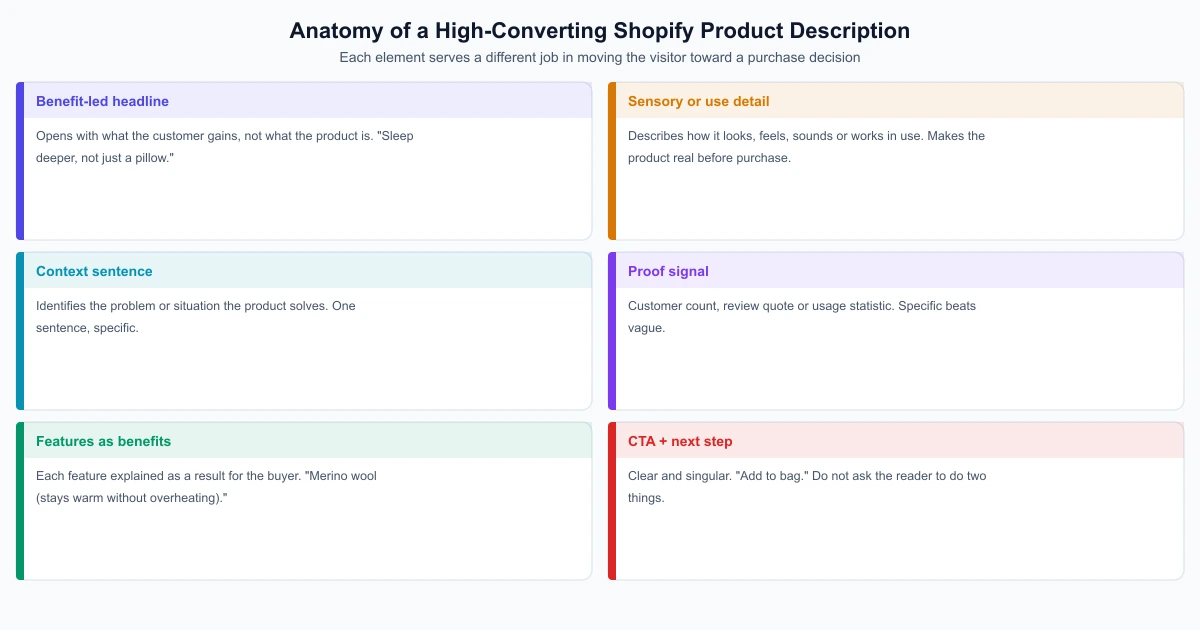
Lead with the benefit, not the feature
The most common product description mistake is opening with a feature rather than a benefit. “Made from 100% Merino wool” is a feature. “Keeps you warm without overheating, even when layered” is the benefit that makes the feature matter. Both pieces of information belong in the description, but the benefit earns the right to the feature rather than the other way around.
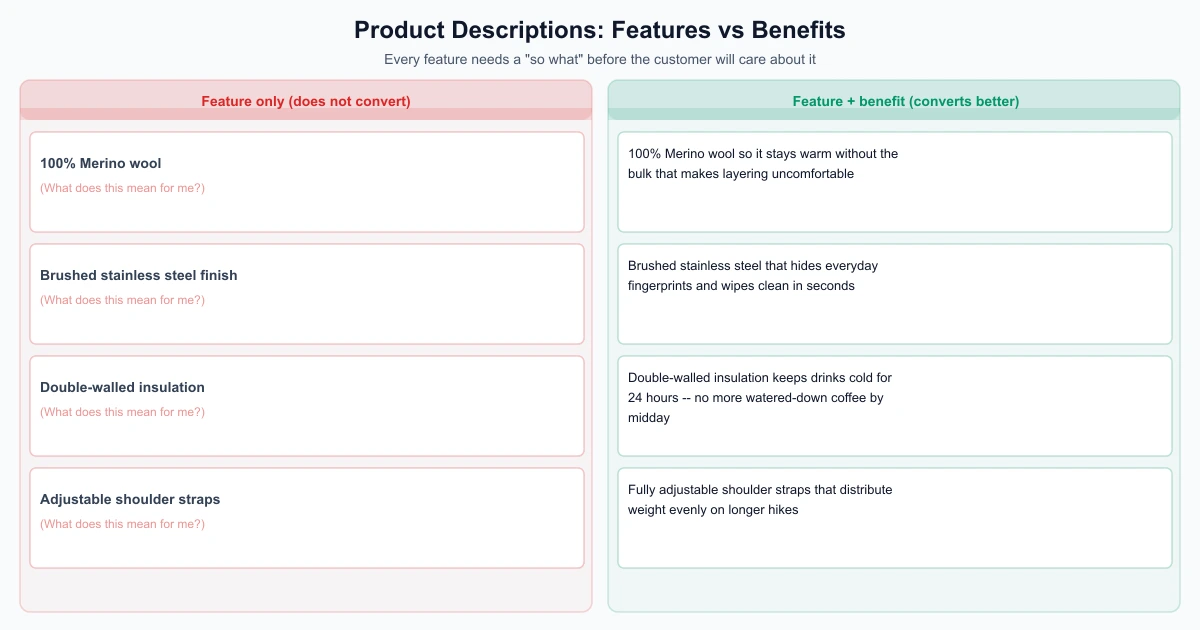
| Feature only (does not convert) | Feature + benefit (works better) |
|---|---|
| 100% Merino wool | 100% Merino wool so it stays warm without the bulk that makes layering uncomfortable |
| Brushed stainless steel finish | Brushed stainless steel that hides fingerprints and wipes clean in seconds |
| Double-walled insulation | Double-walled insulation keeps drinks cold for 24 hours, no more watered-down coffee by midday |
| Adjustable shoulder straps | Fully adjustable shoulder straps that distribute weight evenly on longer hikes |
Format for how people actually read
On a product page, most visitors scan before they read. They look at the headline, skim the first sentence, check the price, look at the images and then, if still interested, read the description more carefully. Structure your description to support this pattern:
- Opening paragraph: Benefit-led, two to three sentences, answers “what is this and why should I care?”
- Feature list: Each feature followed immediately by its benefit in a short clause
- Use context: Who the product is designed for and when or how they use it
- Technical details: Dimensions, materials, care instructions, what is included
- Closing statement: Optional; works best when it addresses the last hesitation before buying
Keep paragraphs to three or four sentences. A single unbroken block of text signals effort to the reader and most will not make that effort.
Include the details that answer real questions
The questions customers ask before buying are usually the ones missing from the product description. Common omissions include:
- Dimensions and weight
- Materials and their grade or origin
- Care and maintenance requirements
- What is included in the package
- What the product is not suitable for
- How it compares to related products in the same range
Review your customer service enquiries and look for patterns. If the same question comes up regularly before purchase, that information belongs in the product description. For stores already handling enquiries through chat, the questions that repeat most frequently are a reliable signal of what is missing from product pages, since those are the gaps between what the page explains and what customers actually need to know before buying.
How AeroChat helps Shopify merchants improve product descriptions
AeroChat is an AI agent platform that helps Shopify merchants run customer service on autopilot across website chat, WhatsApp, Instagram and other channels. For product description writing, it creates a direct feedback loop between customer questions and page content.
When an AI chatbot for Shopify handles incoming product enquiries, the questions customers ask most often reveal exactly what the product pages are not answering. If ten customers in a week ask whether a jacket is machine washable, that detail should be in the product description. If customers are asking whether a product ships with batteries included, that is a missing line in the specifications. Descriptions updated based on real customer questions improve conversion on existing traffic without requiring new visitors.
AeroChat also handles the enquiries that come in after a customer has already read the description but still has a question before committing to buy. Those conversations are handled automatically, using your store’s product information and policies, and passed to a human agent when they need personal attention. Plans start from $49 per month and include a 7-day trial so you can test it on your store before committing.
Writing for search without stuffing keywords
Product descriptions are indexed by search engines. Use the product’s primary search term in the first sentence or paragraph, in at least one subheading if you use them, and in the meta description (set separately in Shopify’s SEO section for each product). Beyond that, write for the human reader. A description that clearly covers materials, dimensions, use case and who it is for will include relevant search terms naturally without needing to be forced.
Good product photography supports the description rather than replacing it. The Shopify product photography guide covers how to plan and shoot images that answer the visual questions descriptions cannot, including scale, texture, packaging and in-use context.
For a broader framework covering how product pages fit into your overall traffic strategy, the ecommerce content marketing guide covers how product descriptions, blog content and social channels work together to drive consistent organic traffic to your store.
Common mistakes to avoid
Manufacturer copy is the most common problem on new Shopify stores. Copying supplier descriptions creates duplicate content that search engines will not index uniquely and provides no differentiation from other stores selling the same product. Rewrite every sentence rather than editing around the edges.
Superlatives without evidence are equally common. “The best”, “highest quality” and “world-class” require evidence to carry weight. A customer reading “cold-pressed within 24 hours of harvest and independently tested at below 0.2% acidity” can evaluate that claim. A customer reading “the finest olive oil available” cannot. Specific, verifiable claims convert better than vague superlatives.
For the broader context of what a well-optimised product page needs beyond the description, the Shopify pre-launch testing checklist covers page speed, mobile presentation and image quality alongside content. The ecommerce startup checklist puts product page quality in the context of the full launch sequence.
Frequently asked questions
How long should a Shopify product description be?
Long enough to answer the questions a customer needs answered before buying, and no longer. Simple, familiar products might need 100 to 150 words. Complex, technical or high-consideration products might need 400 words or more. Length follows from what needs to be communicated, not a word count target.
Should I use bullet points in product descriptions?
Bullet points work well for feature lists and specifications where each item is discrete. They work less well as a substitute for prose throughout the whole description, because they make it harder to explain why a feature matters or create any sense of the product’s character. Use bullets for scannable lists and prose for explanation and context.
Do product descriptions affect Shopify SEO?
Yes. Product descriptions are indexed content. A well-written description covering relevant terms naturally will appear in more relevant searches than a thin or duplicate one. A description that answers customers’ questions also reduces bounce rate and improves conversion, both signals search engines use to evaluate page quality. For the full picture of how content drives organic traffic to a Shopify store, the ecommerce content marketing strategy guide covers how product pages, blog content and external links work together.