


How to Sell Handmade Products Online Without Outgrowing Your Workshop

To sell handmade products online, calculate how much your workshop can produce before deciding how many products to list. Choose a fulfilment model, price materials and labour properly, publish clear lead times and sell through one primary channel until the order process is dependable.
The most dangerous early result is not always a lack of demand. A product can sell well while the maker loses money, misses dispatch dates and spends every evening answering custom requests. A sustainable handmade store sells a promise the workshop can keep.
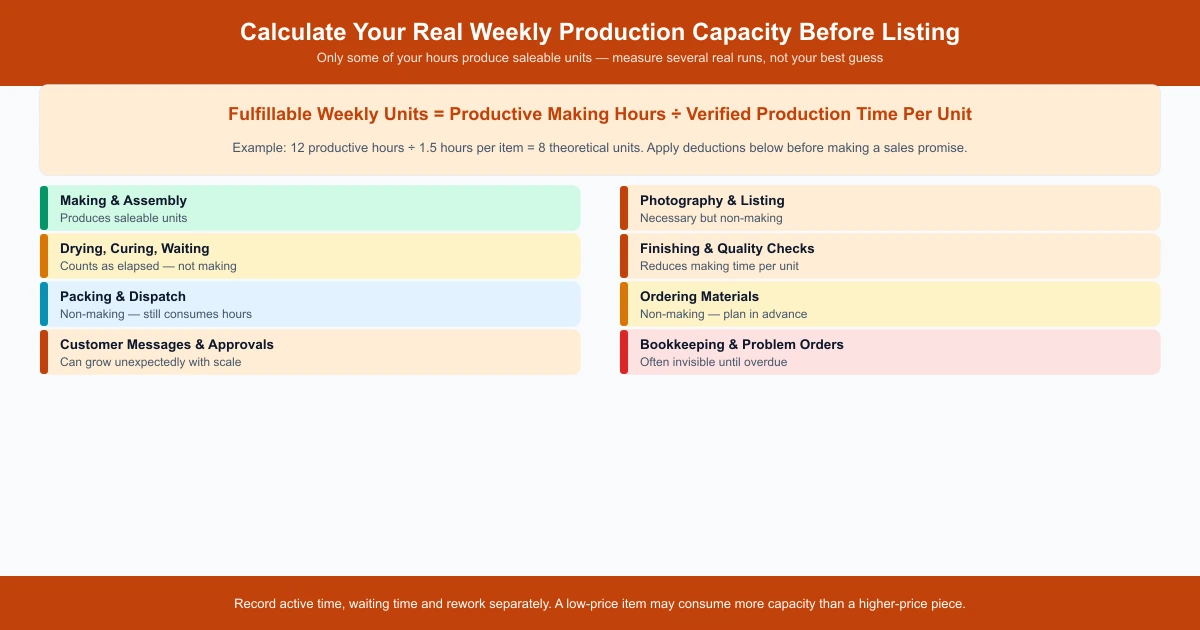
Calculate capacity before choosing the size of the catalogue
Start with the hours actually available each week. Then separate:
- making and assembly;
- drying, curing or other waiting stages;
- finishing and quality checks;
- photography and listing work;
- packing and dispatch;
- ordering materials;
- customer messages and custom approvals;
- bookkeeping and problem orders.
Only some of those hours produce saleable units.
For a repeatable product, a basic planning estimate is:
Fulfillable weekly units = productive making hours ÷ verified average production time per unit
If twelve productive hours are available and a finished item takes an average of ninety active minutes, the theoretical result is eight units. That is not yet a safe sales promise. Allow for material delays, rejected work, equipment problems, admin and existing orders.
Measure several real production runs instead of relying on memory. Record active time, waiting time and rework separately. The result may reveal that a popular low-price item consumes more capacity than a higher-price piece.
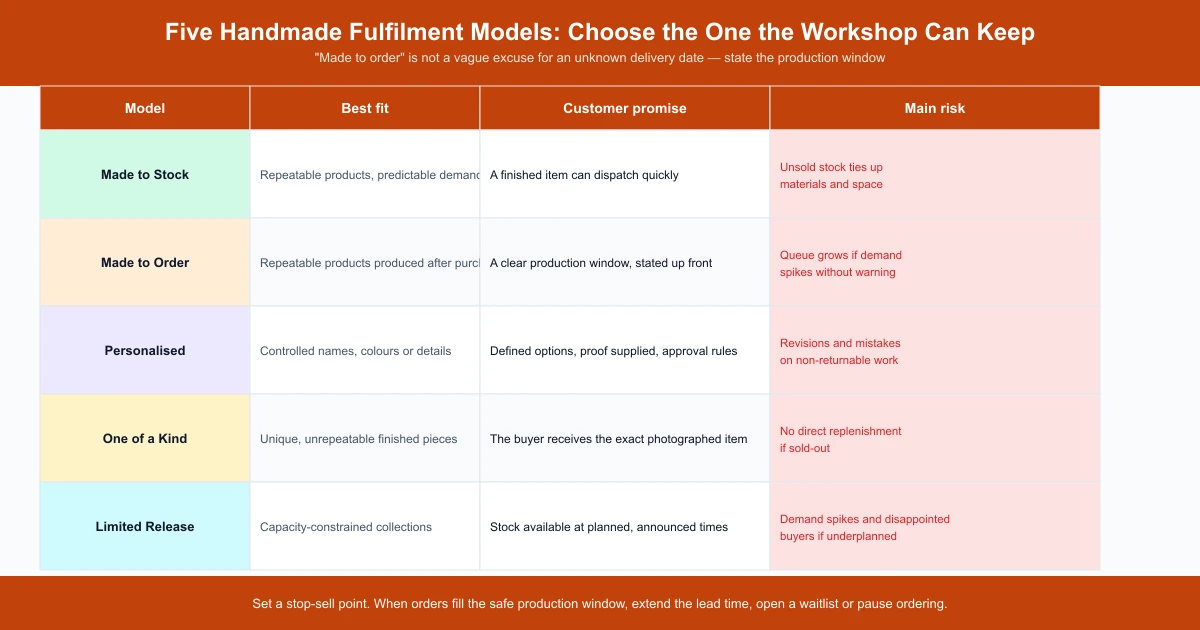
Choose a fulfilment model that matches the craft
| Model | Best fit | Customer promise | Main risk |
|---|---|---|---|
| Made to stock | Repeatable products with predictable demand | A finished item can dispatch quickly | Unsold stock |
| Made to order | Repeatable products produced after purchase | A clear production window | A growing queue |
| Personalised | Controlled names, colours or details | Defined options and approval rules | Revisions and mistakes |
| One of a kind | Unique finished pieces | The buyer receives the photographed item | No direct replenishment |
| Limited release | Capacity-constrained collections | Stock is available at planned times | Demand spikes and disappointed buyers |
Do not use “made to order” as a vague excuse for an unknown delivery date. State the production window, when it begins and what can change it.
Personalisation needs boundaries. Define the accepted characters, colours, dimensions, proof process and number of revisions. A blank “tell us what you want” box can turn a repeatable product into unpriced bespoke work.
Limited releases can protect capacity when they reflect a real production limit. Do not invent permanent urgency if the same items will be available again.
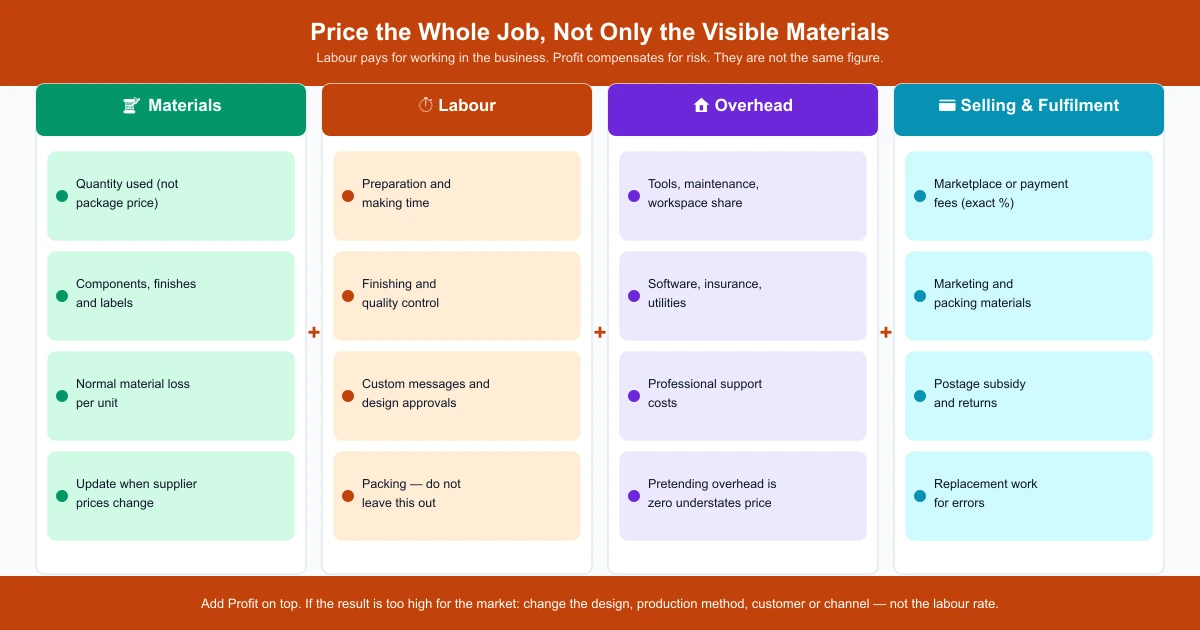
Price the whole job, not only the visible materials
A practical starting formula is:
materials + labour + overhead + normal wastage and rework + packaging + selling costs + fulfilment + profit
Materials
Include the quantity used, not only the package price. Add components, finishes, labels and normal loss. Update the calculation when supplier prices or yields change.
Labour
Pay for preparation, making, finishing, quality control and packing. Custom messages and design approvals are labour too.
Overhead
Allocate an appropriate share of tools, maintenance, workspace, software, insurance, utilities and professional support. The method can be simple, but pretending overhead is zero understates the price.
Selling and fulfilment
Add marketplace or payment fees, marketing, packing materials, postage subsidy, returns and replacement work. Use current official fee information for the channel and your actual country.
Profit
Labour pays the maker for working in the business. Profit compensates the owner for risk and supports investment, slow periods and growth. They are not the same.
If the resulting price is far above what the intended customer will pay, do not immediately remove the labour. Change the design, production method, customer, sales channel or product.
Design a capacity-safe product range
A large choice can create small batches, material sprawl and constant switching. Build the first collection around shared decisions:
- a recognisable customer or use;
- a limited group of materials;
- repeatable production stages;
- meaningful rather than decorative variants;
- standard packaging;
- a clear maximum order queue.
Suppose a maker sells ceramic mugs. Offering four glaze families and two sizes may be manageable. Allowing any colour, handle, inscription, shape and deadline creates a custom studio disguised as a standard product page.
Set a stop-sell point. When paid orders fill the safe production window, extend the displayed lead time, open a waitlist or pause ordering. Taking unlimited orders and apologising later shifts the workshop’s capacity problem to the customer.
Choose where each sales channel earns its place
Marketplaces, owned stores, social platforms, craft fairs and wholesale are not interchangeable.
Marketplace
A marketplace such as Etsy can provide access to shoppers seeking eligible creative goods. The seller works inside its product rules, search system, fees and customer experience.
Owned store
Shopify or another owned store provides greater control over presentation, product education and the customer relationship. The maker must generate the traffic.
Social discovery
Process videos, demonstrations and finished work can attract an audience. Social engagement is not a substitute for a product page, price or reliable checkout.
Craft fairs
In-person events provide immediate feedback on touch, scale, price and customer language. They also consume production time and involve stall, travel and stock costs.
Wholesale
Wholesale can create larger orders but requires pricing, lead times and output that support the buyer’s margin. A handmade retail price does not automatically produce a viable wholesale price.
The detailed Shopify versus Etsy guide for product sellers can help assign the marketplace and owned-store roles. Master one primary route before adding inventory synchronisation across several channels.
Prove the item is handmade without writing a fairy tale
Customers may value the person, process and variation behind handmade work. Show that evidence honestly:
- photographs or short clips of meaningful production stages;
- the materials and tools used;
- what the maker does personally;
- any disclosed production partner;
- why natural or handmade variation occurs;
- the studio location at a level the owner is comfortable sharing;
- the time or skill that changes the finished result.
Do not invent a founder struggle, customer quotation or centuries-old tradition. Avoid implying that every component is handmade when the maker assembles bought parts.
Current platform definitions matter. Etsy’s Creativity Standards distinguish items made, designed, handpicked or sourced by a seller and set disclosure expectations. Check the current policy for the exact product and production process.
Build product pages for decisions and custom-order boundaries
Each page should answer:
- Is the photographed item exact or representative?
- What are the materials and dimensions?
- Which variations are selectable?
- What differences should be expected?
- How long does production take?
- When is the dispatch estimate calculated?
- What personalisation is included?
- Is a proof supplied, and what happens after approval?
- How should the item be used and cared for?
- What is included in the package?
- What are the return and correction routes?
Use photographs to show scale, texture, edges, back, underside, fastenings and packaging. The Shopify product photography tips offer a practical shot-planning process.
For made-to-order products, show the current lead time near the purchase control. A generic shipping policy in the footer is too far from the decision.
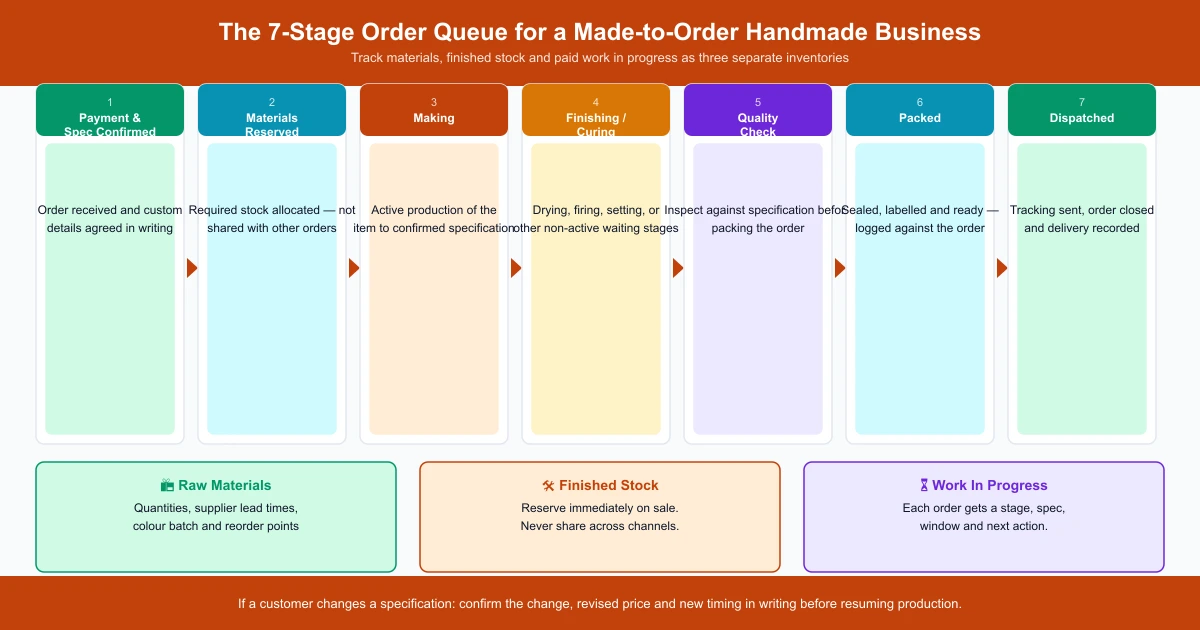
Plan materials, finished stock and the order queue separately
These are three different inventories.
Raw materials determine what can be produced. Track quantities, supplier lead times, colour or batch differences and reorder points.
Finished stock can normally be sold and dispatched. Reserve it immediately when the same item is listed across channels.
Paid work in progress consumes both materials and future time. Give every order a production stage, required specification, promised window and next action.
A simple queue might move through:
- payment and specification confirmed;
- materials reserved;
- making;
- finishing or curing;
- quality check;
- packed;
- dispatched.
Record custom approvals with the order. If a customer changes a specification, confirm the change, price and revised timing in writing.
Market the work in a rhythm you can sustain
Handmade businesses have more useful content than finished-product announcements:
- a process that explains value;
- a material decision;
- care or use;
- a comparison between variants;
- a batch in progress;
- the reason for a seasonal cut-off;
- customer use with permission;
- the development of a new design.
Batch photography and video while working rather than interrupting production every day. Choose a small number of recurring content formats and one primary social channel.
For customer photographs, permissions and realistic use examples, see the ecommerce user-generated content guide.
Seasonal cut-offs should follow the queue. State the last order date supported by current capacity and materials; do not guarantee carrier delivery outside the business’s control.
How AeroChat can help when handmade enquiries repeat
AeroChat is an AI agent platform that helps ecommerce brands run customer service on autopilot.
For an established Shopify maker, AeroChat can answer from approved information about materials, dimensions, standard options, current lead times, care, delivery and order status. It can collect structured details for a custom enquiry before passing the request to the maker.
It should not promise that a new design is feasible, approve a custom change, set an unverified deadline or accept a policy exception. Artistic decisions, final proofs, safety questions, complaints and unusual requests need a person.
Makers can compare Shopify AI chatbot options and explore customer-service automation for handmade stores. AeroChat is a growth-stage investment for repeated conversations across channels, not a required cost before the first sale.
Scale the queue without making false promises
Growth does not have to mean converting every product into mass production.
Options include:
- batching repeatable stages;
- reducing low-value variants;
- setting order windows;
- using waitlists;
- releasing finished collections;
- training help for documented, quality-controlled tasks;
- outsourcing non-distinctive work transparently;
- offering wholesale only for products the workshop can repeat profitably.
Measure on-time dispatch, rework, returns, contribution per productive hour and the age of the order queue. Revenue alone can rise while the workshop becomes less sustainable.
If the business operates from home, the guide to running ecommerce from a home workspace covers storage, boundaries and fulfilment considerations.
A maker’s publish-or-pause checklist
- Has production time been measured across real units?
- Does the price include labour, overhead, rework and selling costs?
- Is the fulfilment model stated clearly?
- Are custom options controlled and priced?
- Does the product page show materials, dimensions and expected variation?
- Is the current lead time visible before purchase?
- Are raw materials, finished stock and paid orders tracked separately?
- Is there a stop-sell point when the queue is full?
- Can unusual requests reach the maker?
A handmade store becomes durable when its commercial promise fits the workshop. Build the price, range and channels around real capacity, then expand only when the system can deliver the work without hiding the cost from the maker or the delay from the customer.
Handmade products share key challenges with jewellery and candles: the product story matters as much as the product itself, and shoppers need more context before buying than they do for mass-produced goods. The guide to selling jewellery online covers the trust-building approach in detail, and selling candles online covers a similarly craft-focused category. For stores building an audience through content, an ecommerce content strategy explains how to turn that product story into consistent organic traffic.