

What Is the Best Time to Post on Instagram for Sales? 2026 Guide

There is no universal best time to post on Instagram for sales. Use follower activity in Instagram Insights as a starting point, then test two or three practical posting windows against product-page visits, qualified enquiries, add-to-carts and purchases.
The best slot is the one that repeatedly produces valuable customer actions for your account—not necessarily the time that earns the most likes. Audience location, product price, content format, offer and the time required to make a buying decision can all change the result.
Is there one best time to post on Instagram for sales?
No. Published studies can suggest reasonable starting windows, but they combine many accounts, industries and time zones. They also tend to measure engagement rather than completed purchases.
For example, current studies from Buffer, Hootsuite and Sprout Social use different datasets and methods. Their recommendations vary, which is expected: a clothing brand selling to UK students, a homeware shop serving US homeowners and a beauty business with customers across several countries do not share the same buying routine.
Use benchmark studies to select a first test. Use your own account and store data to make the final decision.
Businesses primarily trying to earn more saves, shares and comments should follow the separate guide to improving Instagram engagement rate. This article focuses on posting time as a sales variable.
What do Instagram posting-time studies measure?
Before applying a study, check what its “best time” actually means.
| Source | What the study is useful for | Important limitation |
|---|---|---|
| Buffer | Broad day-and-time starting points from a large post dataset | The strongest engagement window is not automatically the strongest sales window |
| Hootsuite | Timing patterns by day, industry and time zone | Industry averages can hide major differences between individual audiences |
| Sprout Social | Broad engagement windows across many social profiles | Cross-account engagement cannot prove when your customers purchase |
| Instagram Insights | Your followers’ locations and active times | Activity data does not show purchase intent by itself |
Meta’s Instagram Insights documentation states that professional accounts can review follower trends, top locations and times followers are most active, subject to account and data availability. This is more relevant than a global chart, but it is still only one input.
How do you find when your Instagram followers are active?
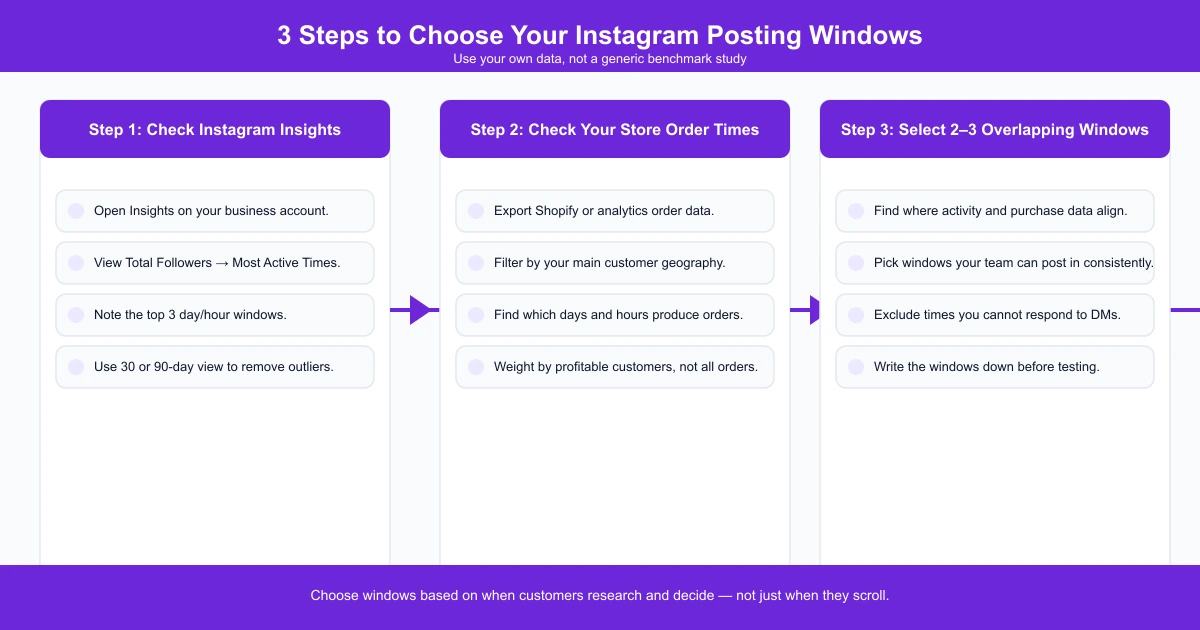
Use a business or creator account and review Insights in the Instagram app. Menu wording can change, but the usual process is:
- Open your profile and professional dashboard.
- Select Insights or the audience/follower view.
- Open the Total followers information.
- Review top countries and cities.
- Check the days and times when followers are most active.
- Use a 30- or 90-day view where available to reduce the effect of one unusual week.
- Record two or three windows that your team can test consistently.
If activity data is unavailable, the account may not yet have enough follower information. Begin with customer location, past post performance and one relevant benchmark study, then collect your own evidence over time.
Do not combine all follower locations into one assumed time zone. If most paying customers live in one market but the largest follower group lives elsewhere, customer and store data should carry more weight.
Why might the most active time produce fewer sales?
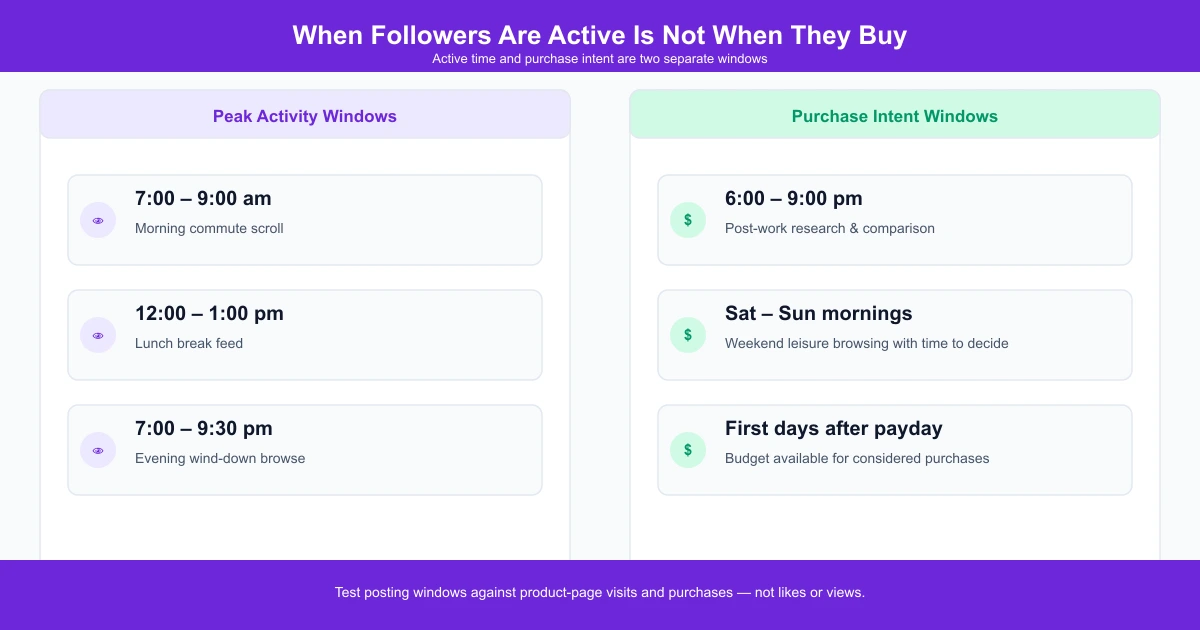
A customer can open Instagram without being ready to buy. Someone scrolling during a commute may watch a Reel but postpone a product comparison. Someone browsing after work may have more time to review sizing, delivery and returns.
These differences make active time and buying time separate questions.
Likes and views do not prove purchase intent
A humorous Reel may reach more people than a detailed product carousel while sending fewer qualified visitors to the store. If the objective is sales, compare the actions that move someone towards buying.
Useful measures include:
- product-page visits;
- website taps;
- product-tag taps where available;
- qualified comments and DMs;
- add-to-carts;
- purchases;
- revenue attributed under one consistent method; and
- returns or cancellations related to misunderstood product information.
Customer time zones can differ from follower totals
Follower growth can come from markets the business does not serve or from people unlikely to buy. Review order locations and profitable customer segments alongside follower locations.
For an international account, consider separate windows for priority markets instead of searching for one compromise time. A post can also be supported with later Stories or reminders rather than publishing identical feed content repeatedly.
The product changes the time to conversion
A low-cost accessory may produce a quick purchase. Furniture, technical products or higher-priced clothing may require comparison, measurement or discussion. Measure a suitable delay between the post and the sale instead of crediting only immediate purchases.
Response availability can affect a high-intent post
A launch or restock can trigger questions about sizes, stock, delivery and returns. Publishing at the hour with the largest audience may be counterproductive if nobody can answer an important question until the next day.
The practical sales window is therefore:
a time when relevant customers are active and the business can support the buying decision.
How should you choose candidate posting windows?
Start with the commercial job of the post.
| Goal | Suitable content | Customer action | Timing consideration |
|---|---|---|---|
| Launch a product | Demonstration Reel or carousel | View the product and understand its value | Publish when questions and early orders can be monitored |
| Announce a restock | Story and product post | Check size or variant availability | Align with stock going live and support coverage |
| Promote a limited offer | Clear post plus timed Stories | Visit the offer and purchase before expiry | Leave enough buying time before the deadline |
| Explain a considered product | Carousel, demonstration or Live | Save, compare, ask and revisit | Test a window that allows unhurried attention |
| Remind undecided shoppers | Story or follow-up content | Return to product or checkout | Use store behaviour and campaign timing, not follower activity alone |
Select two or three windows. Too many variables will make the test slow and inconclusive.
For example, a UK clothing retailer could test a weekday lunchtime window, a weekday evening window and one weekend period. These are test labels, not recommendations that apply to every UK account.
Does the best time change for Reels, Stories and feed posts?
It can, because each format has a different role and distribution pattern.
Reels
Reels can continue reaching people after publication. The first hour may still matter operationally, but judging a Reel only from immediate activity can miss later discovery and sales.
Use Reels for movement, product demonstrations, styling or a concise explanation. Track results over the same number of days for every Reel in the timing test.
Stories
Stories are useful for timely launches, stock updates, reminders and objection handling. Their shorter visible lifecycle makes the relationship between timing and the offer more direct.
Schedule Stories around when a customer can act. A final reminder posted after most of the audience has gone offline gives people little chance to respond.
Feed posts and carousels
Carousels can help buyers compare options, understand features or review size and care information. They may produce saves and return visits before a purchase.
If a carousel supports a considered decision, measure more than immediate clicks. Keep the comparison window consistent across candidate times.
No format is automatically best for sales. Match the format to the information the buyer needs, then test its timing.
How do you run a four-week Instagram sales-time test?
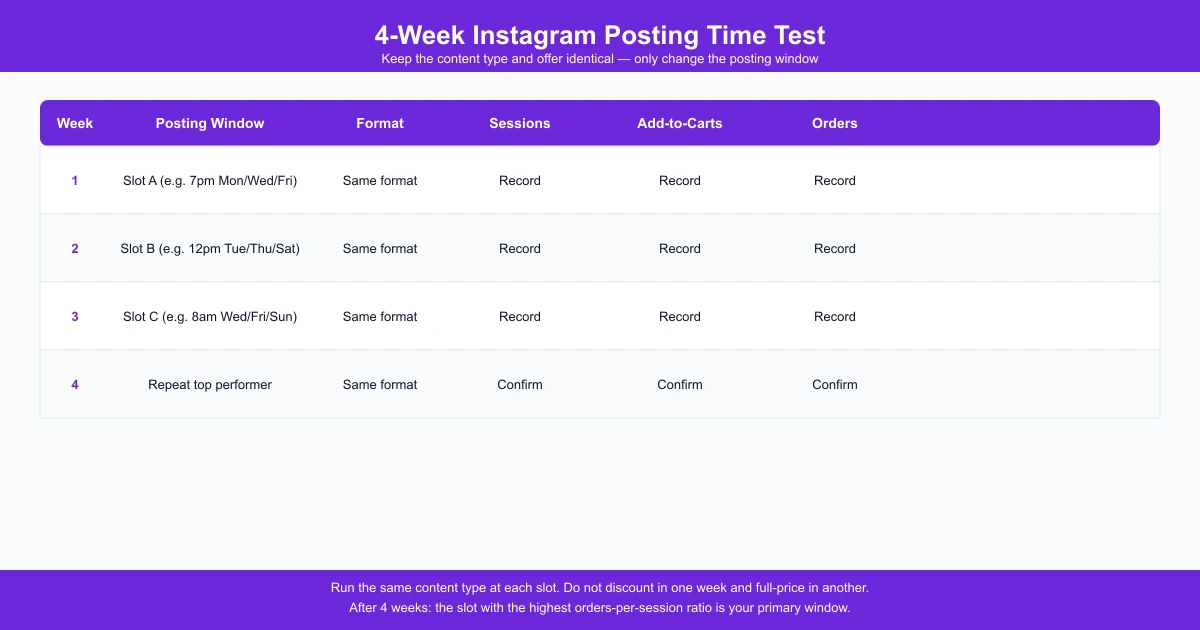
A useful test changes the publication window while keeping other important variables as stable as possible.
Step 1: Choose two or three candidate windows
Use:
- follower activity;
- paying-customer locations;
- previous product-page traffic;
- past enquiries and sales;
- staff response coverage; and
- one relevant benchmark study.
Write each time with its time zone. “Post at 7” is not a usable instruction for an international team.
Step 2: Compare similar content
Do not compare a major discount Reel at one time with an ordinary product photograph at another. Group posts by format, product type, offer and purpose.
Perfect control is unrealistic in marketing, but obvious differences should be recorded. If a celebrity mentions the product or paid promotion begins, exclude the post from the timing conclusion or label the event clearly.
Step 3: Use consistent destinations
Send comparable posts to product pages with working mobile checkout. Use consistent campaign parameters or another agreed attribution method where appropriate.
The Instagram marketing strategy for ecommerce explains how content, shopping features and measurement fit into the wider customer journey.
Step 4: Record immediate and delayed actions
Use a worksheet like this:
| Date | Time and zone | Format | Product or offer | Product visits | Qualified enquiries | Add-to-carts | Purchases | Notes |
|---|---|---|---|---|---|---|---|---|
| Example | 12:30 BST | Carousel | New product education | Complete after the measurement window |
Reach, views and engagement still provide diagnostic information, but keep them separate from sales actions.
Step 5: Compare like with like
Calculate results per post and, where volume permits, per 1,000 accounts reached. One time slot can appear stronger merely because its posts received more distribution.
Low-volume accounts should avoid declaring a winner from one purchase. Extend the test or use directional evidence from product visits and qualified conversations while more sales data accumulates.
Step 6: Repeat the strongest window
A winning slot should perform well more than once. Retest it with similar content before changing the entire calendar.
Review the result monthly or quarterly. Audience location, daylight-saving time, seasonality, school schedules and buying habits can change.
How long after posting should you measure sales?
Use at least two windows:
- an immediate window for views, clicks and conversations; and
- a longer, consistent window for add-to-carts and purchases.
The appropriate length depends on the product and campaign. A time-limited launch may need a short window, while a higher-consideration product may need several days.
Avoid claiming that the last Instagram post caused every later purchase. A customer may have encountered a creator, email, advert, search result and several organic posts before buying. Use the same attribution method throughout the test so the comparison remains useful.
The guide to turning Instagram followers into customers covers the wider conversion path beyond publication time.
How should you plan response coverage?
Before a high-intent post goes live:
- Confirm prices, stock, variants and product links.
- Make size, compatibility, delivery and return information easy to find.
- Prepare approved answers to predictable questions.
- Assign someone to monitor unusual or urgent requests.
- Define what must move to a human.
- Record questions that the content or product page failed to answer.
Response coverage does not mean pressuring every commenter. It means removing avoidable uncertainty while the customer is evaluating the product.
Strong timing will not rescue unclear content. Keep the caption’s message, product facts and next action clear during the test.
How does AeroChat help after a sales-focused Instagram post?
AeroChat is an AI agent platform that helps Instagram business owners automate and scale customer conversations.
When a post produces repeated questions about products, stock, delivery or returns, AeroChat Instagram ai chatbot can answer suitable Instagram DMs and comments using approved business information. Conversations requiring judgement can move to a human agent with their context.
Best for: DTC and ecommerce brands handling frequent customer enquiries across Instagram and other channels.
AeroChat does not determine the best posting time, create or schedule content, or increase algorithmic reach. Its role begins after a potential customer starts a conversation.
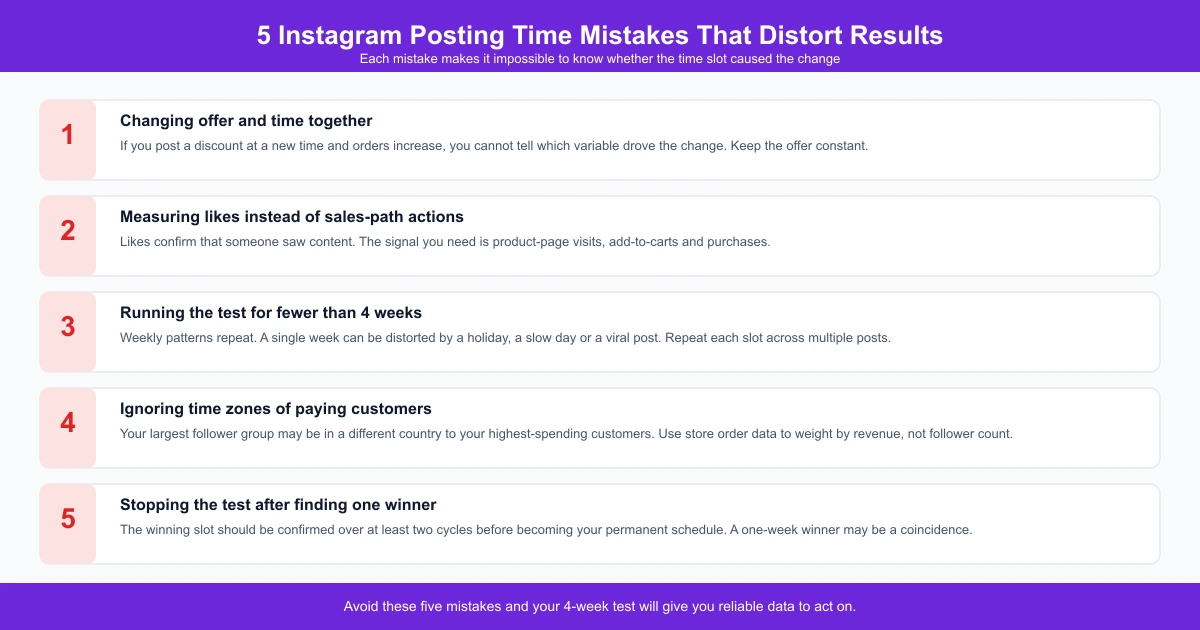
What timing mistakes distort the result?
Changing the offer and the time together
If the discount, creative, audience and time all change, the result cannot isolate timing.
Choosing the post with the most likes
High engagement can be useful without producing immediate sales. Match the winner to the stated commercial objective.
Ignoring customer location
A benchmark in Eastern Time is not a direct recommendation for customers in London, Singapore or Sydney.
Testing each window once
One post can be affected by news, competition, seasonality or creative quality. Repeat the comparison.
Treating formats as interchangeable
A Story reminder and an educational carousel serve different purposes. Compare timing within a similar content role.
Publishing when questions cannot be handled
A high-intent customer may postpone or abandon the purchase when an essential question remains unanswered.
Optimising only for immediate purchases
Considered products can have a longer path. Review delayed actions under a consistent attribution method.
Final decision checklist
- Review follower activity and paying-customer locations.
- Select two or three practical windows with time zones.
- Group posts by comparable format, product and offer.
- Use consistent product links and attribution.
- Track product visits, qualified enquiries, add-to-carts and purchases.
- Apply the same immediate and delayed measurement windows.
- Record events that could distort the result.
- Repeat the strongest slot before adopting it.
- Recheck the decision as the audience and season change.
The best time to post on Instagram for sales is not a permanent number found in a global chart. It is a repeatable window supported by your account, customer and store evidence.
Timing is one variable in Instagram reach. The captions guide covers the content quality side, and how Instagram carousels work explains the format that tends to generate the most saves and shares regardless of posting time. For businesses using Instagram for sales specifically, selling clothing on Instagram covers how timing, content and DM strategy work together for product-focused accounts.