
25 Ecommerce Business Ideas for 2026, Ranked by Cost and Potential

The best ecommerce business ideas for 2026 solve a specific problem for a clearly defined customer and can be tested without a large inventory commitment. Digital templates, niche starter kits, specialist replacement parts, personalised gifts and replenishment products are among the strongest options because they offer either low startup costs, healthy margins or repeat-purchase potential.
The idea alone is not what makes an online store profitable. A promising category can still fail if products are expensive to ship, easy to return or impossible to differentiate. This guide compares 25 ecommerce ideas by startup cost, margin potential, repeat sales and operating difficulty so you can choose one that fits your resources.
Quick comparison of ecommerce Business ideas
The ratings below are directional. Actual costs and margins depend on your country, suppliers, platform and customer acquisition method.
| Ecommerce business idea | Startup cost | Margin potential | Repeat purchases | Difficulty |
| Professional digital templates | Very low | High | Medium | Low |
| Niche educational downloads | Very low | High | Medium | Low |
| Personalised digital gifts | Very low | High | Low | Low |
| Micro-community print-on-demand | Low | Medium | Medium | Low |
| Curated affiliate storefront | Very low | Low | Medium | Medium |
| Hobby starter kits | Low | Medium | Medium | Medium |
| Small-space organisation products | Low | Medium | Medium | Medium |
| Apartment pet enrichment kits | Low | Medium | High | Medium |
| Culturally specific gift boxes | Low | Medium | High | Medium |
| Creator merchandise services | Low | Medium | Medium | Medium |
| Adaptive clothing accessories | Low to medium | Medium | Medium | Medium |
| Remote-work comfort products | Low to medium | Medium | Medium | Medium |
| Micro-adventure accessories | Low to medium | Medium | Medium | Medium |
| Car and EV organisation | Low to medium | Medium | Medium | Medium |
| Specialist replacement parts | Medium | High | High | Medium |
| B2B consumable supplies | Medium | Medium | High | Medium |
| Premium cooking ingredients | Medium | Medium | High | High |
| Beauty discovery kits | Medium | Medium | High | High |
| Refillable household products | Medium | Medium | High | High |
| Refurbished accessories | Medium | Medium | Medium | High |
| Private-label pet care | Medium to high | High | High | High |
| Personalised skincare | High | High | High | High |
| Smart ageing-at-home products | High | Medium | Medium | High |
| Niche subscription boxes | Medium | Medium | High | High |
| Local specialist marketplace | Medium to high | High | High | High |
What makes an ecommerce idea strong in 2026?
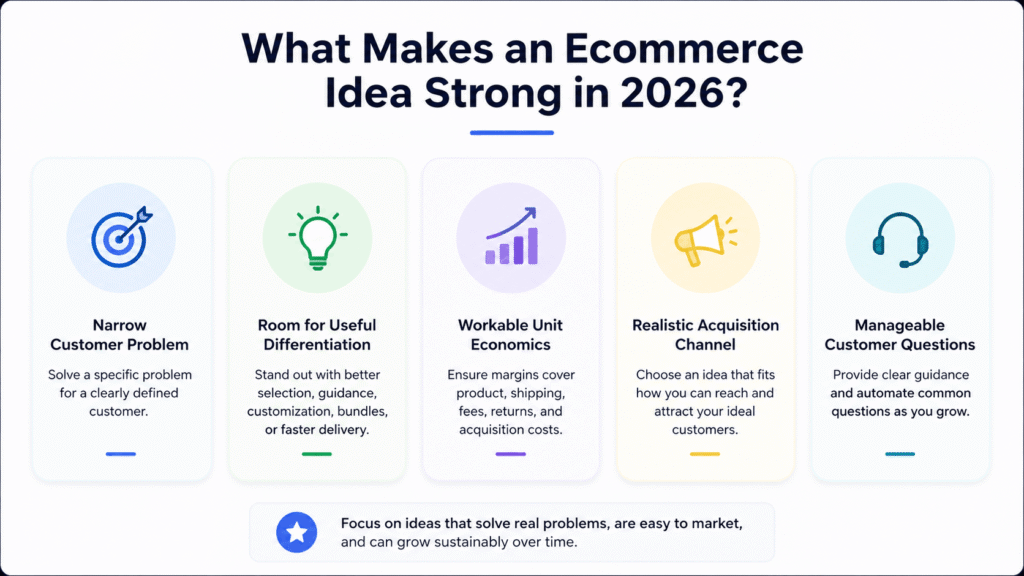
An attractive market is not always an attractive business. Before choosing a product, look for five qualities.
A narrow customer problem
“Home products” is too broad. “Space-saving storage for renters in studio apartments” gives you a recognisable customer, a clear problem and a focused product range.
Room for useful differentiation
Small stores rarely win by selling the same item as a large marketplace. They can win through better product selection, expert guidance, customisation, bundles, faster local delivery or content for a particular community.
Workable unit economics
Your selling price must cover the product, packaging, payment fees, fulfilment, shipping support, returns, discounts and customer acquisition. High revenue with weak contribution margin is not a healthy business.
A realistic acquisition channel
Choose an idea that fits how you can reach people. Visual products may work through Instagram or TikTok. Technical replacement parts may perform better through Google Search, YouTube tutorials and enthusiast communities.
Manageable customer questions
Products involving fit, compatibility, ingredients or installation create more pre-purchase questions. That is not necessarily bad; good guidance can become a competitive advantage. As volume grows, stores can automate common pre-sales questions while keeping human help available for unusual cases.
Low-cost ecommerce business ideas
These ideas can usually be tested without ordering a large quantity of stock. Low cost does not mean effortless; the main investment is often skill, audience building or content creation.
1. Professional digital templates
Sell templates that save a specific profession time: client onboarding packs for photographers, stock trackers for small bakeries, quoting sheets for contractors or content calendars for property agents.
The strongest template stores are built around a job, not a file type. A generic spreadsheet competes with thousands of free downloads. A complete workflow designed for one profession can command a higher price.
Best for: Founders with practical experience in a profession or workflow.
Low-cost test: Create one template, show it to ten target users and improve it from their feedback before building a larger bundle.
2. Niche educational downloads
Printable activity packs, revision materials, language-learning cards and hobby guides can be created once and sold repeatedly.
Avoid broad topics already covered by free resources. Focus on a specific learning outcome, age group, curriculum, language pair or situation. For example, “travel English” is broad, while “English phrase cards for hotel housekeeping teams” is easier to understand and market.
Best for: Teachers, trainers and subject specialists.
Biggest risk: Producing content before confirming that the target audience pays for it.
3. Personalised digital gifts
Custom family illustrations, pet portraits, wedding maps, star charts and printable memory books require no physical inventory.
Personalisation protects the product from direct price comparison, but the ordering process must be simple. Ask only for information needed to complete the design and show customers exactly how revisions work.
Best for: Designers and illustrators who can create a repeatable production system.
Low-cost test: Offer three fixed styles rather than accepting unlimited creative directions.
4. Micro-community print-on-demand
Print-on-demand still has a low inventory risk, but generic slogan shirts are crowded. A better approach is to serve a specific community with designs that reflect its language, humour or identity.
Examples include merchandise for niche sports clubs, specialist occupations, regional communities or overlooked hobbies. The community should already gather somewhere you can reach it.
Best for: Creators or community organisers with an existing audience.
Biggest risk: Low margins after fulfilment and paid advertising.
5. Curated affiliate storefront
Instead of stocking products, create a specialist buying destination that recommends products sold by other retailers and earns a commission.
This works best when buyers need comparison help. Think accessible kitchen tools, equipment for first-time campers or software for independent salons. Original testing, clear comparison criteria and honest disadvantages matter more than the number of products listed.
Best for: Content creators with search, video or newsletter skills.
Biggest risk: Depending on another company’s commission rates and tracking.
6. Creator merchandise operations
Many smaller creators want to sell merchandise but do not want to handle suppliers, product pages and customer enquiries. You can build a service-led ecommerce operation that manages limited product drops for several creators.
Revenue can come from setup fees, a percentage of sales or both. Start with one repeatable product range rather than promising every possible item.
Best for: Operators who understand ecommerce, design and creator partnerships.
Low-cost test: Run one small pre-order campaign before holding stock.
Product-led ecommerce niche ideas
These ideas normally require samples or a small amount of inventory. Their advantage is stronger brand potential and more room for repeat purchases.
7. Hobby starter kits
Beginners often struggle to know which tools and materials they need. A starter kit removes that uncertainty.
Possible niches include visible mending, miniature painting, balcony gardening, coffee brewing, journalling or home fermentation. The value comes from the selection, instructions and beginner-friendly sequence, not from placing ordinary items in a box.
Best for: Founders with genuine knowledge of a hobby.
Low-cost test: Assemble ten kits manually and sell them to members of one relevant community.
8. Small-space organisation products
Renters and apartment dwellers need storage that works without permanent installation. A focused store could sell under-bed organisers, narrow shelving, foldable work surfaces and renter-safe mounting systems.
Differentiate through room measurements, space-planning guides and bundles for specific situations such as studio kitchens or shared bedrooms.
Best for: Founders with home, interiors or organisation content skills.
Biggest risk: Bulky items can make shipping and returns expensive.
9. Apartment pet enrichment kits
Pet owners living in smaller homes need ways to keep animals active without a garden. A store could focus on rotation kits for indoor cats, small dogs or rabbits.
The opportunity is not another general pet shop. It is a planned enrichment system with size guidance, safety information and refill items. Consumable treats or replaceable components can support repeat purchases.
Best for: Pet owners, trainers or animal-care professionals.
Biggest risk: Product-safety responsibility and intense competition in broad pet categories.
10. Culturally specific gift boxes
Gift boxes designed around a particular festival, region or family tradition can serve buyers who find mass-market gifting impersonal.
The store could offer festive food, artisan products, corporate options and personalised messages. Local sourcing creates a stronger story and can shorten delivery times, but food and fragile items require careful fulfilment planning.
Best for: Founders with supplier relationships in a particular community.
Repeat-purchase angle: Annual festivals, weddings, client gifts and family occasions.
11. Adaptive clothing accessories
People with limited mobility, sensory sensitivities or temporary injuries often need easier fastenings, comfortable seams and practical dressing aids.
A smaller store can begin with accessories such as magnetic closures, zip pulls, soft waist extenders or clothing organisers before developing a full apparel line. Product descriptions should explain who each item is designed for without making medical promises.
Best for: Founders who can involve users in product selection and testing.
Biggest risk: Poor design decisions made without lived-experience input.
12. Remote-work comfort products
The broad office-accessory market is crowded, but specific work environments remain underserved. Examples include compact desk kits for renters, travel setups for hybrid workers or comfort products for people working long hours from small spaces.
Use practical content to show dimensions, setup and compatibility. Avoid unverified health claims; focus on adjustability, organisation and comfort.
Best for: Founders who can demonstrate products through short videos and comparison content.
Biggest risk: Competing against commodity products available everywhere.
13. Micro-adventure accessories
Not every outdoor customer needs expedition equipment. Day hikers, car campers and weekend cyclists often want compact, accessible gear for short trips.
A store could specialise in car-camping comfort, beginner day-hike kits or urban-to-trail commuting accessories. Clear use cases help a smaller brand compete against retailers with much larger catalogues.
Best for: Outdoor enthusiasts who can publish trustworthy field demonstrations.
Biggest risk: Seasonal demand and safety expectations.
14. Car and EV organisation
Drivers need products for cable storage, boot organisation, child travel, pet transport and everyday vehicle care. Electric vehicle ownership also creates new accessory needs, but compatibility must be stated carefully.
Rather than listing hundreds of generic accessories, organise products by vehicle use: family travel, rideshare work, outdoor trips or home charging.
Best for: Automotive content creators and specialist retailers.
Biggest risk: Returns caused by unclear dimensions or compatibility.
15. Specialist replacement parts
Replacement knobs, clips, filters, straps, seals and adapters are not glamorous, but they solve urgent and highly searchable problems.
The strongest opportunities sit below the attention of large retailers: parts for discontinued hobby equipment, older appliances or specialist professional tools. Detailed compatibility information becomes the store’s competitive advantage.
Best for: Technical founders who can identify and catalogue parts accurately.
Repeat-purchase angle: Maintenance items and multiple-device households.
Repeat-purchase ecommerce ideas
Recurring demand can reduce the pressure to acquire a completely new customer for every sale. These businesses require disciplined inventory and retention management.
16. B2B consumable supplies
Small businesses repeatedly buy labels, packaging inserts, cleaning items, appointment cards and other operating supplies. Large suppliers often serve the market broadly, leaving room for curated packs built for one trade.
Examples include dispatch supplies for home bakers, packaging for handmade soap sellers or aftercare cards for beauty studios.
Best for: Founders who understand a specific small-business workflow.
Biggest risk: Price-sensitive buyers and thin margins on heavy items.
17. Premium cooking ingredients
Single-origin spices, regional sauces, specialist baking ingredients and cooking kits can attract buyers who value discovery and authenticity.
Content is central to the model. Recipes, storage advice and ingredient stories help customers understand why the product is different. Small trial sizes can reduce the barrier to a first purchase.
Best for: Food specialists with reliable sourcing and fulfilment knowledge.
Biggest risk: Shelf life, food regulations and temperature-sensitive delivery.
18. Beauty discovery kits
Beauty shoppers often want to try smaller quantities before committing to full-size products. A focused discovery store could specialise in fragrance, textured-hair care, sensitive-skin products or independent brands.
The business needs proper sourcing and clear hygiene rules. Do not repackage products unless you understand the legal, labelling and safety requirements in your market.
Best for: Beauty professionals and credible niche reviewers.
Repeat-purchase angle: Full-size follow-up products and seasonal discovery sets.
19. Refillable household products
Cleaning concentrates, reusable dispensers and refill systems can produce repeat orders while reducing shipping weight compared with ready-mixed liquids.
Convenience matters as much as sustainability. Customers need simple dilution instructions, safe packaging and reminders that make refilling easier than returning to a supermarket brand.
Best for: Founders with product-safety and supply-chain experience.
Biggest risk: Chemical labelling, shipping restrictions and unsupported environmental claims.
20. Refurbished accessories
Rather than refurbishing complex electronics immediately, start with inspectable accessories such as camera bags, premium keyboards, audio equipment cases or replacement components.
Publish a clear grading system, photograph the actual item and explain testing and return conditions. Trust determines whether customers see the product as good value or unwanted second-hand stock.
Best for: Founders who can inspect, clean and grade products consistently.
Biggest risk: Inconsistent supply and disputes over condition.
21. Private-label pet care
Grooming, dental-care and coat-care products can create repeat demand, but private label requires more capital and compliance work than reselling established products.
A credible brand should solve a narrow problem for a defined pet type rather than launch a general range. Begin with one hero product, validate repeat demand and expand only when reviews reveal a connected need.
Best for: Experienced pet retailers with supplier and regulatory knowledge.
Biggest risk: Safety, claims and minimum order quantities.
22. Personalised skincare
Personalisation can help shoppers navigate an overwhelming category through questionnaires, routines and carefully selected products.
This is not a beginner-friendly low-cost idea. Formulation, testing, claims, privacy and regional cosmetics rules require professional support. A lower-risk entry is to curate existing compliant products by routine rather than manufacture immediately.
Best for: Experienced beauty founders with adequate capital.
Biggest risk: Regulation, adverse reactions and expensive customer acquisition.
23. Smart ageing-at-home products
Older adults and family caregivers need practical products that support safer, easier daily living. The opportunity includes simplified devices, reminder tools, accessible household products and carefully selected mobility accessories.
The store should prioritise clear instructions, telephone or human support and honest product limitations. Avoid positioning ordinary consumer products as medical devices.
Best for: Founders with caregiving, accessibility or healthcare-adjacent experience.
Biggest risk: Product liability and the need for patient customer support.
24. Niche subscription boxes
Subscription boxes work when the recurring selection is more valuable than buying each product separately. Strong examples serve a continuing habit: monthly craft practice, regional cooking, pet enrichment or professional supplies.
Weak boxes rely on novelty and accumulate cancellation pressure. Before launching a subscription, prove that customers want a second and third delivery.
Best for: Operators strong in sourcing, merchandising and retention.
Biggest risk: Churn, fulfilment complexity and unsold monthly inventory.
25. Local specialist marketplace
A marketplace can bring together fragmented sellers in one category or region, such as independent food producers, adaptive products or repair specialists.
The opportunity is significant, but a marketplace has two customers: buyers and sellers. It needs enough quality supply to attract shoppers and enough shoppers to retain vendors. Start as a curated store or directory before investing in complex marketplace technology.
Best for: Founders with strong industry relationships and a long-term budget.
Biggest risk: Trying to scale both sides before proving local demand.
Which ecommerce business should you choose?
The best choice depends more on your unfair advantage than on the size of the market.
If you have less than $500
Start with professional templates, educational downloads, personalised digital gifts or a tightly focused affiliate storefront. Spend on customer research and a simple storefront, not a large logo package or paid advertising campaign.
If you have an existing audience
Micro-community print-on-demand, creator merchandise, hobby kits and limited product drops let you test demand with the people who already trust you.
If you have specialist knowledge
Replacement parts, B2B supplies, adaptive products and educational resources reward accuracy and experience. Your knowledge can be harder to copy than the physical product.
If you want repeat purchases
Consider consumables, replenishment products, hobby kits or carefully designed subscriptions. Check that the repeat purchase is natural; customers should need the next order, not be pushed into one.
If you want a Shopify store
Choose a niche with enough product depth to support bundles, related items and repeat orders. Before selecting store software and support tools, it can help to compare Shopify AI chatbots based on actual order-data access and channel coverage rather than feature count alone.
How to validate an ecommerce idea
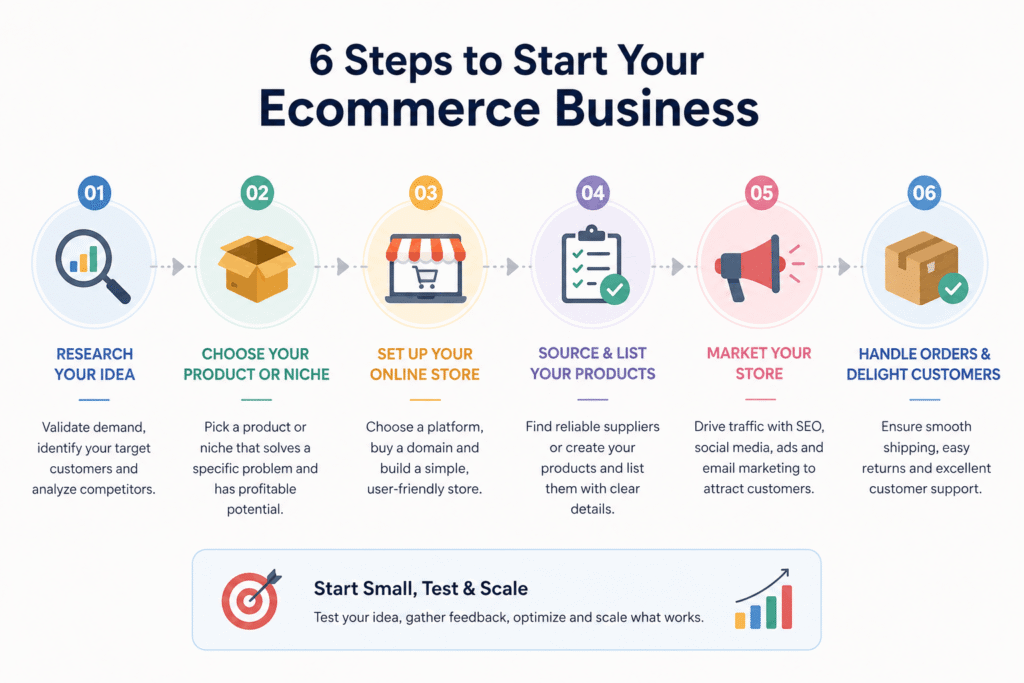
Do not order a large amount of inventory because a trend chart looks promising. Use several independent signals.
Step 1: Define one customer and problem
Write a sentence in this format:
We help [specific customer] solve [specific problem] with [specific product approach].
If the sentence could describe hundreds of stores, narrow it further.
Step 2: Study real customer language
Read marketplace reviews, Reddit discussions, specialist forums, social comments and competitor FAQs. Record repeated complaints, buying questions and reasons for returns.
Negative reviews are especially useful. They show where existing products create frustration and where a new store could provide better selection or guidance.
Step 3: Check commercial demand
Use Google Trends to compare long-term interest, keyword tools to identify searches and marketplaces to see whether buyers already spend money in the category.
Do not treat high search volume as proof. Look for purchase-intent searches such as comparisons, sizes, compatibility, refills, delivery and “best for” use cases.
Step 4: Calculate the real margin
Estimate contribution margin per order:
Selling price − product cost − packaging − payment fees − fulfilment − shipping subsidy − expected returns − advertising cost
Run a conservative scenario, not only a best case. If the business works only with very cheap advertising and no returns, it is too fragile.
Step 5: Run the smallest credible test
Depending on the idea, this could be:
- A landing page with an email waiting list
- Ten manually assembled kits
- A pre-order with a clear delivery date
- One digital product sold to a small community
- Five customer interviews followed by a paid pilot
The test should ask for a meaningful commitment. Compliments and survey answers are weaker evidence than an email sign-up, deposit or purchase.
Plan customer service before launch
Support demand differs sharply by niche. Digital downloads may create access questions, while clothing generates fit queries and replacement parts generate compatibility questions.
Write down the ten questions customers are most likely to ask before and after purchase. Answer them on product pages, shipping pages and order emails. Once conversations begin arriving through several platforms, a system that can connect customer support channels prevents your team from losing context between website chat and social messages.
AeroChat is an AI agent platform that helps Shopify merchants run customer service on autopilot. It can answer recurring questions using store and business information, while handing unusual cases to a person. This becomes relevant after the store has validated demand and message volume begins consuming time—not before the business has a product customers want.
Founders comparing technical setups can review these ecommerce chatbot integration options after choosing their commerce platform and support workflow.
How AeroChat Supports a Growing Ecommerce Business
AeroChat is an AI agent platform that helps Shopify merchants run customer service on autopilot.
When a new store begins attracting customers, the same questions often appear repeatedly:
- Is this product available?
- Which option is right for me?
- How long will delivery take?
- Where is my order?
- Can I return or exchange it?
At first, answering these questions manually helps you understand what customers need. However, as orders and messages increase, support can start taking time away from product development, marketing and fulfilment.
AeroChat’s AI customer service platform connects with Shopify product, inventory and order information to provide relevant answers across website chat and supported messaging channels. It can handle common product, delivery, order and return questions while transferring conversations to a team member when human help is needed.
This makes AeroChat best for Shopify merchants who want to automate and scale customer service without extra manpower and costs. It is not an essential expense before demand has been validated, but it becomes valuable when repetitive customer questions begin limiting the founder’s time or causing slow responses.
Common mistakes when choosing an ecommerce niche
Following a product instead of a problem
Trending products attract fast competition. A durable store understands the customer well enough to add new products when the first trend fades.
Starting with too many products
A large catalogue ties up cash and makes the store difficult to explain. Begin with one hero product or a tightly connected collection.
Ignoring returns and support
Apparel sizing, electronic compatibility and fragile products can look profitable until returns and customer-service time are included.
Competing only on price
Large marketplaces usually win price wars. Smaller businesses need a reason to exist: expertise, curation, speed, customisation, community or a better buying experience.
Buying inventory before validation
Supplier minimums can make an untested idea feel more legitimate than it is. Samples, pre-orders and small batches produce better information with less risk.
Automating too early
Do not automate a confusing process. Handle the first conversations manually, learn what customers need and document the right answers. When repeated enquiries begin slowing the team down, use AI customer service automation for predictable questions and preserve human review for sensitive cases.
Final takeaway
The strongest ecommerce business ideas for 2026 are specific, testable and operationally realistic. A narrow store for apartment pet enrichment or specialist replacement parts has a clearer reason to exist than another general pet or gadget shop.
If your budget is limited, begin with a digital product, pre-order or small manually assembled batch. Validate that people will pay, calculate the full contribution margin and learn which questions block the purchase. Only then should you invest in more stock, paid acquisition or advanced automation.
The goal is not to find an ecommerce niche with no competition. It is to find a customer you understand well enough to serve more clearly than the existing options.
Frequently asked questions
What are the best ecommerce business ideas for 2026?
Strong options include professional digital templates, hobby starter kits, specialist replacement parts, apartment pet enrichment products, B2B consumables and culturally specific gift boxes. The best choice depends on your budget, expertise and ability to reach a defined audience.
What is the cheapest ecommerce business to start?
Digital templates, educational downloads, personalised digital products and affiliate storefronts are among the lowest-cost options because they do not require physical inventory. They still require useful expertise, customer research and a reliable way to attract buyers.
Which ecommerce niches have repeat customers?
Consumables, pet care, beauty, specialist food, B2B supplies, hobby materials and refill products can generate repeat purchases. Verify how often customers naturally need to reorder before building a subscription or retention forecast.
Is dropshipping still worth considering in 2026?
Dropshipping can still be used to test demand without holding inventory, but generic products face intense price competition and inconsistent delivery experiences. It works better when the store has a narrow audience, reliable suppliers and a real advantage beyond paid advertising.
How do I find a profitable ecommerce niche?
Start with a specific customer problem, study marketplace reviews and community discussions, check search and purchase activity, obtain supplier quotes and calculate contribution margin. Test the idea with a landing page, sample batch or pre-order before making a large commitment.
How many products should a new ecommerce store launch with?
There is no universal number, but a focused launch is usually easier to explain and validate. One hero product with a small set of related items can provide clearer feedback than a broad catalogue assembled before the founder understands customer demand.
Many of the niches in this guide require the same foundation: product photography that builds trust, a content strategy that drives organic traffic and a customer service setup that answers pre-purchase questions at scale. The ecommerce content marketing guide covers the traffic side, and print-on-demand for beginners is a useful starting point for the lowest-inventory business models on the list. For anyone choosing between physical and digital product categories, selling digital products on Instagram covers how the sales process differs.