
How to Sell Digital Products on Instagram in 2026

Instagram has become one of the most effective channels for selling digital products — not because it has the slickest payment infrastructure, but because it combines built-in distribution, social proof, and an enormous audience that is already looking for inspiration and solutions.
The problem most creators run into is not about the product — it is about timing. A follower sees your post, feels the impulse to buy, sends you a DM, and then waits three hours for a response. By then the moment has passed. This guide covers how to set everything up correctly: what to sell, how to create content that converts, how to price and deliver products, and how to automate the DM conversation so no sale slips through.
What Digital Products Can You Sell on Instagram
Not every digital product is equally suited to Instagram’s format, but a wide range of them work well when positioned correctly. Here is a practical breakdown:
| Product Type | Best Content Format | Delivery Platform | Typical Price Range |
|---|---|---|---|
| Ebooks & guides | Carousel (preview pages), Reels | Gumroad, Payhip | £5–£30 |
| Online courses | Reel demos, Stories with testimonials | Teachable, Kajabi, Podia | £50–£500 |
| Canva templates & presets | Before/after posts, Reels | Gumroad, Etsy | £5–£50 |
| Printables & planners | Lifestyle flat lays, Reels | Etsy, Payhip | £2–£20 |
| Software & tools | Demo Reels, comparison posts | Lemon Squeezy, own site | £10–£200+ |
The common thread across all of these: Instagram gives you the audience, the content becomes the demo, and the DM becomes the checkout counter. Each step needs to be intentional.
Set Up Your Instagram Account for Selling
Before promoting anything, get the account structure right. These steps apply whether you are starting from scratch or converting an existing personal account:
- Switch to a Professional account. Go to Settings → Account → Switch to Professional Account. Choose Creator or Business depending on your situation. Creator accounts have better music licensing for Reels; Business accounts have full access to ads and WhatsApp Business linking.
- Write a bio that sells before someone clicks. Include: who you help, what result they get, and one call to action. “I help fitness coaches sell their programmes online. Free DM script template ↓” is better than “Digital creator | Entrepreneur | Mum of 2.”
- Set up your bio link. For a single product, link directly to your Gumroad or Payhip page. For multiple products, use a link-in-bio tool (Linktree, Beacons, Stan Store) to give each product its own destination.
- Enable Instagram Shopping if your product category qualifies. Digital products have more limited eligibility than physical goods, but it is worth checking. The direct bio link and DM automation typically drive more conversions for digital products anyway.
- Connect to WhatsApp Business. Many buyers — especially outside the UK and US — will reach out via WhatsApp rather than Instagram DM. Having both connected to the same chatbot means no one falls through the gap.

Create Content That Actually Converts
Instagram content for digital products works when it does one of three things: shows the result, gives a free sample of the value, or creates urgency. Here is how each format maps to those goals:
Carousel posts are the highest-converting format for digital products because you can simulate the product itself across the slides. A preview of your ebook’s key chapter, the first three pages of your template, or a five-step excerpt from your course — give enough away that the reader understands the value and wants the rest.
Reels drive the most reach. Instagram still prioritises video in its algorithm. A 30-second Reel showing the exact problem your product solves — and the moment it resolves — is more effective than a two-minute explainer. Show the outcome, not the process.
Stories are best for urgency and warm audiences. Use link stickers to drive traffic to your sales page, countdown stickers for launches, and question boxes to generate the engagement signals that push your profile to new people.
Social proof content — screenshots of customer results, reposted buyer Stories, short testimonial clips — consistently outperforms promotional posts because it shows the product working for someone else. This is particularly important for higher-ticket digital products where buyers need to see evidence before committing.
How to Price and Deliver Digital Products
Most successful digital product sellers on Instagram use a tiered pricing structure that creates natural entry points for different buyer readiness levels:
- Low-ticket (£5–£30): The entry product. Low friction, easy yes. Builds your buyer list and creates a relationship. A short ebook, a single template pack, a starter guide.
- Mid-tier (£50–£150): Where most of your revenue concentrates once you have momentum. A course, a full template suite, a comprehensive system.
- Premium (£200+): Serves your most engaged audience. Often requires the most trust-building and usually works best after buyers have already purchased something from you.
For delivery, you do not need to build a custom checkout system. Gumroad handles payment and file delivery with minimal setup. Teachable and Kajabi work for courses with video content. Shopify is the right choice if you are building a larger catalogue combining digital and physical products.
Automate Instagram DMs to Close More Sales
Automating your Instagram DMs is the single most impactful change most digital product sellers can make — not because it removes the human element, but because it removes the delay that kills impulse purchases.
When someone comments “LINK” on your post or sends a DM asking about your product, an automated flow can send a reply within two seconds: the product link, the price, a one-line summary, and an offer to answer questions. No waiting, no lost sales during sleeping hours, no manual copying and pasting of payment links 40 times a day.
Conversational selling through Instagram DMs has become standard practice for DTC brands because the DM is often the only sales conversation that happens before a purchase. For digital products especially, the automated response performs the role that a product listing page and reviews section would handle on a traditional ecommerce site — it answers the question, reduces uncertainty, and provides a clear next step.
The setup involves connecting your Instagram Business account to an Instagram-compatible chatbot platform, configuring keyword triggers and default responses, and setting up a flow for common pre-purchase questions. Once it is running, it requires almost no ongoing maintenance.
AeroChat: Instagram DM Automation Built for Sellers
What AeroChat Does for Instagram Digital Product Sellers
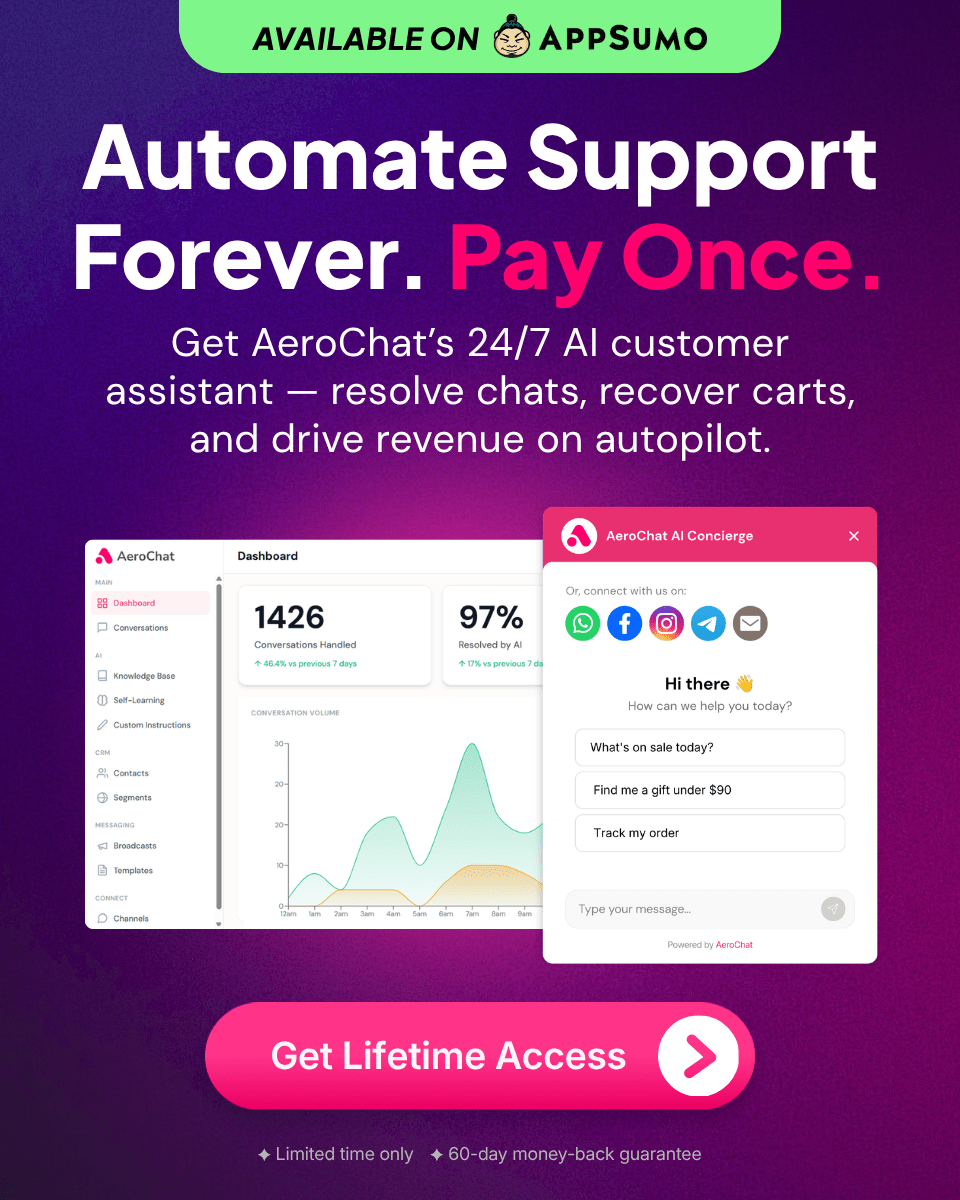
AeroChat connects directly to your Instagram Business account and manages DM conversations on your behalf. When a follower messages you asking about your ebook or course, the bot reads the message, identifies the intent, and responds with the product link, price, and answers to common questions — in seconds, any time of day.
Beyond keyword triggers, AeroChat handles context: it can manage a conversation that starts with a question (“Do I need any experience to use this template?”) rather than only a trigger phrase. You set up the answers to your most common pre-sale questions once, and the bot delivers them consistently to every person who asks.
AeroChat also connects to your WhatsApp Business account, so buyers who prefer WhatsApp — particularly in South Asia, the Middle East, and Latin America — get the same instant, informed response without you managing two separate platforms.
If you are also running Instagram AI chatbots for your business across multiple product types or accounts, consolidating everything into a single platform makes both training and monitoring significantly simpler.
Grow Your Digital Product Sales Over Time
Once the product exists and automation handles incoming DMs, audience growth becomes the primary lever for scaling revenue.
- Hashtag strategy: Focus on a small set of specific, mid-volume hashtags rather than broad ones. #canvatemplates puts you in front of people actively searching for templates; #digitalproducts puts you in a feed dominated by large accounts. Specificity wins.
- Micro-influencer collaborations: Accounts with 10,000–50,000 highly engaged followers in your niche often generate more sales than larger accounts with passive audiences. The economics are favourable for digital products — no fulfilment cost, no per-unit margin impact.
- Instagram ads: Worth testing once you have organic proof-of-concept. Retargeting campaigns (targeting people who have engaged with your content) typically outperform cold audiences for digital products because some familiarity already exists.
- Email list building: Use Instagram as the top of a funnel that ends with email subscribers, not just followers. Followers are rented; email subscribers are owned. Offer a free lead magnet in exchange for an email address and move your best buyers into a list you control.
Related Guides
- How to automate your DMs and increase Instagram sales
- Instagram marketing strategy for ecommerce brands in 2026
- Best Instagram AI chatbots in 2026
Selling digital products on Instagram is more dependent on trust and content credibility than physical products, because buyers cannot inspect what they are getting before purchase. The Instagram captions guide covers how to explain digital product value in a post. For coaches and consultants using Instagram to sell services alongside digital products, Instagram chatbot for coaches covers how to automate the DM follow-up. The ecommerce content marketing guide also applies to digital product stores, particularly around building an email list alongside the Instagram audience.