

Print-on-Demand for Beginners: How to Test Your First Store
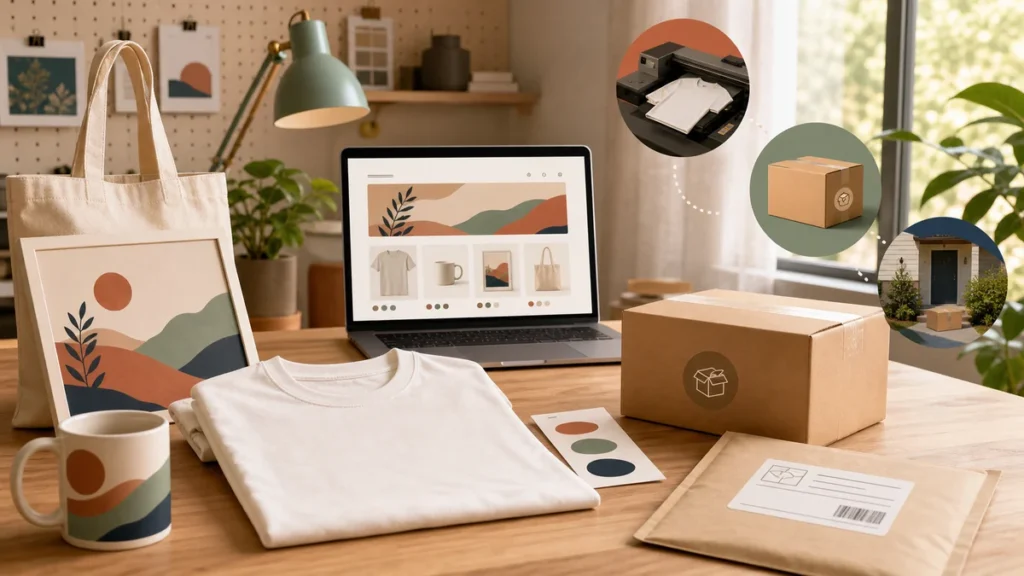
Print-on-demand is a fulfilment model in which a product is printed only after a customer places an order. The seller creates the design and storefront; a production partner prints, packs and ships the item. This removes the need to buy a large batch of stock, but it does not remove product costs, customer-service work or the seller’s responsibility to make accurate promises.
The sensible beginner approach is a controlled test: one audience, a small collection, ordered samples and a margin calculation based on the destination you expect to serve. Launching dozens of untested designs usually creates more decisions without producing better evidence.
How does print-on-demand work?
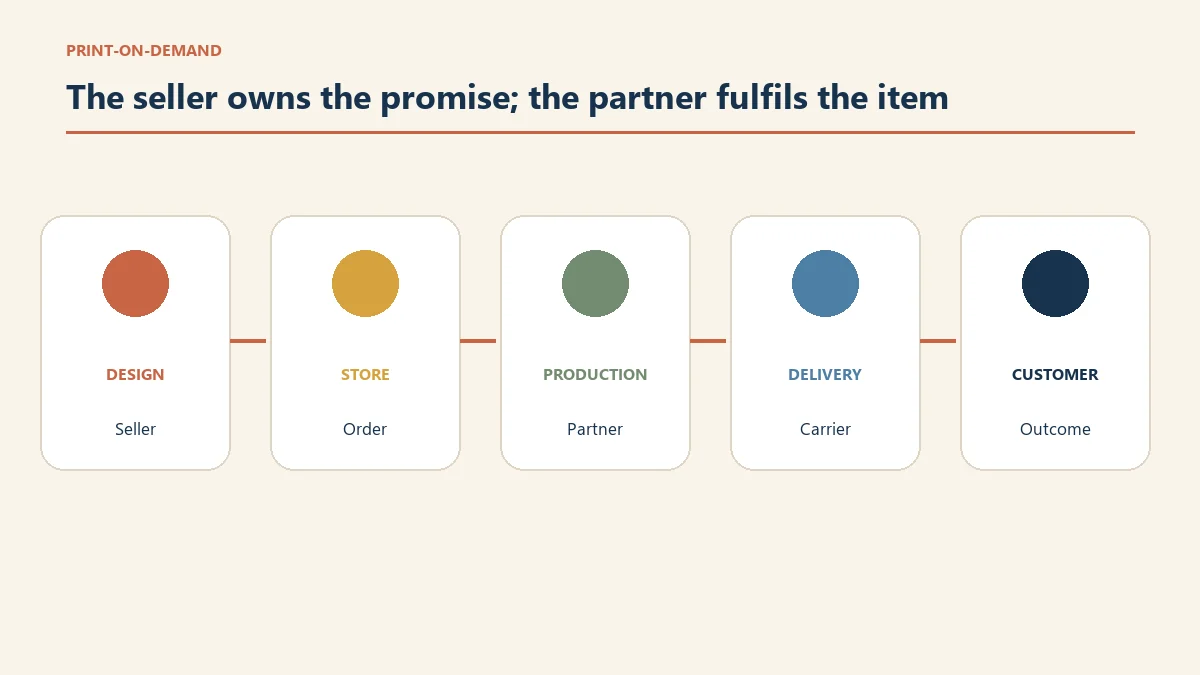
A typical order follows six steps:
- You create or license a design and place it on a supplier’s supported product.
- You publish the product on a marketplace or your own ecommerce store.
- A customer places an order and pays the retail price.
- The order and production details reach the print-on-demand supplier.
- The supplier charges you, produces the item and sends it to the customer.
- You remain responsible for the customer relationship, including accurate listings and the response when something goes wrong.
The supplier may physically dispatch the parcel, but the customer bought from the storefront. A late, damaged or misprinted order therefore becomes a seller problem as well as a supplier problem.
Is print-on-demand suitable for a beginner?
It can be, particularly when the beginner wants to test a creative concept without holding stock. The model is less attractive when the product needs very low unit costs, exact colour consistency, fast local delivery in every market or extensive custom manufacturing.
| Print-on-demand can suit you when… | Consider another model when… |
|---|---|
| You want to test demand before ordering inventory | The product needs a unique structure or material unavailable in supplier catalogues |
| A small coherent range is enough to launch | Unit cost must be close to bulk-manufacturing cost |
| You can order and inspect samples | You cannot tolerate production variation between locations or batches |
| You understand that fulfilment is outsourced, not responsibility | Delivery must be controlled from your own local stock |
| Your design and positioning create a reason to choose the product | The plan depends only on uploading generic designs to saturated marketplaces |
Print-on-demand is not passive income. It is a lower-inventory way to operate a product business, and it still requires design judgement, merchandising, marketing, policy decisions and customer support.
Start with the margin, not the mock-up
A supplier mock-up shows how a design may look. It does not show whether the sale is financially worthwhile. Calculate contribution per order before spending on a storefront or campaign.
Contribution per order = selling price − product and print cost − shipping subsidy − platform and payment fees − expected discounts − allowance for replacements and returns − variable marketing cost
Use actual figures for a representative destination. Product price, shipping and tax treatment can change by fulfilment location and customer country. Do not treat tax collected from the customer as profit.
A worked example with replaceable numbers
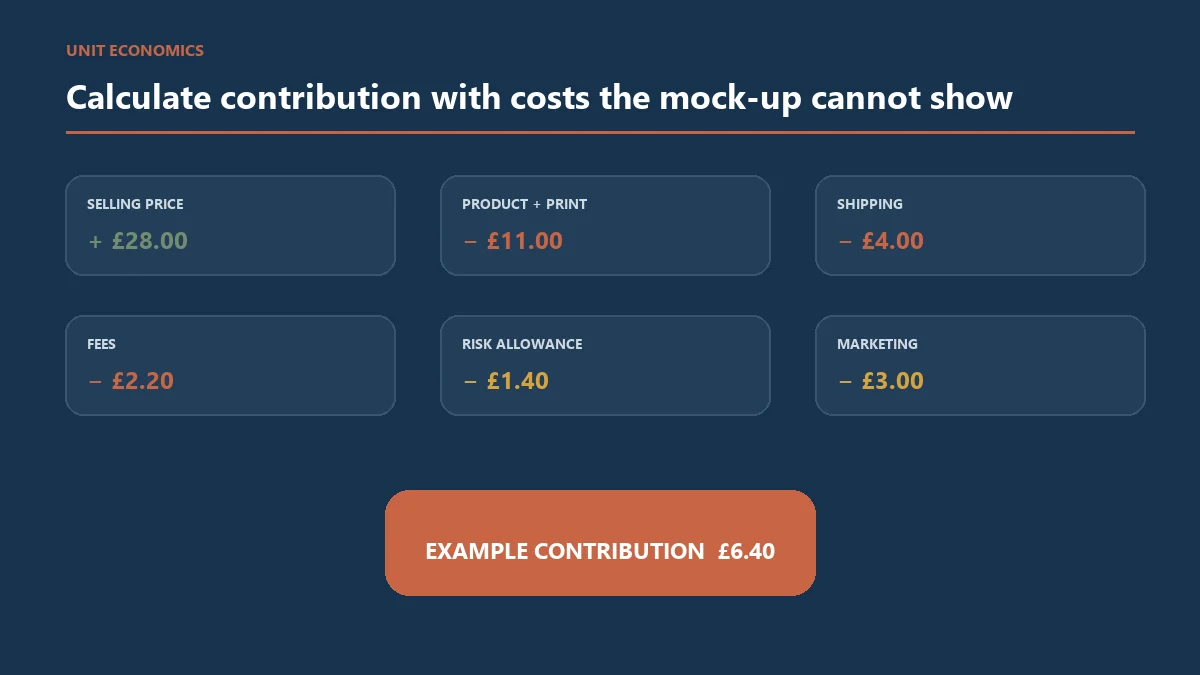
The figures below demonstrate the calculation only; they are not supplier quotes or a recommended retail price.
| Item | Example amount |
|---|---|
| Customer selling price | £28.00 |
| Product and printing | −£11.00 |
| Shipping paid by seller | −£4.00 |
| Platform and payment fees | −£2.20 |
| Replacement and returns allowance | −£1.40 |
| Variable marketing cost | −£3.00 |
| Example contribution before fixed costs and tax | £6.40 |
Run a second version for a discounted order and a third for an expensive delivery region. If a modest discount or one replacement removes the margin, the product is not ready simply because the normal-price row is positive.
The wider breakdown of online-store start-up costs can help separate these variable order costs from domain, software, sample and business-registration expenses.
Choose one audience and one product problem
A niche is not merely a broad identity printed on a shirt. It is a group with a recognisable context, taste or reason to buy. “People who like dogs” is wide; “urban greyhound adopters looking for understated homeware” gives the seller more useful product, visual and language decisions.
Research the audience before making designs:
- What products do they already buy?
- Which visual clichés are overused?
- Is the purchase for the buyer, a gift or an event?
- Which sizes, materials or formats matter?
- What questions and objections appear in reviews?
- Can the seller reach this audience without relying on copyrighted names or imagery?
Begin with three to eight related products or designs. A coherent collection is easier to photograph, explain and learn from than a catalogue built for several unrelated audiences.
Check intellectual-property rights before publishing
Do not use a phrase, logo, character, photograph, artwork or celebrity image simply because it appears online or another seller uses it. Copyright, trade mark, design and publicity rights vary by work and country.
Keep records for original design files, commissioned work, licences and font or asset permissions. Check what a licence permits on physical products and whether there are volume, territory or attribution conditions. A supplier accepting an uploaded file does not confirm that you have the right to sell it.
This article is not legal advice. Seek qualified advice when a design depends on someone else’s name, brand, creative work or likeness.
Compare print-on-demand suppliers with a scorecard
Product range and headline price are only the beginning. Shortlist suppliers using the product and destinations you actually plan to offer.
| Criterion | Evidence to collect | Why it matters |
|---|---|---|
| Product specification | Material, dimensions, printable area and variants | Determines whether the product matches the listing promise |
| Production locations | Location used for each target market and product | Affects delivery, customs and consistency |
| Base and print cost | Current cost for the exact variant | Drives margin |
| Shipping | Price, method, tracking and estimated range by country | Shapes the customer promise |
| Branding | Packing slip, return address, inserts and packaging options | Determines what the customer receives |
| Quality process | Misprint policy, evidence needed and response time | Matters when production fails |
| Store connection | Supported platform, order sync and manual fallback | Affects operational work and error risk |
| Support | Contact route and escalation process | Becomes critical when a customer’s order is delayed |
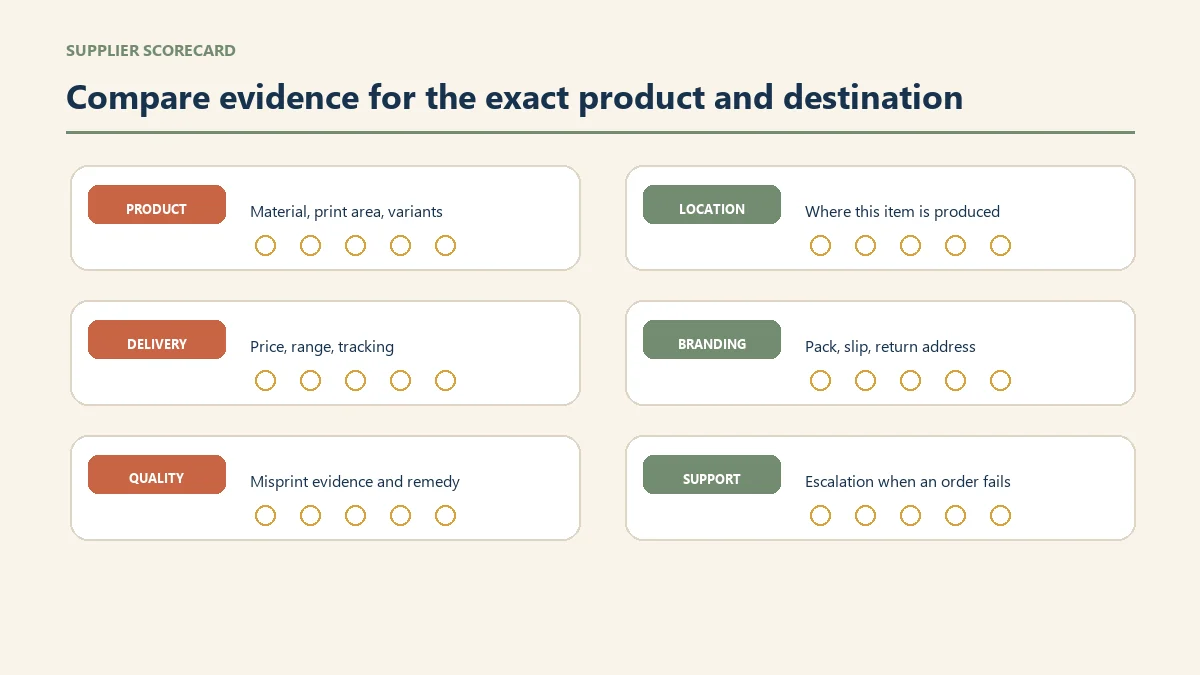
Do not score a supplier from marketing pages alone. Create a small test order, contact support with a realistic question and read the current policy for lost, damaged and misprinted items.
Order samples and inspect the complete product
A digital mock-up is a sales visual, not quality assurance. Order the exact product, colour, size and print method you expect to promote. If the supplier uses different production locations for major markets, consider samples from more than one relevant location.
Inspect the sample in normal use:
- Is the product itself the material and size described?
- Is the print sharp, positioned correctly and acceptable on folds or seams?
- Do colours remain understandable under daylight and indoor light?
- Does the item survive the relevant wash, wear or handling test?
- Is the packaging protective and proportionate?
- What sender, branding, packing slip and return information appear?
- How long did production and delivery actually take in this test?
- Can you photograph the real item instead of relying only on a mock-up?
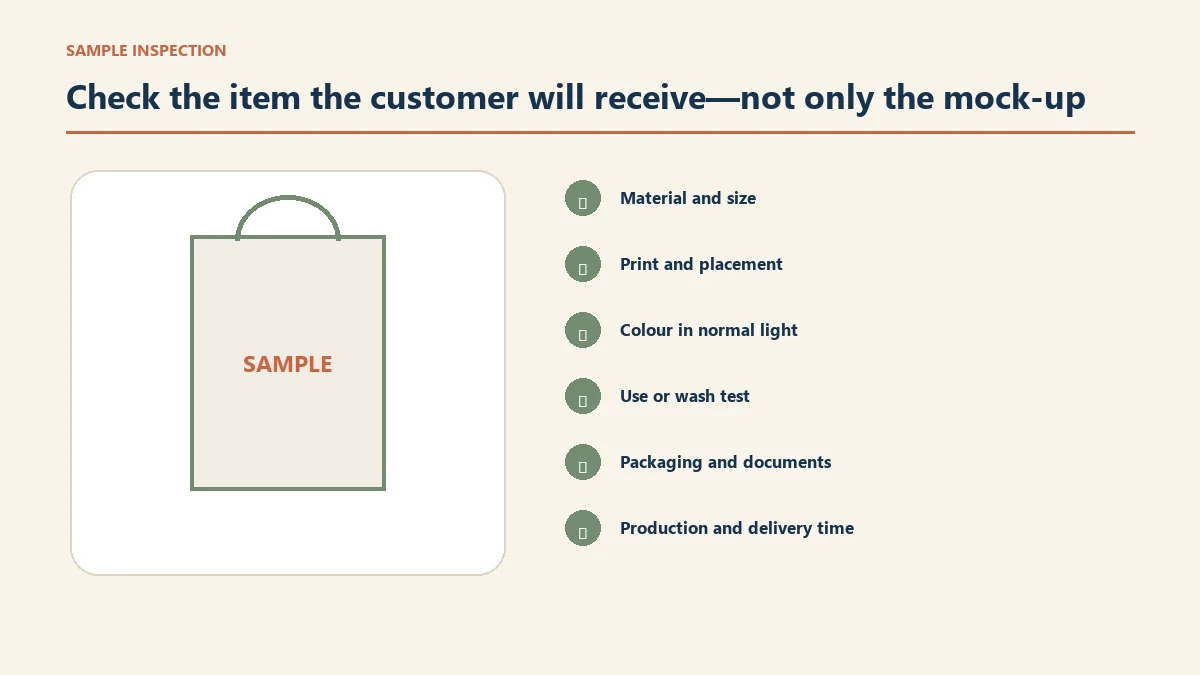
Record observations rather than declaring that one sample proves permanent quality. Production can vary by item, batch and fulfilment location.
Choose between a marketplace and your own store
Marketplace
A marketplace can provide an existing shopping environment and customer discovery, but it controls listing rules, fees and account access. Sellers also compete beside alternative products and have less control over the customer journey.
Etsy permits original seller designs produced by a disclosed production partner, subject to its current rules. Its production partner guidance explains the disclosure requirement. This is different from reselling a mass-produced product the seller did not design.
Own ecommerce store
An own store provides greater control over presentation, policies, data and the post-purchase experience. It also means the seller must generate traffic and maintain the storefront. A platform such as Shopify can connect to print-on-demand suppliers, but the connection should be tested with a sample order before launch.
The detailed Shopify and Etsy comparison covers fees, customer ownership and operating differences. Some businesses use both, but beginners should establish one reliable order flow before duplicating products across channels.
Build product pages from verified information
A print-on-demand product page should state what the customer receives, not merely present a lifestyle mock-up. Include:
- Product material, dimensions and fit information
- Design placement and any expected variation
- Care instructions supplied for that product
- Production time separated from delivery time
- Delivery regions and tracking expectations
- Return, replacement and cancellation rules
- A clear contact route
Use photographs of ordered samples where possible. If an image is a mock-up, ensure it does not imply a texture, print scale or packaging detail the supplier will not provide.
Shopify merchants can use the existing steps for adding products to a Shopify store, but supplier-synchronised listings still need human review. Product titles, variants, shipping profiles and policy wording should not be accepted blindly from an import.
Define who owns each part of the order
Print-on-demand involves at least four systems or parties. Write the responsibility map before taking orders.
| Event | Storefront or marketplace | Seller | POD supplier | Payment provider or carrier |
|---|---|---|---|---|
| Customer places an order | Records the order | Checks routing and exceptions | Receives production request | Processes payment where applicable |
| Address is wrong | May allow limited editing | Contacts customer and supplier promptly | Changes it only if production stage permits | Carrier rules apply after dispatch |
| Item is misprinted | Holds order communication | Collects evidence and resolves customer outcome | Reviews production claim | Not usually responsible |
| Parcel is late | Shows available tracking | Updates customer and investigates | Confirms production and dispatch | Carrier provides transit status |
| Customer changes their mind | Enforces published policy | Applies fair, lawful policy | May not accept a made-to-order return | Refund processing may carry rules or fees |
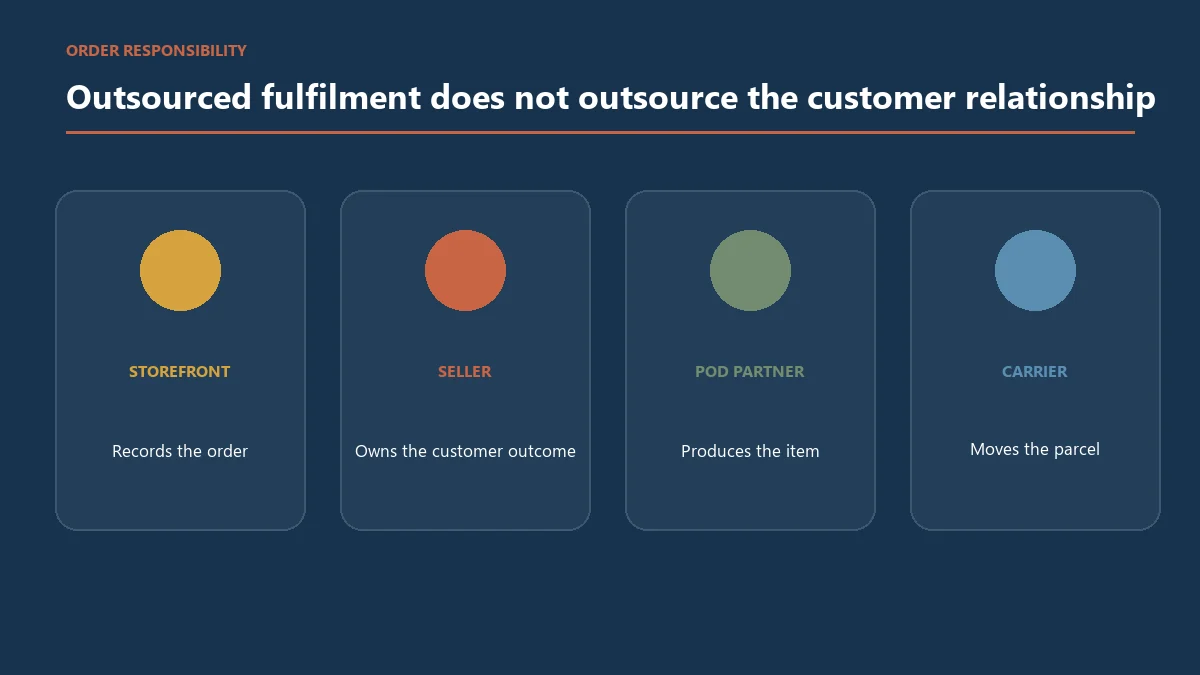
Consumer rights differ by country and may override store wording. “Made to order” does not automatically remove every cancellation or return obligation in every market. Obtain local advice for the countries you target.
A 30-day print-on-demand test plan
Days 1–7: define the offer
Choose one audience, review competing products and create a short design brief. Check rights and shortlist one or two product types. Build the margin worksheet using the likely customer countries.
Days 8–14: verify the product
Choose the supplier, order samples and document the expected production and delivery journey. Write the product page and policies from confirmed specifications rather than placeholder claims.
Days 15–21: build and test the order flow
Connect the supplier, configure variants and shipping, then place a test order. Confirm the customer email, payment, supplier record, address, tracking and support route. Fix the flow before adding more products.
Days 22–30: run a limited launch
Publish a small collection and use one or two audience-relevant promotion methods. Track product-page visits, add-to-basket activity, orders, margin and customer questions. Do not judge the concept only by social likes or by revenue without costs.
At the end of the month, decide whether to improve the offer, change the product, test another audience route or stop. A small negative result is useful when it prevents a larger inventory, advertising or software commitment.
How AeroChat helps print-on-demand stores manage customer questions
Print-on-demand questions often involve size, material, production status, delivery, damage or a design that looks different from the listing. Create clear answers and an escalation route before the first order.
AeroChat is an AI agent platform that helps ecommerce brands run customer service on autopilot. When enquiry volume increases, it can use approved product, delivery and return information to answer suitable routine questions across supported channels. A customer asking about a documented material, size guide or order status can receive a relevant answer without the team rewriting the same response.
The AI customer-service workflow for print-on-demand stores explains how store information and human handover can work together. A damaged product, disputed print quality, suspected rights complaint or exception outside the published policy should still reach a person with the conversation context.
Automation should not invent a delivery date, approve a refund outside policy or hide a supplier problem. The seller still needs access to the correct order information and a human path for damaged, missing or disputed orders.
AeroChat is generally a growth-stage support investment rather than a required launch cost. A beginner with occasional enquiries may need accurate product pages and dependable response windows first; automation becomes more useful when repeated questions create a measurable support workload.
Frequently asked questions
How much money do beginners need for print-on-demand?
There is no reliable universal amount. A realistic budget can include samples, a domain or marketplace costs, design tools or licences, business registration, software, marketing tests and enough cash flow to pay supplier charges before marketplace or payment funds become available. Build the budget from the chosen platform, product and target country rather than a promotional minimum.
Is print-on-demand profitable?
It can produce a positive contribution when selling price exceeds all variable order costs and the business can acquire customers efficiently. Profit is not guaranteed, and revenue does not show the answer. Calculate margin after production, shipping, platform, payment, replacement, discount and marketing costs.
Do I need Shopify to start print-on-demand?
No. Print-on-demand suppliers may connect to marketplaces, ecommerce platforms or manual order systems. Shopify is one option for an own store; a marketplace may be simpler for discovery but provides less control. Choose according to customer acquisition and operating needs.
Should I use more than one POD supplier?
Not at the beginning unless a clear product or regional need justifies it. Each supplier adds different costs, packaging, policies and support processes. Establish one reliable workflow first, then add a second source deliberately rather than as an untested emergency backup.
Can I sell print-on-demand products worldwide?
Technically available destinations do not mean every market is commercially or legally sensible. Check production location, delivery range, customs, tax, product safety, labelling, consumer rights and support capacity for each target region. Start with countries the business can serve accurately.
Print-on-demand sits at the intersection of product creation and ecommerce launch. For the broader store setup context, ecommerce business ideas ranked by cost shows where print-on-demand sits versus other low-inventory models. The timeline for making money on Shopify is a realistic companion read for new print-on-demand stores, and for stores using Instagram to drive their first sales, selling digital products on Instagram covers an overlapping audience and channel approach.