


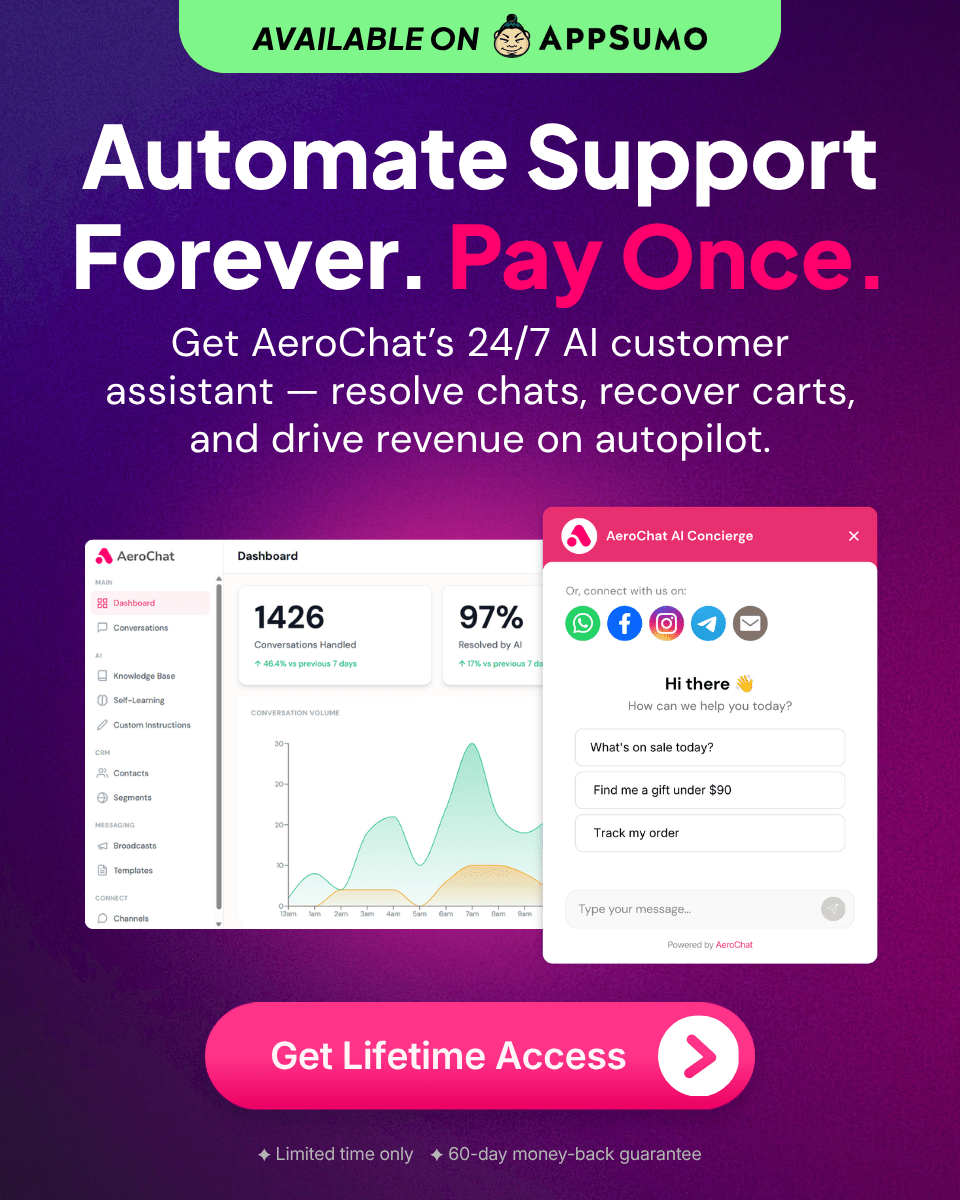
Automating Customer Service for a One-Person Shop
When you run a shop alone, automate the questions that have the same answer every time, and keep your own time for the ones that need you. Start with order status, delivery times, sizing and returns. Connect your store so the answers come from real order data. Set a short list of topics that always come to you. Most solo sellers can set this up in an afternoon and stop answering the same five questions every evening.
Why customer service gets hard when you are on your own
In a one-person shop, every message competes with everything else: making or sourcing stock, packing orders, posting content, running ads. Messages arrive on WhatsApp, Instagram, your website and maybe a marketplace, often at night and on weekends. If you reply late, some buyers move on. If you reply to everything, you stop doing the work that grows the shop.
The good news is that a small shop’s messages are very predictable. A handful of questions make up most of them. That is exactly the kind of work software can do well, as long as it answers from your real data and knows when to stop and ask you.
Step 1: List what customers actually ask
Scroll back through your last few weeks of messages and write down every question. Group them. A typical list for a small online shop looks like this:
- Where is my order? When will it arrive?
- Is this in stock? When will it be back?
- Which size should I get? Is it true to size?
- Do you ship to my country, and how much is shipping?
- Can I change my address or add something to my order?
- How do I return or exchange this?
- Do you have a discount code?
Mark each one with what you need to answer it: your store’s order data, your stock, your size chart, your shipping rates or your policy. If you need only data or a written policy, it can be automated. If you need to think about it, keep it.
Step 2: Decide what stays with you
Write down the short list of things you want to see yourself. For most solo sellers it is:
- Damaged, wrong or missing items, where you decide what to do.
- Refunds above a small amount you choose.
- Custom orders, wholesale and collaboration requests.
- Any upset customer.
Everything else can finish in the chat. This list is what keeps automation safe. The AI answers inside your limits and hands the rest to you with the conversation attached, so you never have to ask the customer to repeat themselves. See live chat handover.
Step 3: Connect the data the answers need
An AI that guesses is worse than no AI. The answers to order and stock questions must come from your store, not from a document you wrote months ago.
- Your store. Shopify, WooCommerce and Wix are built into AeroChat. If you sell from a spreadsheet, the Google Sheets store lets you sell in chat with your products and orders in a Google Sheet.
- Your policies. Point AeroChat at your shipping, returns and FAQ pages so policy answers use your own wording.
- Payment. If you take orders in chat, Airwallex is built in for payment links, and payment is detected automatically. The customer never has to type “paid”. No Airwallex account yet? Open one here.
- Delivery. POS Malaysia is built in, and other couriers and tracking tools connect through their APIs.
Step 4: Put every channel in one place
The biggest time sink for a solo seller is switching apps. Connect WhatsApp, Instagram, Messenger, your web chat and your email to one inbox. The same workflows run on each, so a customer who asks on Instagram gets the same answer as one who asks on WhatsApp. If you use the WhatsApp Business app on your phone, you can keep it: AeroChat supports coexistence, so the same number runs on the app and the API. See WhatsApp coexistence.
Step 5: Describe the workflow and test it
With AeroChat you describe each workflow in your own words, in any language, and AeroChat builds it. No code needed. New workflows start as drafts, so you can test them with your own phone before you switch them on.
Copy this into AeroChat
When a customer asks where their order is, confirm their email or phone number, find the order and tell them its status and tracking link. When they ask about stock, check the product and tell them if it’s available, and if it’s sold out, offer to message them when it’s back. When they ask about size, ask their usual size and height and suggest one from our size chart. For returns, explain our policy and start the return if the order is within 30 days of delivery (example). If anything arrived damaged or wrong, or a customer is upset, ask for a photo and hand the conversation to me with the order number. Never offer a discount unless the customer asks, and then only our current code WELCOME10 (example).
Change the return window and the code to your own before you paste it.
What it looks like at 11pm
Customer, on Instagram: hi! is the linen dress in sage still available in S? (example)
AeroChat: Hi! Yes, the linen dress in sage is in stock in S. It runs true to size. Would you like the link to order?
Customer: yes pls. and how long to ship?
AeroChat: Here’s the link. Orders ship within two working days (example), and you’ll get a tracking link once it’s on its way.
Behind the reply: stock came from the store, the fit note from the product details and the shipping time from the delivery policy. The seller saw the conversation the next morning and had nothing to do.
How to check it’s working
- Once a week, read ten conversations it handled alone. Fix any answer that wasn’t how you would say it, by updating the policy page or the workflow description.
- Look at what was handed to you. If the same question keeps coming over, decide whether it can be answered from data and add it to a workflow.
- Watch how fast customers get a first reply. See first response time.
For the problem from a different angle, see customer service for a one-person online shop and after-hours customer service for online stores.
Questions
Will customers know they’re talking to software?
You decide how the assistant introduces itself. Many solo sellers say plainly that it is an assistant and that they personally look at anything it can’t sort out. Customers mostly care that they get a correct answer quickly.
Can I still reply myself when I want to?
Yes. You can take over any conversation in the AeroChat inbox, and hand it back when you’re done.
Do I need to write any code?
No code needed. You connect your store and channels in the dashboard and describe the workflows. If you later want something custom built, freelancers and developers build on AeroChat too.
What does it cost?
Plans come with a set number of AI responses, and you top up if you use more. See AeroChat pricing. Start with the 7-day free trial to see how many messages your shop gets.
Get your evenings back
Start your 7-day free trial. No credit card needed. Connect your store and one channel, paste the recipe above, and send yourself a test message.
On Shopify? Install AeroChat from the Shopify App Store.