

Tidio Klaviyo Integration 2026 – Setup and Limitations
The Tidio Klaviyo integration sends email subscribers collected through Tidio to a selected Klaviyo list. It is useful when you want to turn website chats into email sign-ups, but the standard integration is not a complete connection between customer conversations and your marketing data.
This distinction matters for ecommerce businesses. A customer may ask about a product on Instagram, request an order update through WhatsApp and later visit your website. Sending an email address from one chat widget to Klaviyo captures only a small part of that journey.
This guide explains how the Tidio Klaviyo integration works, how to set it up correctly, why subscribers sometimes fail to appear and where its limitations begin. It also explains when an omnichannel AI customer service platform such as AeroChat is a more suitable option alongside Klaviyo.
What does the Tidio Klaviyo integration do?
The standard Tidio Klaviyo integration adds consenting email subscribers from Tidio to one Klaviyo list.
Tidio documents three ways to collect and send these subscribers:
- A visitor provides an email address and marketing consent through the pre-chat survey.
- An agent manually changes a contact’s status to Subscribed.
- A Tidio Flow collects an email through the Subscribe for Mailing node.
Once connected, Tidio passes the subscriber’s email address to the Klaviyo list selected during setup.
| Capability | Standard Tidio Klaviyo integration |
| Send consenting email subscribers to Klaviyo | Yes |
| Choose a destination Klaviyo list | Yes, one list |
| Collect subscribers through a pre-chat survey | Yes |
| Collect subscribers through a Tidio Flow | Yes |
| Add a subscriber manually during a chat | Yes |
| Send the full chat transcript automatically | Not documented as part of the standard integration |
| Trigger different Klaviyo journeys from every chat intent | Requires additional configuration |
| Create contacts through a Lyro AI action | Yes, through a separately configured API action |
For a business that only wants a chat-based newsletter sign-up, this may be enough. For a store that wants customer service automation across its website and social channels, subscriber sync solves only one small part of the problem.
How to integrate Tidio with Klaviyo
The standard connection is relatively straightforward. You need access to both accounts and permission to create a private API key in Klaviyo.
Step 1: Create a private API key in Klaviyo
Log in to Klaviyo and open your account settings. Go to API Keys and create a new private API key.
Tidio’s documentation states that the integration needs full access to these scopes:
- Lists
- Profiles
- Subscriptions
Give the key a clear name, such as “Tidio integration”, so your team knows what it is used for later. Copy the key after creating it and store it securely. An API key should be treated like a password and should never appear in a public page or screenshot.
Step 2: Install the Klaviyo integration in Tidio
Open your Tidio admin panel and select Integrations from the sidebar. Find Klaviyo and click Install Klaviyo.
Choose New authentication, then paste the Klaviyo private API key into the authentication field. Tidio will use this key to confirm that it has the required access.
If authentication fails, first check whether the key has the correct Lists, Profiles and Subscriptions permissions. Creating a fresh key with the documented access is usually safer than repeatedly changing an unrelated key used by another system.
Step 3: Select the correct Klaviyo list
After authentication, choose the Klaviyo List ID that should receive new subscribers and finish the connection.
The standard Tidio integration sends subscribers to one list. A dedicated list such as “Tidio chat subscribers” makes the source easy to identify and helps you monitor consent, list growth and flow performance.
Avoid sending every chat contact into a general promotional list without checking whether they explicitly agreed to receive marketing emails. Providing an email address to obtain customer support is not automatically the same as giving marketing consent.
Step 4: Enable a subscriber collection method
Connecting the accounts does not collect subscribers by itself. You must enable at least one of Tidio’s supported collection methods.
For a pre-chat survey, enable the email field and newsletter consent option. This is suitable when you want to ask for contact details before a website conversation begins.
For a Tidio Flow, add the Subscribe for Mailing node after the visitor has been shown a clear reason to subscribe and has agreed to it.
For manual collection, an agent can change the customer’s subscriber status to Subscribed after the customer has given consent during the conversation.
Step 5: Test the complete subscriber journey
Run a test using an email address that is not already subscribed. Follow the same journey a real visitor would follow, then check:
- Did Tidio collect the email and consent?
- Was the contact sent to the correct Klaviyo list?
- Did Klaviyo create or update the profile?
- Was a confirmation email sent?
- Did the intended Klaviyo welcome flow begin after confirmation?
This full test is important. A successful API connection only proves that the accounts can communicate. It does not prove that the form, consent setting, list and Klaviyo automation all work together.
Why are Tidio subscribers not appearing in Klaviyo?
Double opt-in is one of the most common reasons a new subscriber does not immediately appear as subscribed in Klaviyo.
When the selected Klaviyo list uses double opt-in, the person receives a confirmation email after signing up. They must click the confirmation link before becoming a subscribed member of the list.
If your test contact does not appear, check the following before rebuilding the integration:
- Look for the Klaviyo confirmation email, including in the spam folder.
- Confirm that Tidio is connected to the intended List ID.
- Search for the profile in Klaviyo and review its consent status.
- Check the list’s opt-in setting under Settings > Consent.
- Test with a new email address that has not previously subscribed or unsubscribed.
Klaviyo allows a list to use single opt-in, but disabling confirmation should not be the automatic solution. Double opt-in helps prevent invalid addresses and can protect email deliverability. The correct setting depends on where your subscribers are located, what consent you collect and how you intend to contact them.
Can Lyro create contacts in Klaviyo?
Yes. Tidio also provides a Klaviyo action template for Lyro, its AI agent. This is separate from the standard subscriber-list integration.
The Lyro action can ask a visitor for information such as a name and email address, then use a configured Klaviyo API request to create a contact. You can adjust the input variables and the instructions that determine when Lyro should run the action.
This option gives businesses more control than the standard pre-chat subscriber sync. However, it requires additional setup inside the Lyro Action editor, including a separate Klaviyo API key and a properly configured HTTP request.
It should not be described as an automatic two-way data integration. The information Klaviyo receives depends on the variables and API request your team configures.
Useful Tidio and Klaviyo workflows
The best workflows are simple, consent-based and easy to measure.
Chat subscriber welcome flow
A visitor agrees to receive marketing emails in Tidio’s pre-chat survey. Tidio adds the contact to a dedicated Klaviyo list, which starts a welcome series.
This is the clearest use of the standard integration because the visitor’s action and the Klaviyo follow-up are directly connected.
Product-interest follow-up
A Tidio Flow or Lyro conversation helps a shopper choose a product and then asks whether they would like the recommendation sent by email. A configured action can create the Klaviyo contact using the details the shopper provides.
The follow-up must match what the visitor agreed to receive. A request to email one recommendation should not quietly become consent for unrelated promotional campaigns.
Human-assisted subscription
During a live chat, a shopper may ask to be notified about future offers or product updates. Once the customer gives clear consent, the agent changes the Tidio subscriber status to Subscribed, and the contact is sent to Klaviyo.
This is useful for lower-volume businesses where agents can make a reliable judgement during the conversation.
The limitations of the Tidio Klaviyo integration
The integration works well for its intended purpose. The problem begins when businesses expect a subscriber-sync connection to operate like a complete customer-service and customer-data platform.
One email address does not explain customer intent
An email address alone does not show whether the customer asked about product availability, delivery, an order delay or a return. The standard integration does not automatically turn those conversational details into useful Klaviyo profile properties.
Without additional configuration, Klaviyo knows that the person subscribed but not necessarily what assistance they needed.
One destination list limits segmentation
The standard integration sends contacts to one selected list. This is enough for a general welcome sequence but less useful when you want separate follow-ups based on products, customer type or support intent.
You can extend the setup with Lyro Actions, API requests or third-party automation, but that increases the amount of configuration your team must maintain.
Customer service happens outside website chat
Ecommerce customers increasingly contact businesses through Instagram, WhatsApp and Facebook Messenger as well as the website. If each channel is managed separately, agents lose context and customers may have to repeat the same information.
This is why many stores look beyond a basic email-list connection and compare Tidio with AeroChat for ecommerce support.
More connections create more maintenance
Every API action, automation and third-party connector adds another possible failure point. Someone must test the trigger, map the correct fields, monitor consent and update the workflow if either platform changes.
This may be manageable for a technical team. For a smaller ecommerce business, the growing stack can become more work than the original problem.
Where AeroChat fits alongside Klaviyo
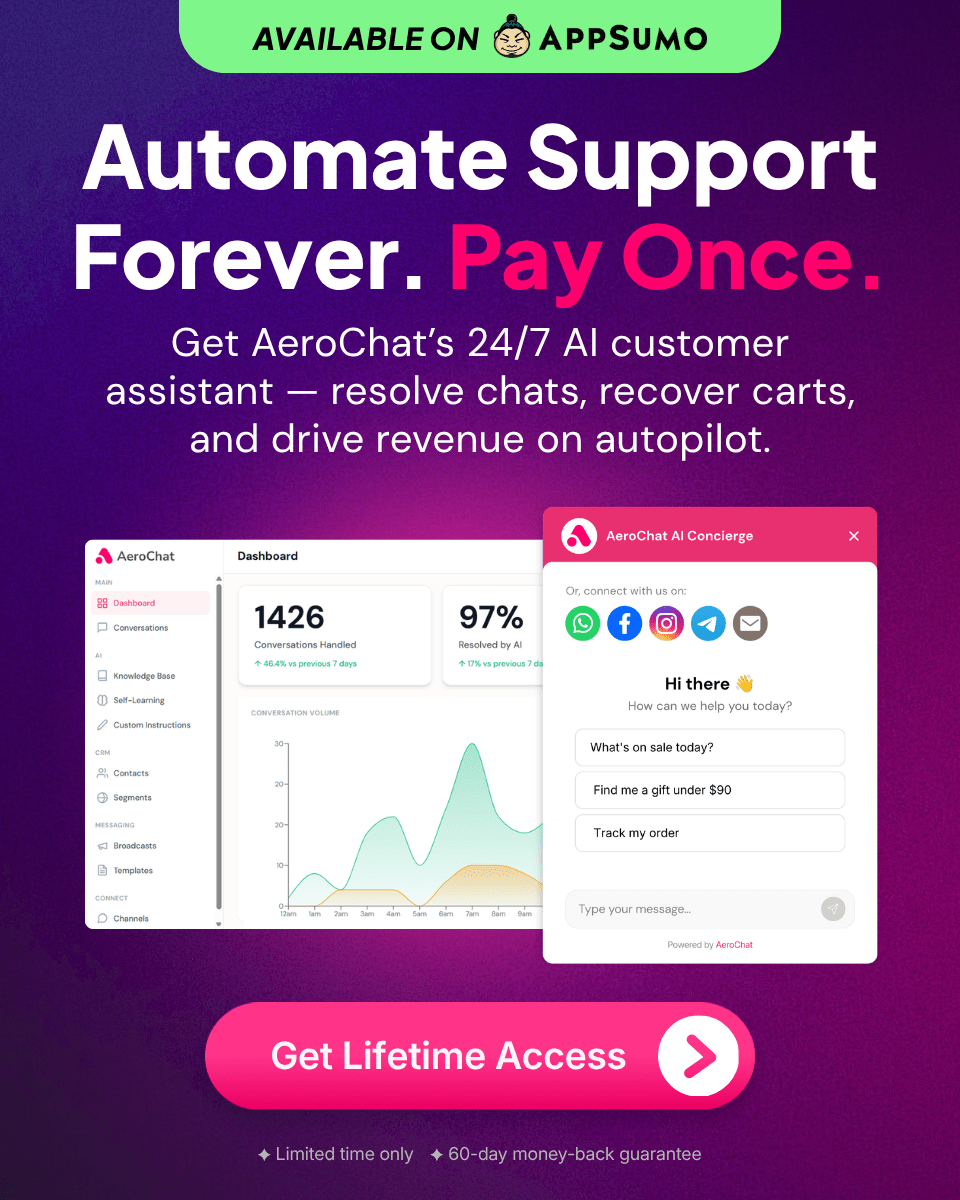
AeroChat is an AI agent platform that helps Shopify merchants run customer service on autopilot.
It does not replace Klaviyo’s email and SMS marketing tools. Instead, it addresses the customer-service problem that a subscriber sync cannot solve.
AeroChat brings website chat, WhatsApp and Instagram conversations together with other supported channels in one inbox. It can connect with Shopify store data so the AI agent can answer common questions about products, stock, orders, delivery and returns.
This allows a customer to receive help with questions such as:
- Is this product available in my size?
- What is the difference between these two products?
- When will my order arrive?
- Do you deliver to my location?
- Can I exchange this item?
Stores can continue using Klaviyo for consent-based email and SMS campaigns while using AeroChat for customer conversations and support automation. When a business needs to pass data to another system, it can configure a workflow through webhooks based on its requirements.
For teams evaluating Klaviyo’s own customer-service products, the Klaviyo Conversations vs AeroChat comparison explains where each platform fits.
Tidio with Klaviyo vs AeroChat with Klaviyo
These two combinations solve different problems. The right choice depends on whether your main goal is subscriber capture or customer-service automation.
| Requirement | Tidio with Klaviyo | AeroChat with Klaviyo |
| Add website chat subscribers to a Klaviyo list | Direct standard integration | Requires a configured data workflow |
| Run email and SMS marketing | Klaviyo | Klaviyo |
| Handle customer conversations | Tidio live chat, Flows and Lyro | AeroChat AI agent and unified inbox |
| Use Shopify product and order data in support | Available through Tidio features depending on setup and plan | A central AeroChat ecommerce use case |
| Bring multiple customer messaging channels together | Depends on supported channel and plan configuration | A central AeroChat use case |
| Create advanced Klaviyo data workflows | Lyro Actions, APIs or third-party automation | Configured webhooks and integrations |
| Best suited to | Businesses already using Tidio that mainly need subscriber capture | Ecommerce teams that need AI customer service across multiple channels while keeping Klaviyo for marketing |
Choose Tidio with Klaviyo if your existing Tidio setup works well and your main requirement is to add consenting website chat leads to an email list.
Consider AeroChat with Klaviyo if your support team spends time answering repetitive questions across several channels and needs its AI agent connected to current ecommerce information. Shopify businesses comparing more options can also review these Shopify AI chatbots for ecommerce support.
For stores running on WordPress, AeroChat can also connect through the WooCommerce REST API. The WooCommerce AI chatbot comparison explains the available options and setup differences.
A practical AeroChat and Klaviyo customer journey
Imagine that a shopper sees a product on Instagram and asks whether it is available in a particular colour. Later, the shopper visits the website to ask about delivery and the return policy.
With an omnichannel support setup, the business can answer those questions using the same product and policy knowledge instead of treating every message as a new conversation. AeroChat’s role is to understand and resolve the enquiry across supported channels.
If the shopper separately agrees to receive marketing communication, the business can pass the required data to its marketing system through a configured workflow. Klaviyo can then manage the email or SMS journey based on the consent collected.
Each platform remains focused on what it does best:
- AeroChat manages AI-powered customer conversations and human handover.
- Shopify or WooCommerce remains the source of product and order information.
- Klaviyo manages permission-based email and SMS marketing.
This structure is usually more reliable than expecting a basic subscriber integration to manage the entire customer journey.
Final verdict
The Tidio Klaviyo integration is useful for businesses that already use both platforms and want consenting chat leads added to a Klaviyo list. The standard setup is simple, while the Lyro Klaviyo action provides a more configurable option for teams comfortable working with API requests.
However, the integration should be judged by what it is designed to do. It transfers subscriber information; it does not automatically unify every customer conversation or create a complete omnichannel support system.
If your main requirement is website email capture, Tidio and Klaviyo may be sufficient. If your larger problem is repetitive customer service across your website, WhatsApp, Instagram and other channels, start with AeroChat and keep Klaviyo focused on email and SMS marketing.
Frequently asked questions
Does Tidio integrate with Klaviyo?
Yes. The standard Tidio Klaviyo integration sends consenting email subscribers collected through a pre-chat survey, a manual subscriber-status update or a Tidio Flow to one selected Klaviyo list.
How do I connect Tidio to Klaviyo?
Create a Klaviyo private API key with the access scopes documented by Tidio. Open Integrations in Tidio, install Klaviyo, authenticate the connection with the API key and select the Klaviyo List ID that should receive subscribers.
Why are Tidio subscribers not showing in Klaviyo?
Check the destination list, the contact’s consent status and the list’s opt-in setting. If double opt-in is enabled, the person must confirm the subscription before becoming a subscribed member of the list.
Can Lyro create a Klaviyo contact?
Yes. Tidio provides a Lyro Action template that can collect visitor details and create a Klaviyo contact through a configured API request. This requires separate setup from the standard Tidio Klaviyo integration.
Does Tidio send chat transcripts to Klaviyo?
Tidio’s standard integration is documented as a way to add subscribers to a Klaviyo list. Businesses should not assume it automatically sends complete transcripts or every chatbot event. Additional information requires a deliberately configured action or automation.
Does AeroChat integrate with Klaviyo?
AeroChat and Klaviyo can be used together for different purposes. AeroChat handles AI customer service across supported channels, while Klaviyo manages email and SMS marketing. Data exchange can be configured through webhooks when a business needs a custom workflow.
Does AeroChat replace Klaviyo?
No. AeroChat is used for AI-powered customer conversations, unified inbox management and ecommerce support. Klaviyo remains the marketing platform for email and SMS campaigns.
When should I consider AeroChat?
Consider AeroChat when your team repeatedly answers product, order, delivery and return questions across your website and social messaging channels. If your only requirement is adding website chat subscribers to Klaviyo, the standard Tidio integration may already be enough.