
AI-First vs AI-Only Customer Service for Ecommerce: When to Hand Off to a Human

AI-first customer service uses automation as the normal starting point for routine enquiries while keeping an effective path to human help. AI-only customer service removes that path or makes it unreasonably difficult to use. AI-first support can reduce waiting and repetitive work. AI-only support can leave customers trapped when the system reaches its limits.
For an ecommerce team, the goal is not to maximise the number of conversations touched by AI. It is to give each customer the shortest credible route to a resolution. Sometimes that route is an instant order lookup. Sometimes it is a person who can approve an exception, investigate a damaged delivery or understand why the customer is angry.
Merchant discussions repeatedly describe the same objection: automation becomes frustrating when it keeps talking after it can no longer help. A workable AI-first model therefore needs clear boundaries, human ownership and a handoff that actually completes.
What does AI-first customer service mean?
AI-first customer service makes AI part of the support operating model rather than adding a chatbot beside an unchanged inbox. Routine questions can be answered automatically, structured information can be collected before an agent joins, and conversations can be routed using their content and urgency.
It does not mean every customer must exhaust the bot before reaching a person. A customer asking for an order status and a customer disputing a partial refund are not the same support job.
AI-first is an operating model, not a front-door bot
Putting a chat widget on the website changes the interface. An operating model also answers:
- Which conversations may be resolved automatically?
- Which decisions remain under human authority?
- Who monitors escalations?
- What information reaches the agent?
- What happens outside staffed hours?
- How is performance reviewed across channels?
Without those decisions, the bot may be the first contact but the team is not genuinely AI-first. It is still running manual support behind an automated gate.
AI-only creates a different customer experience
An AI-only design treats human access as a cost to suppress. The bot repeats suggestions, offers irrelevant articles or closes the exchange even when the issue remains unresolved. That creates customer effort without reducing the underlying work: the customer often returns through email, social media or a payment dispute.
Good ecommerce customer-support automation should reduce avoidable effort for both sides. It should not move the burden from the support team to the customer.
The seven boundaries of workable ecommerce automation
These boundaries help decide when AI should resolve, assist or step aside. They are operational rules, not universal technical thresholds.
1. Automate answers that can be verified
AI is well suited to repeatable questions where the source is current and the answer does not require discretion. Examples include published care instructions, available product variants, standard delivery destinations and a live order status from an authenticated lookup.
A delivery estimate copied from a general FAQ is not a verified status for a delayed parcel. Verification means the answer comes from the source appropriate to the question. Product recommendations can use documented catalogue attributes, but the AI should not infer compatibility that the catalogue does not confirm.
2. Keep policy exceptions under human authority
A bot can explain the standard return window. A person should normally decide whether to waive it for a damaged gift, a courier failure or a long-standing customer. The distinction is not that people are always more accurate. It is that exceptions need commercial judgement and clear accountability.
For premium and high-ticket stores specifically, the threshold for that judgement is often lower; see the dedicated guide to AI customer service for luxury and high-ticket ecommerce.
Define which decisions the AI may make, which it may prepare and which require approval. Do not let the wording of the conversation quietly expand its authority.
3. Respect an explicit request for a person
When a customer directly asks for a human, treat that request as a routing instruction. The AI may collect an order number or ask which issue needs attention if doing so clearly speeds up the transfer, but it should not force the customer through another troubleshooting loop.
The customer may have already tried self-service, need an accessibility accommodation or simply recognise that the issue is exceptional. They should not need to find a secret phrase to escape automation.
4. Stop after repeated failed attempts
One clarifying question can resolve ambiguity. Several versions of the same unsuccessful answer show that the conversation is no longer progressing.
Set a practical failure rule. For example, after the bot has misunderstood the same issue twice, it should summarise what it has understood and offer a human route. The exact limit can vary by task, but “keep answering until the customer leaves” is not a support strategy.
5. Treat emotion and commercial risk as routing signals
An angry customer does not always require an immediate transfer; a clear order update may resolve the frustration. But anger combined with a failed delivery, disputed charge or repeated incorrect answer usually needs judgement and recovery, not more automated reassurance.
Commercial risk matters too. Chargebacks, alleged fraud, product-safety concerns and unusual refund requests deserve a controlled human path even if the language is calm.
6. Preserve a human path on every support channel
A store may have a strong web-chat transfer but leave Instagram or WhatsApp customers in an automated loop. From the customer’s perspective, that is still an AI-only system.
Document the path for every channel you support. The destination may be a live agent, an assigned queue or an honest follow-up during business hours, but it must be real and monitored.
7. Assign ownership when nobody is immediately available
“Our agents are offline” explains availability but does not resolve ownership. A useful after-hours flow records the issue, tells the customer what will happen next and places the conversation in a queue someone is responsible for reviewing.
The handoff is not complete when the bot stops speaking. It is complete when the team has the request, the customer has a credible expectation and a named role owns the next action.
Decide who owns each ecommerce conversation
Map common enquiries before configuring a tool. The same AI can play different roles depending on the task.
| Conversation | AI role | Human role | Required information | Failure path |
|---|---|---|---|---|
| Product colour, size or care | Answer from current product data | Correct catalogue gaps | Product record | Avoid guessing; collect the missing detail |
| Live order status | Authenticate and retrieve current status | Investigate exceptions | Order and fulfilment record | Hand over if no match or conflicting status |
| Standard return-window question | Explain the published policy | None unless circumstances differ | Current returns policy | Offer review for an exception |
| Damaged or wrong item | Collect order, item and evidence | Decide remedy and own recovery | Order context and customer account | Route with the information already collected |
| Partial refund or multi-order issue | Separate the requests and gather context | Apply judgement and execute actions | Several order and payment records | Escalate as one connected case |
| Complaint after failed answers | Acknowledge, summarise and stop | Repair trust and resolve | Full conversation history | Prioritised human review |
| Fraud, chargeback or safety concern | Avoid unsupported advice; secure the case | Specialist investigation | Approved internal procedure | Immediate restricted route |
This matrix prevents a common mistake: deciding that an entire category is either automated or manual. A standard return explanation can be automated while the exception remains human-owned.
Design human access without transferring every conversation
Visible human access does not require every customer to start with an agent. The design can offer fast automation for routine work and a clear exit when it is not suitable.
Let AI collect useful context
Before a transfer, the AI can ask for the order identifier, confirm which item is affected and summarise what the customer wants. That work is valuable only when the agent receives it.
Do not turn context collection into another barrier. If the customer cannot find an order number, the flow should offer another approved identifier or allow the agent to help locate it.
Do not make the customer repeat the story
A good handoff preserves:
- customer identity and contact details already provided;
- relevant order and item context;
- the conversation history;
- answers or actions already attempted;
- the reason the AI stopped;
- the outcome the customer is seeking.
Context completeness and repeated explanation should be reviewed as separate measures of handoff quality. A transfer can technically succeed while still forcing the customer to repeat every detail. The human should continue the conversation, not restart it.
The personalised customer-service examples guide covers this same handover principle alongside eleven other practical cases.
For the detailed fallback choices that lead to a transfer, use the existing guide to ecommerce chatbot fallback decisions.
Plan for evenings, peaks and unavailable specialists
An ecommerce store can receive messages at any time, but AI availability and human availability are different promises.
During unstaffed hours, let AI continue resolving approved routine work. For cases that need a person, state when the team is available and preserve the request. Avoid a precise response time unless the staffing plan can meet it.
During a product launch or seasonal peak, decide which queues receive priority. A delivery question with a successful live lookup can remain automated. A customer reporting a duplicate charge should not wait behind hundreds of routine product questions.
The capacity plan becomes particularly important when Shopify message volume increases. Prevention, automation and triage should work together; a human queue cannot absorb every uncertainty simply because the bot has been told to escalate.
Give each queue an owner
Ownership can belong to a support lead, an on-duty agent or a specialist team. What matters is that someone checks aged conversations, failed transfers and cases assigned while no agent was online.
Build a simple exception review into each shift:
- unassigned escalations;
- customers who requested a person;
- conversations with repeated failed answers;
- high-risk payment, safety or complaint cases;
- promised follow-ups approaching their due time.
Measure whether AI-first support is helping customers
Automation rate shows capacity, not the whole customer outcome. Pair it with measures that reveal whether the combined AI-human system is working.
Resolution and repeat-contact rate
Count whether the issue was resolved, then check whether the customer returned about the same problem. A conversation that disappears from chat and reappears as an email is not genuine deflection.
Customer effort after escalation
Review how many times the customer had to provide the same information, how long they waited after the transfer and whether the receiving agent could act on the context.
Handoff completion
Track transfers that reached the intended queue and received a human response. Separate “handoff offered” from “handoff completed”. The first is an interface event; the second is an operational outcome.
Appropriate automation by intent
Measure which question types AI resolves well and which produce corrections, reopens or complaints. A single overall automation rate can hide a strong order-status flow and a weak policy-exception flow.
The AI-resolved versus AI-touched distinction is central to measuring this honestly rather than reporting broad AI involvement as if it were autonomous resolution.
How AeroChat supports AI-first ecommerce customer service
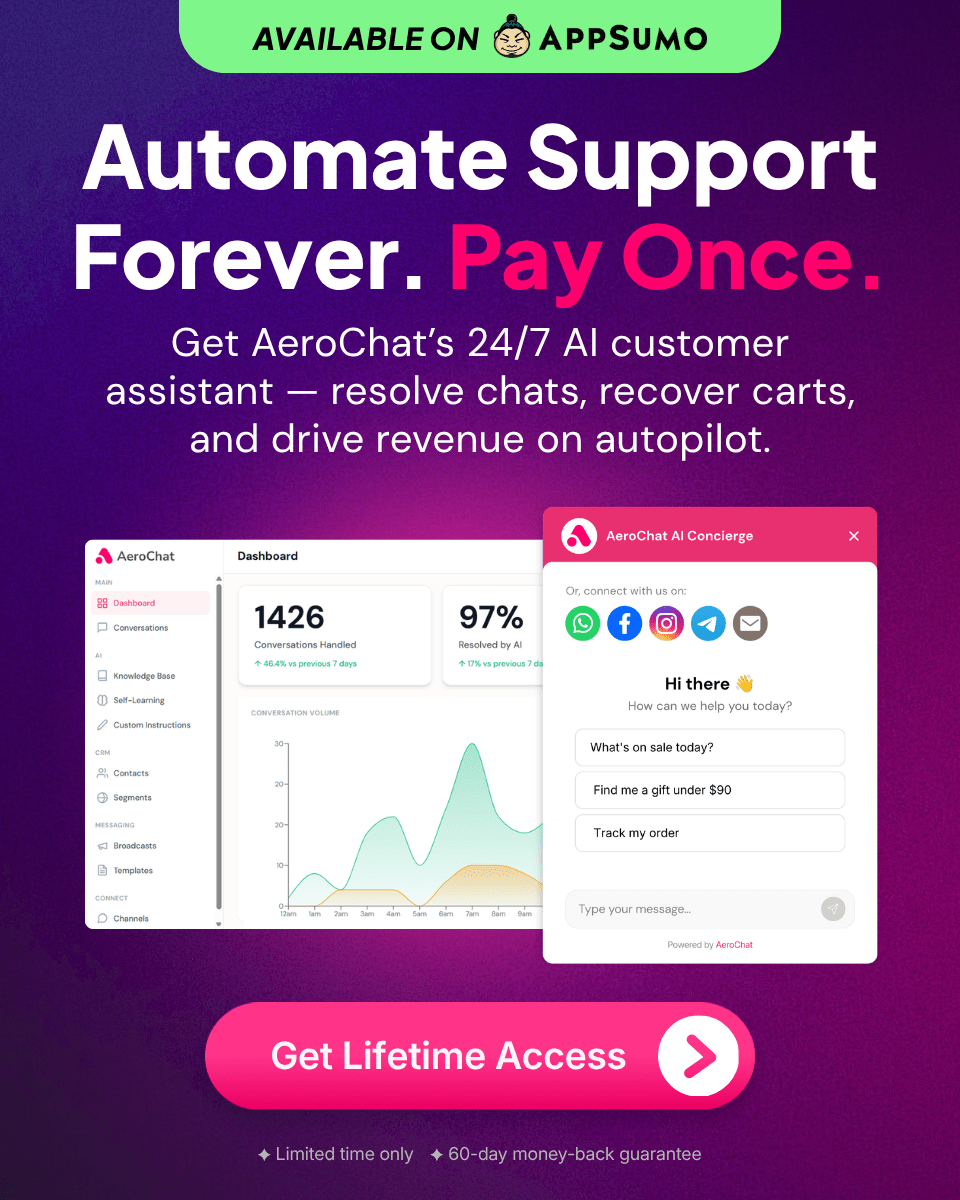
AeroChat is an AI agent platform that helps ecommerce brands run customer service on autopilot. In an AI-first model, its role is to resolve routine, verifiable enquiries while keeping human support available when a conversation requires judgement, authority or personal attention.
For a Shopify merchant, AeroChat can use synchronised product and order information to answer questions about availability, product details and order status. It can manage customer conversations across website chat, WhatsApp, Instagram, Facebook Messenger, Telegram and email, so routine support does not have to be handled separately in every inbox.
When the customer asks for a person or the AI is not confident it can answer correctly, AeroChat’s human handover can transfer the conversation to the team. The agent receives the conversation history, which helps them continue from the point automation stopped instead of asking the customer to explain the issue again.
Human handover does not remove the need for an operating policy. The merchant still decides which refund or cancellation exceptions require approval, who monitors handed-over conversations, what happens outside staffed hours and how quickly the team should respond. AeroChat provides the automation and routing layer; the business remains responsible for decisions and customer outcomes.
AeroChat is generally a growth-stage support investment rather than a required launch cost. It becomes more relevant when customer enquiries increase or the business begins managing conversations across several channels.
Map the last 100 support conversations
Take a recent sample and label each conversation as:
- automate from verified data;
- let AI assist or collect context;
- keep under human judgement;
- prevent through clearer product, delivery or policy information.
For each group, record the required data, the human path and who owns the next action. That exercise produces a more reliable AI-first strategy than starting with a target automation percentage.
AI-first support works when automation shortens the route to help. The moment it becomes a wall between the customer and a resolution, it has crossed into AI-only support.