
Telegram Bot vs AI Assistant: What Is the Difference?

A Telegram bot is an account and software connection that receives messages and sends responses inside Telegram. An AI assistant is the intelligence and decision layer that may sit behind that bot. A Telegram bot can follow fixed commands without AI, while an AI assistant can interpret natural language and use approved information to form a response.
The terms are often used as if they describe competing products. They do not. Telegram is the conversation channel; the connected backend determines whether the experience is a menu, a scripted chatbot, an AI answer system or an agent that can take actions.
The short answer: compare the layer, not the chat window
Two Telegram chats may look almost identical while behaving very differently.
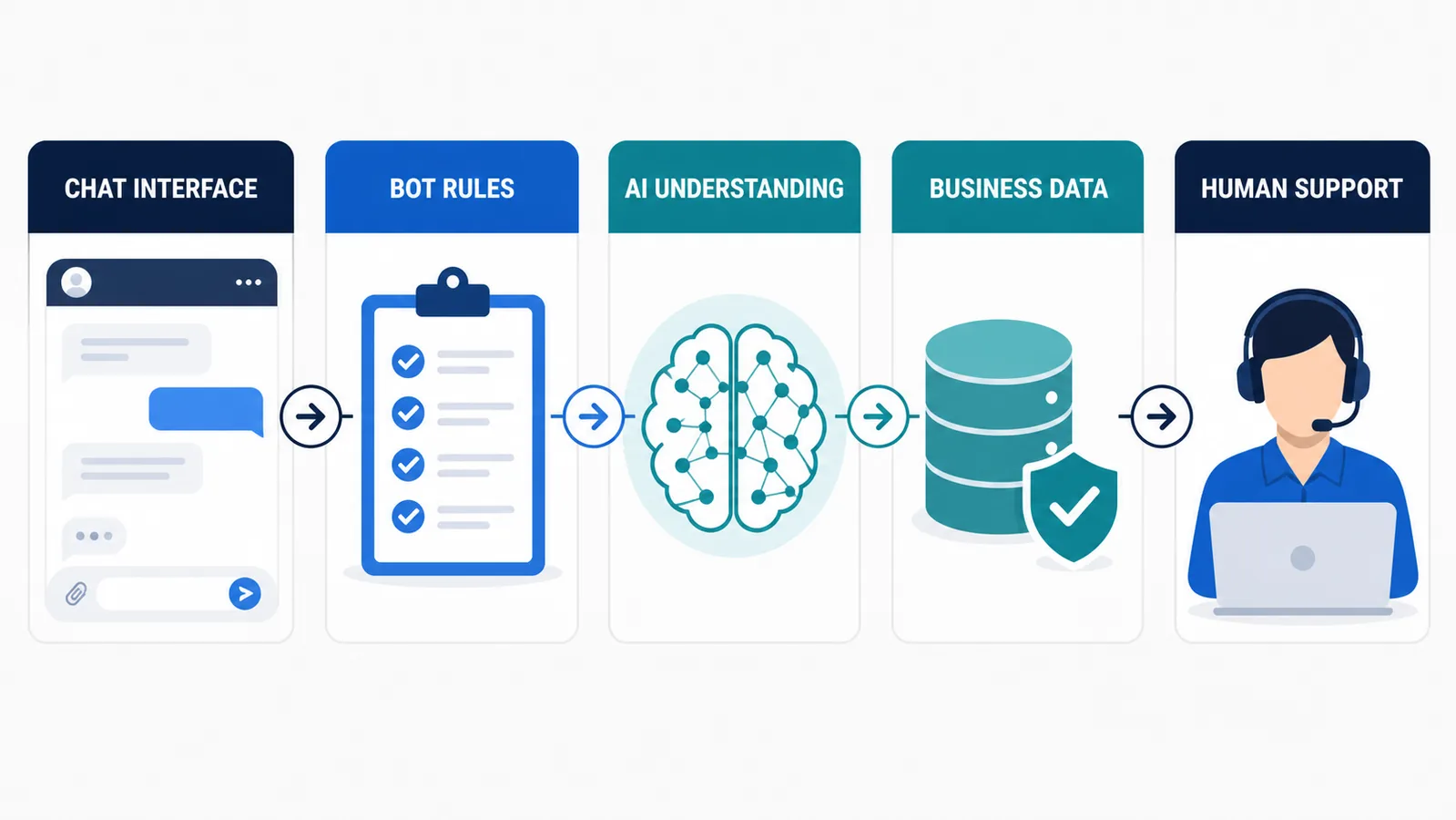
| Layer | What it contributes | Simple example |
|---|---|---|
| Telegram bot account | Identity, messages, buttons, files and the connection to Telegram | Receives /start and sends a welcome message |
| Rules or workflow | Predictable steps and conditions | Asks for an order number, then shows a fixed menu |
| AI assistant | Natural-language understanding and generated answers | Understands “has my parcel left yet?” as an order-status question |
| Business tools and data | Current facts or permitted actions | Looks up an order or retrieves the latest return policy |
| Human support | Judgement, exceptions and accountability | Takes over a disputed refund or unusual complaint |
A bot becomes more useful as layers are added, but it also becomes more complex to govern. The right question is not “bot or assistant?” It is “which layers does this customer journey require, and which decisions must remain deterministic or human?”
What is a Telegram bot?
Telegram describes bots as special accounts connected to an owner’s server. People interact with them inside the app, but the owner’s software processes the inputs and decides what to send back. The official introduction to Telegram bots also notes that bots cannot start a new conversation with a user; the user must message the bot, open its link or add it to an appropriate chat first.
A basic bot does not need generative AI. It can:
- respond to commands such as
/help; - show buttons and menus;
- collect structured form answers;
- send notifications after a user has started the interaction;
- retrieve a known record through an API; or
- route a request using fixed rules.
This predictability is useful. A fixed workflow is often the better choice when there is one correct sequence and little benefit from free-form language.
For example, a warranty registration bot might ask for a serial number, purchase date and proof of purchase. Allowing an AI model to improvise that process would add risk without adding much value.
What is an AI assistant inside Telegram?
An AI assistant adds language understanding and response generation behind the Telegram bot. It can interpret different ways of asking the same question, maintain useful context within a conversation and retrieve relevant information from a knowledge source.
Instead of requiring “Order status” from a menu, it may understand:
- “Has my parcel shipped?”
- “Where is order 1048?”
- “It was meant to arrive yesterday.”
- “Can you check the delivery for the trainers I bought?”
These sentences share an intent, but the wording and available details differ. AI helps map the message to the right next step.
That does not mean every AI assistant can browse private systems, remember forever or complete transactions. Those abilities depend on separate integrations, permissions and business rules. A language model can produce a confident sentence without having access to the order it mentions. Always ask which source or action supports the answer.
Is an AI assistant the same as an AI agent?
There is no universally enforced naming rule, so vendors use these terms differently.
In practical business evaluation:
- an AI chatbot mainly holds a natural-language conversation;
- an AI assistant helps a user or customer by answering and guiding;
- an AI agent may also select tools or perform permitted actions toward an outcome.
The label alone proves very little. A product called an “agent” may only answer FAQs, while a product called a “bot” may retrieve order data and route cases. Evaluate evidence: inputs, sources, tools, permissions, fallbacks and auditability.
The existing guide to Telegram’s native AI and third-party bots explains another important distinction. Telegram’s own writing and summary features are not the same as connecting a business bot to an external AI service.
Telegram bot vs AI assistant comparison
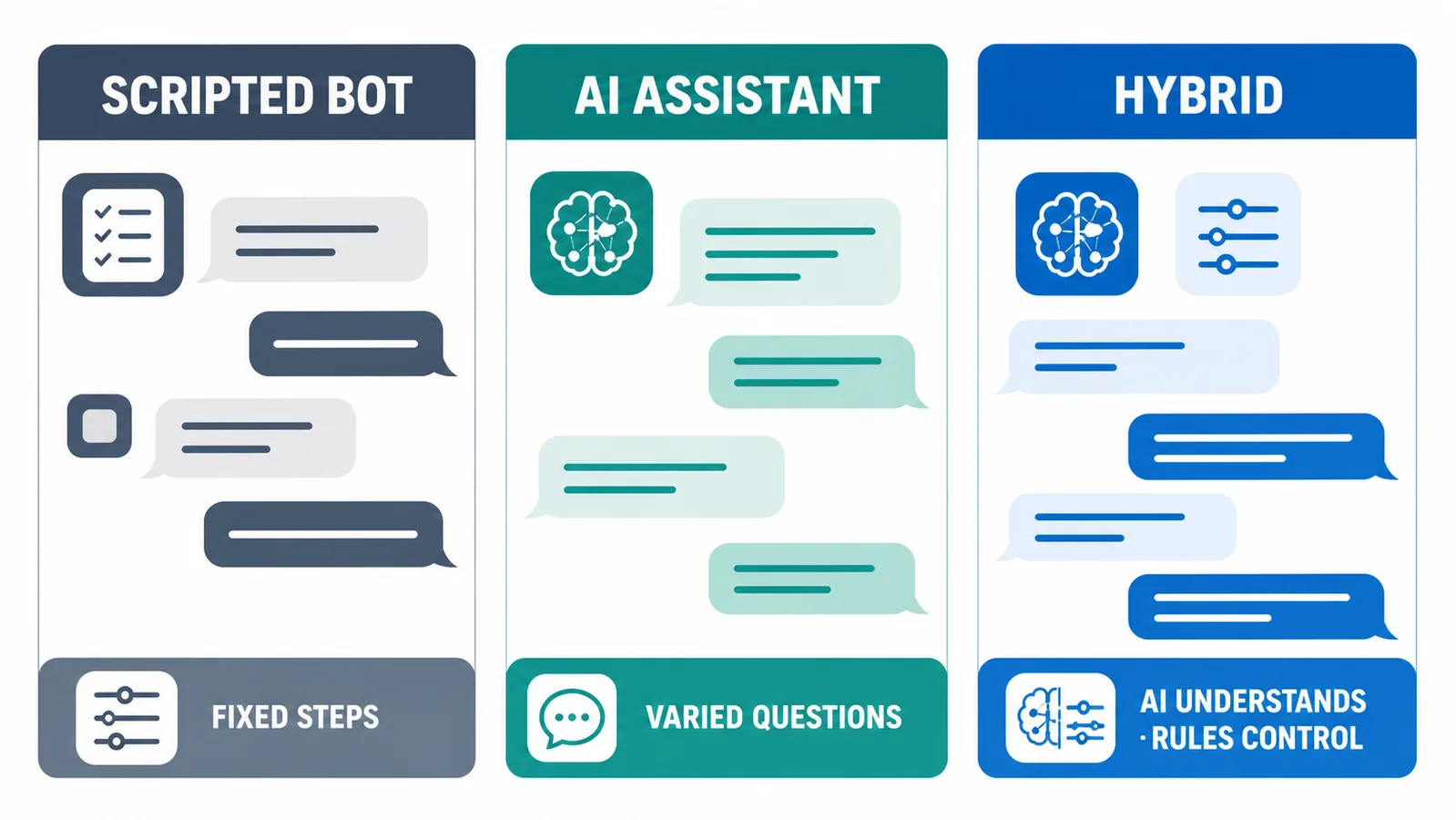
| Criterion | Scripted Telegram bot | AI assistant on Telegram | Hybrid design |
|---|---|---|---|
| Input | Commands, buttons and expected phrases | Free-form language and follow-up questions | Free-form entry with structured actions |
| Predictability | High within designed paths | Responses can vary | High-risk actions stay controlled |
| Knowledge | Hard-coded text or API results | Retrieved documents, business content and connected data | AI retrieves information; rules control state changes |
| Unfamiliar wording | Often falls back or shows a menu | Usually better at recognising intent | AI interprets, workflow confirms |
| Setup | Simple for narrow tasks | Requires knowledge, testing and guardrails | More design work but clearer control |
| Maintenance | Update flows and code | Update sources, instructions and evaluations | Maintain both rules and knowledge |
| Best fit | Repetitive, fixed transactions | Varied questions and conversational support | Customer service with both questions and actions |
| Main risk | Frustrating dead ends | Plausible but unsupported answers | Poor boundary design between AI and rules |
The hybrid column is not automatically superior. It is useful when the journey contains both fuzzy language and exact actions. A small notification bot may need nothing more than a script.
When is a scripted Telegram bot the better choice?
Choose a deterministic bot when the allowed choices and outcome can be defined precisely.
The path is fixed
Appointment type, location, date and contact details can often be collected through a known sequence. A natural-language opening may be convenient, but the final booking still needs structured fields and confirmation from the real scheduling system.
A mistake changes money, access or account state
Payments, cancellations, address changes and access permissions should not depend on a generated guess. The bot can explain the process, but rules, verification and the source system should control the change.
The answer must be identical every time
Legal notices, consent text and other approved wording may need to be reproduced exactly. A stored template is more appropriate than asking a model to rewrite it on each occasion.
The task is too small to justify AI
A bot that sends a download link after a user presses one button does not need language generation. Extra complexity creates another service to secure, monitor and pay for.
When does an AI assistant add real value?
AI becomes useful when people express the same need in many different ways or need help choosing between information.
Customers ask varied product questions
“Will this fit a narrow shelf?”, “Is it safe outside?” and “What is the difference between the two sizes?” do not fit one neat button tree. An AI assistant can retrieve the relevant specifications and explain them conversationally.
The conversation includes follow-ups
A customer may ask whether an item is available, then say “what about the black one?” Useful context lets the assistant understand that “one” refers to the product already being discussed.
The business serves several languages
Language detection and translation can reduce the need for a separate flow for every supported language. Important names, policies and numbers still need testing, and human support remains necessary for exceptions.
The answer exists across several business sources
A customer-service assistant may need product details, delivery information and the return policy to answer one question. A controlled business knowledge base is more reliable than letting the system answer from general model memory.
Why a hybrid Telegram design is often safer for customer service
Customer support mixes natural conversation with actions that need precision. A hybrid design gives each part to the mechanism that handles it best.
Consider an address-change request:
- AI recognises that the customer wants to change a delivery address.
- A rule checks whether the order has shipped.
- The system asks for the required verification through an approved process.
- A deterministic action updates the source system, or the request moves to a person.
- The customer receives confirmation only after the source system reports success.
The AI helps understand and explain. It should not invent whether the change occurred.
What should you evaluate before choosing?
Ignore the product label for a moment and ask these questions.
What information can it use?
Does it answer from public model knowledge, approved documents, a live website or connected store data? Can the business exclude outdated sources and see what has finished training?
What actions can it actually complete?
“Supports orders” could mean explaining the order policy, reading status or modifying an order. Ask for a demonstration of the exact state change you need.
How does it handle uncertainty?
Look for clarification, an honest “I don’t know”, or a handover. A generic apology followed by another guess is not a fallback strategy.
What does it retain?
Review conversation history, files, contact data, deletion controls and subprocessors. The safety guide for third-party Telegram bots covers the difference between what Telegram sends and what a bot operator may do afterwards.
Can a human take over with context?
The customer should not need to repeat the problem. Confirm that the agent receives the preceding messages and that the bot stops responding while a person is handling the chat.
Does Telegram fit the audience?
Even a capable assistant is a poor investment on a channel customers do not use. Telegram chatbot platforms helps evaluate channel coverage, business fit and limitations rather than choosing on an AI label alone.
How does AeroChat fit into Telegram?
AeroChat is an AI agent platform that helps online businesses run customer service on autopilot.
The customer still interacts through a Telegram bot. AeroChat supplies the business customer-service layer behind it: answers can use approved business knowledge, Telegram conversations can sit with other supported channels, and complex cases can move through human handover with the conversation context.
This makes AeroChat more relevant than a fixed menu when customers ask varied product, delivery, return and order-related questions. It is also different from a general personal assistant. Its role is handling customer conversations for a business, not managing the owner’s private calendar or home devices.
The AeroChat Telegram integration is best for online businesses that already receive customer enquiries on Telegram and want those conversations grounded in business information rather than isolated inside a basic bot.
Possible limitation: if the only requirement is one simple command, a broadcast notification or a fixed form, a basic Telegram bot may be sufficient. AI is valuable when language variation, business knowledge and escalation justify it.
A practical decision rule
Use the smallest system that can complete the job safely.
- Choose a scripted bot for a narrow, repeatable flow with fixed inputs.
- Choose an AI assistant for varied questions that can be answered from trusted information.
- Choose a hybrid design when customers use natural language but the outcome changes an account, order, booking or payment.
- Keep a human route for ambiguity, exceptions, complaints and sensitive decisions.
If you decide that an AI layer is justified, the Telegram AI chatbot setup process explains how the bot account and customer-service platform connect. Building the bot identity is the beginning; defining knowledge, permissions, tests and handover makes it useful.
Frequently asked questions
Is every Telegram bot an AI bot?
No. Telegram bots can run fixed commands, menus and API actions without generative AI. AI is an optional capability supplied by the connected backend.
Can an AI assistant work without a Telegram bot?
It can work through another interface, but it needs a Telegram bot connection to receive and send messages inside Telegram.
Is an AI assistant always better than a scripted bot?
No. Scripted bots are often better for fixed, high-precision workflows. AI adds value when the system must understand varied language or retrieve and explain information.
Can a Telegram AI assistant change an order?
Only if it has a verified integration and permission to perform that action. Understanding the request does not prove that the assistant can or should complete it.
What happens when the AI cannot answer?
A responsible design asks for clarification, gives a truthful limitation or transfers the conversation. It should not make up a policy, status or action result. If the bot stops responding altogether rather than giving an uncertain answer, that usually points to a connection problem rather than an AI limitation — see the separate guide to a Telegram AI bot that is not working.