

Shopify vs Etsy: Which Platform Should You Start With?

Choose Etsy when you sell products that meet its Creativity Standards and want to test demand inside an established marketplace. Choose Shopify when you want an independent store, broader control over branding and products, and are prepared to attract your own visitors. Use both when Etsy discovery and an owned storefront serve different, clearly planned roles.
The cheapest option depends on more than monthly revenue. Etsy combines listing, transaction, payment-processing and sometimes advertising charges. Shopify combines a subscription, payment processing, possible app costs and the cost of generating traffic. A seller’s country, average order value, product range and marketing ability can change the answer.
Shopify vs Etsy at a glance
| Decision factor | Etsy | Shopify |
|---|---|---|
| Business model | Marketplace containing many sellers | Platform for building an independent online store |
| Existing shopper traffic | Yes, but visibility is competitive and not guaranteed | No built-in audience; the merchant attracts traffic |
| Product eligibility | Items must meet Etsy’s current Creativity Standards | Broader range, subject to law, platform rules and payment-provider restrictions |
| Core cost model | Setup fee may apply, then listing and selling fees | Monthly subscription plus payment processing and optional apps |
| Branding control | Shop branding within Etsy’s marketplace design | Broad control over domain, theme and customer journey |
| Customer relationship | Seller access and marketing use are limited by Etsy policy and consent | Merchant operates its own store and marketing systems, subject to privacy law |
| Technical work | Low | More setup decisions, although hosting is included |
| Main risk | Dependence on marketplace rules and search visibility | Dependence on the merchant’s ability to generate profitable traffic |
| Best early use | Testing eligible products with marketplace demand | Building an independent brand and repeatable acquisition channels |
If you have not yet validated the product, audience and fulfilment model, work through this ecommerce startup checklist before paying for either route.
The fundamental difference: marketplace or independent store
An Etsy shop sits inside Etsy. Shoppers search the marketplace, compare listings from different sellers and complete the purchase through Etsy’s checkout. Etsy controls the marketplace interface, eligibility rules and many parts of the transaction.
A Shopify store runs on the merchant’s chosen domain and branding. Shopify supplies the hosted commerce software, but the merchant creates the storefront, chooses its acquisition channels and manages the wider customer journey.
That creates a practical exchange:
- Etsy reduces the work required to reach a marketplace audience, but the seller competes inside rules it does not control.
- Shopify provides greater control, but a new store begins without visitors unless the merchant already has an audience or invests in marketing.
Neither model guarantees sales. Etsy traffic is not guaranteed to reach a new listing, and a polished Shopify theme does not create demand by itself.
What can you sell on Etsy?
Etsy’s current Creativity Standards organise eligible products into four broad groups:
- Made by a seller: Physical items made by the seller by hand or with personal tools
- Designed by a seller: Original seller designs, including eligible digital downloads and designs produced by a disclosed production partner
- Handpicked by a seller: Qualifying vintage, natural or curated items
- Sourced by a seller: Items such as eligible craft and party supplies that support buyer creativity
This is more precise than saying every Etsy product must be handmade. It also means that generic reselling and ordinary mass-produced stock are not made eligible simply by calling them handmade.
Print-on-demand can be permitted when the seller created the original design and correctly discloses the production partner. Buying a ready-made product from a wholesaler and reselling it without a qualifying creative role is a different situation.
Etsy can remove listings or suspend accounts that do not follow its policies. Sellers should review the current standard for their exact product, especially where AI-generated designs, production partners, gift baskets, vintage goods or personalised items are involved.
What can you sell on Shopify?
Shopify supports a much broader range of legitimate retail models, including branded manufactured goods, subscriptions, print-on-demand and dropshipping. It is still incorrect to say that Shopify has no product restrictions.
A product must comply with applicable law, Shopify’s Acceptable Use Policy, the rules of connected sales channels and the payment provider’s business restrictions. Shopify Payments can reject a category even when the product can otherwise be hosted on Shopify with another eligible gateway.
Before choosing Shopify for a product Etsy does not allow, confirm:
- The product is legal in every target market.
- Shopify permits the business activity.
- A suitable payment provider accepts the category.
- Advertising and social platforms allow its promotion.
- Shipping carriers and insurers will handle it.
What does Etsy cost?
Etsy’s current Fees & Payments Policy includes several possible charges.
One-time setup fee
Etsy may charge a non-refundable setup fee when a new shop completes onboarding. The amount, if applicable, is shown during the setup process and can vary. This makes “free to open” an unreliable universal claim.
Listing fees
Etsy’s standard policy lists a fee of $0.20 USD for each listing. A listing normally expires after four months and can incur the fee again when renewed. Multi-quantity sales can also trigger additional renewal listing fees.
The amount shown in another currency can change with Etsy’s conversion process. A UK article should not permanently translate $0.20 into a fixed sterling amount without a date.
Transaction fees
Etsy charges 6.5% of the order amount covered by its policy. This includes the displayed item price and amounts charged for shipping and gift wrapping. Tax treatment within that calculation differs between US and non-US sellers.
Payment-processing fees
Etsy Payments processing combines a percentage and fixed amount that varies by the country of the seller’s bank account. US, UK, Canadian and Australian sellers therefore need separate calculations.
Offsite Ads
When Etsy attributes an order to an Offsite Ad, the standard fee is 15%. A shop that has reached $10,000 USD in Etsy sales during the relevant 365-day calculation moves to a 12% rate and is required to participate for the lifetime of the shop, subject to Etsy’s terms. Shops below the threshold can generally opt out.
The fee applies only to attributed orders, so it should not be added to every sale in a cost model. It can still change the margin on an individual order substantially.
Other possible costs
Depending on the seller and market, costs can also include currency conversion, regulatory operating fees, VAT or similar tax on fees, optional Etsy Ads, shipping labels and subscriptions to additional Etsy services.
What does Shopify cost?
Shopify uses a subscription model. US prices displayed for annual billing in July 2026 start at $29 per month for Basic, while prices and plan names can be localised in other countries.
The total cost can include:
- Shopify subscription
- Card-processing charges
- Additional Shopify fee when a third-party payment provider processes eligible orders
- Domain registration
- Paid theme or design work
- Apps for reviews, email, subscriptions or other functions
- Marketing and content production
- Currency and international-selling charges
Shopify does not charge Etsy-style listing renewal fees or an automatic marketplace advertising percentage. That does not make customer acquisition free. The merchant pays or works to attract visitors through search, social media, advertising, partnerships, email or repeat purchases.
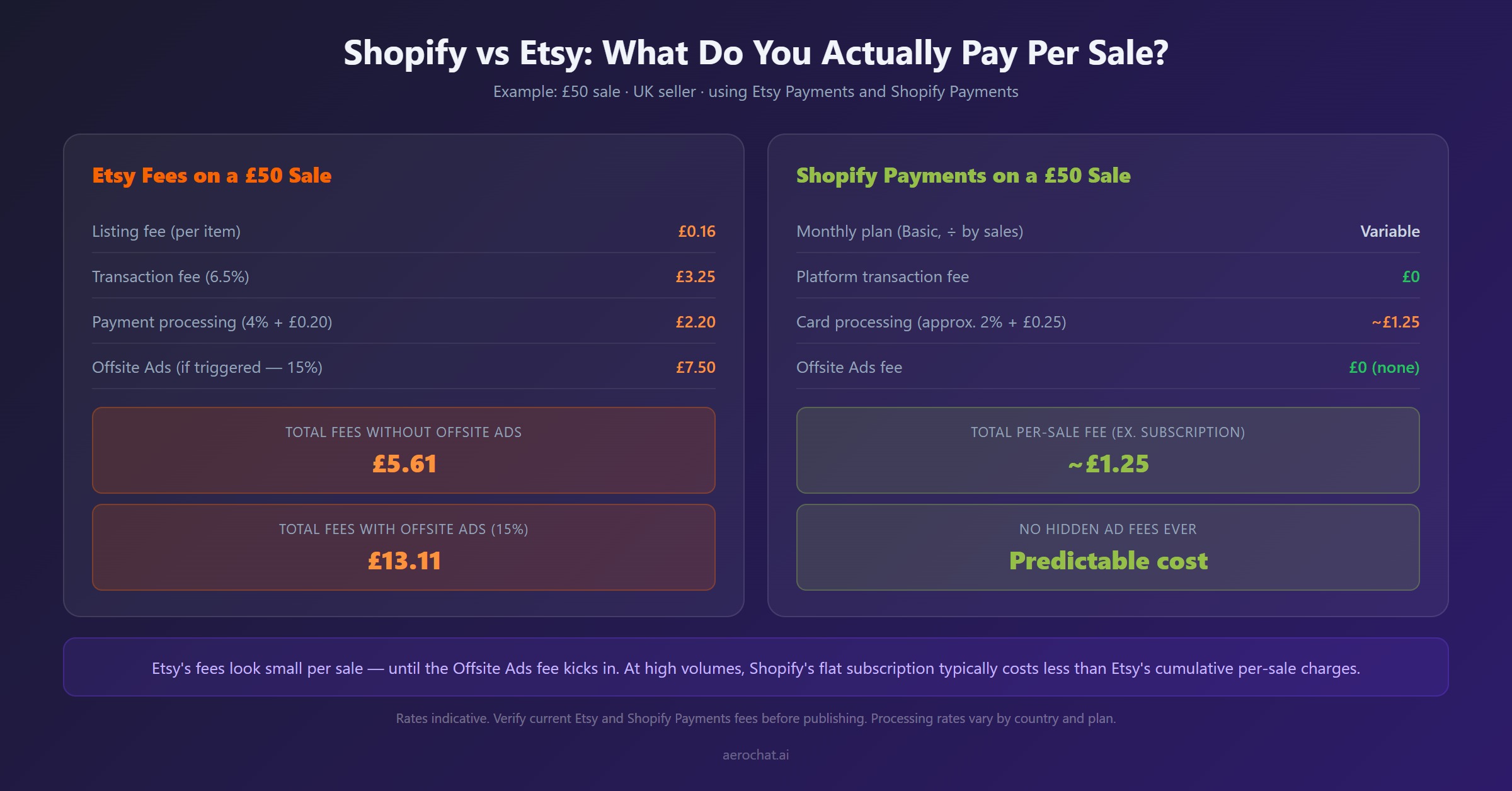
How to calculate which platform costs less
There is no dependable universal threshold such as “Shopify becomes cheaper above £1,500 per month”. Use the seller’s actual numbers.
Etsy monthly cost estimate
Calculate:
listing and renewal fees + transaction fees + country payment-processing fees + attributed Offsite Ads + optional services + relevant taxes/currency costs
Shopify monthly cost estimate
Calculate:
subscription + payment processing + apps + theme/development allocation + domain + customer-acquisition cost + relevant currency costs
Then calculate the cost per completed order and contribution margin, not just the percentage of revenue.
For example, Offsite Ads affect two otherwise identical Etsy sellers differently if one receives no attributed orders and the other receives a large share through those ads. A Shopify seller with an established email audience also has a different acquisition cost from a seller buying every first visit through advertising.
Run at least three scenarios:
- Current order volume without Offsite Ads attribution
- Higher order volume with a realistic share of attributed orders
- Shopify with the actual subscription, apps and expected traffic cost
Is Etsy easier to start?
Etsy usually requires fewer storefront decisions. The seller creates a shop, completes verification, configures policies and payments, and publishes eligible listings within Etsy’s established interface.
Shopify requires decisions about domain, theme, navigation, payment provider, shipping, tax, policies, analytics and traffic. It remains accessible to non-developers, but there is more business infrastructure to assemble before the first visitor arrives.
Easier setup does not mean easier growth. An Etsy seller must learn marketplace search, photography, listing quality, customer-service standards and policy compliance. A Shopify seller must learn acquisition and website optimisation. Each platform moves the work to a different place.
Branding and customer relationships
Etsy allows a shop name, logo, banner, shop story, policies and listing presentation, but the customer remains inside a recognisable Etsy experience. This can create marketplace trust while limiting differentiation.
Shopify offers control over the domain, theme, navigation, content and post-purchase journey. That is more useful when the business has a clear brand and resources to maintain it.
Avoid saying that Etsy simply “owns” the customer while Shopify does not. Under Etsy’s policies and applicable privacy law, Etsy and the seller can have separate responsibilities for personal information. A seller receives order information to complete the transaction but cannot add a buyer to an email or physical mailing list, use their identity for marketing, or send unsolicited commercial messages without the required consent.
On Shopify, the merchant builds its own consent and customer-data processes, but remains responsible for privacy, security and marketing law. Control creates responsibility as well as opportunity.
How traffic works on Etsy and Shopify
Etsy discovery
Etsy shoppers already have marketplace intent. Listings can appear through search, categories, recommendations and advertising. Visibility depends on factors Etsy documents or controls, including relevance, listing quality and marketplace performance signals.
A new listing can be discovered, but it competes with established sellers, reviews, pricing, photography and delivery offers. Marketplace presence is access to demand, not a guaranteed allocation of it.
Shopify acquisition
A new Shopify store normally begins with little or no traffic. Merchants build an audience through channels such as:
- Organic search and useful content
- Social media and creator partnerships
- Paid search and social advertising
- Email and SMS with valid consent
- Retail, events and existing customers
- Referrals and affiliate relationships
Shopify becomes more attractive when the seller already has an audience or has identified a repeatable acquisition method. Otherwise, the cost and time required to create traffic must be included in the decision.
Can you sell on Etsy and Shopify together?
Yes. The same eligible seller can operate an Etsy shop and a Shopify store, subject to each platform’s rules. This can combine marketplace discovery with a branded direct channel.
Do not assume that Shopify Marketplace Connect will create a new Etsy connection. Shopify’s current Marketplace Connect requirements state that new Etsy connections cannot be made at this time. Existing Etsy connections through the app can continue.
A seller considering another connector should verify it independently. Check whether it can:
- Sync stock in both directions
- Map Etsy variations to Shopify variants
- Import orders without duplicating them
- Keep separate prices where required
- Handle tax and shipping correctly
- Preserve Etsy listing attributes
- Recover safely after an API or sync failure
No connector removes the need to follow Etsy policy. Do not use Etsy Messages or buyer details to divert an Etsy transaction off the marketplace.
When should each platform become the priority?
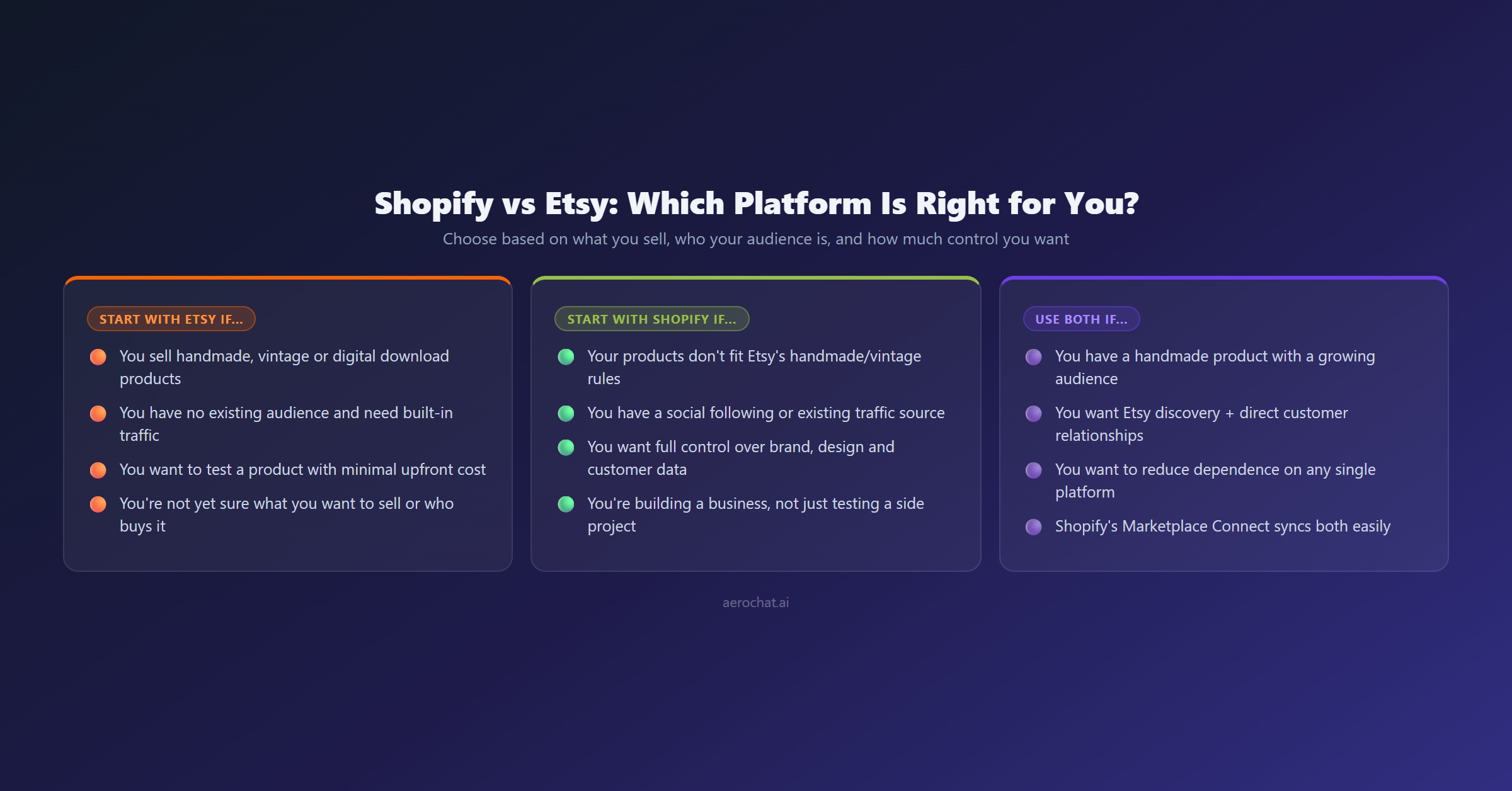
Start with Etsy if:
- Products clearly meet Etsy’s Creativity Standards
- The business is testing demand with a limited range
- Marketplace discovery is more valuable than full design control
- The seller has little independent audience today
- Per-order fees remain workable within product margins
Start with Shopify if:
- Products fall outside Etsy’s marketplace model but meet Shopify and gateway rules
- The business already has an audience or acquisition plan
- Brand, content and customer journey need more control
- Repeat purchase and consent-based marketing are central
- The catalogue or operations need functions Etsy cannot provide
Use both if:
- Etsy is a profitable discovery channel for eligible products
- Shopify serves repeat customers, content and a broader catalogue
- Inventory and fulfilment can be managed reliably
- The seller understands Etsy’s off-platform and customer-data restrictions
- Each channel has its own measured role rather than duplicated effort
There is no single “successful seller path”. Some businesses remain Etsy-led, some begin on Shopify, and others use both for different audiences. Choose using margin, customer source and operational evidence.
Where AeroChat fits for sellers adding Shopify
Moving from Etsy-only selling to an independent Shopify store creates a new responsibility: the merchant must answer questions on its own website and connected channels. Customers may ask about product suitability, delivery, stock, returns and order status through web chat, WhatsApp or Instagram rather than Etsy Messages.
AeroChat is an AI agent platform that helps Shopify merchants run customer service on autopilot. Its Shopify integration syncs product, inventory, order, discount and policy information so the AI can answer common questions using the merchant’s store data. Order-status tracking can verify the customer and retrieve the relevant Shopify order information inside a conversation.
This role is specific to the Shopify side of the operation. It does not replace Etsy Messages, bypass Etsy’s communication rules or create a new Marketplace Connect integration.
When a return exception, payment issue or unhappy customer needs personal attention, AeroChat’s human handover transfers the conversation with its context. That keeps automation focused on repeatable questions while people handle decisions requiring judgement.
AeroChat is a growth-stage investment, not a requirement for testing the first product. It becomes more relevant when the Shopify store receives consistent enquiries or the same questions arrive through several channels. The Shopify AI chatbot comparison explains the wider options.
Best for: Shopify merchants who want to automate and scale customer service without extra manpower and costs.
Final decision
Etsy is the stronger starting environment when marketplace discovery and low storefront complexity matter more than control. Shopify is the stronger foundation when the business is ready to own its brand experience and customer-acquisition work. Using both can be sensible, but only when inventory, policy and channel roles are clearly managed.
Before deciding, answer four questions:
- Does the product meet Etsy’s current rules?
- Where will the first 100 relevant visitors come from?
- What does each completed order cost under realistic fee and advertising scenarios?
- Does the business want to optimise a marketplace listing, build an independent brand, or do both deliberately?
Those answers are more reliable than a universal revenue threshold or a claim that one platform is always cheaper.