
Per Message vs Unlimited Chatbot Pricing: The Break-Even Math at Every Scale (2026)
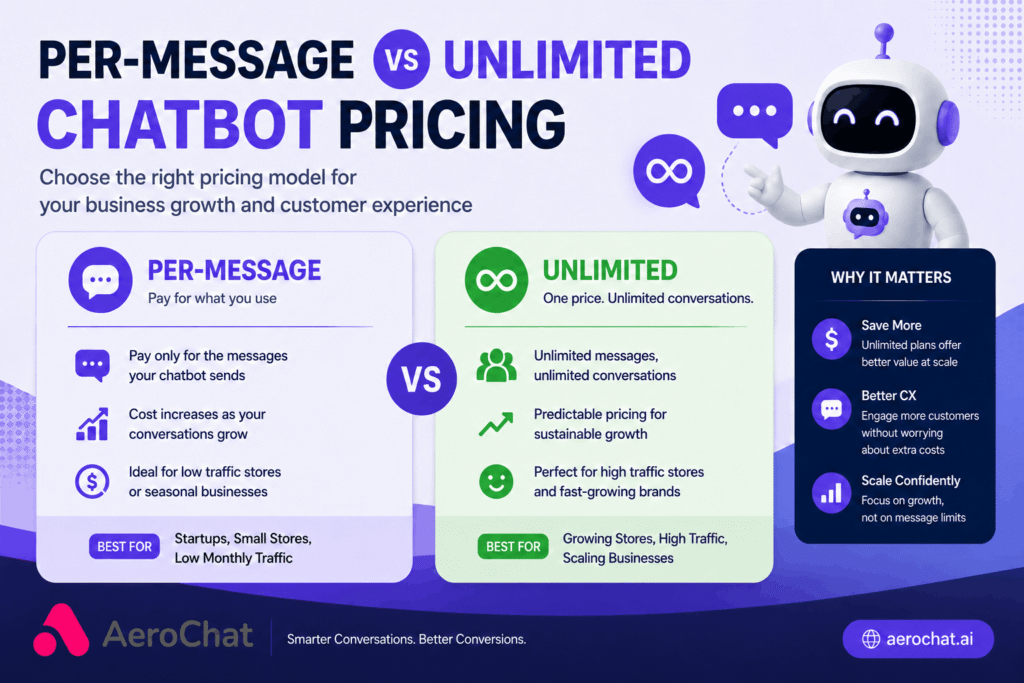
Chatbot vendors have spent considerable effort making their pricing feel simple. Pay per conversation. Or pay a flat monthly fee. The choice looks obvious until you run the numbers at the volume your business actually handles — or plans to handle in twelve months.
This guide does not describe pricing models. It calculates them. You will find the exact conversation volume at which each model flips from cheaper to more expensive, the hidden costs inside plans that advertise as unlimited, and a decision framework based on where your business sits today and where it is going.
The Two Models, Defined Precisely
Before the math, the definitions — because both models have variations that change the calculation significantly.
Per-message pricing charges per individual message sent or received within a conversation. A single customer interaction spanning 12 messages costs 12 units. This is the least common model in 2026 because vendors found that customers resent being charged for their chatbot being verbose.
Per-conversation pricing (also called per-resolution or per-session) charges once per conversation regardless of how many messages it contains. Intercom charges $0.99 per resolved conversation via Fin AI. Tidio’s Lyro charges $0.50 per conversation. This is the dominant pay-as-you-go model in the market.
Unlimited flat-rate pricing charges a fixed monthly fee regardless of conversation volume. What “unlimited” actually covers varies significantly — more on this in the hidden costs section. Many platforms offer tiered unlimited plans where the fee is fixed but the conversation ceiling is not literally infinite.
Hybrid pricing combines a flat monthly base with a conversation allowance, then charges per conversation above the limit. This is the most common model for mid-market SaaS chatbot platforms and the one that requires the most careful analysis at scale.
For this analysis, the comparison that matters most for growing businesses: per-conversation pricing versus unlimited flat-rate — because this is the decision most companies face when evaluating chatbot platforms.
The Break-Even Calculation
The break-even point is the conversation volume at which the total monthly cost of a per-conversation model equals the total monthly cost of an unlimited plan. Below that volume, per-conversation is cheaper. Above it, unlimited wins.
The formula:
Break-even conversations = Unlimited monthly cost ÷ Per-conversation rate
Example with real 2026 pricing:
Intercom Fin AI: $0.99 per resolved conversation Mid-tier unlimited plan equivalent: $299/month
Break-even = $299 ÷ $0.99 = 302 conversations per month
At 300 conversations per month, per-conversation costs $297. The unlimited plan costs $299. Nearly identical.
At 500 conversations: per-conversation = $495. Unlimited = $299. Unlimited saves $196/month. At 1,000 conversations: per-conversation = $990. Unlimited = $299. Unlimited saves $691/month. At 3,000 conversations: per-conversation = $2,970. Unlimited = $299. Unlimited saves $2,671/month.
The math is not linear in favour of unlimited — the gap widens with every conversation. This is the core reason per-conversation pricing works so well for vendors: their revenue scales with your growth automatically. Your cost problem becomes their revenue opportunity.
Break-Even Tables at Every Volume Tier
Using Tidio Lyro pricing ($0.50/conversation) vs. flat-rate equivalent ($149/month):
|
Monthly conversations |
Per-conversation cost |
Unlimited cost |
Cheaper model |
Monthly saving |
|---|---|---|---|---|
|
100 |
$50 |
$149 |
Per-conversation |
$99 |
|
200 |
$100 |
$149 |
Per-conversation |
$49 |
|
298 |
$149 |
$149 |
Break-even |
— |
|
500 |
$250 |
$149 |
Unlimited |
$101 |
|
1,000 |
$500 |
$149 |
Unlimited |
$351 |
|
2,000 |
$1,000 |
$149 |
Unlimited |
$851 |
|
5,000 |
$2,500 |
$149 |
Unlimited |
$2,351 |
|
10,000 |
$5,000 |
$149 |
Unlimited |
$4,851 |
Using Intercom Fin AI ($0.99/conversation) vs. flat-rate equivalent ($299/month):
|
Monthly conversations |
Per-conversation cost |
Unlimited cost |
Cheaper model |
Monthly saving |
|---|---|---|---|---|
|
100 |
$99 |
$299 |
Per-conversation |
$200 |
|
200 |
$198 |
$299 |
Per-conversation |
$101 |
|
302 |
$299 |
$299 |
Break-even |
— |
|
500 |
$495 |
$299 |
Unlimited |
$196 |
|
1,000 |
$990 |
$299 |
Unlimited |
$691 |
|
3,000 |
$2,970 |
$299 |
Unlimited |
$2,671 |
|
10,000 |
$9,900 |
$299 |
Unlimited |
$9,601 |
Using AeroChat unlimited ($99/month) vs. Tidio Lyro ($0.50/conversation):
|
Monthly conversations |
Per-conversation cost (Tidio) |
AeroChat unlimited |
Cheaper model |
Monthly saving |
|---|---|---|---|---|
|
100 |
$50 |
$99 |
Per-conversation |
$49 |
|
198 |
$99 |
$99 |
Break-even |
— |
|
300 |
$150 |
$99 |
AeroChat |
$51 |
|
500 |
$250 |
$99 |
AeroChat |
$151 |
|
1,000 |
$500 |
$99 |
AeroChat |
$401 |
|
2,000 |
$1,000 |
$99 |
AeroChat |
$901 |
|
5,000 |
$2,500 |
$99 |
AeroChat |
$2,401 |
|
10,000 |
$5,000 |
$99 |
AeroChat |
$4,901 |
Using AeroChat unlimited ($99/month) vs. Intercom Fin AI ($0.99/conversation):
|
Monthly conversations |
Per-conversation cost (Intercom) |
AeroChat unlimited |
Cheaper model |
Monthly saving |
|---|---|---|---|---|
|
50 |
$49.50 |
$99 |
Per-conversation |
$49.50 |
|
100 |
$99 |
$99 |
Break-even |
— |
|
200 |
$198 |
$99 |
AeroChat |
$99 |
|
500 |
$495 |
$99 |
AeroChat |
$496 |
|
1,000 |
$990 |
$99 |
AeroChat |
$891 |
|
3,000 |
$2,970 |
$99 |
AeroChat |
$2,871 |
|
5,000 |
$4,950 |
$99 |
AeroChat |
$4,851 |
|
10,000 |
$9,900 |
$99 |
AeroChat |
$9,801 |
Why AeroChat wins at scale
AeroChat’s break-even against Tidio Lyro hits at just 198 conversations per month — and against Intercom Fin AI at just 100 conversations. Most businesses cross both thresholds within their first month of live chat. Beyond those points, every additional conversation widens AeroChat’s cost advantage.
The bigger difference: Tidio and Intercom charge per conversation on website chat only. WhatsApp and Instagram DMs are billed separately. AeroChat’s $99/month covers WhatsApp Business API, Instagram DMs, and website chat under one flat fee — no per-channel billing, no overage surprises. A business handling 500 conversations split across three channels pays $99 with AeroChat and $750+ with a per-conversation multi-channel stack.
The Hidden Costs Inside “Unlimited” Plans
Unlimited is a marketing claim, not an engineering specification. Here is what that word often excludes.
AI resolution limits
Many unlimited conversation plans cap the number of AI-resolved conversations per month separately from total conversations. A plan that promises unlimited conversations may limit AI resolutions to 500 per month — beyond that, conversations either queue for human agents or the AI is disabled until the next billing cycle. Always check the plan details for “AI conversations” or “AI resolutions” as a distinct line item.
Seat limits within flat-rate plans
An unlimited conversation plan typically limits agent seats. A team growing from 3 to 8 agents on a flat-rate plan often finds the next tier costs significantly more — not because of conversations, but because of seats. Read the per-seat terms carefully before assuming the conversation-unlimited plan covers your whole operation.
Channel restrictions
Some unlimited plans cover website chat only. WhatsApp, Instagram DMs, and Facebook Messenger conversations may be counted and charged separately, reverting to per-conversation billing on those channels even while website chat is “unlimited.” If you run multi-channel support, verify each channel’s billing status individually.
AeroChat’s flat-rate plans cover WhatsApp, Instagram DMs, and website chat under a single monthly fee — no per-channel billing and no channel exclusions in the fine print. For businesses running support across more than one channel, this distinction changes the total cost calculation significantly. See how AeroChat’s unified pricing compares against channel-restricted unlimited plans.
API call charges
AI chatbots make API calls to language models to generate responses. Some platforms absorb these costs into their flat rate. Others pass them through as a usage multiplier above a threshold. A platform charging $99/month for “unlimited AI conversations” may also charge separately for underlying model API usage. This is the least visible cost and the one most likely to surprise on the first invoice.
Overage rates on hybrid plans
Hybrid plans combine a flat base with a conversation allowance, then charge per conversation above the limit. Your costs are fixed when volume is low and variable when volume is high — exactly when you least want budget uncertainty. Evaluate the overage rate on any hybrid plan as carefully as the base price.
The Volatility Cost: What Per-Conversation Pricing Actually Costs Beyond the Invoice
There is a cost to per-conversation pricing that does not appear on your invoice: the cost of budget unpredictability.
A business on a flat-rate chatbot plan has a fixed line item in its monthly operating budget. A business on per-conversation pricing has a variable line item that can double or triple when:
-
A product launch drives a traffic spike
-
A PR mention sends a wave of new visitors
-
A bug or outage causes a surge in support contacts
-
A seasonal period arrives earlier than expected
At 10,000 conversations per month, a doubling of traffic from any of the above causes a single-month chatbot invoice spike of $5,000 to $10,000 at $0.50 to $0.99 per conversation. This is not a theoretical risk — it is a predictable consequence of variable pricing applied to inherently variable support volume.
The management overhead of monitoring conversation volume, forecasting usage, and explaining cost variances to finance teams is real and unmeasured. Flat-rate pricing eliminates this overhead entirely.
Conservative estimate: Two hours per month of finance and operations time managing chatbot cost variance, at $50/hour blended rate = $100/month in implicit overhead. Add this to the per-conversation calculation for a more accurate total cost of ownership.
Who Should Choose Per-Conversation Pricing
Early-stage businesses with under 200 monthly conversations
Below the break-even point (approximately 300 conversations/month), per-conversation pricing costs less. A startup handling 150 support conversations per month pays $75 to $150 on a per-conversation model versus $99 to $299 for a flat-rate plan. The saving is real at this volume.
Businesses with extreme seasonality
A business handling 5,000 conversations in December and 200 in January faces a math problem with unlimited pricing — the quiet months cost the same as peak months. Per-conversation pricing means low-volume months cost almost nothing. For businesses where peak season is short and defined, the blended annual cost of per-conversation pricing can beat flat-rate — but run the full 12-month calculation before concluding this.
Teams in proof-of-concept phases
Per-conversation pricing carries lower risk during evaluation. A three-month pilot at $0.50 per conversation is financially lower-risk than committing to a $299/month annual plan before volume is proven. This is not a long-term pricing strategy — it is a risk-reduction approach during validation.
Who Should Choose Unlimited Flat-Rate Pricing
Businesses beyond 300 conversations per month
This covers the majority of companies beyond their first year of operation. The break-even sits at 300 conversations regardless of which specific platforms you compare. Above that volume, flat-rate pricing saves money — and the saving compounds as volume grows.
Teams running multi-channel support
If your support runs across WhatsApp, Instagram, and website chat, per-conversation pricing across all three channels multiplies the variable cost by the number of channels. A flat-rate plan covering multiple channels under one fee changes the total cost calculation entirely. AeroChat’s multi-channel pricing covers WhatsApp Business API conversations, Instagram DMs, and website chat from a single flat monthly rate — no per-channel billing.
Companies in active growth phases
A business growing from 500 to 2,000 conversations per month over 12 months saves an increasing amount each month on flat-rate versus per-conversation. The saving at month 1 (500 conversations) is approximately $101. The saving at month 12 (2,000 conversations) is approximately $851. Annual total saving against per-conversation pricing at $0.50/conversation versus a $149/month flat rate: approximately $5,000 over the growth year. That is a meaningful operational cost, not a rounding error.
Finance teams that need predictable budgets
Variable invoices create real administrative overhead. For any business where finance reviews monthly SaaS costs or where budgets are set quarterly, predictable flat-rate invoices reduce friction and remove the risk of unbudgeted cost spikes during traffic surges.
The Decision Framework: Which Model to Choose
Run this calculation before deciding:
Step 1: Calculate your current average monthly conversation volume. If you do not have this data, estimate: monthly website visitors × 2-3% chat engagement rate.
Step 2: Calculate your projected volume in 12 months using your current growth rate.
Step 3: Calculate annual cost of per-conversation pricing across current and projected volume.
Annual per-conversation cost = (Current volume + Projected volume) ÷ 2 × 12 × Per-conversation rate
Step 4: Calculate annual cost of the unlimited flat-rate plan.
Annual flat-rate cost = Monthly flat rate × 12
Step 5: Compare. Add $100/month to the per-conversation model for variance management overhead if your finance team tracks SaaS spend closely.
Step 6: If the flat-rate annual cost is lower, switch now — the saving starts month one.
The Negotiation Angle at Enterprise Scale
At enterprise conversation volumes (10,000+ per month), both models become negotiable. Vendors price enterprise contracts based on expected annual spend, not published rates.
Per-conversation pricing at 10,000 conversations per month at $0.99 represents $9,900/month or $118,800 per year — a contract size that triggers custom pricing at every vendor in this space. Enterprise accounts routinely negotiate 40-60% discounts off published per-conversation rates.
Unlimited flat-rate plans at enterprise volume are similarly negotiable. Vendors discount the annual flat rate to win multi-year contracts.
The practical point: if your business is approaching enterprise volume, do not accept published pricing from either model. Request a custom quote, provide your volume data, and negotiate. At this scale, AeroChat’s enterprise pricing is structured for negotiation — contact the team directly rather than self-serving on the published tier.
Real Cost Comparison: Three Business Scenarios
Scenario A: Early-stage business, 150 conversations/month
Per-conversation at $0.50: $75/month, $900/year Unlimited plan at $149/month: $149/month, $1,788/year Verdict: Per-conversation saves $888/year. Not the right time for flat-rate.
Scenario B: Growing business, 800 conversations/month
Per-conversation at $0.50: $400/month, $4,800/year Unlimited plan at $149/month: $149/month, $1,788/year Verdict: Unlimited saves $3,012/year. Switch immediately.
Scenario C: Scaling business, 3,000 conversations/month across WhatsApp + Instagram + web
Per-conversation at $0.50 per channel × 3 channels: $4,500/month, $54,000/year AeroChat unified unlimited (all channels): flat monthly rate covering all three Verdict: Multi-channel flat-rate saves tens of thousands annually. The per-conversation model was never designed for this volume.
Scenario C is where channel multiplication makes per-conversation pricing untenable. A $0.50 per conversation rate that looks affordable for a single channel at low volume becomes catastrophically expensive when applied across three channels at scale. The businesses that learn this lesson on their invoice rather than before signing are the ones writing frustrated reviews about “hidden costs.”
Conclusion
The answer to “which is cheaper at scale” is mathematically clear: unlimited flat-rate pricing wins above approximately 300 conversations per month, and the advantage compounds with every conversation above that threshold.
What every comparison article skips is that the break-even calculation needs to use projected volume, not current volume. A business selecting per-conversation pricing because it looks cheaper today, and growing past the break-even in three months, locked itself into a model that is now more expensive — with switching costs to change it.
Buy for where you will be in 12 months. Run the break-even calculation with your growth rate applied. If that number puts you above 300 monthly conversations within the year, flat-rate is the correct model now, not eventually.
AeroChat’s unlimited flat-rate plans cover WhatsApp Business API, Instagram DMs, and website chat under one monthly fee. No per-channel billing, no AI resolution caps on standard plans, no invoice surprises during traffic spikes. For businesses past the early stage running support across more than one channel, the calculation is not close. Start with AeroChat’s free trial and run your own volume against the break-even table above.
FAQs
At what conversation volume does unlimited chatbot pricing become cheaper than per-conversation?
The break-even sits at approximately 300 conversations per month for most platform comparisons. Below that, per-conversation costs less. Above it, flat-rate unlimited saves money — at 1,000 conversations/month the saving is typically $350 to $700 per month depending on the per-conversation rate.
Is per-message pricing the same as per-conversation pricing?
No. Per-message charges for each individual message in a conversation. A 10-message conversation costs 10 units. Per-conversation charges once for the entire session regardless of message count. Per-message pricing is rare in 2026 — most vendors use per-conversation or per-resolution models.
What does unlimited actually mean in chatbot pricing plans?
Unlimited typically means unlimited total conversations but may cap AI-resolved conversations separately, limit agent seats, exclude specific channels (WhatsApp, Instagram), or pass through API costs above a threshold. Read the plan specifics before assuming unlimited means literally without limit. AeroChat’s unlimited plans explicitly cover all three channels — WhatsApp, Instagram, and website chat — under the same flat rate.
Does per-conversation pricing get cheaper at enterprise volume?
Yes, through negotiation. Published per-conversation rates apply to self-service plans. Enterprise accounts at 10,000+ monthly conversations typically negotiate 40-60% discounts. At that volume, always request a custom quote rather than paying published pricing.
How do I calculate my expected monthly conversation volume?
Multiply monthly website unique visitors by your chat engagement rate (2-4% without proactive triggers, 5-10% with proactive triggers). For multi-channel businesses, add WhatsApp and social DM volume separately. Use that number against the break-even tables above to choose the right model.
Which chatbot pricing model is better for businesses with seasonal traffic spikes?
Per-conversation handles off-peak months cheaply but creates unpredictable cost spikes during peak periods — exactly when you most need budget certainty. Flat-rate pricing keeps costs identical whether it is your slowest month or your busiest sale. For most growing businesses, that predictability outweighs the off-peak saving of per-conversation pricing.