
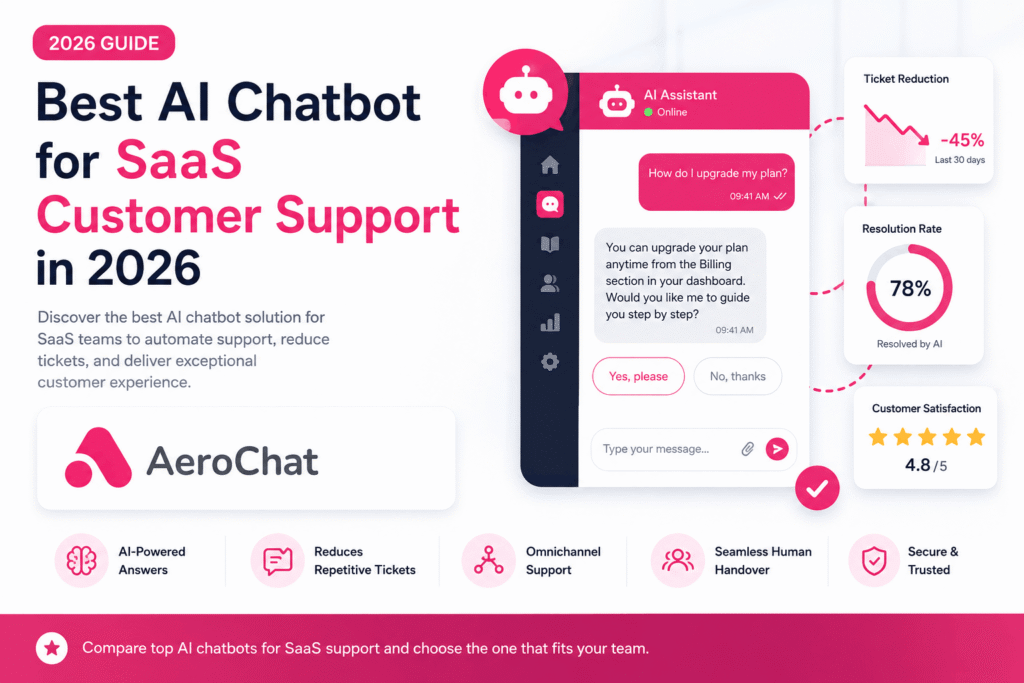
Best AI Chatbot for SaaS Customer Support in 2026
SaaS customer support is different from normal website chat.
A SaaS customer is not only asking, “What is your pricing?” or “How do I contact support?” They may be asking why an integration is not syncing, how to change a billing setting, where to find a feature, why an account limit was reached, or how to fix an onboarding issue before they churn.
That is why the best AI chatbot for SaaS customer support needs to do more than send fast replies. It should understand product documentation, help centre articles, pricing rules, onboarding questions, account-related FAQs, and support workflows. It should also know when to stop and pass the conversation to a real support agent.
In this guide, we compare the best AI chatbots for SaaS customer support in 2026, including AeroChat, Intercom Fin, Zendesk AI, Ada, Freshdesk Freddy AI, and Tidio Lyro.
What Is the Best AI Chatbot for SaaS Customer Support?
The best AI chatbot for SaaS customer support depends on your team size, support volume, and product complexity.
AeroChat is a strong choice for SaaS businesses that want to run customer service on autopilot across website chat, WhatsApp, Instagram, Messenger, and other customer channels. It is especially useful for SaaS teams that want fast setup, knowledge base training, multilingual replies, and human handover without building a heavy enterprise helpdesk.
Intercom Fin is a strong option for SaaS companies already using Intercom and willing to pay per resolved outcome. Zendesk AI is better for larger support teams already built around Zendesk. Ada is best suited for enterprise teams with complex automation needs. Freshdesk Freddy AI is a practical option for teams already using Freshworks. Tidio Lyro is a simpler starting point for small SaaS teams that want live chat and basic AI support.
How We Compared These SaaS AI Chatbots
We compared the tools based on what matters most for SaaS support teams:
- How well the chatbot answers from a knowledge base
- Whether it can handle onboarding and product questions
- Whether it works across multiple channels
- How easily it hands over to a human agent
- Whether it supports small teams or only enterprise teams
- Pricing model and how costs may scale
- Setup complexity
- Best fit by SaaS stage
For SaaS businesses, the ideal chatbot should not only answer simple FAQs. It should reduce repetitive tickets, help users move through onboarding, support trial users, and protect customer experience when the AI is not confident.
Best AI Chatbots for SaaS Customer Support: Quick Comparison
| Tool | Best For | Main Strength | Starting Point |
|---|---|---|---|
| AeroChat | SaaS teams that want AI support across website chat and messaging channels | Omnichannel AI support with knowledge base training and human handover | From $49/month |
| Intercom Fin | SaaS companies already using Intercom | Strong AI agent and helpdesk ecosystem | Outcome-based pricing |
| Zendesk AI | Larger support teams already using Zendesk | Enterprise support workflows and AI agents | Zendesk plan-based pricing |
| Ada | Enterprise SaaS support automation | Advanced AI customer service automation | Custom / enterprise pricing |
| Freshdesk Freddy AI | Teams already using Freshworks | AI support inside Freshdesk ecosystem | Freshdesk plans from $15/month |
| Tidio Lyro | Small SaaS teams starting with live chat and AI | Simple AI support and live chat setup | Free / paid plans |
1. AeroChat – Best for SaaS Teams That Want Customer Service on Autopilot
AeroChat is an AI agent platform that helps SaaS businesses run customer service on autopilot.
It is a good fit for SaaS companies that want to answer customer questions across website chat and messaging channels without forcing the support team to manage every conversation manually. Instead of relying only on a static FAQ page, AeroChat can be trained on your product content, help documentation, pricing information, onboarding guides, and support policies.
For SaaS teams, this matters because many support questions are repetitive but still important. A user may ask how to connect an integration, where to find a feature, how to upgrade a plan, whether a trial includes a certain limit, or why something is not appearing in their dashboard. If those answers already exist in your help centre or internal documentation, an AI chatbot can respond instantly and reduce pressure on your support team.
AeroChat also works across multiple customer channels. If your SaaS customers ask questions through your website, WhatsApp chat, Instagram, or Messenger, AeroChat helps centralise those conversations instead of spreading them across separate inboxes. This is especially useful for SaaS companies that use social channels for lead generation, onboarding, community support, or customer engagement.
For teams that already have documentation, the knowledge base training feature is important because it allows the AI to answer from approved business content instead of guessing. This helps make answers more consistent and more aligned with your product.
AeroChat also supports human handover, which is important for SaaS support. Not every issue should be handled by AI. Billing disputes, technical bugs, account access problems, refund requests, and angry customers often need a real person. A good SaaS chatbot should know when to step back.
Where AeroChat works well for SaaS:
- Answering product and feature questions
- Supporting trial users during onboarding
- Reducing repetitive FAQ tickets
- Handling support across website chat and messaging channels
- Responding outside office hours
- Supporting multilingual customer conversations
- Passing complex issues to a human agent
Where AeroChat may not be the right fit:
- If your SaaS company needs a full enterprise ticketing suite
- If your team is already deeply locked into Zendesk or Intercom
- If all support requires account-level troubleshooting inside your app
- If you only need a very basic live chat widget
Best for: SaaS startups, growing software companies, product-led teams, and online businesses that want AI customer support across multiple channels without the complexity of enterprise helpdesk software.
2. Intercom Fin – Best for SaaS Teams Already Using Intercom
Intercom Fin is one of the strongest names in AI customer support, especially for SaaS companies that already use Intercom for live chat, product tours, onboarding, and customer messaging.
Its biggest advantage is that it sits inside the Intercom ecosystem. If your help centre, support inbox, customer conversations, and user data already live in Intercom, adding Fin can feel like a natural next step. It can answer customer questions from your support content and escalate to human agents when needed.
For SaaS companies, Intercom is especially popular because it is not only a support tool. It is also used for onboarding, lifecycle messaging, product announcements, and customer engagement. That makes Fin useful for companies that want AI support connected to the rest of their customer communication system.
The trade-off is pricing. Intercom Fin uses outcome-based pricing, which can work well when the AI resolves meaningful support conversations, but costs may rise with higher resolution volume. SaaS companies with a lot of repetitive support questions need to model this carefully.
Where Intercom Fin works well:
- Strong for SaaS companies already using Intercom
- Good AI answer quality
- Works well with Intercom’s inbox and help centre
- Useful for product-led support and onboarding
- Good escalation to human agents
Where it may not be the right fit:
- Can become expensive as resolution volume grows
- Less attractive if you are not already using Intercom
- May be more platform than a small SaaS team needs
- Setup depends on the quality of your help centre content
Best for: SaaS companies already using Intercom that want to add AI support without changing their customer communication stack.
3. Zendesk AI – Best for Larger SaaS Support Teams
Zendesk AI is a strong option for SaaS companies with larger support operations, especially teams that already use Zendesk for tickets, help centre content, workflows, and reporting.
Zendesk is built around structured customer service. It is useful when support is not just a live chat conversation but a full ticketing workflow with SLAs, agent routing, macros, internal notes, reporting, and multiple support teams.
For SaaS businesses with complex support needs, that structure can be valuable. A growing SaaS company may need to route billing questions to one team, technical issues to another, onboarding questions to customer success, and enterprise escalations to senior support. Zendesk AI can fit into that kind of environment.
The downside is complexity. Zendesk is powerful, but smaller SaaS teams may find it heavier than they need. If your team only needs fast customer replies, a trained AI chatbot, and simple human handover, Zendesk may feel like too much system to manage.
Where Zendesk AI works well:
- Strong ticketing and helpdesk workflows
- Good for larger SaaS support teams
- Useful routing and escalation features
- Works well when support is already structured around Zendesk
- Good reporting and operational control
Where it may not be the right fit:
- Can feel complex for small SaaS teams
- Pricing may grow with seats, add-ons, or AI usage
- Setup takes more planning than lightweight chatbot tools
- Better for ticket-heavy teams than simple website chat automation
Best for: Mid-market and enterprise SaaS companies with established support teams and structured ticketing workflows.
4. Ada – Best for Enterprise SaaS Automation
Ada is built for larger companies that want advanced customer service automation across multiple channels. It is often considered by enterprise SaaS teams that need serious automation, governance, and scale.
For SaaS customer support, Ada can be useful when a business has high ticket volume, many support categories, and a need to automate a large percentage of conversations. It is designed more for enterprise customer service than quick-start live chat.
The main benefit is depth. Ada is strong when a company wants to build detailed customer service automation and connect AI with existing support operations. It can support complex flows, escalation logic, and customer service processes at scale.
The drawback is that Ada is usually not the simplest or cheapest option. Smaller SaaS teams that just want an AI chatbot on their site may find it too enterprise-focused. It is better suited to companies that have the time, team, and budget to implement AI support properly.
Where Ada works well:
- Strong enterprise automation
- Useful for high-volume SaaS support
- Good for teams with mature support operations
- Can support complex customer service workflows
- Built for scale
Where it may not be the right fit:
- Not ideal for small SaaS startups
- Pricing is usually enterprise-focused
- Setup may require more planning and resources
- Can be more than what early-stage teams need
Best for: Enterprise SaaS companies that want advanced AI customer service automation and have the resources to implement it properly.
5. Freshdesk Freddy AI – Best for Teams Already Using Freshworks
Freshdesk Freddy AI is a good option for SaaS companies already using Freshdesk or other Freshworks products. It brings AI into the Freshdesk support environment, helping agents answer tickets faster and giving customers quicker responses.
Freshdesk is often attractive for teams that want helpdesk features without going as deep into enterprise complexity as some larger platforms. It includes ticketing, knowledge base tools, automation, and agent productivity features.
For SaaS teams, Freshdesk Freddy AI can help with common product questions, ticket summaries, suggested replies, and customer service automation. If your team already works inside Freshdesk, this can be a practical way to add AI without changing systems.
However, if your support strategy is more conversational and multi-channel, Freshdesk may feel more like a ticketing system than a true AI-first customer conversation platform.
Where Freshdesk Freddy AI works well:
- Good for teams already using Freshdesk
- Helpful ticketing and support workflow features
- Practical AI assistance for support agents
- Easier to adopt for Freshworks users
- Useful for growing SaaS support teams
Where it may not be the right fit:
- Less ideal if you want an AI-first inbox across messaging channels
- Some advanced AI features may depend on plan or add-ons
- Better for ticket workflows than social and messaging conversations
- May require setup work to get strong AI answers
Best for: SaaS companies already using Freshdesk that want to add AI into their existing support workflow.
6. Tidio Lyro – Best for Small SaaS Teams Starting with AI Support
Tidio Lyro is a good starting option for small SaaS teams that want live chat, basic AI support, and a simple setup.
It is easier to launch than many enterprise tools, and it can help answer common questions from your website content or support materials. For early-stage SaaS companies, this can be useful when the support team is small and many questions are repetitive.
Tidio is also suitable for teams that are not ready to invest in a larger support platform. If your SaaS product receives a manageable number of customer questions and you mostly need help with FAQs, pricing questions, onboarding basics, and lead capture, Lyro can be a practical option.
The limitation is depth. As your SaaS support becomes more complex, you may need stronger routing, deeper integrations, better multi-channel support, or more advanced AI control.
Where Tidio Lyro works well:
- Simple setup
- Good for small teams
- Useful for common FAQ-style questions
- Includes live chat and AI support
- Lower entry point than enterprise tools
Where it may not be the right fit:
- Not ideal for complex SaaS support workflows
- AI conversation limits can affect scaling
- Less suitable for advanced routing or account-specific support
- May not be enough for high-volume SaaS teams
Best for: Small SaaS teams, early-stage startups, and businesses testing AI support before moving to a more advanced platform.
What a SaaS Customer Support Chatbot Should Handle
A SaaS customer support chatbot should not only answer basic questions. It should support the full customer journey, from first visit to onboarding to ongoing account support.
At minimum, it should help with:
- Product feature questions
- Pricing and plan questions
- Trial and onboarding support
- Integration FAQs
- Billing and subscription questions
- Account setup guidance
- Help centre answers
- Troubleshooting steps
- Support routing
- Human handover
The most important part is accuracy. SaaS users are often trying to solve a real problem inside a product. If the chatbot gives a vague or incorrect answer, the user may lose trust quickly.
This is why training matters. A chatbot should answer from approved help documents, product guides, policies, and support content. AeroChat’s knowledge base training is useful here because SaaS teams can train the AI on the information they already use to support customers.
Why Omnichannel Support Matters for SaaS
Many SaaS teams think support only happens through the website or help centre. In reality, customers may contact you through live chat, email, WhatsApp, Instagram, Messenger, LinkedIn, or community channels.
This becomes messy when every channel has a different inbox. The customer may ask a question on the website, follow up through WhatsApp, and later send a message on Instagram. If your team cannot see the full context, support becomes slower and less consistent.
That is why an omnichannel support chatbot approach can be useful for SaaS companies. It helps centralise conversations and keeps replies consistent across channels.
For SaaS teams using messaging apps, AeroChat’s WhatsApp integration can help turn WhatsApp into a support and customer communication channel. For teams that receive DMs from prospects or users, the Instagram integration can also help bring those conversations into the same support flow.
How to Choose the Right AI Chatbot for SaaS Customer Support
Before choosing an AI chatbot for SaaS customer support, look at your support workflow, team size, customer channels, and pricing model. The right chatbot should match how your customers actually ask for help.
1. Decide Whether You Need a Chatbot or a Full Helpdesk
If you already have a large support team, ticket queues, SLAs, reporting needs, and complex routing, a full helpdesk platform such as Zendesk, Intercom, or Freshdesk may fit better.
If you mainly want fast AI support across customer channels without a heavy enterprise setup, AeroChat may be a simpler option. It is better suited for SaaS teams that want to automate common support questions while still allowing human handover when needed.
2. Check Where Your Customers Ask Questions
Some SaaS companies only receive support questions through website chat or email. Others get messages through WhatsApp, Instagram, Messenger, or social media DMs.
If your customers use multiple channels, choose a chatbot that can support those channels naturally. This helps your team avoid switching between different inboxes and gives customers a more consistent support experience.
3. Review the Quality of Your Support Content
AI chatbots work best when they have strong content to learn from.
Before choosing a tool, check whether you already have useful support content such as help centre articles, onboarding guides, product FAQs, pricing pages, troubleshooting guides, and policy documents.
The better your support content is, the better your AI chatbot can answer customer questions accurately.
4. Make Sure Human Handover Is Available
For SaaS customer support, human handover is important.
A chatbot can handle repetitive questions, but it should not try to resolve every issue on its own. Billing disputes, account access problems, technical bugs, refund requests, and frustrated customers often need a real person.
The right chatbot should know when to answer automatically and when to pass the conversation to a support agent.
5. Understand How Pricing Will Scale
Do not choose a chatbot based only on the lowest starting price.
Some platforms charge per support seat. Some charge per AI resolution. Some charge by AI conversation volume. A tool that looks affordable at low volume may become expensive as your customer base grows.
Before deciding, estimate your expected monthly support volume and check how the pricing will change as conversations increase.
Final Recommendation
If you run a SaaS business and want a practical AI chatbot for customer support, start by looking at your support workflow.
If your team already lives inside Intercom, Fin is a strong option. If you are built around Zendesk, Zendesk AI is the natural fit. If you are an enterprise SaaS company with high ticket volume and complex automation needs, Ada is worth considering. If your team already uses Freshdesk, Freddy AI can add useful AI support inside that system. If you are a small SaaS team testing AI chat for the first time, Tidio Lyro is a simple starting point.
But if you want a flexible AI support platform that can answer from your knowledge base, support customers across website chat and messaging channels, and hand over to humans when needed, AeroChat is a strong fit.
For SaaS teams, the best AI chatbot is not only the one that replies fastest. It is the one that gives accurate answers, reduces repetitive support work, supports customers where they already message you, and helps your team focus on the conversations that actually need a human.
SaaS businesses shortlisting Intercom alongside other platforms will find a detailed breakdown in the Intercom alternatives for support teams guide, including where each platform handles in-app messaging and product tours. For teams also evaluating Zendesk, the Zendesk replacements guide covers the enterprise-side comparison, and Freshdesk for growing teams addresses the mid-market tier where many SaaS companies find the right balance of features and cost.