
WhatsApp Chatbot for Restaurants and Food Delivery: How to Cut 20-30% Commission Costs in 2026
Here is the math that is making restaurant owners across India, the Middle East, and Southeast Asia reconsider their entire delivery strategy.
A restaurant doing $10,000 per month through Zomato or Swiggy pays $2,000 to $3,000 in commissions every month. That is not a marketing cost. That is a structural tax on every order placed through their platform. A restaurant doing the same revenue through WhatsApp pays the cost of the chatbot platform and the WhatsApp Business API conversation fees, which together run $80 to $400 per month at that volume.
The question is not whether WhatsApp ordering saves money. The math is not complicated. The question is how to set it up, which platform to use, and how to shift enough repeat customers off the aggregators to make the savings meaningful. That is what this guide covers.
Quick Answer
|
Question |
Answer |
|---|---|
|
Can restaurants take orders on WhatsApp? |
Yes, with a WhatsApp Business API chatbot |
|
How much do aggregators charge? |
18-30% commission per order |
|
What does WhatsApp ordering cost? |
$80-$400/month for 1,000 orders |
|
Does WhatsApp replace Zomato/Swiggy? |
For repeat orders yes. For discovery, no. |
|
How long to set up? |
3-7 days for a working ordering flow |
|
Best tool for multi-channel restaurants? |
AeroChat (WhatsApp + Instagram + website) |
Why Restaurants Are Moving to WhatsApp Ordering
The commission conversation has been happening in restaurant WhatsApp groups across Mumbai, Dubai, São Paulo, and Bangkok for the past three years. What changed in 2025 and 2026 is that the tools to actually do something about it became accessible to single-outlet restaurants, not just chains with technology budgets.
Here are the real commission numbers:
-
Zomato (India): 18-25% commission on orders, plus packaging and delivery charges
-
Swiggy (India): 18-30% depending on restaurant tier and city
-
Talabat (MENA): 20-30% commission
-
HungerStation (Saudi Arabia): 18-25%
-
iFood (Brazil): 12-27% depending on plan
-
GrabFood (Southeast Asia): 25-30%
-
foodpanda (Pakistan, SEA): 20-30%
Now the WhatsApp side. A restaurant sending 500 orders per month through WhatsApp in India pays approximately $0.005 to $0.01 per conversation in API fees, plus the platform cost. At 500 conversations, that is $2.50 to $5 in API fees. The platform runs $50 to $200 per month. Total cost: under $210 per month.
The same 500 orders through Zomato at an average ticket of $6 and a 25% commission rate costs $750 per month in commissions alone.
For a restaurant doing $10,000 per month in Zomato orders, the commission bill runs $2,000 to $3,000 every month. Shifting 30% of those to WhatsApp direct ordering saves $600 to $900 per month. Shifting 60% saves $1,200 to $1,800. The chatbot pays for itself within the first week of operation at meaningful order volumes.
The reason WhatsApp has become the preferred customer channel in these markets is not just cost. It is familiarity. In India, the Middle East, Latin America, and Southeast Asia, WhatsApp is where customers already live. Getting an order confirmation in WhatsApp feels more natural than a third-party app notification to many customers in these regions.
What a WhatsApp Restaurant Chatbot Actually Does
Understanding what the technology covers helps restaurant owners evaluate whether the setup effort is worth it for their specific situation.
Menu browsing with images, categories, and prices
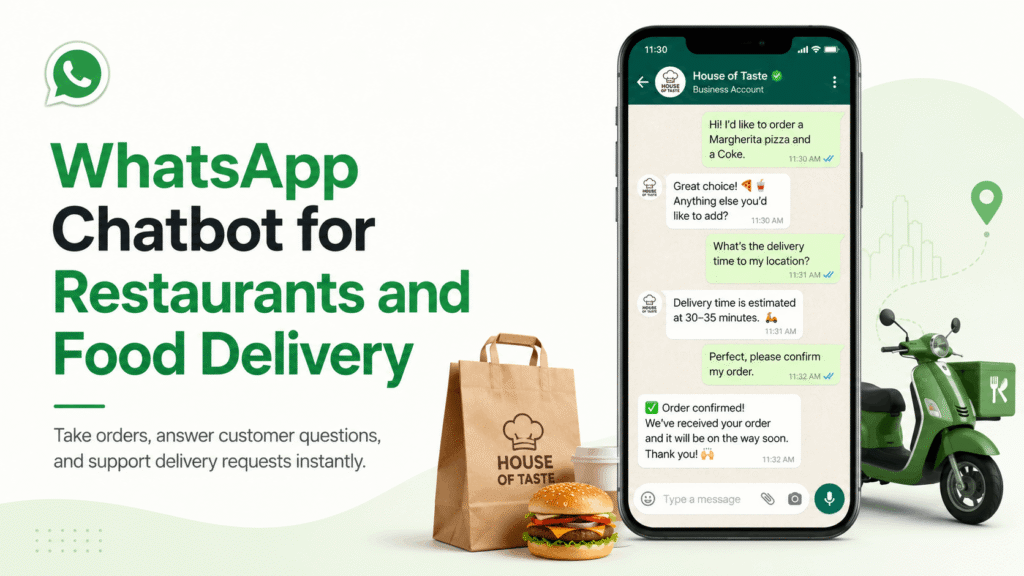
A customer sends a message asking to order. The chatbot responds with a structured menu organized by category: starters, mains, sides, drinks, desserts. Each item includes a photo, description, and price. The customer browses without ever leaving WhatsApp. This is the equivalent of scrolling through an aggregator app menu, except there is no commission at the end of it.
Order taking with customization
The chatbot captures “one biryani, no raita, extra mirchi, two rotis” as a structured order rather than a free-text note. Customization options are built into the ordering flow so the kitchen receives clear instructions rather than trying to parse a rambling DM message. This matters for operations: the chatbot formats the order the same way every time.
Payment integration by region
In India, the chatbot generates a UPI payment link (Razorpay, PayU, PhonePe) that the customer pays from their banking app. In MENA, it integrates with Tamara, PayTabs, or cash-on-delivery confirmation. In LATAM, Mercado Pago and PIX links work through the same flow. WhatsApp Pay is also live in India and Brazil for direct in-chat payment, removing even the payment link step.
Order status updates
Once the order is confirmed and paid, the chatbot sends updates at each stage: order received, being prepared, out for delivery, delivered. This eliminates the “where is my order?” call volume that ties up staff during peak hours. For WhatsApp order confirmation automation, the same message logic that works for ecommerce applies directly to restaurant delivery.
Table reservation with availability
A customer who wants to dine in sends a message asking about a table for Saturday at 7pm for four people. The chatbot checks availability against the restaurant’s reservation calendar and confirms or offers alternatives without a phone call. Automatic reminders 24 hours before reduce no-shows.
Reorder automation
A returning customer who ordered the same pizza three times gets a prompt: “Welcome back, Priya. Order your usual chicken tikka pizza and garlic bread?” One confirmation message completes the order. This is the single highest-ROI automation for restaurants with repeat customer bases.
Broadcast promotions to opted-in customers
A restaurant with 800 opted-in WhatsApp customers can send a Tuesday afternoon broadcast offering 20% off for the next three hours. The cost is the API conversation fee. The return is measurable orders within minutes of the broadcast. This replaces paying Zomato for promotional placement.
WhatsApp Ordering vs Aggregators — The Honest Trade-offs
Most WhatsApp chatbot content written by chatbot vendors pretends aggregators have no value. That is not an honest or useful position for restaurant owners, so here is the actual comparison.
What WhatsApp ordering gives you that aggregators do not:
Zero commission on repeat orders. Direct customer relationship with first-party data you own. The ability to message your customer base directly with promotions. Customer phone numbers and order history that stay yours when you switch platforms. Feedback collected directly rather than filtered through a third-party review system.
What aggregators give you that WhatsApp ordering does not:
New customer discovery. Someone in a new neighbourhood who has never heard of your restaurant finds you on Zomato because of a search or a featured placement. WhatsApp ordering does nothing for this. You cannot acquire new customers through WhatsApp ordering; you can only serve customers who already know you exist.
Last-mile delivery infrastructure. Zomato and Swiggy have delivery networks. WhatsApp ordering means you need your own delivery, a third-party logistics partner like Dunzo, Shadowfax, or Lalamove, or delivery limited to collection only. This is an operational reality that every restaurant must account for before going WhatsApp-first.
Platform trust for first-time orders. A customer ordering from a restaurant for the first time is more comfortable paying through an established aggregator than paying a UPI link from an unknown number. This trust gap matters more in markets where digital payment fraud anxiety is high.
The honest verdict:
WhatsApp ordering does not replace aggregators for new customer acquisition. It replaces aggregators for repeat orders. The optimal strategy is to use aggregators for discovery (pay the commission on first orders) and convert those customers to WhatsApp for every subsequent order. A restaurant that runs this strategy well pays full commission on acquisition and near-zero cost on retention.
Six Use Cases That Drive Real ROI
Direct ordering for repeat customers
This is where the math works most clearly. A pizza restaurant in Singapore with 400 regular customers shifted 35% of repeat orders to WhatsApp over 90 days. At an average ticket of SGD 25 and a 28% GrabFood commission, that shift saved approximately SGD 3,430 per month. The chatbot platform and API costs ran SGD 180 per month. Net saving: over SGD 3,250 per month from one operational change.
Reservation management with automatic reminders
A mid-scale restaurant that previously took reservations by phone found 18% of bookings resulting in no-shows. After moving reservation management to WhatsApp with a 24-hour automated reminder and a deposit requirement for groups over four, no-shows dropped to 6%. At an average table revenue of $80 per sitting and 40 reservations per week, the no-show reduction recovered over $480 per week in previously lost revenue.
Slow-day flash promotions
A cloud kitchen in Dubai ran Tuesday and Wednesday lunch promotions through WhatsApp broadcasts to 620 opted-in customers. The promotions offered 15% off orders placed before 1pm. Average Tuesday revenue before the campaign: $180. Average Tuesday revenue after: $310. The broadcast cost: under $2 in API fees per send.
Order status updates replacing phone calls
A delivery-focused restaurant was receiving 60 to 80 “where is my order?” phone calls per day during peak hours. Every call took 2 to 3 minutes of staff time. Automated WhatsApp status updates reduced those calls to under 10 per day. At $8 per hour staff cost, recovering 2.5 hours of daily call time saves approximately $20 per day or $600 per month.
Loyalty program operation
Points balance queries, reward redemption, and tier status updates all run through WhatsApp without a separate app download or login. Customers in markets where loyalty app adoption is low engage significantly more with WhatsApp-based loyalty messages than push notifications from a restaurant’s own app.
Post-meal feedback collection
An automated message sent 30 minutes after a delivery asks for a rating and an optional photo. Restaurants that collect feedback this way average significantly more reviews than those relying on in-app aggregator prompts, because the request arrives at the right moment through a channel the customer is already using.
How to Set Up a WhatsApp Restaurant Chatbot
Step 1: Apply for WhatsApp Business API through a BSP
You cannot access the WhatsApp Business API directly from Meta as a restaurant. You must go through a Business Solution Provider (BSP) approved by Meta. Platforms like AeroChat, QuickReply.ai, and WATI are BSPs or connect through BSPs. The application process verifies your business name and phone number.
Step 2: Build your menu in the chatbot dashboard
Upload each menu category with item names, descriptions, prices, and photos. Photos increase order completion rates in WhatsApp menu flows significantly. Organize by category the same way your aggregator listing is organized. Customers who switch from Zomato to WhatsApp ordering will navigate a familiar structure more easily.
Step 3: Set up payment integration for your region
For Singapore, the primary payment method to configure is PayNow — the majority of customers expect to scan a QR code and pay instantly through their bank app (DBS, OCBC, UOB, Standard Chartered). HitPay is the most practical integration for Singapore restaurants on WhatsApp: it generates PayNow QR links, accepts credit and debit cards, and supports GrabPay from a single dashboard. Stripe works well for card-only setups. For customers who prefer a digital wallet, GrabPay links cover a significant portion of the under-35 demographic. Cash on delivery remains an option for first-time customers who are not yet comfortable paying a new direct channel. Test the full payment flow on a real device — scan the PayNow QR yourself on a DBS or OCBC account before the first customer uses it.
Step 4: Build opt-in collection
WhatsApp ordering only works with customers who opt in to receive messages from you. The most effective opt-in methods for restaurants are: QR codes on table tents and receipts linking to a WhatsApp chat, Instagram bio link to WhatsApp, and a message on the Zomato/Swiggy order confirmation asking customers to follow you on WhatsApp for direct order discounts. For building a WhatsApp opt-in list for a restaurant, the receipt QR code method has the highest conversion because customers scan it at the moment they are most satisfied with their meal.
Step 5: Connect to your POS or order management system
If you use a POS system, check whether your chatbot platform has a direct integration or webhook connection. AeroChat and QuickReply.ai connect to several restaurant POS systems. Without integration, orders from WhatsApp are received manually and entered into the POS, which adds staff overhead. For high-volume restaurants, the POS connection is worth the additional setup time.
Step 6: Test the full ordering flow end to end
Before sharing with customers, go through the complete flow as a customer would. Order something, customise it, pay, receive the confirmation, track the status. Have a staff member try it on a different device. Fix anything that breaks or confuses before the first real customer uses it.
Section 6: Five Best WhatsApp Chatbot Platforms for Restaurants
1. AeroChat — Best for restaurants that also run Instagram and website chat
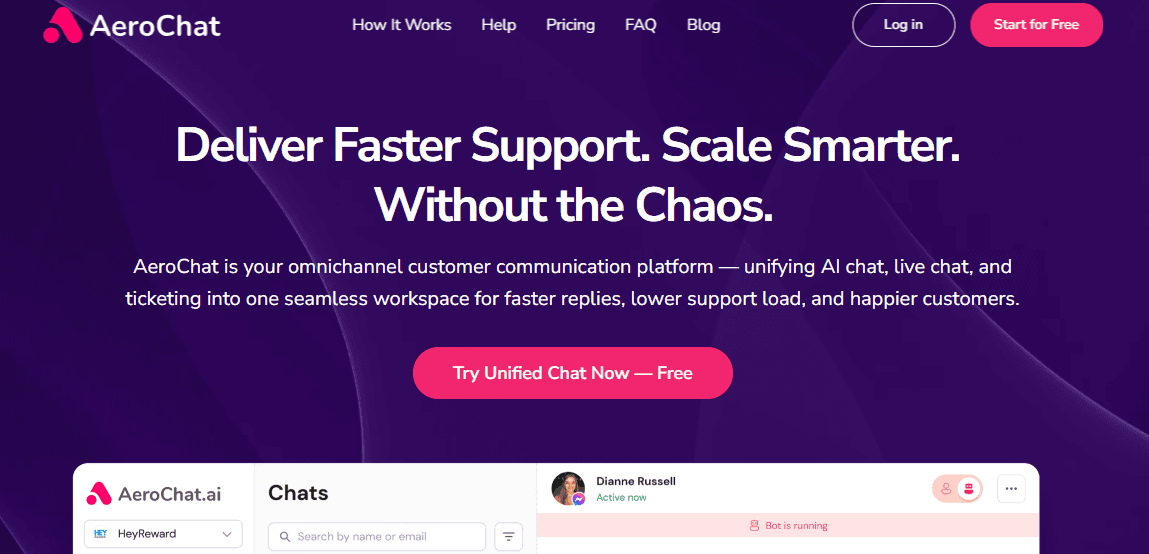
AeroChat connects WhatsApp, Instagram DMs, and website chat from one unified inbox. For restaurants that take reservations via Instagram, handle delivery enquiries on WhatsApp, and receive catering quotes through their website, managing all three from one dashboard reduces the missed message problem that plagues multi-channel restaurant operations.
The WhatsApp automation setup guide covers the restaurant ordering configuration in detail.
Best for: Restaurants and cloud kitchens that receive enquiries across WhatsApp, Instagram, and website and want one tool rather than three.
Where it falls short: Not a restaurant-specialist platform. Tools built specifically for food ordering have deeper menu catalog features and POS integrations out of the box.
2. QuickReply.ai — Best for India market with deep WhatsApp Business API
QuickReply.ai is built specifically for the Indian market with deep WhatsApp Business API access, UPI payment integration, and support for Hinglish and regional language flows. The broadcast and segmentation features are strong: you can send different promotions to customers who ordered curry dishes versus customers who ordered rice dishes.
Best for: India-based restaurants and cloud kitchens wanting to shift Zomato/Swiggy repeat orders to direct WhatsApp ordering.
Where it falls short: Primarily India-focused. MENA and LATAM restaurants will find less regional payment integration support.
Pricing: Plans from approximately $30/month for basic access.
3. Wazzy – Best restaurant-specialist WhatsApp tool
Wazzy is built specifically for restaurant WhatsApp ordering with menu management, order routing, and kitchen notification features designed for food service operations. The menu catalog builder supports modifier groups (size, spice level, add-ons) in a way that translates directly to kitchen-ready orders.
Best for: Single-outlet and small chain restaurants where the primary automation need is WhatsApp ordering.
Where it falls short: Less strong on multi-channel coverage.
4. Olaclick – Best for LATAM market
Olaclick is a restaurant ordering platform with strong WhatsApp integration and market-specific payment support for Brazil, Mexico, Colombia, and Argentina.
Best for: LATAM restaurants wanting to build a direct ordering channel that competes with iFood and Rappi for repeat customers.
Where it falls short: Limited presence outside LATAM.
5. Landbot – Best for restaurants wanting full control over conversation design
Landbot is a no-code chatbot builder with strong WhatsApp integration that gives restaurant operators full control over how their ordering conversation flows. For restaurants with specific ordering logic that generic templates do not accommodate (set menus, chef’s choice systems, subscription meal plans), Landbot’s flexibility is the differentiator.
Best for: Restaurants with non-standard ordering formats willing to invest more setup time.
Pricing: Free plan available. Paid from $40/month.
WhatsApp Compliance Rules Every Restaurant Must Know
The 24-hour customer service window
When a customer messages you, you have 24 hours to send free-form messages in response. After that window, you can only contact them using pre-approved Template Messages (HSMs).
Template message approval
Promotional messages sent outside the 24-hour window must be pre-approved by Meta before use. This process typically takes 24 to 48 hours.
Opt-in requirements
You cannot send WhatsApp messages to customers who have not explicitly opted in. In India, the DPDPA 2023 requires clear consent for marketing communications. Your opt-in method must make the nature of the messages clear.
Per-conversation pricing
WhatsApp Business API pricing in 2026 is charged per 24-hour conversation window. Utility conversations (order confirmations, status updates) are priced lower than marketing conversations. In India, utility conversations cost approximately $0.004 per conversation. Marketing conversations cost approximately $0.011 per conversation.
What triggers account flags
Sending messages to numbers that did not opt in, sending the same template to large numbers of users in a short period, and receiving high block or spam report rates. Build the opt-in list properly.
What WhatsApp Restaurant Chatbots Actually Cost
|
Cost Component |
Monthly Cost (India example) |
|---|---|
|
WhatsApp Business API (utility conversations) |
$4-$10 |
|
WhatsApp Business API (marketing broadcasts) |
$2-$5 |
|
Chatbot platform (mid-tier) |
$50-$150 |
|
BSP fees (if separate from platform) |
$0-$50 |
|
Total monthly cost |
$56-$215 |
|
Aggregator commission equivalent (1,000 orders x $6 avg x 22%) |
$1,320 |
|
Monthly saving on shifted orders |
$1,105-$1,264 |
The ROI calculation depends on what percentage of orders you successfully shift to WhatsApp. At 30% shift: saving $330 to $380 per month. At 60% shift: saving $660 to $760. Most restaurants reach 30% direct order volume within 60 to 90 days.
For the full breakdown of WhatsApp Business API pricing by country, conversation rates differ significantly between India ($0.004), MENA ($0.014), and LATAM ($0.06 to $0.09).
Conclusion
WhatsApp ordering for restaurants is not a technology upgrade. It is a margin recovery strategy. Restaurants that have spent three years paying 20 to 30% of every delivery order to an aggregator are not making a tech decision when they set up a WhatsApp chatbot. They are reclaiming revenue that was always theirs.
The honest framing matters: WhatsApp does not replace aggregators for new customer acquisition. It replaces them for the repeat orders that aggregators charge full commission on every single time, despite doing no acquisition work on those orders. A customer who found you on Zomato six months ago and orders from you every Friday is paying your aggregator $1.50 every week for a customer relationship you built.
Shift that customer to WhatsApp. Keep paying Zomato for the new customer they bring next week.
If you want to test this on your restaurant’s WhatsApp number, AeroChat’s free trial sets up the full ordering flow in under an hour. No POS integration required for the first test. Run it alongside your existing setup and see how many customers switch before committing to a full migration.
FAQs
How does WhatsApp ordering work for a restaurant?
A customer sends a message to your WhatsApp Business number. A chatbot responds with your menu, takes their order including customisations, generates a payment link, confirms the order, and sends status updates as it is prepared and dispatched. No aggregator involved.
Can a chatbot take food orders on WhatsApp without human involvement?
Yes. A properly configured WhatsApp chatbot handles the full ordering flow: menu display, item selection, customisation capture, payment processing, and order confirmation without any staff involvement.
Do I need the WhatsApp Business API for my restaurant or is the Business App enough?
The standard WhatsApp Business app allows only one device, no automation, and no broadcast messages beyond very limited use. For restaurant ordering at meaningful volume, the Business API is required.
Can a WhatsApp chatbot handle both reservations and delivery orders?
Yes. A well-built WhatsApp restaurant chatbot handles both in the same conversation thread.
Can a WhatsApp chatbot send appointment reminders for restaurant reservations?
Yes. Automated reminder messages sent 24 hours before a reservation qualify as utility messages under Meta’s message tag rules. Restaurants that implement reminders see no-show rates drop from 15-20% to 5-8% on average.
Will using a WhatsApp chatbot get my restaurant’s account banned?
Not if you use an official Meta BSP or API-connected platform and follow opt-in rules.
How do I get my existing customers to switch from Zomato to WhatsApp ordering?
The most effective method is a discount incentive. “Order directly on WhatsApp and save 10% every time” converts aggregator customers to direct customers fastest. Print the WhatsApp QR code on your packaging, receipts, and table tents.
Does WhatsApp ordering work for cloud kitchens without dine-in?
Yes. Cloud kitchens are often the best fit for WhatsApp ordering because they have no table management complexity and their entire operation is delivery-focused.