
Why Messaging Apps Are Becoming the New Customer Support Channel
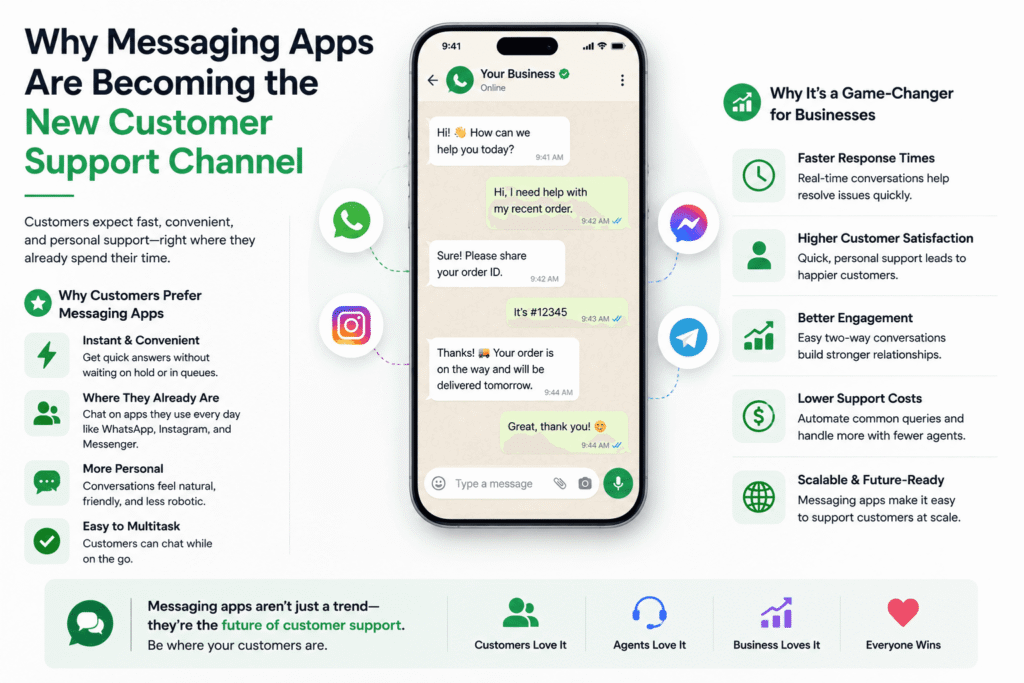
Messaging apps are rapidly replacing email and phone calls as the primary customer support channel for many businesses.
Customers increasingly prefer:
-
Instagram DMs
-
Telegram
because communication feels faster, easier, and more conversational.
Businesses now use messaging apps for:
-
customer support
-
pre-sales questions
-
order updates
-
lead qualification
-
booking requests
-
post-purchase communication
The shift is happening because customer behavior changed. Most people already spend large portions of their day inside messaging platforms, which makes traditional ticket systems and email support feel slower and less convenient by comparison.
That behavioral shift is now reshaping how companies manage customer communication in 2026.
Grounded in the uploaded messaging-support content strategy and omnichannel workflow SEO direction.
Why Messaging Apps Are Replacing Traditional Support Channels
|
Messaging Apps |
Traditional Support Channels |
|---|---|
|
Faster perceived replies |
Slower response expectations |
|
Mobile-first communication |
Often email-first workflows |
|
Continuous conversations |
Separate ticket threads |
|
Higher engagement rates |
Lower reply rates |
|
Conversational interaction |
Formal communication |
|
Easier for quick questions |
More friction for customers |
The biggest reason messaging apps are becoming support channels is simple:
customers already communicate there daily.
Businesses are adapting to where customer attention already exists instead of forcing customers into slower support systems.
Customer Expectations Changed Faster Than Most Businesses Expected
Five years ago, most businesses still treated messaging apps as secondary communication channels.
Support primarily happened through:
-
email
-
ticket portals
-
phone calls
Messaging apps were mostly used for:
-
marketing
-
promotions
-
casual communication
That separation no longer exists.
Today, customers expect businesses to respond through the same platforms they already use naturally throughout the day.
A customer browsing Instagram expects answers inside Instagram.
A customer messaging through WhatsApp expects support through WhatsApp.
The moment customers are forced to switch platforms unnecessarily, friction increases.
That friction often becomes the difference between:
-
continuing the conversation
-
abandoning it completely
Businesses increasingly recognize how modern customer communication behavior overlaps directly with broader omnichannel messaging workflows because customers now move fluidly between platforms during the buying journey.
Messaging Apps Feel Faster Than Email — Even When They Aren’t
One of the most important psychological shifts happening in customer support is perceived speed.
Messaging apps feel immediate.
Email feels delayed.
Even when response times are technically similar, customers psychologically associate messaging apps with:
-
live conversations
-
active engagement
-
real-time interaction
That perception matters heavily for customer trust.
A customer waiting twenty minutes for a WhatsApp reply often feels less frustrated than waiting twenty minutes for an email response because the communication environment itself feels more conversational and active.
Businesses increasingly study how faster customer responses affect behavior because perceived responsiveness directly impacts conversion and retention.
Some ecommerce brands also discover how slow support replies quietly reduce revenue before customers ever formally complain.
Customers Want Support Inside the Same Conversation Flow
Traditional customer support often interrupts the customer journey.
A shopper discovers a product on Instagram.
Then they must:
-
visit a website
-
open a ticket
-
send an email
-
wait for a reply
That process feels disconnected.
Messaging apps remove that interruption.
Customers can:
-
ask questions immediately
-
continue conversations naturally
-
return to the same chat later
-
receive updates inside familiar apps
That continuity creates smoother customer experiences.
It also changes how businesses think about customer support operationally because support conversations increasingly blend into:
-
sales
-
onboarding
-
retention
-
post-purchase communication
instead of remaining isolated inside separate support systems.
Messaging Apps Are Becoming the New Front Door for Businesses
For many companies, messaging apps now act as the first-touch communication layer.
Customers increasingly begin relationships through:
-
Instagram DMs
-
WhatsApp
-
Messenger
-
website chat
before they ever:
-
place orders
-
submit forms
-
speak with sales teams
-
create accounts
That means messaging apps are no longer just support channels.
They are becoming:
-
discovery channels
-
conversion channels
-
relationship channels
at the same time.
Many businesses now use messaging systems to:
-
answer pre-sales questions
-
qualify leads
-
recommend products
-
guide customer decisions
before traditional support even begins.
Ecommerce businesses increasingly automate pre-sales customer conversations because hesitation often appears before checkout starts.
Others focus on conversational workflows designed to improve website lead generation without creating additional manual workload.
Why Messaging Apps Work Better for Mobile-First Customers
Most customer communication now happens on smartphones.
Messaging apps are naturally designed for:
-
mobile interaction
-
short-form communication
-
quick replies
-
asynchronous conversations
Traditional support systems often still feel:
-
desktop-oriented
-
slower
-
more formal
-
less convenient
Messaging apps align more naturally with how customers already use their phones throughout the day.
That usability advantage becomes even stronger during:
-
ecommerce browsing
-
travel
-
food delivery
-
appointment booking
-
local-service enquiries
where customers expect fast conversational interaction instead of long-form support workflows.
Messaging Apps Blur the Line Between Support and Sales
One major reason messaging platforms are growing rapidly in customer support is because they support much more than support alone.
Inside one conversation thread, customers may:
-
ask pricing questions
-
request recommendations
-
check delivery timing
-
confirm availability
-
continue the conversation later
That creates a much more continuous relationship between businesses and customers.
The same conversation can naturally move between:
-
support
-
sales
-
onboarding
-
retention
without forcing customers into separate systems.
This is one reason messaging apps often generate stronger engagement compared to traditional ticket-based support environments.
The Rise of Messaging Apps Also Creates Operational Problems
The shift toward messaging-first customer support creates major operational pressure too.
Without centralized workflows, businesses quickly struggle with:
-
scattered conversations
-
duplicated replies
-
missed enquiries
-
inconsistent response quality
-
fragmented communication
A small team may suddenly manage conversations across:
-
WhatsApp
-
Instagram
-
Messenger
-
website chat
-
email
simultaneously.
That fragmentation becomes difficult to scale manually.
Businesses increasingly look for systems that help manage WhatsApp, Instagram, and website chat together instead of forcing teams to constantly switch between disconnected inboxes.
AI Is Accelerating the Shift Toward Messaging-Based Support
Without automation, messaging apps would overwhelm many support teams operationally.
Customers expect messaging to feel immediate.
But small teams cannot realistically respond instantly across every platform manually.
AI changes that equation.
Businesses now increasingly use AI-powered systems to:
-
answer FAQs
-
automate repetitive questions
-
qualify leads
-
route conversations
-
provide instant replies
-
manage after-hours enquiries
across messaging platforms simultaneously.
This allows smaller teams to handle much larger conversation volume without increasing support headcount proportionally.
Many businesses now explore how AI helps smaller teams manage more customer conversations as communication volume scales across channels.
Others prioritize systems designed to handle high customer-message volume efficiently before operational bottlenecks start affecting customer experience.
How Businesses Are Using Messaging Apps Today
|
Use Case |
Common Messaging Channel |
|---|---|
|
Customer support |
|
|
Product questions |
Instagram DMs |
|
Order updates |
Messenger |
|
Appointment booking |
Website chat |
|
Lead qualification |
WhatsApp + AI Chat |
|
Post-purchase follow-up |
Messaging automation |
The biggest operational shift is not just that businesses are using messaging apps.
It’s that messaging apps are becoming the primary customer communication layer itself.
Real-Time Messaging Reduces Customer Hesitation
Many customers abandon purchases because they cannot get answers quickly enough.
Messaging apps reduce that hesitation because customers can ask questions instantly during:
-
product browsing
-
checkout
-
onboarding
-
booking flows
That speed matters heavily for conversions.
Businesses increasingly use:
-
WhatsApp support
-
AI messaging systems
-
conversational product guidance
-
instant reply workflows
to reduce hesitation before customers leave entirely.
Many ecommerce brands specifically focus on conversational systems designed to reduce cart abandonment using instant replies during high-intent shopping moments.
Others prioritize workflows designed to reduce customer waiting time operationally across support and sales conversations.
Where AeroChat Fits
AeroChat focuses specifically on helping businesses manage customer communication across modern messaging channels using AI-powered automation.
Instead of replacing support teams entirely, AeroChat helps businesses:
-
automate repetitive questions
-
improve response speed
-
manage omnichannel messaging
-
reduce manual conversation workload
-
handle customer enquiries across multiple platforms
Complex customer situations can still route to human teams when necessary.
That distinction matters because messaging apps dramatically increase conversation volume. Businesses usually do not need fewer customer conversations.
They need better systems for handling them operationally.
Businesses increasingly explore:
-
AI-powered FAQ automation
-
support automation maturity models
before messaging-related support pressure scales further.
Frequently Asked Questions
Why are messaging apps becoming customer support channels?
Customers increasingly prefer messaging apps because communication feels faster, easier, and more conversational compared to traditional email or phone-based support.
Which messaging apps are most commonly used for customer support?
Businesses commonly use WhatsApp, Instagram DMs, Facebook Messenger, Telegram, and website chat platforms for customer communication.
How do messaging apps improve customer support?
Messaging apps improve support by reducing communication friction, improving perceived response speed, enabling mobile-first conversations, and supporting continuous customer interaction.
Can AI automate messaging-app customer support?
Yes. Many businesses now use AI systems to automate repetitive questions, FAQs, lead qualification, customer routing, and after-hours messaging support.
Are messaging apps replacing email support completely?
Not completely. Many businesses still use email and phone support, but messaging apps are increasingly becoming the primary communication layer for customer interaction.
Final Thoughts
Customer communication behavior changed much faster than traditional support systems did.
Customers now expect businesses to respond through:
-
WhatsApp
-
Instagram
-
Messenger
-
website chat
because those are the platforms customers already use naturally throughout the day.
That shift is turning messaging apps into the new customer support layer itself.
The businesses adapting successfully are usually the ones building:
-
faster communication systems
-
omnichannel workflows
-
messaging automation
-
AI-assisted support operations
before conversation volume becomes operationally overwhelming.