
How to Handle High-Volume Customer Messages on Shopify

To handle high-volume customer messages on Shopify, first measure where demand is coming from, then prevent avoidable enquiries, automate low-risk repeat requests and route exceptions to people with the authority to resolve them. The goal is not to make every conversation automated. It is to keep routine questions out of the human queue while protecting customers who need judgement, reassurance or an account change.
A store receiving 1,000 messages a day will need more capacity than one receiving 100, but message count alone does not tell you whether the operation is healthy. A smaller queue can still be unmanageable when it contains duplicate contacts, ageing complaints and requests that agents cannot resolve without approval. The system below works for sustained growth as well as temporary spikes caused by product launches, promotions and seasonal trading.
How do you know support volume has become a system problem?
High volume becomes a system problem when new work arrives faster than the team can resolve it, the backlog grows across shifts or customers contact you repeatedly about the same issue. At that point, asking agents to type faster will not solve the underlying cause.
Track demand and capacity together:
| Measure | What it tells you | How to use it |
|---|---|---|
| New conversations by day and channel | Where support demand originates | Compare normal weeks with launches, promotions and fulfilment disruptions |
| Resolved conversations by day | The team's actual capacity | Compare like-for-like shifts rather than relying on an assumed tickets-per-agent target |
| Backlog size and oldest waiting message | Whether unresolved work is accumulating | Watch both the total queue and the age of high-risk cases |
| Contacts per 100 orders | Whether support demand is rising faster than sales | Divide customer-initiated conversations by orders, then multiply by 100 |
| Repeat contacts for the same issue | Where slow or unclear responses create extra work | Group conversations by customer, order and enquiry type |
| Reopened conversations | Where an apparent resolution did not solve the problem | Review the original answer, promised next step and ownership |
Contacts per 100 orders is particularly useful because raw message volume usually rises with sales. If orders increase by 40% and conversations rise by 40%, the support burden per order is broadly unchanged. If conversations rise much faster, look for a broken delivery update, unclear promotion, product-information gap or policy change.
Do not set a universal “healthy” benchmark from another store. Product complexity, average delivery time, returns policy and customer mix can all change how much support an order creates. Establish your own baseline and investigate meaningful departures from it.
Map customer messages before choosing a tool
Take a representative sample from a normal week and, if relevant, a recent peak. Classify each conversation by:
- reason for contact;
- channel;
- customer or order stage;
- information needed to answer;
- action needed to resolve it;
- risk if the answer is wrong; and
- whether a human decision or identity check is required.
Start with broad categories such as order status, delivery issue, product question, cancellation, return, refund, complaint and account problem. Split a category only when the difference changes how it should be handled. “Where is my order?” and “My order is marked delivered but is missing” may sound related, for example, but the second case needs investigation rather than a routine status response.
Shopify Inbox can help organise this work. Its official conversation guidance describes staff assignment, customer and order context, and automatic topic labels for supported English conversations. Those labels are useful starting points, but your operating rules should reflect the products, policies and risks of your own store.
The result of this exercise should be a message map, not a shopping list of software. It shows which enquiries can be prevented, which can be answered from verified information and which need access, approval or judgement.
Step 1: Reduce messages customers should not need to send
The safest message to automate is often the one you prevent. Look at your highest-volume categories and ask what information the customer was missing at the point they decided to contact you.
Make order and delivery information easy to find
Send accurate confirmation and dispatch updates, provide a clearly labelled tracking route and explain what each fulfilment status means. If tracking has not updated for several days, tell customers what to do next instead of sending them back to the carrier without guidance.
For routine status requests, you can automate Shopify order-status questions using live order information. Access should be gated by an appropriate identity check before order details are shown.
Fix recurring product-information gaps
Review pre-purchase conversations by product. Repeated questions about sizing, compatibility, ingredients, materials, care or what is included often point to a weak product page rather than a support staffing problem.
Add the answer where the buying decision happens. Use a comparison table when customers must distinguish variants, a short measurement guide when fit is the issue, and plain limitations when the product is unsuitable for a particular use. The objective is to help the customer choose correctly, not simply reduce contact.
Clarify returns, cancellations and promotion rules
Place important conditions where customers can see them before checkout and in the relevant post-purchase message. State deadlines, exclusions, evidence requirements and the next step in ordinary language.
Shopify's customer-service documentation recommends clear return policies and notes that common questions such as order status, shipping and basic product information can be handled with appropriate automation. Complex or unhappy cases still need empathy and human judgement.
Step 2: Decide what to automate, assist or keep human
Use risk and required action—not frequency alone—to decide how each message should be handled. A frequent request is not automatically safe to automate.
| Handling route | Suitable examples | Required controls | Keep out of this route |
|---|---|---|---|
| Automated answer or self-service | Published policy, product specification, verified order status | Approved source, confidence boundary, identity check where customer data is involved, clear handover option | Exceptions, disputed facts, irreversible account changes |
| AI-assisted human reply | Delivery investigation, return within policy, product question needing context | Agent reviews the source and proposed action before sending | Cases where a plausible but wrong answer could create material harm |
| Rules-based routing | Complaint, cancellation request, missing delivery, payment concern | Reliable intent labels, priority rules, named queue owner | Automatic resolution without reviewing the case |
| Human decision | Refund dispute, policy exception, repeated service failure, vulnerable customer, fraud concern | Appropriate access, decision authority, audit trail and escalation route | Forced bot loops or replies that merely restate policy |
Automation should answer only from information the business is prepared to stand behind. If product data, delivery estimates or policy wording are inconsistent, fix the source before expanding automation.
Separate “answering” from “acting”. An automated system may safely explain a cancellation policy but should not necessarily cancel a fulfilled order. Map every action that changes an order, payment, address, account or entitlement, then decide whether it requires verification, human approval or both.
Step 3: Triage the remaining queue by risk and customer need
A useful queue is not simply oldest-first. It makes urgent, high-impact and time-sensitive work visible without allowing ordinary requests to disappear.
Create a small number of priority levels that agents can apply consistently:
- Immediate risk: payment or account-security concerns, safety issues, credible fraud signals and any case with a legal or privacy escalation route.
- Time-sensitive order change: cancellation, address correction or delivery intervention where delay may remove the available option.
- Service failure: missing or damaged delivery, repeated contact, complaint, failed refund or broken promise.
- Buying decision: a customer needs accurate information before placing an order.
- Routine information: standard order status, policy or product question with no exception.
Attach the relevant customer, order and previous-conversation context before an agent begins. The fastest reply is not useful if the customer must repeat the problem or if two agents take conflicting actions.
Set response and resolution commitments by category based on your staffing hours, operational dependencies and promises to customers. Avoid copying an arbitrary one-hour or four-hour target from another business. Measure whether your own commitment is met and whether the case is actually resolved.
Give each queue a named owner. Shared responsibility often becomes no responsibility, especially across shift changes. The owner does not have to answer every case, but must know when the queue is outside its agreed operating range.
Prepare support for product drops and seasonal peaks
Peak planning should begin with your own history. Review the last comparable launch, promotion or seasonal period and identify which products, channels, fulfilment stages and campaign messages created contact.
Before the event:
- estimate orders and contacts using your own past contact rate, then model a sensible low and high case;
- confirm trading hours, staffing cover and escalation ownership;
- check product, stock, discount, delivery and returns information for contradictions;
- prepare approved replies for predictable questions, while leaving room for case-specific details;
- test order lookup, identity checks and human handover;
- decide which order or account actions remain human-only;
- pause non-essential changes to support tools during the peak; and
- tell marketing and fulfilment teams how to report a promotion error, stock mismatch or delivery disruption.
During the event, monitor new conversations, resolutions, backlog age and repeat contacts by category. A growing “discount not working” queue needs a promotion fix, not a larger macro library. A sudden increase in delivery questions may require a proactive update to affected customers.
After the event, record what created avoidable demand and what agents could not resolve at first contact. Those findings should change the next product page, campaign brief, fulfilment message or authority rule.
Build reliable human handover and AI quality control
Human handover works when the customer keeps their place in the conversation. The agent should receive the transcript, detected intent, customer and order context, information already supplied and the reason automation stopped.
Define handover triggers such as:
- the customer asks for a person;
- identity cannot be confirmed;
- available information conflicts;
- the request requires an order, payment or account change;
- the customer disputes a previous answer;
- frustration or a complaint is detected; or
- the system cannot support its answer from an approved source.
Then review a sample of automated and AI-assisted conversations every week. Include both apparently successful conversations and those that were reopened or escalated. Classify errors by severity: unclear wording, incomplete answer, wrong source, incorrect factual answer, missed escalation or unauthorised action.
Do not judge quality only by the percentage of conversations that avoided an agent. A high containment rate can hide poor outcomes if customers return later, abandon the conversation or receive a confident but incorrect answer.
Measure whether the new system is working
Use a compact scorecard that connects efficiency with customer outcome:
- Contacts per 100 orders: shows whether preventable demand is changing.
- First-contact resolution: shows whether the first interaction solved the issue.
- Repeat-contact and reopen rate: reveals weak resolutions and broken promises.
- Backlog size and oldest waiting case: shows whether work is accumulating.
- Response and resolution time by category: keeps urgent cases from being hidden inside an overall average.
- Automation containment by intent: shows which categories finish without an agent.
- Automation error and escalation rate: adds a quality check to containment.
- Customer satisfaction by handling route: compares automated, assisted and human experiences without treating them as identical.
Read metrics together. If automated containment rises while repeat contact and complaints also rise, the system is moving work rather than resolving it. If contact rate falls after a product-page update without an increase in returns, prevention is probably working.
Shopify Inbox, a helpdesk or an AI agent: what do you need?
The right layer depends on the job. Many growing stores use more than one, but overlapping tools should have clear ownership of routing, customer context and reporting.
| Support layer | Best suited to | Main limitation to plan for |
|---|---|---|
| Shopify Inbox | Centralising Shopify-linked chat conversations for a small team, with assignment and customer context | It does not replace a complete high-volume operating model or make every complex case automatable |
| Customer-service helpdesk | Multi-agent queues, ownership, permissions, service commitments and reporting across support work | It may organise repeat demand without preventing or resolving it automatically |
| AI customer-service agent | Answering verified repeat questions, retrieving relevant commerce information and handing exceptions to people | Quality depends on source data, boundaries, testing and a reliable human route |
| Self-service and proactive communication | Preventing predictable order, delivery, policy and product enquiries | Poorly timed or inaccurate information can create more contacts |
Before buying a tool, use the message map to write three lists: required data, permitted actions and human-only decisions. Then compare Shopify AI chatbot options against those requirements, not a generic feature count. Include implementation effort and ongoing usage when you compare Shopify chatbot pricing.
How AeroChat helps Shopify teams manage repeated conversations
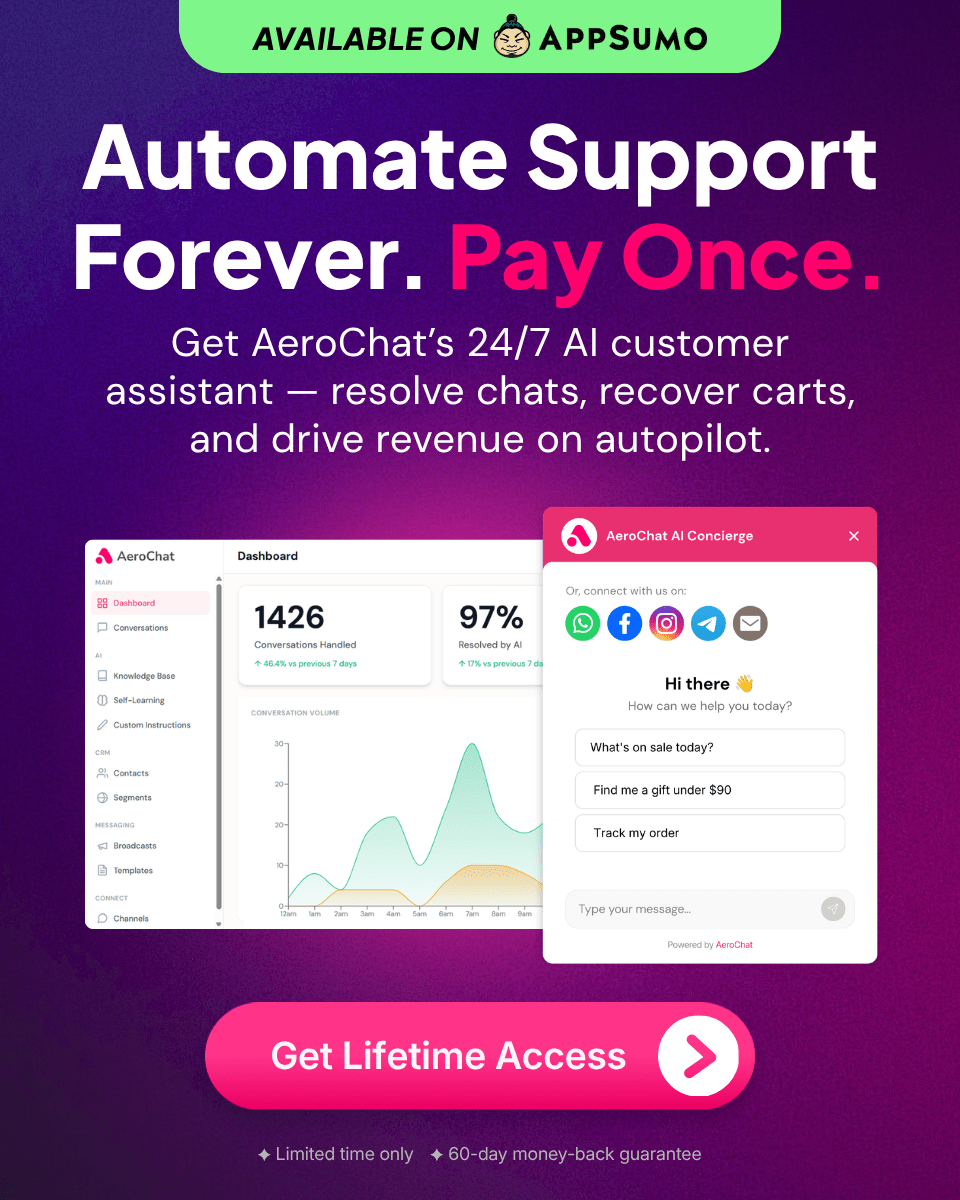
AeroChat is an AI agent platform that helps Shopify merchants run customer service on autopilot. It can synchronise relevant Shopify product, collection, order, discount and store-page information, then use that information to answer supported product, policy and order questions.
For a high-volume operation, its practical role is to take verified repeat enquiries out of the human queue and keep exceptions connected to the right context. AeroChat can support conversations across website chat, WhatsApp, Instagram, Facebook Messenger, Telegram and email, while handing a conversation to a human when it needs personal attention.
Order information should still be protected. AeroChat's order-status workflow uses an email address or phone number to confirm identity before sharing order details. Teams should test this flow, review source information and define which requests require a person before expanding coverage.
Best for: Shopify merchants who want to automate and scale customer service without extra manpower and costs.
AeroChat is generally a growth-stage support investment rather than a required launch cost. It becomes more relevant when customer enquiries increase or the business begins managing conversations across several channels. It cannot correct inaccurate product information or decide how your business should handle a sensitive exception; those remain operational and human responsibilities.
You can set up a Shopify chatbot after the message map and escalation rules are ready, or review AI customer service for Shopify to see how the connection and supported workflows fit your operation.
A practical 14-day implementation plan
Days 1–3: Measure and classify
Export a representative sample, calculate contacts per 100 orders and identify backlog age, repeat contacts and the highest-volume intents. Note what information and action each intent requires.
Days 4–7: Prevent and route
Fix the clearest product, delivery, returns and promotion gaps. Define the automate, assist and human-only categories. Assign queue owners and escalation authority.
Days 8–10: Configure and test
Connect approved information sources, configure identity checks and test normal, ambiguous and adversarial examples. Include an out-of-policy request, conflicting product information, an angry customer and a failed lookup.
Days 11–14: Release in controlled stages
Start with a narrow, low-risk category. Review conversations daily, correct the source or rule behind each error and expand only when the current category is reliable. Keep a rollback route and tell agents what changed.
Final operating checklist
Before the next sales or seasonal spike, confirm that:
- contact demand and resolution capacity are measured by day and channel;
- the team can see the oldest and highest-risk unresolved cases;
- repeated product, delivery and policy gaps have an owner;
- automated answers use approved, current information;
- identity is checked before protected order details are shared;
- irreversible or sensitive actions have suitable approval;
- customers can reach a person without restarting the conversation;
- queue ownership and shift handover are explicit;
- AI-assisted and automated conversations are sampled for quality; and
- post-peak findings feed back into product, marketing and fulfilment work.
High-volume support becomes manageable when the store treats customer contact as an operational signal. Prevent what should not become a message, automate what is safe and repeatable, and give skilled people the context and authority to resolve everything else.