
Top Shopify Apps for Boosting Sales

The best Shopify sales app is the one that fixes a measured weakness in your buying journey. Shopify Search & Discovery is a sensible free starting point when shoppers cannot find products. Judge.me helps when a lack of reviews is weakening trust. Klaviyo suits stores ready for segmented email and SMS. Rebuy is aimed at more advanced upselling, while AeroChat is relevant when unanswered product questions are holding shoppers back.
Installing all of them would be a poor strategy. Each app adds cost, operational work and, in some cases, storefront code. Start with the sales bottleneck, choose one app that can affect it and decide in advance how you will measure the result.
The best Shopify sales apps by business problem
| Sales problem | App to consider | Public starting point* | Shopify App Store rating* |
|---|---|---|---|
| Shoppers cannot find suitable products | Shopify Search & Discovery | Free | 2.7 |
| Pre-purchase questions go unanswered | AeroChat | From $49/month | 5.0 |
| New products lack credible reviews | Judge.me | Free; Awesome from $15/month | 5.0 |
| Visitors do not return after browsing | Klaviyo | Free to install; paid email from $20/month | 4.7 |
| Average order value needs improvement | Rebuy | Free option; paid tools from $25/month | 4.7 |
| Repeat-purchase products need subscriptions | Appstle Subscriptions | Free; Starter from $10/month | 5.0 |
| A campaign needs a purpose-built landing page | PageFly | Free; Builder from $24/month | 4.9 |
| A small team needs free live chat | Shopify Inbox | Free | 4.6 |
*Public pricing and ratings checked on 1 September 2026. Prices are in USD and may change. Ratings should be read alongside review volume and recent critical reviews, not treated as a quality guarantee.
How these apps were selected
This is a desk-researched comparison for merchants deciding which sales problem to solve next. We reviewed current Shopify App Store listings, public pricing, stated capabilities, review patterns and the operational work each app introduces.
The list is organised by sales job rather than popularity. An app qualified only if it could support a recognisable part of the customer journey: discovery, trust, follow-up, order value, repeat purchasing, campaign conversion or pre-purchase assistance.
The comparison does not claim that an app caused the results described in its reviews. Store economics, implementation quality, traffic source and product demand all affect performance.
1. Shopify Search & Discovery: best free starting point for product discovery
Shopify Search & Discovery helps merchants configure storefront filters, search synonyms, product boosts and complementary-product recommendations. It is most useful when customers know roughly what they want but struggle to reach the right product or variant.
Best for: stores with a catalogue large enough to need filters, synonyms or product-level recommendations.
Useful when: internal search regularly returns irrelevant or empty results, or collection pages force shoppers to browse too broadly.
Main limitation: its 2.7 App Store rating signals that merchants should test the current feature set against their catalogue rather than assuming a native app will meet every merchandising requirement. Complex search logic may need a specialist tool.
Start by reviewing the search terms that lead to no results. Add synonyms only where customer language clearly differs from catalogue terminology, then check whether the change helps shoppers reach a suitable product.
2. AeroChat: best for product questions that interrupt a purchase
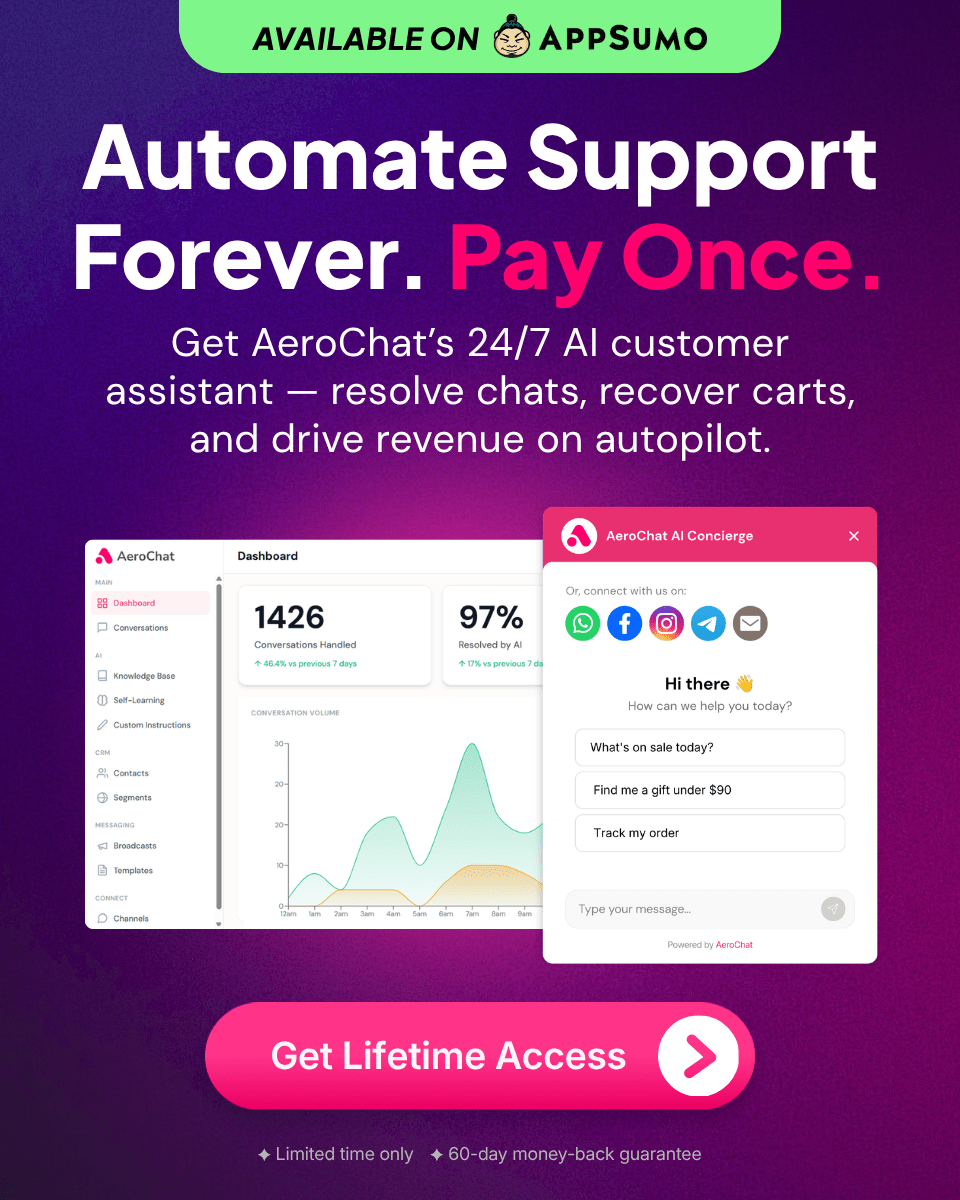
AeroChat is an AI agent platform that helps Shopify merchants run customer service on autopilot. It can use synchronised Shopify product, collection, inventory, order, discount and store information to answer suitable questions across supported channels, then hand a conversation to a person when judgement is needed.
This is a different job from changing the page layout or attracting more visitors. It becomes relevant when shoppers repeatedly ask questions such as whether a size is in stock, which product fits a stated need, whether a discount applies or where an existing order is.
Best for: growing Shopify stores losing sales or staff time to recurring product and order conversations.
Useful when: pre-purchase questions arrive outside staffed hours or across several channels, and the answers depend on current store information.
Main limitation: it is a growth-stage support investment, not a required launch app. A low-volume store should first improve incomplete product pages, delivery information and policies. The Shopify AI chatbot comparison is the more appropriate next step for merchants comparing conversational tools rather than sales apps generally.
3. Judge.me: best for building product-review coverage
Judge.me collects and displays product reviews, including photo and video submissions. Its free plan gives a new store a practical route to start requesting reviews without committing to a large monthly bill.
Best for: stores whose product pages need credible customer evidence.
Useful when: customers regularly ask whether an item fits, looks or performs as described, and existing buyers could answer those doubts through specific reviews.
Main limitation: a review widget cannot repair a weak product or poor fulfilment. Merchants also need a responsible process for moderation, incentives and responses. Do not hide useful criticism simply to protect the average rating.
Place reviews where they answer a decision, not only in a long block at the bottom of the page. A clothing store might surface comments about fit near its size selector; an electronics store might prioritise verified comments about setup and compatibility.
4. Klaviyo: best for segmented email and SMS follow-up
Klaviyo connects Shopify activity with email and SMS campaigns, forms, segments and automated flows. It is most valuable when a store has enough customer and behavioural data to send different messages to different groups.
Best for: merchants ready to operate welcome, browse-abandonment, cart, post-purchase and win-back programmes from one lifecycle-marketing system.
Useful when: returning visitors and existing customers account for a meaningful share of revenue, but follow-up is still mostly manual or identical for everyone.
Main limitation: the bill and operating workload rise with usage. Segmentation, consent, deliverability and campaign production need ongoing attention. A store with a tiny list may not need the complexity yet.
The purpose is not to send more messages. It is to make each message relevant enough to justify its place in the customer's inbox. The Shopify retention strategy guide explains where lifecycle communication fits alongside service and repeat-purchase work.
5. Rebuy: best for advanced upsells and personalisation
Rebuy provides product recommendations, cart merchandising, checkout and post-purchase offers, search tools and testing options. It is intended for stores with enough order volume to measure whether a more sophisticated merchandising layer improves average order value or customer lifetime value.
Best for: established stores with a clear upsell or cross-sell hypothesis and sufficient traffic to evaluate it.
Useful when: shoppers commonly buy products that have genuinely complementary accessories, refills or bundles.
Main limitation: pricing can scale with order volume and the app can affect important storefront surfaces. Review current billing rules, compatibility and performance before rollout. Test the cart and checkout path after every material change.
An offer should improve the order, not merely enlarge it. Recommend a replacement filter with an air purifier; do not add an unrelated product because an algorithm found a loose association.
6. Appstle Subscriptions: best for repeat-purchase products
Appstle supports replenishment subscriptions, boxes, memberships, prepaid options and a customer portal. It can turn a naturally recurring purchase into a more convenient repeat-order relationship.
Best for: consumables and replenishment categories with a credible repeat interval.
Useful when: customers already reorder and would benefit from predictable delivery or a subscription incentive.
Main limitation: subscription revenue is not automatically healthy revenue. Poor cancellation controls, unsuitable frequencies or weak fulfilment can create support work and churn. The free and paid plans also carry different subscription-revenue limits.
Before installing it, calculate the likely gross margin after subscription discounts, fulfilment and failed-payment handling. Merchants comparing this category in depth can review the best Shopify subscription apps separately.
7. PageFly: best for campaign-specific landing pages
PageFly is a visual page builder for home, product, collection and landing pages, with templates and higher-tier optimisation tools. It is useful when a campaign needs a focused page that the current theme cannot produce efficiently.
Best for: teams running distinct launches or paid campaigns that need controlled landing-page layouts.
Useful when: campaign visitors currently land on a generic collection page and must reconstruct the offer for themselves.
Main limitation: another page-building layer can create maintenance, consistency and performance work. A flexible editor does not replace a clear offer or sound UX judgement.
Create the smallest page that answers the campaign promise. Keep product evidence, price, delivery information and the next action obvious. The wider ecommerce conversion-rate guide covers the on-site friction to check before buying more traffic.
8. Shopify Inbox: best free live-chat baseline
Shopify Inbox gives merchants a free way to chat with storefront visitors and manage suitable conversations from Shopify's ecosystem. It is a sensible baseline for a small store that wants to learn what customers ask before investing in automation.
Best for: early-stage merchants who can answer chats themselves and need evidence of conversation volume.
Useful when: the store has no live-chat route and the owner wants to collect real pre-purchase questions.
Main limitation: live chat still requires somebody to be available. As volume and channel count grow, response coverage and repetitive work can become the constraint.
Run it long enough to identify question types, time-of-day patterns and missed conversations. That evidence will show whether better product content, staffing or an automated support layer should come next.
Choose the app from the constraint, not the feature list
Use a simple diagnostic:
- Traffic arrives but cannot find products: improve navigation, filters and search.
- Product pages receive visits but lack trust: improve product evidence and review coverage.
- Visitors browse but rarely return: build permission-based lifecycle follow-up.
- Orders contain only one item: test a relevant merchandising or bundle hypothesis.
- Suitable products should be repurchased: assess subscription economics.
- Campaign clicks reach an unfocused page: create a dedicated landing experience.
- Shoppers ask before buying and wait for answers: improve information and conversation coverage.
Do not diagnose an app problem from revenue alone. Segment conversion by landing page, device, traffic source and customer type. A checkout app will not fix low-quality traffic, and an email platform will not fix a product that customers do not want.
Test one Shopify sales app for four weeks
Record a baseline before installation. Choose one primary measure and at least two guardrails.
| App job | Primary measure | Guardrails |
|---|---|---|
| Search and discovery | Search-to-product-view rate | No-result searches; page speed |
| Reviews | Product-page conversion | Review request opt-outs; moderation workload |
| Lifecycle messaging | Revenue per recipient | Unsubscribes; spam complaints |
| Upsells | Average order value | Checkout conversion; returns |
| Subscriptions | Active subscriber growth | Churn; failed payments; support contacts |
| Landing pages | Campaign conversion rate | Load time; bounce rate |
| Customer conversations | Suitable questions resolved | Escalations; answer accuracy; response coverage |
At the end of the test, keep, improve or remove the app. “It has useful features” is not a result. The question is whether it changed the intended customer behaviour without creating a larger cost, speed or service problem elsewhere.
Questions merchants ask before installing sales apps
How many apps should a Shopify store install?
There is no ideal number. Install only the apps with a defined owner, business job and success measure. Two purposeful apps can outperform a stack of ten overlapping tools.
Can Shopify apps slow down a store?
Apps that add storefront code, scripts or widgets can affect performance. Shopify advises merchants to review app and theme features when investigating speed. Test important templates before and after installation, and remove code left behind by uninstalled apps where necessary.
Which Shopify sales app should a new store install first?
Use Shopify's included capabilities until a real constraint appears. A new store may need no paid sales app. Collect search terms, questions, orders and abandonment data first, then buy the tool that addresses the clearest loss.
The strongest Shopify app stack is usually smaller than a feature comparison suggests. Start with one measurable constraint, protect storefront speed and keep the tools that make the buying journey clearer or the operation easier to run.