

How to Increase Ecommerce Conversion Rate in 2026 – 12 Strategies Ranked by Impact
Ecommerce conversion rate is the percentage of your website visitors who complete a purchase. The global average sits between 1.65 and 2.5 percent, meaning between 97 and 98 out of every 100 people who visit your store leave without buying.
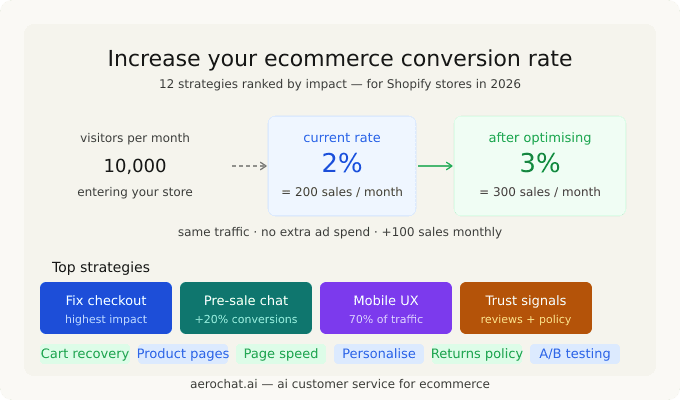
Increasing that number by even half a percentage point creates significant revenue from the same traffic. Here is what that looks like for a real store.
A Shopify store generating £200,000 annually with 100,000 annual visitors has a conversion rate of roughly 2 percent. If that store improves its conversion rate to 2.5 percent without changing its traffic, annual revenue rises to £250,000. That is £50,000 in extra revenue without spending a pound more on ads.
The 12 most effective strategies to increase ecommerce conversion rate, ranked by impact, are fixing checkout friction, improving product page quality, optimising mobile experience, adding trust signals, answering pre-sale questions with a chatbot, improving site search, recovering abandoned carts, adding and surfacing reviews, improving page speed, personalising the shopping experience, making returns easy, and running structured A/B tests.
This guide covers each one with specific, actionable steps you can implement rather than general advice to “improve trust” or “be more mobile-friendly.”
What is a good conversion rate for your store?
Before optimising, you need to know what you are optimising toward. The global average of 1.65 to 2.5 percent is not a useful benchmark because it blends every industry, device, and traffic source together.
By industry. Food and beverage converts at around 5 to 6 percent because purchase decisions are fast and familiar. Fashion and beauty converts at 2 to 3 percent. Electronics typically sits at 1 to 1.5 percent because customers spend longer researching before committing. If your fashion store converts at 1.5 percent, you have a problem. If your electronics store converts at 1.5 percent, you are near average.
By device. Desktop converts at around 3 to 4 percent. Mobile converts at 1.5 to 2.8 percent. Mobile drives 70 to 75 percent of ecommerce traffic for most stores but still lags significantly on conversion. If your mobile conversion rate is below 1.5 percent, mobile experience is your single highest-impact optimisation area.
By traffic source. Email converts at 4 percent or higher for engaged lists. Organic search converts at 2 to 3 percent for high-intent queries. Paid social converts at 0.5 to 1.5 percent because those visitors are not in an active buying mindset. If your paid social conversion rate is above 1.5 percent, you are performing well.
Use your own analytics to break your overall conversion rate into these segments. The segment with the biggest gap between its current rate and its potential rate is where to focus first.
12 strategies to increase ecommerce conversion rate, ranked by impact
Strategy 1 – Fix checkout friction first
Checkout is where the most recoverable revenue is. Cart abandonment averages 70.19 percent globally — over two thirds of customers who reach the checkout stage still do not complete the purchase.
The four most common checkout friction points are required account creation before purchase, shipping costs that are not visible until the final step, too many form fields, and limited payment method options.
Guest checkout removes the biggest single barrier for new customers. Required account creation before purchase causes immediate abandonment from customers who are not ready to commit to a brand relationship before they have bought once. Enable guest checkout and let the account creation invitation come after the purchase is complete, when the customer is already satisfied.
Show shipping costs before the final checkout step. The moment a customer sees an unexpected shipping fee on the payment page, the purchase psychology resets. They feel deceived rather than delighted. Show shipping costs on the product page, on the basket, and at every checkout step — not just at the end.
Reduce your checkout form to the minimum fields required to process the order. Every additional field is friction. Address autocomplete, saved payment methods for returning customers, and one-click checkout for recognised customers all reduce the effort required to complete the purchase.
Add the payment methods your customers use. Apple Pay and Google Pay are table stakes for mobile conversion. Buy Now Pay Later options like Klarna increase average order value and conversion rate particularly for higher-ticket items.
For a full breakdown of cart abandonment recovery including the WhatsApp flows that recover 22 to 35 percent of abandoned carts, the WhatsApp automation guide covers the specific setup and message timing.
Strategy 2 – Improve product page quality
Baymard Institute research finds that 56 percent of users start by exploring product images when they arrive on a product page. Yet only 25 percent of ecommerce sites provide enough images for customers to properly evaluate a product.
A product page that does not answer every question the customer has before buying is a leaking conversion point. Every unanswered question is a reason to leave and look elsewhere.
The minimum for any product page in 2026: multiple high-quality images from different angles, at least one image showing the product in context or in use, a size guide with actual measurements for clothing and footwear, detailed specifications for technical products, a clear and prominent display of your returns policy, delivery timeline and cost visible without clicking to a separate page, and a product description that explains the benefit of the product not just its features.
Video dramatically improves conversion on high-consideration products. A thirty-second product video on a furniture or electronics page showing the product in a real environment answers questions that static images cannot.
User-generated content — real customer photos on the product page — increases confidence in ways that professional photography does not. Customers trust other customers more than they trust brand imagery.

Strategy 3 – Fix your mobile experience
Mobile drives the majority of your traffic and converts at roughly half the rate of desktop for most stores. That gap is your largest conversion opportunity if you have not addressed it.
The mobile conversion problems that kill the most revenue are slow page load times on mobile connections, product images that do not load at the right size, checkout forms that are difficult to complete on a small screen, and product descriptions that require too much scrolling to reach the add-to-cart button.
Test your own store on a mobile device on a standard 4G connection, not on your office WiFi. The experience your customers have is different from the one you see on a fast desktop connection. Most stores discover specific friction points they were not aware of through this exercise.
Page load speed on mobile is the most direct mobile conversion fix. For every one second of additional page load time, mobile conversion rates drop by an estimated 20 percent. Compress images, minimise scripts, and use a content delivery network to bring your pages as close as possible to your customers geographically.
Strategy 4 – Add trust signals throughout the purchase journey
A customer who does not trust your brand does not buy from it. Trust is built through multiple signals throughout the shopping experience — not just a padlock icon at checkout.
Display your returns policy prominently on product pages, not hidden in a footer link. A visible, generous returns policy reduces the perceived risk of buying from a brand the customer does not know yet. Fifty-seven percent of consumers will not shop from a store without free returns.
Security badges at checkout — SSL certificate indicators, recognised payment provider logos, and established security certification marks — reduce payment anxiety at the moment the customer is asked to enter their card details.
Customer reviews displayed prominently on product pages are the most powerful trust signal available to ecommerce stores. Products with 11 to 30 reviews convert 68 percent higher than those with zero reviews. The number and recency of reviews matters — a product with 500 reviews from three years ago converts less well than one with 50 reviews from the last three months.
Live visitor counts, genuine scarcity indicators, and sold-out notifications create social proof that signals your store is active and your products are in demand. Low-stock warnings increase conversion rates by 10 to 25 percent when used for genuine stock situations, not manufactured urgency.
Strategy 5 – Answer pre-sale questions with an AI chatbot
This is the conversion strategy that is genuinely underused and completely unaddressed by every other guide on this topic.
A customer who has a question about a product before buying has two outcomes. They get an instant, accurate answer and continue to purchase. Or they leave to find the answer elsewhere and do not return.
Sizing questions, compatibility questions, ingredient queries, delivery timeline questions, payment method availability — these are pre-sale questions that occur on your product page at the moment the customer is closest to buying. Each one that goes unanswered is a conversion lost.
An AI chatbot connected to your live product catalogue and store data answers these questions within seconds, at any hour, without a human agent. AeroChat handles pre-sale questions on website chat, WhatsApp, and Instagram DM — all connected to your Shopify store data so answers are accurate, not generic.
AI chatbots achieve twenty percent or more conversion increases when properly configured for pre-sale support, according to industry research. The mechanism is simple: more questions answered, more purchases completed.
The difference between AeroChat and a generic chatbot is data access. A generic chatbot gives a canned response about contacting support. AeroChat checks your live inventory, reads your actual product specifications, and gives the specific answer the customer needs to feel confident buying.
For the specific pre-sale conversation flows and how to train your chatbot on product-specific questions, the best Shopify AI chatbot guide covers the setup and which question types drive the highest conversion impact.
Strategy 6 – Improve your site search
Customers who use your site search are your highest-intent visitors. They are actively looking for something specific and ready to buy if they find it. Site search users convert at two to three times the rate of non-searchers.
Yet most ecommerce stores have poor search functionality. Common failures include search results that return nothing for natural language queries, no tolerance for spelling errors or synonyms, no autocomplete suggestions, and no alternative recommendations when a product is out of stock.
Fix your site search to handle natural language. A customer searching for “navy blue summer dress under £50” should return relevant results, not zero results or an irrelevant list. Modern site search tools with AI capability handle this well. Older keyword-only search does not.
Add autocomplete to guide customers toward products you carry before they have finished typing. Add alternative product suggestions when a search returns zero results rather than an empty page. An empty search results page converts at near zero. A page that says “We do not have that exact item but you might like these” converts at a meaningful rate.
Strategy 7 – Recover abandoned carts on WhatsApp
Cart abandonment recovery is not a new strategy. Abandoned cart emails exist in every store. What is relatively new — and significantly more effective — is abandoned cart recovery on WhatsApp.
WhatsApp messages have a 98 percent open rate versus 21 percent for email. WhatsApp cart abandonment messages sent within thirty minutes of abandonment recover between 22 and 35 percent of abandoned carts. Email recovery at the same timing recovers 8 to 12 percent.
The difference is timing and visibility. A WhatsApp message sent thirty minutes after abandonment arrives while the customer still has their shopping session mentally active. An email sent at the same time sits in an inbox the customer checks twice a day.
The message should name the specific products left in the cart, not be generic. “Your Blue Linen Shirt (size M) is still in your cart” converts far better than “You left something behind.” It signals that you paid attention, which builds the trust that closes the purchase.
For the complete WhatsApp cart recovery setup including the three-message sequence and what each message says, the WhatsApp automation guide covers the full flow with timing and message templates.
Strategy 8 – Surface reviews strategically
Reviews exist on most ecommerce sites. Strategic placement of reviews is much less common.
The placement decisions that most impact conversion are: showing a star rating and review count directly under the product title (not just at the bottom of the page), featuring reviews that address common purchase objections near the add-to-cart button, and using reviews that mention specific attributes customers care about for your product category.
For clothing: surface reviews mentioning “true to size,” “runs small,” or “fabric quality.” For electronics: surface reviews mentioning “easy to set up,” “good battery life,” or “works as described.” For food and supplements: surface reviews mentioning “taste” or “felt a difference.”
This targeted surfacing of relevant reviews at the right point on the product page reduces the specific purchase anxiety that was going to cause abandonment.
Video reviews and user-generated content photos convert better than text reviews alone. A customer seeing a product on a real person whose body type or use case matches their own has significantly higher purchase confidence.
Strategy 9 – Improve page speed
Every additional second of page load time reduces conversion rate. On mobile, the impact is more severe than on desktop. Google’s research finds that a one-second delay in mobile page load reduces conversions by up to 20 percent.
Check your Core Web Vitals in Google Search Console. The three metrics that matter most for conversion are Largest Contentful Paint (how fast the main content loads), Cumulative Layout Shift (how much elements jump around as the page loads), and Interaction to Next Paint (how quickly the page responds to interactions).
The fastest improvements come from compressing images — the single most common cause of slow product pages — removing unnecessary third-party scripts, and using lazy loading for images below the fold so the visible part of the page loads first.
A store loading in under two seconds on mobile converts measurably better than the same store at three to four seconds. Most Shopify stores carry more apps than they actually use, and each unused app adds load time. Audit and remove apps you are not actively using.
Strategy 10 – Personalise the shopping experience
Personalisation increases conversion rates by 10 to 30 percent when implemented with actual customer data rather than generic segment assumptions.
The personalisation moves with the highest conversion impact are dynamic product recommendations based on the specific customer’s browsing and purchase history, personalised homepage content that shows different featured products to a first-time visitor versus a repeat buyer, and personalised cart abandonment messages that reference the specific products and the specific customer rather than sending the same message to everyone.
For returning customers, showing recently viewed products prominently and offering a quick reorder option for consumables removes the browsing friction that causes abandonment on repeat visits.
For ecommerce stores connecting WhatsApp customer communication to personalisation, the combination of a customer’s purchase history visible to the chatbot and a WhatsApp conversation that references their actual past orders creates a personalised support experience that directly increases repeat purchase confidence.
Strategy 11 – Make your returns policy a conversion tool
Most stores treat their returns policy as a legal requirement. Customer-focused stores treat it as a conversion tool.
A visible, generous, easy-to-understand returns policy removes the perceived risk of buying from a brand the customer does not fully trust yet. Fifty-seven percent of consumers will not buy from a store without free returns. A free returns policy, prominently displayed on product pages, directly converts undecided customers.
The returns policy should be on the product page itself, not only accessible through a footer link. It should be written in plain language, not legal language. And it should be genuinely generous — thirty days beats fourteen days, free label beats customer-pays, no questions asked beats “in original packaging with receipt.”
The argument that generous returns policies increase return rates is not well supported by data. What the data shows is that generous policies increase purchase rates significantly — and that customers who bought with confidence return less frequently than customers who bought while uncertain.
Strategy 12 – Run structured A/B tests
A/B testing is the only way to know with certainty what improves conversion for your specific store with your specific customers. Every general recommendation in this guide — including every one above — should be validated against your own data through structured testing.
The testing hierarchy for most ecommerce stores is: checkout flow first (highest impact, most recoverable revenue), product page elements second (images, reviews placement, description format, price display), and then homepage, navigation, and promotional elements.
Run one test at a time. Each test needs enough traffic to reach statistical significance before you draw conclusions — typically two to four weeks for most stores. A change that improves conversion for a fashion store may reduce it for an electronics store. Your store’s data is the only data that matters for your decisions.
Keep a record of every test, the result, and the reason you ran it. This builds an institutional knowledge of what your specific customers respond to that compounds in value over time.
The quick win audit – what to check this week
Five things you can check and fix without a developer, without a budget, and without technical expertise.
Check your guest checkout availability. Open your own store on a mobile device and try to add a product and reach checkout without creating an account. If you cannot, this is your highest-priority fix.
Check your shipping cost visibility. Add a product to your cart and note the first point at which shipping cost is visible. If it only appears at the payment step, move it earlier. At minimum, add a shipping cost calculator or clear delivery cost statement to the basket page.
Check your mobile product page. Open your top three product pages on your phone on a 4G connection. Note how long they take to load and whether the add-to-cart button is visible without scrolling. If neither is true, you have direct mobile conversion losses.
Check your review count on your top products. If any of your top three selling products have fewer than 10 reviews, add a post-purchase review request email to every order this week. Products with 11 to 30 reviews convert 68 percent higher than those with zero.
Check your chat response time. Send a message to your own store’s chat at a non-business hour and note how long before a response arrives. If the answer is hours or never, you are losing the pre-sale customers who had a question and did not get an answer. Configure AeroChat during your 7-day free trial to handle those conversations automatically using your live Shopify product data.
For the specific customer service KPIs that connect directly to conversion rate performance, that guide covers what to track and how to use the data to identify conversion gaps.
Frequently asked questions
What is a good ecommerce conversion rate?
A good conversion rate depends on your industry, traffic source, and device. For fashion and beauty stores, 2 to 3 percent is a reasonable benchmark. Electronics typically converts at 1 to 1.5 percent. Food and beverage converts at 5 to 6 percent. Established ecommerce sites generally achieve 2.5 to 4 percent overall. Your mobile conversion rate will typically be 1 to 1.5 percentage points lower than desktop — if the gap is larger than this, mobile experience is your primary optimisation area.
What is the fastest way to increase ecommerce conversion rate?
Fixing checkout friction delivers the fastest measurable improvement for most stores. Enabling guest checkout, showing shipping costs before the final step, reducing form fields, and adding popular payment methods like Apple Pay and Google Pay all remove barriers that are actively stopping customers from completing purchases right now. These changes typically show results within days of implementation, not weeks.
How much revenue does a 1 percent conversion rate increase add?
For a store with 100,000 annual visitors and a current conversion rate of 2 percent generating £200,000 annually: improving to 3 percent adds £100,000 in annual revenue with no additional traffic. Improving to 2.5 percent adds £50,000. Even a 0.5 percentage point improvement adds £25,000 annually from the same visitors. The impact scales with traffic volume — a store with 500,000 visitors annually sees five times this impact from the same percentage improvement.
Does an AI chatbot improve ecommerce conversion rates?
Yes. AI chatbots that answer pre-sale questions — sizing, compatibility, delivery timelines, product specifications — directly increase conversion rates by keeping customers on the product page rather than losing them to search engines or competitor sites. Industry data shows AI chatbots achieve twenty percent or more conversion increases when configured for pre-sale support. The key is data integration: a chatbot connected to your live Shopify product catalogue gives accurate, specific answers. A generic chatbot with no product data connection does not.
What is the most common reason ecommerce visitors do not convert?
Cart abandonment research from Baymard Institute identifies the five most common reasons as unexpected shipping costs at checkout (48 percent), being forced to create an account (24 percent), a slow or complicated checkout process (18 percent), not trusting the site with payment information (17 percent), and not being able to calculate total order cost upfront (16 percent). All five of these are checkout and trust problems — which is why checkout optimisation is the highest-impact starting point for most stores.