


How to Sell Pet Products Online Without Building a Generic Pet Store

To sell pet products online, choose a specific animal, owner problem and product category before choosing a store theme. Verify the supplier and the product information required in each market, then build an assortment that works after shipping, returns, expiry and customer acquisition—not merely one that looks popular.
“Pet products” is not one operating model. A dog lead, raw pet food, grooming spray, supplement and aquarium heater create different questions, risks and fulfilment demands. A focused store can explain its products more accurately and earn trust more easily than a catalogue assembled from unrelated trending items.
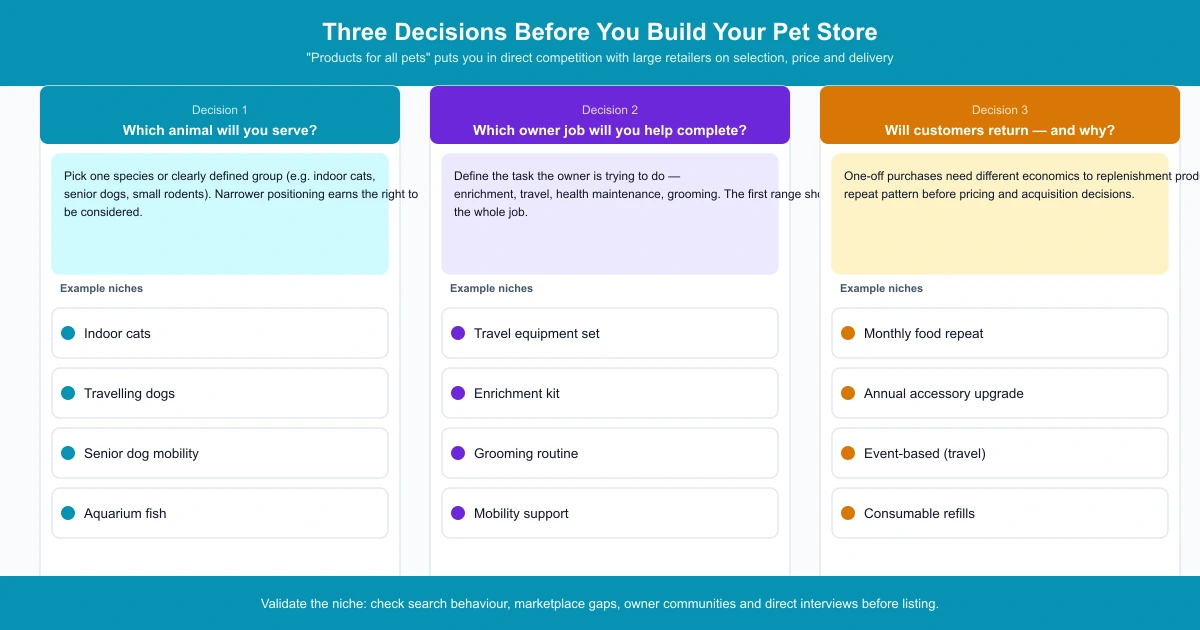
Pick one pet, one owner problem and one reason to return
“Products for all pets” puts a new store in direct competition with large retailers on selection, price and delivery. Narrower positioning gives the business a reason to be considered.
Start with three decisions:
- Which animal or clearly defined group will the store serve?
- Which owner job will the range help complete?
- Will customers need the products once, occasionally or repeatedly?
A store might focus on indoor-cat enrichment, travel equipment for small dogs or practical products for senior-dog mobility. These are examples to investigate, not guaranteed opportunities. Validate the need by reviewing search behaviour, marketplace listings, competitor gaps, owner communities and direct interviews. Then check whether buyers will pay enough to support safe sourcing and delivery.
The first range should solve a complete job. A travel collection, for example, might include a correctly specified carrier, portable bowl and compatible cleaning accessory. It should not add food, supplements or medical products merely to make the catalogue appear larger.
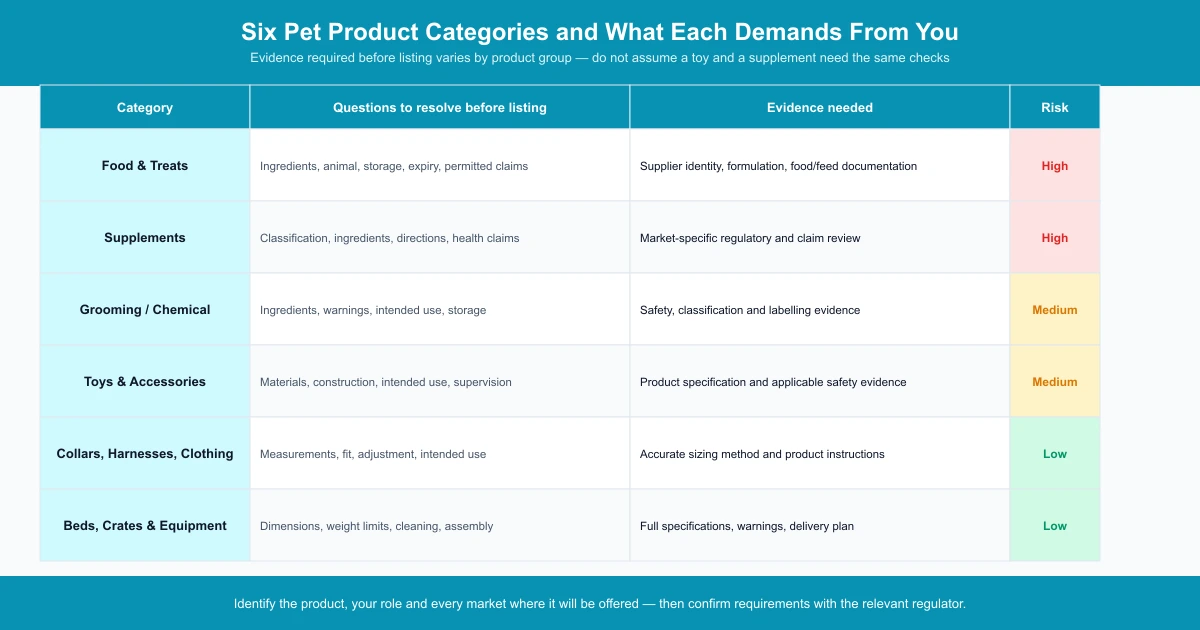
Decide which product risk you are prepared to manage
Different categories require different knowledge, documents and support.
| Product group | Questions the business must resolve | Evidence needed before listing |
|---|---|---|
| Food and treats | Ingredients, intended animal, storage, expiry and permitted claims | Supplier identity, formulation and applicable food/feed documentation |
| Supplements | Product classification, ingredients, directions and health claims | Market-specific regulatory and claim review |
| Grooming or chemical products | Ingredients, warnings, intended use and storage | Safety, classification and labelling evidence |
| Toys and accessories | Materials, construction, intended use and supervision | Product specification and applicable safety evidence |
| Collars, harnesses and clothing | Measurements, fit, adjustment and use | Accurate sizing method and product instructions |
| Beds, crates and equipment | Dimensions, weight limits, cleaning, assembly and damage | Complete specifications, warnings and delivery plan |
The US Food and Drug Administration explains that animal-food businesses may face registration, ingredient, safety, labelling and record duties depending on their activities. Its animal-food business guidance also warns that websites and promotional material can form part of product labelling.
UK requirements differ. Businesses making or placing certain animal feed on the market should review the current GOV.UK animal-feed guidance and confirm their position with the appropriate authority.
Do not convert these examples into a global checklist. Identify the product, your role and every country where it will be offered, then use the relevant regulator and qualified advice.
Build an assortment that works commercially
Score each proposed product before adding it to the range.
Purchase pattern
Is it replenished on a fairly predictable schedule, replaced occasionally or normally purchased once? Repeat demand can help retention, but expiry, storage and discounting may offset the benefit.
Delivered economics
Calculate landed product cost, packaging, payment and marketplace fees, fulfilment, shipping subsidy, expected returns and acquisition cost. Heavy products can produce attractive revenue but weak contribution after delivery.
Fit and return complexity
Harnesses, coats, crates and carriers need accurate measurements. A high return rate may indicate an unclear sizing system, unsuitable range or poor product—not merely a generous returns policy.
Evidence burden
What must the supplier prove? Food, supplements, chemical products and certain equipment can require substantially more review than a simple accessory.
Catalogue role
Does the product complete the store’s customer job, or is it present because a supplier catalogue made it easy to add?
Use a small launch range and record why each item belongs. If the store cannot explain the intended animal, use, key limitations and product information, it is not ready to support that SKU.
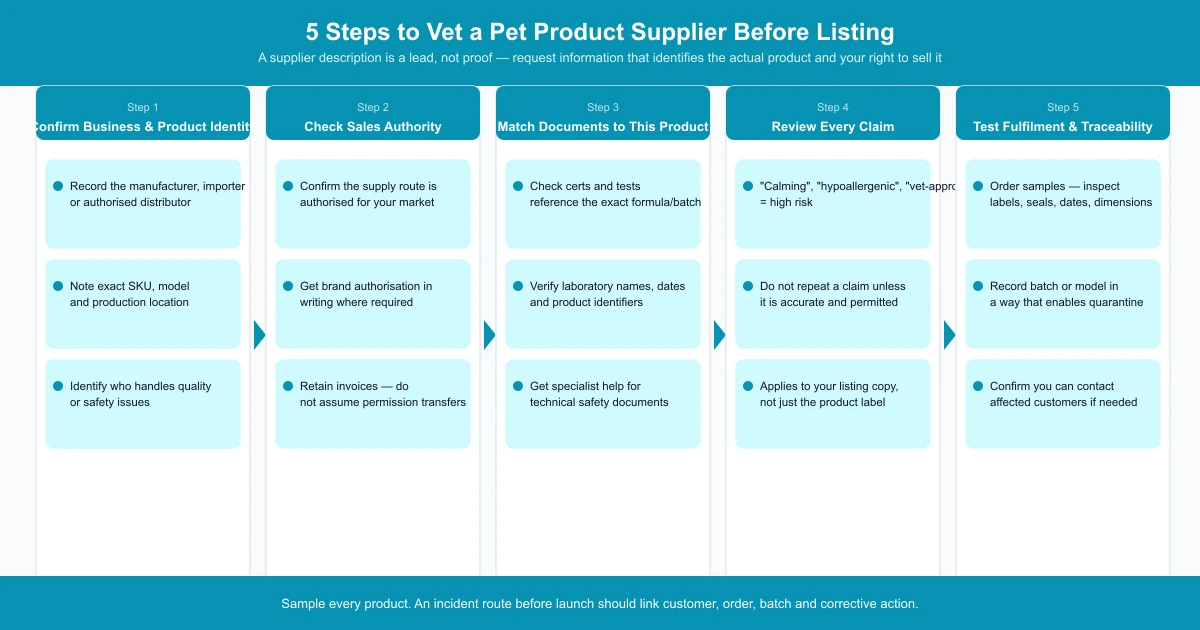
Vet suppliers before trusting their listing copy
A supplier description is a lead, not proof. Request information that identifies the actual product and your right to sell it.
Confirm the business and product identity
Record the manufacturer, importer or authorised distributor; exact SKU or model; production location where relevant; and who handles quality or safety issues.
Check sales authority and authenticity
If you are reselling a branded product, confirm that the supply route and marketplace use are authorised. Retain invoices and brand authorisation where required.
Match documents to the product
Certificates, tests or safety sheets are not useful when they refer to a different formula, size, batch or model. Check names, dates, laboratories, standards and product identifiers. Obtain specialist help where the documents require technical interpretation.
Review every claim
Words such as calming, hypoallergenic, dental, therapeutic, natural or vet-approved can create significant trust and compliance implications. Do not repeat a supplier claim unless it is accurate, permitted and supported for the exact product.
Test fulfilment and traceability
Order samples. Inspect packaging, seals, labels, instructions, dates, dimensions and product consistency. Record batch or model information in a way that lets the business quarantine stock and contact affected customers if necessary.
Make the catalogue answer “is this right for my pet?”
Good navigation reduces unsuitable choices without pretending to offer veterinary judgement.
Useful filters may include:
- animal or species;
- life stage defined by the manufacturer;
- product type;
- exact dimensions or size range;
- intended activity or use;
- material or ingredient;
- care and cleaning method;
- stock and delivery timing.
Avoid using breed as a substitute for measurement where fit depends on the individual animal. Two dogs of the same breed can have different proportions. Show customers how to measure, what to do when between sizes and which parts are adjustable.
Health-led navigation needs particular caution. A collection titled “products for arthritis” or “allergy cures” can imply medical suitability the retailer is not qualified to determine. Organise factual product attributes and send medical questions to a veterinarian.
Build pet product pages around suitability
A product page should let the owner decide what is known, what is not and when professional advice is needed.
Include, where relevant:
- intended animal and life stage;
- product dimensions and weight;
- size or fit method;
- complete materials or ingredients;
- directions and required supervision;
- cleaning, storage and expiry;
- warnings, exclusions and compatibility;
- what is included in the package;
- manufacturer or responsible business details;
- delivery, returns and support;
- the source behind any material performance or health claim.
Photographs should show scale, labels, closures, texture and the parts the customer must inspect. A lifestyle image may demonstrate context, but it should not depict unsafe or unapproved use.
The Shopify product photography checklist can help create consistent evidence-led images. For customer photographs and reviews, obtain appropriate permission and follow the principles in the ecommerce UGC guide.
Choose sales channels from the business model
An owned store provides control over catalogue structure, education and the customer relationship. A marketplace provides access to existing demand but imposes listing, approval, fee and fulfilment rules. Social channels can create discovery, particularly when products are demonstrable, but the business still needs a reliable place for product facts and policies.
Before listing on a marketplace, check whether the category or brand requires approval and which documents are accepted. Do not assume that permission on one platform means the product complies with the law or another platform’s rules.
If Shopify is the primary store, work through the ecommerce startup checklist for payments, policies, analytics and launch tasks that this pet-specific guide does not repeat.
Design fulfilment for the product, not the website theme
Map what happens between the shelf and the customer:
- How is the product stored?
- Does it have a batch, lot, model or expiry?
- Can it leak, melt, freeze, break or absorb moisture?
- Does the carrier restrict it?
- Can the package survive the expected route?
- Is the return safe to restock?
- How will a complaint be linked to the supplier and affected stock?
Heavy consumables need a delivery model that does not erase the margin. Liquids need tested seals and absorbent protection where appropriate. Sized items need return handling that identifies whether the problem came from the product, size chart or customer measurement.
Create a simple incident route before launch:
- record the customer, order, product and batch/model;
- assess whether stock should be held;
- contact the supplier or responsible business;
- escalate safety or regulatory concerns appropriately;
- notify affected customers when required;
- record the corrective action.
Earn repeat orders without creating waste
Subscriptions and replenishment reminders work best for products with stable, legitimate repeat use. They are less suitable when consumption varies widely, the product expires quickly or the owner needs professional advice before continued use.
Make frequency adjustable and cancellation clear. Use the customer’s own order history rather than pretending every household consumes the same amount.
Complementary recommendations should complete a known job. Suggesting a compatible refill or replacement filter can be useful. Adding unrelated treats to every cart is simply an upsell.
For a broader retention system, read the Shopify customer retention strategies and adapt them to the product’s real purchase cycle.
How AeroChat can support a growing online pet store
AeroChat is an AI agent platform that helps ecommerce brands run customer service on autopilot.
For a Shopify pet store, AeroChat can answer approved questions about product dimensions, materials, ingredients, availability, delivery and order status. It can guide a shopper through declared catalogue attributes such as pet type, life stage or measurements and pass the conversation to a person when the request falls outside those facts.
The boundary matters. An AI agent should not diagnose an animal, prescribe a product, interpret symptoms, approve an off-label use or overrule a veterinarian. Adverse reactions, safety complaints, unclear feeding questions and medical suitability requests need human escalation.
Merchants can compare Shopify AI chatbot platforms and then review the narrower guide to AI support for Shopify pet stores. Treat automation as a growth-stage support investment. It is useful when verified product and order questions repeat at volume, not as a substitute for supplier evidence or qualified advice.
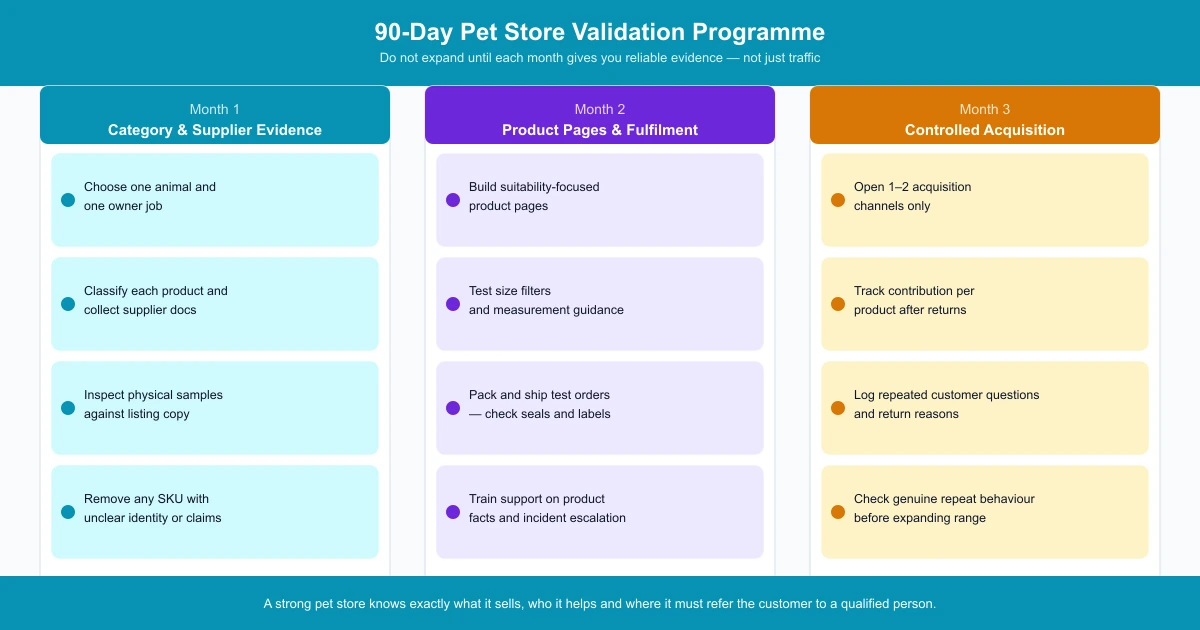
A 90-day pet-store validation programme
Month 1: category and supplier evidence
Choose the animal, customer job and launch range. Classify each product, collect supplier documents, inspect samples and remove any SKU whose identity, claims or obligations remain unclear.
Month 2: product pages and fulfilment
Build suitability-focused pages, test filters, pack real orders and run test shipments. Train the support process on product facts, sizing, returns and incident escalation.
Month 3: controlled acquisition
Use one or two acquisition channels. Track contribution by product, return reasons, repeated questions, delivery problems and genuine repeat behaviour. Do not expand simply because traffic increased.
Stop, revise or expand?
| Evidence | Decision |
|---|---|
| Product sells with healthy contribution and few suitability problems | Consider deeper stock or adjacent products |
| High views but repeated unanswered product questions | Improve information before buying more traffic |
| Frequent fit-related returns | Rework sizing, range or product |
| Repeat purchase occurs at a stable, appropriate interval | Test reminders or an adjustable subscription |
| Safety, supplier or claim evidence is incomplete | Stop or hold the product |
| Heavy products lose money after delivery | Change price, pack size, geography or range |
A strong online pet store is not the one with the most animal categories. It is the one that knows exactly what it sells, who it helps, how each product should be chosen and where the business must stop and refer the customer to a qualified person.
Pet products compete in a market where repeat purchase rate is high but first conversion depends heavily on ingredient transparency and safety signals. The baby products guide covers the same trust-first approach for a similarly safety-conscious buyer. For stores in this niche on Shopify, ecommerce niche ideas ranked by potential gives context on where pet products sit versus other categories, and building an ecommerce content strategy explains how to turn product expertise into traffic through blog and social content.