
Ecommerce Holiday Marketing Strategy: A Q3-Q4 Planning Guide

An effective ecommerce holiday marketing strategy for Q4 covers five areas: a clear promotional offer finalised before October, an email campaign sequence with segmented sends, social content scheduled in advance, inventory ordered with a safety buffer above your forecast, and customer service prepared for a volume spike that typically runs two to five times normal levels. Planning for all five starts in August, not November.
This guide provides a month-by-month planning framework from August through to January, covering each area with specific actions and timing. If you are building a new store ahead of the holiday season, start your free Shopify trial early enough to have your store set up and tested before Q4 begins.
When to start planning
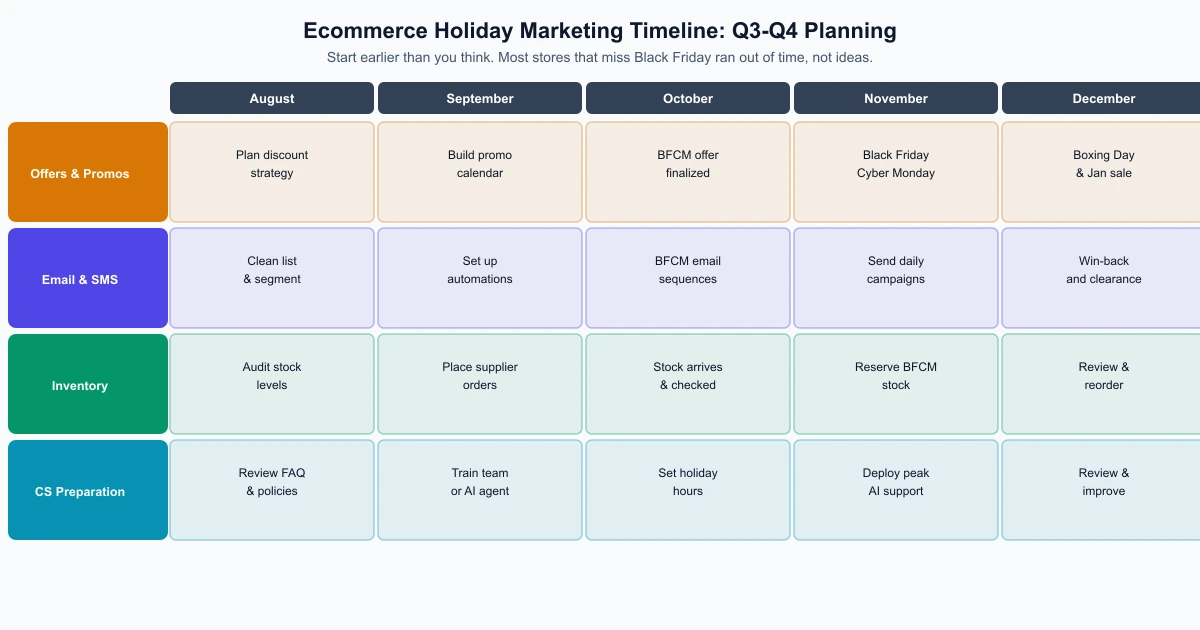
August is when to finalise your Q4 strategy. By August you should know which products performed well in previous years, what your margin structure allows in terms of discounting, and which channels are working for your store. Use this rough planning calendar:
| Month | Key priorities | What should be finished |
|---|---|---|
| August | Strategy and offers | Discount structure, product selection, campaign angles |
| September | Production and setup | Email sequences built, creative designed, inventory ordered |
| October | Final configuration | All tools live and tested, CS policies updated, team briefed |
| November | Execution | BFCM campaign running; no structural changes during this month |
| December | Peak and gifting season | Gift guides, last-order dates, January sale preparation |
October is the last realistic month to make structural changes. Anything requiring a supplier, developer or logistics partner to be ready for November needs to be in motion by early October.
Building your offer and discount structure
Decide on your promotional strategy before building anything else, because the offer determines everything else: email copy, social creative, landing pages and ad targeting. The most common mistake is changing the offer mid-campaign because it did not feel compelling enough.
The most effective holiday offers tend to be specific and easy to understand:
- A single percentage discount on a clearly defined product range
- A free gift with purchase above a specific order value
- A bundle priced at obvious value versus buying items separately
- Early access for email subscribers before the public sale
Build your BFCM offer around your best-margin products, not your hardest-to-sell ones. Discounting slow stock during Black Friday can move it, but it also trains your customer base to wait for sales on items you want to sell at full price. The guide to increasing Shopify conversion rate and average order value covers how pricing and offer structure affect buying behaviour year-round.
Email and SMS campaigns
Email is your highest-value owned channel during the holiday season because it reaches people who have already shown interest in your store. A well-segmented email list at average open rates will typically outperform paid social targeting cold audiences at the same budget in most product categories.
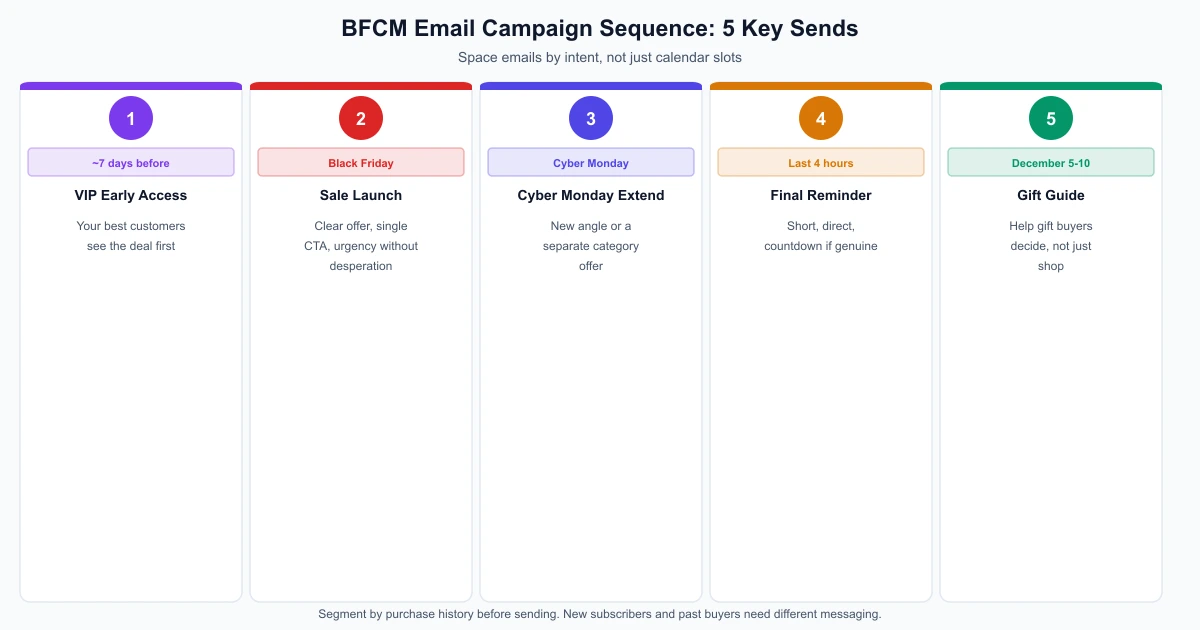
The core email flows to have ready before November:
- VIP early access — sent to your most engaged subscribers 7 days before the public sale
- BFCM sale launch — sent on Black Friday morning, clear offer and single CTA
- Cyber Monday extension — new angle or different category to justify a second send
- Last-chance reminder — sent in the final few hours; short, direct, genuine urgency only
- December gift guide — helps gift buyers decide, positioned around recipient types not just products
SMS works well for time-sensitive messages such as sale start announcements and shipping deadline notifications. Keep SMS infrequent: one or two per campaign window. More than that increases unsubscribes disproportionately.
Social media and content
Holiday social content works best when it helps the customer make a decision rather than simply announcing a promotion. Gift guides, comparison posts, behind-the-scenes product detail and customer photos perform more consistently than a stream of discount banners.
User-generated content is particularly valuable during the holiday period because it provides authentic product imagery when your production resources are stretched. The ecommerce UGC guide covers how to request, permission and use customer photos. For product image quality across campaigns, the Shopify product photography guide is worth reviewing before the season. Build and schedule your November social content in October. Creating it during the peak period is too late.
Inventory and fulfilment preparation
Running out of your best-selling products during Black Friday is one of the most costly things that can happen to an ecommerce store. Calculate stock requirements using previous year’s data adjusted for expected growth, then add a 20% safety buffer for your top ten products. Place supplier orders by early October.
Confirm your fulfilment capacity before the season. If you use a third-party logistics provider, discuss peak-period intake limits and cut-off dates in advance. If you fulfil in-house, plan staffing levels against your forecast rather than hoping the existing team can absorb the volume.
How AeroChat handles the customer service surge
Customer enquiry volume typically increases two to five times during the holiday period compared to a normal month, across three distinct waves: pre-purchase questions during BFCM, order and delivery status enquiries throughout December, and returns and exchanges in January.
AeroChat is an AI agent platform that helps Shopify merchants run customer service on autopilot. Setting it up before November means the AI handles the repeatable, high-volume enquiries automatically while your team focuses on the complex situations that need personal attention. Common enquiry types AeroChat handles during peak periods include:
- Order status and tracking requests (“where is my order?”)
- Estimated delivery windows by destination
- Returns and refund policy questions
- Product availability and restock timing
- Gift message and personalisation options
AeroChat connects to your Shopify store for live order data, so responses to order status questions are accurate without your team needing to look up each order manually. You can explore AeroChat for Shopify and review the guide to handling high volumes of WhatsApp messages if WhatsApp is one of your primary customer channels.
Post-holiday strategy
January is underused by most ecommerce stores. Customers who purchased in November and December are warm and have demonstrated willingness to buy from you. A simple post-Christmas email offering a second-purchase discount to new Q4 customers typically performs well in early January. A clearance campaign converts customers who watched your BFCM campaign but did not buy during the peak. Review your Q4 performance data in early January while it is fresh, and let those notes become your August planning inputs for next year.
For the broader content and channel strategy that supports a holiday campaign, the ecommerce content marketing strategy guide covers how to build an audience and content calendar that makes holiday campaigns easier to execute each year.