
How to Handle High Volumes of WhatsApp Messages in 2026
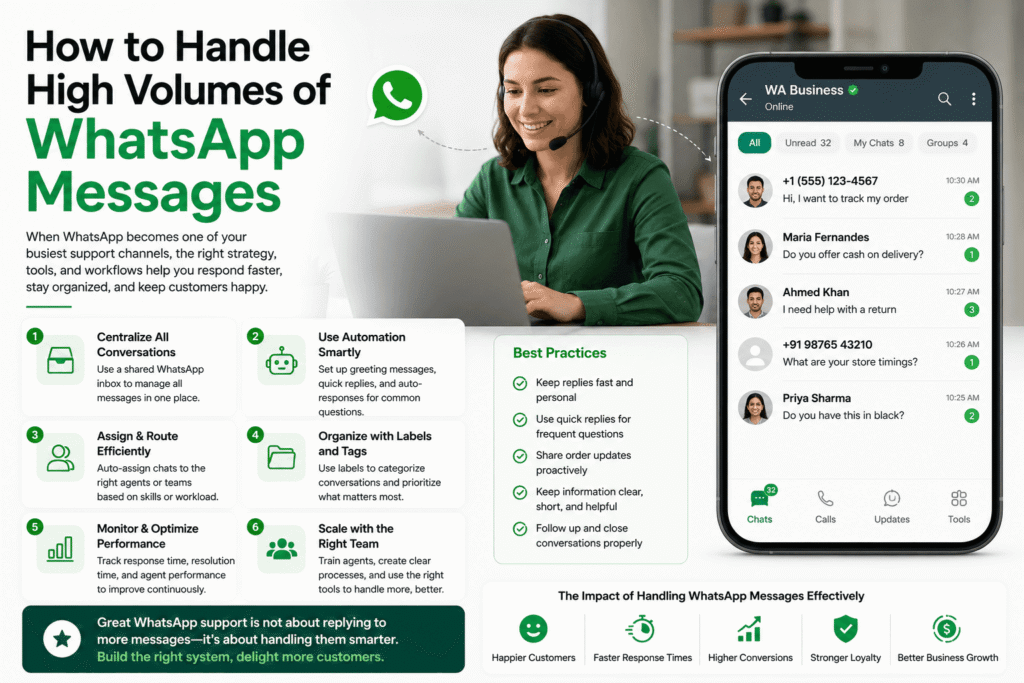
When WhatsApp becomes a real sales and support channel, message volume stops being a trickle and turns into a flood. A single promotion, a viral post, or steady growth can leave you staring at hundreds of unread chats — each one a customer expecting a fast, personal reply. Handling that volume isn’t about typing faster. It’s about changing how the channel is set up, organized, and automated so growth doesn’t break your response times.
To handle high volumes of WhatsApp messages: move from the consumer app to the WhatsApp Business app or API, organize chats with labels and a shared inbox, use saved quick replies for repeat questions, set away and greeting messages to manage expectations, and automate the most common queries with a chatbot so your team only handles what genuinely needs a human. The single biggest lever is automating repetitive questions — they usually make up the majority of incoming messages.
Why WhatsApp Volume Becomes Unmanageable
The problem rarely arrives gradually. WhatsApp messages tend to spike — a marketing campaign, a stockout, a shipping delay, a holiday rush — and the same questions arrive dozens of times at once. “Where’s my order?”, “Is this in stock?”, “What’s your return policy?” repeat endlessly while genuinely complex issues wait in the same undifferentiated queue.
The deeper issue is that personal-app workflows don’t scale. One phone, one person, no way to assign chats or see who’s handling what. As volume grows, replies slow, customers repeat themselves across channels, and the messages that actually need attention get buried under routine ones. Speed is the first thing to collapse, and on WhatsApp — where people expect near-instant replies — slow responses cost sales directly.
Step 1: Use the Right WhatsApp Product
The consumer WhatsApp app is built for personal chats and caps out fast under business volume. The WhatsApp Business app adds labels, quick replies, away messages, and a catalog — enough for a small team handling moderate volume. Beyond that, the WhatsApp Business API is the real answer: it supports multiple agents on one number, connects to automation and chatbots, and is built for scale.
Here’s how the three options compare for handling volume:
|
Capability |
Consumer App |
Business App |
Business API |
|---|---|---|---|
|
Best for |
Personal chats |
Solo / very small team |
Teams & high volume |
|
Multiple agents, one number |
No |
Limited |
Yes |
|
Labels & quick replies |
No |
Yes |
Yes |
|
Away & greeting messages |
No |
Yes |
Yes |
|
Chatbot & automation |
No |
No |
Yes |
|
Store / CRM integrations |
No |
No |
Yes |
|
Proactive message templates |
No |
Limited |
Yes |
|
Typical cost |
Free |
Free |
Provider fee + per-message |
The practical rule: if one person can still keep up with the Business app, stay there. The moment you need several people answering, automated replies, or integration with your store and support tools, move to the API through a provider. Trying to run high volume on the consumer app is the most common reason teams drown.
Step 2: Organize Chats Before You Scale Replies
Volume is only overwhelming when it’s undifferentiated. Labels and a shared inbox turn one chaotic queue into sorted streams — new leads, open orders, complaints, resolved — so the right person picks up the right chat and nothing sits unseen for hours.
A shared team inbox is what separates a real operation from a single overloaded phone. Agents see who’s replying to whom, conversations get assigned, and context follows the customer instead of resetting every time. If you also field messages on Instagram, Messenger, and your website, pulling them into one place prevents the same customer being answered three times — or not at all. (More on consolidating channels: see our guide on managing website, WhatsApp, and Instagram chat.)
Step 3: Kill Repetition With Saved Replies and Templates
Most incoming WhatsApp messages are not unique. The same handful of questions — hours, pricing, shipping, returns, availability — drive the bulk of volume. Saved quick replies let your team answer these in one tap instead of retyping, which alone can cut handling time dramatically.
Pre-approved message templates do the same job for outbound, proactive messages — order confirmations, shipping updates, appointment reminders — sent automatically so customers stop asking in the first place. Every “where’s my order?” you prevent with an automatic shipping update is a message that never enters your queue. Reducing the questions you receive is more powerful than answering them faster.
Step 4: Set Expectations With Away and Greeting Messages
You cannot be online every hour, and pretending otherwise creates angry customers. An automatic greeting tells people you’ve received their message and when to expect a reply. An away message during off-hours sets honest expectations instead of leaving silence that reads as being ignored.
These small automations absorb a surprising amount of pressure. A customer who knows they’ll hear back in an hour waits calmly; a customer who hears nothing sends three more messages and then a complaint — multiplying your volume. Managing expectations is volume control, not just politeness.
Step 5: Automate the Routine With a Chatbot
This is the step that actually breaks the link between growth and chaos. When the most common questions are answered automatically, around the clock, ticket volume stops scaling one-to-one with your customer base. A whatsapp chatbot trained on your own information — products, policies, FAQs — can resolve the routine majority instantly and hand off only the genuinely complex cases to a person.
This is where AeroChat fits: it answers repetitive WhatsApp questions automatically from your store’s own content, handles order and stock queries, replies instantly at any hour, and escalates anything it can’t resolve to your team with full context. It’s AI automation, not a replacement for human judgment — the point is to keep humans for the conversations that need them, not the hundredth identical FAQ. The same automation can run across Instagram and your website too, so one system covers every channel. For the mechanics of training a bot on your own data, see train a chatbot with your own data, and for the broader case, automate pre-sales questions.
Step 6: Measure What’s Driving Volume
You can’t reduce what you don’t track. Look at which questions repeat most, when spikes happen, and what share of messages a human actually needs to touch. If 70% of your WhatsApp messages are the same five questions, that’s not a staffing problem — it’s an automation opportunity sitting in plain sight.
Rising volume is also a signal, not just a cost. A sudden surge in “where’s my order?” messages often points to a shipping or fulfillment problem worth fixing at the source. Treating your message data as a diagnostic — not just a workload — is how mature teams keep volume from quietly growing forever. (Related: why support tickets keep increasing as businesses grow and reduce WISMO tickets.)
The Order That Actually Works
Teams that handle WhatsApp volume well rarely do it by hiring their way out. They get on the right product, organize chats so nothing gets lost, kill repetition with saved replies and proactive updates, set honest expectations, and automate the routine majority — in roughly that order. Each step removes load before the next one, so by the time a message reaches a human, it’s one that genuinely deserves their attention.
Frequently Asked Questions
How do I manage too many WhatsApp messages at once?
Move to the WhatsApp Business app or API, sort chats with labels and a shared inbox, use saved quick replies for repeat questions, and automate the most common queries with a chatbot so your team only handles complex cases.
Can multiple people reply to one WhatsApp number?
Not on the consumer app. The WhatsApp Business API lets several agents work from a single number through a shared inbox, which is the standard setup for teams handling high volume.
What’s the difference between the WhatsApp Business app and the API?
The Business app suits a single person or very small team and includes labels, quick replies, and away messages. The API supports multiple agents, automation, chatbots, and integrations — it’s built for scale.
How do chatbots reduce WhatsApp message volume?
A chatbot answers repetitive questions — hours, pricing, shipping, stock — automatically and instantly, resolving the routine majority before they reach a human and escalating only complex cases. This stops volume from scaling directly with growth.
How do I stop getting so many “where’s my order?” messages?
Send proactive, automated updates — order confirmations and shipping notifications — so customers get the information before they ask. Preventing the question is more effective than answering it repeatedly.
High WhatsApp message volume is usually a sign that either automation is missing or that the content triggering inbound messages is not answering questions upfront. The WhatsApp message templates guide covers the structured responses that reduce repetitive inbound messages, and how WhatsApp improves response time covers what changes when automation is in place. For teams considering whether to build or buy the automation, Wati alternatives covers the tools commonly used to manage this.