

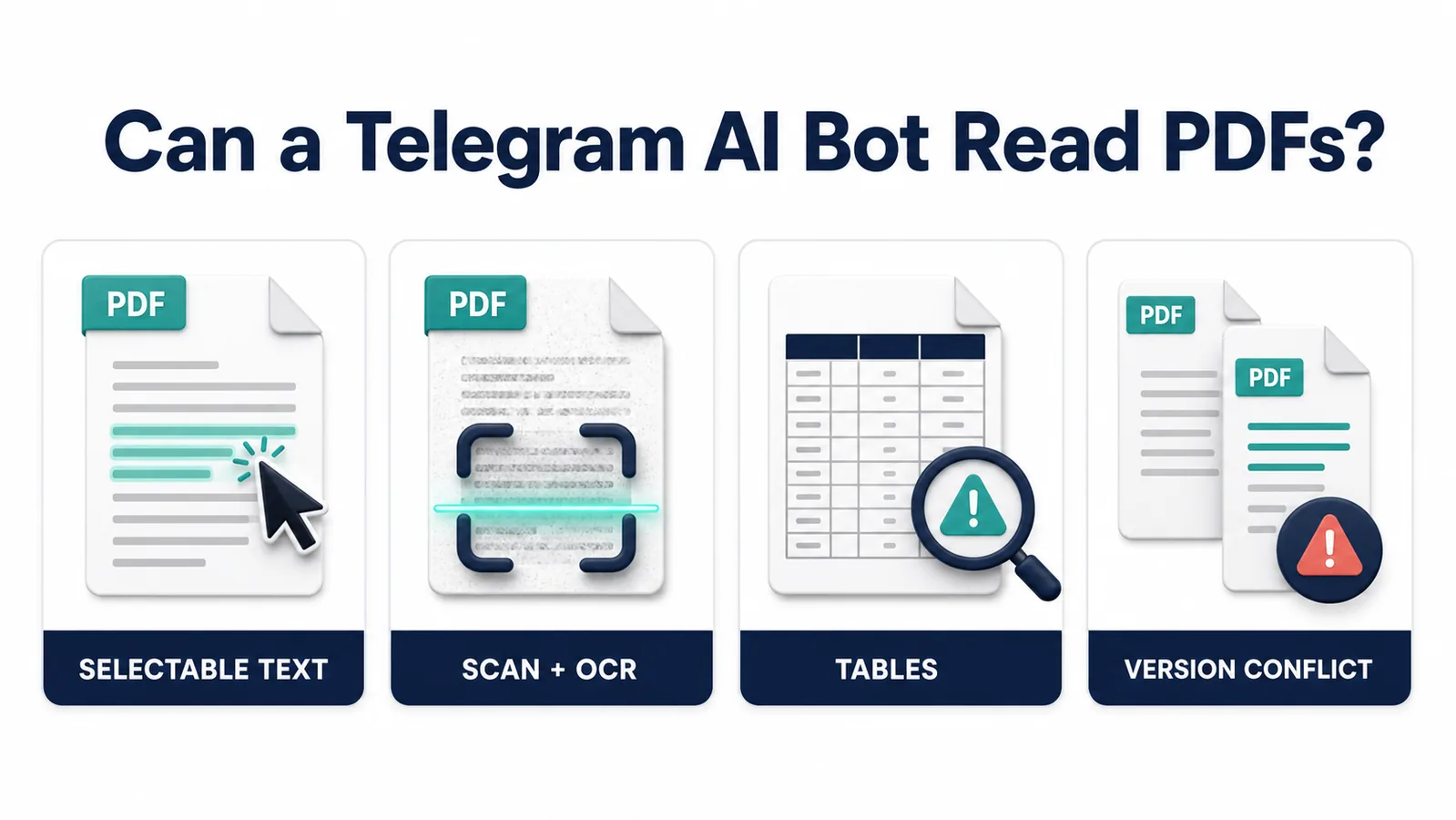
Can a Telegram AI Bot Read PDFs? What Actually Works in 2026

Yes, a Telegram AI bot can read a PDF when its connected software is designed to receive the file, extract its contents and pass relevant text to an AI system. Telegram can deliver the document to the bot, but it does not automatically understand the PDF on the bot’s behalf.
There are also two very different meanings of “read a PDF”. A customer might send a one-off document and ask questions about it, or a business owner might upload an approved manual or policy so the bot can answer future customer enquiries. These workflows need different permissions, retention rules and safety controls.
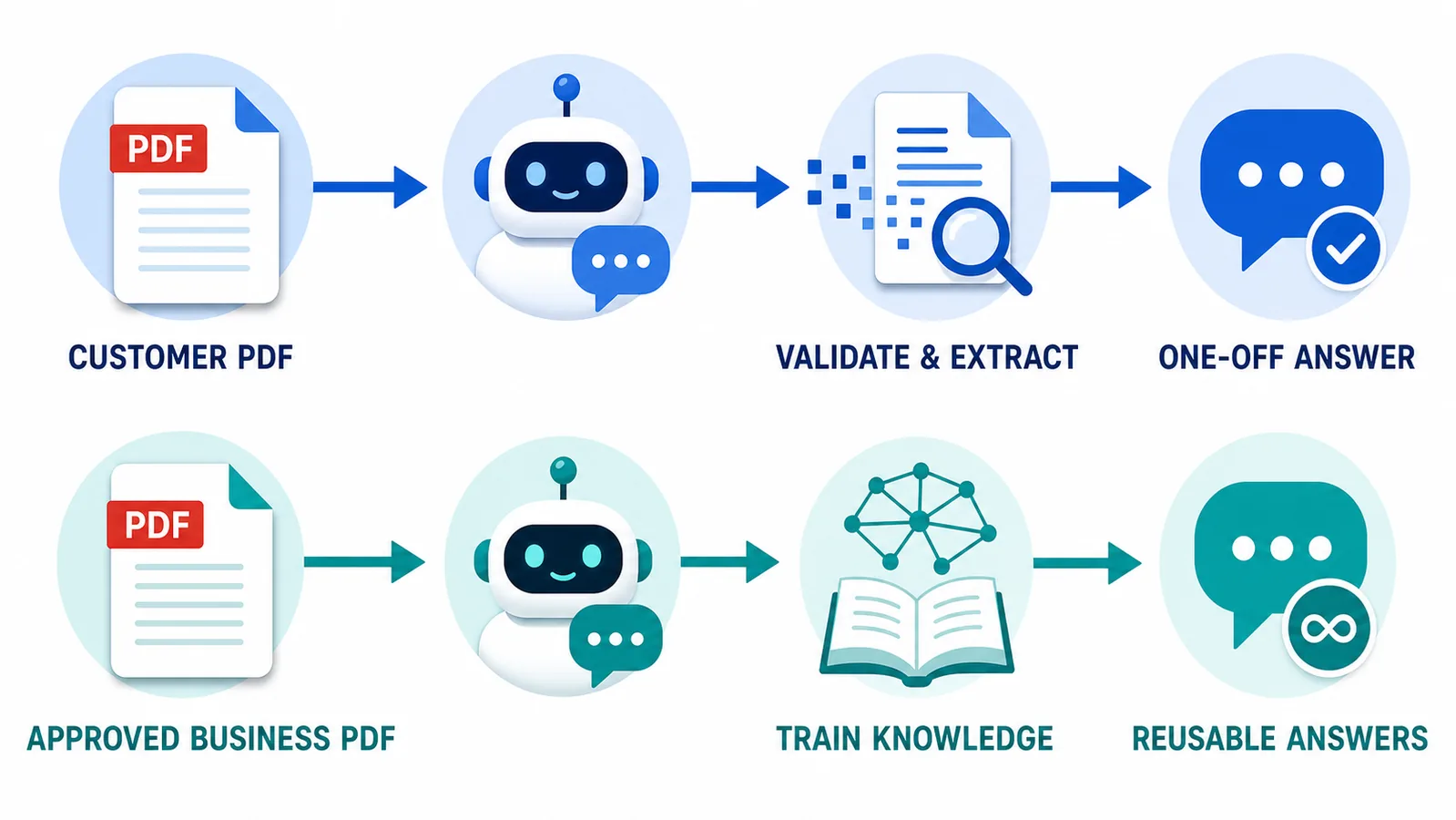
Telegram can receive a PDF, but the backend must interpret it
The current Telegram Bot API exposes a document attached to a message and provides a file identifier that a bot can use to retrieve it. That solves transport: the file can move from the customer’s Telegram chat to the bot operator’s software.
Understanding requires additional stages:
- Validate that the file type and size are allowed.
- Retrieve the document through Telegram.
- Scan or isolate the file according to the operator’s security process.
- Extract selectable text or run optical character recognition on scanned pages.
- Preserve useful structure such as headings, page numbers and tables.
- Split and index the material for retrieval.
- Find the passages relevant to the question.
- Generate an answer grounded in those passages.
- Cite the source or admit when the document does not support an answer.
A bot that completes only the first two stages has received the PDF. It has not understood it.
What are the two ways to use PDFs with a Telegram AI bot?
The distinction changes the whole design.
| Workflow | Who supplies the PDF? | Typical purpose | Main risk |
|---|---|---|---|
| Customer-upload analysis | A Telegram user sends a file during the conversation | Summarise, extract details or answer questions about that one document | Unknown content, personal data, malicious files and unclear retention |
| Business knowledge-base training | The business owner adds an approved file before customers ask questions | Answer repeated questions from policies, manuals, catalogues or FAQs | Outdated, conflicting or poorly structured source material |
Customer-upload analysis is a file-processing service
The bot receives an unfamiliar document and needs to decide whether it is permitted and safe to process. It may need to analyse a contract, receipt, form or report for that user alone.
This route needs strong controls around file validation, isolation, access and deletion. A customer may accidentally send another person’s information or assume the document is private without reading the bot operator’s terms.
Knowledge-base training is a publishing decision
The business deliberately chooses which documents the assistant may use for customer answers. A delivery policy, product manual or wholesale guide becomes a controlled source.
The central questions are accuracy and governance: Is this the current version? Does it apply to every market? Who approved it? What happens when it conflicts with the website or live store data?
For most customer-service teams, this second workflow is the more useful one. It turns existing business material into repeatable answers without inviting every customer to upload arbitrary documents.
Which PDFs are easiest for AI to read?
A clean, text-based PDF with logical headings is easier to process than a scan containing complex tables and handwritten notes.
Text-based PDFs
If you can select and copy the words, extraction is usually straightforward. The result can still be messy when the PDF uses columns, repeated headers, footnotes or unusual character encoding.
Scanned PDFs
A scan may contain only page images. The system needs optical character recognition before it can search the words. Faint text, skewed pages, handwriting, stamps and poor contrast can reduce accuracy.
Tables and forms
Rows and columns can lose their relationship during extraction. A price may be separated from its product, or a condition may be detached from the exception underneath it. If a table controls an important answer, test questions against individual rows and edge cases.
Diagrams and product images
Text extraction alone does not understand a wiring diagram, annotated photograph or size illustration. A multimodal system may analyse visuals, but that is a separate capability that requires its own testing. Do not assume “PDF support” includes reliable visual interpretation.
Password-protected or restricted files
The bot may be unable to open an encrypted PDF. Do not ask users to send a password in the same Telegram chat as the protected document. Use an approved secure process or decline the file.
How does a PDF question-answering system find an answer?
Large documents usually cannot be treated as one undifferentiated block of text. A retrieval-based workflow divides the document into smaller passages, creates a searchable representation and selects the passages that appear relevant to the question.
The language model then writes an answer using that retrieved context. This approach is often called retrieval-augmented generation, but the label matters less than the controls around it.
A useful system should be able to answer four questions:
- Which document supported the reply?
- Which section or page contained the evidence?
- What happens if two sources disagree?
- What happens if no passage supports the answer?
If the system cannot show its source, a fluent answer may be difficult to distinguish from a guess.
The broader knowledge-base chatbot guide explains how approved FAQs, policies and product documentation can support customer answers. The PDF is a source format, not a guarantee of accuracy.
Prepare a PDF before adding it to a business chatbot
Do not upload every file in a shared drive and hope the AI works out which one is correct.
Give the document a clear owner and version
Include a meaningful title, effective date, region and owner. “Returns-final-v7-new.pdf” tells a customer-service system very little about whether the policy is current.
Remove material customers should not receive
An internal manual may contain supplier costs, staff contacts, unreleased products, legal advice or credentials. Create a customer-safe source rather than relying on the AI to ignore confidential paragraphs.
Resolve conflicts before training
If the PDF says returns are allowed for 30 days and the website says 14, the bot should not decide which policy wins. The business must establish one source of truth or define which rule applies to each market and product.
Replace image-only text where possible
Add selectable text or a clean companion document for important scanned material. Keep tables simple and give each exception a descriptive heading.
Write for retrieval
Use specific headings such as “Return window for opened electronics” rather than “Other information”. Keep the condition and its exception together. State units, currencies and jurisdictions explicitly.
Define an update process
Assign someone to replace or exclude the source when a policy changes. A chatbot trained perfectly on last year’s delivery terms is still wrong today.
What can go wrong when a customer sends a PDF?
Customer uploads introduce risks that do not exist when the business controls every source.
The file may contain sensitive information
Receipts, medical documents, identity records and contracts can contain personal or confidential data. The customer needs to know who processes the file, why, for how long and how deletion works.
Instructions inside the PDF may be untrusted
A document can contain text that attempts to instruct the AI to ignore its rules or reveal information. The system should treat document content as evidence to analyse, not as authority to rewrite its security policy.
The PDF may not support the requested conclusion
A customer can ask, “Does this contract prove I will win?” even when the PDF contains no such assurance. A responsible bot distinguishes extraction from professional judgement and avoids presenting legal, medical or financial conclusions as fact.
The file can be technically hostile
Unexpected file types, malformed documents and embedded content require a proper file-security process. Renaming a file with a .pdf extension does not make it safe.
Before sending documents to an unfamiliar public bot, review what Telegram bots can receive and what happens after transfer. Telegram’s delivery controls are only one part of the data path.
Test a PDF bot with questions that expose weak retrieval
Start with a fictional document that contains no real customer data. Include deliberate challenges and record the expected source for every answer.
Use questions such as:
- What is the standard return window?
- Does that window change for an opened item?
- Which products are excluded?
- What does the table say for a shipment above a particular weight?
- Which policy applies in Scotland rather than the United States?
- What is the answer when the PDF does not mention the topic?
- What happens when an older PDF contradicts the current one?
- Can the bot identify the page or section supporting its answer?
- Does it refuse a request for information outside the user’s permission?
- Does a low-confidence result move to a person?
Check the source passage, not only the final wording. A polished answer from the wrong row of a table is not a pass.
How does AeroChat use PDFs for Telegram customer service?
AeroChat is an AI agent platform that helps online businesses run customer service on autopilot.
Its current Knowledge Base Training documentation says a business can add approved content by writing a document or uploading supported files, including PDF, DOC, DOCX, TXT, MD and XLSX. The business can include or exclude sources and see their training status.
Once the approved knowledge is available, customers can ask questions through the AeroChat Telegram integration. That is the owner-trained workflow: the merchant prepares the sources, and the AI uses them to answer suitable customer questions.
This should not be confused with a claim that AeroChat automatically analyses every PDF a customer sends in Telegram. The current public documentation verifies knowledge-base uploads by the business owner; it does not establish arbitrary customer-file analysis as the default Telegram behaviour.
When a PDF is unclear, missing an answer or conflicts with a live business rule, the safer next step is clarification or handover to a human agent, not an invented resolution.
Best for: businesses that already have customer-safe policies, manuals or product documents and want Telegram answers grounded in those approved sources.
When should a person review the answer?
Human review is appropriate when:
- the document is incomplete, damaged or hard to extract;
- two versions conflict;
- the answer changes money, access, eligibility or legal rights;
- the customer asks for professional interpretation;
- the PDF contains personal or confidential information;
- the source passage is ambiguous; or
- the customer challenges the answer.
A bot can find and explain information without becoming the final authority for every decision. That boundary makes the system more trustworthy, not less capable.
If you are starting from scratch, connect and test the basic text journey using the Telegram chatbot setup guide before adding a document library. A small, approved knowledge set is easier to validate than a large folder of mixed files.
Frequently asked questions
Can Telegram bots receive PDF files?
Yes. Telegram’s chatbot API represents general files as documents and gives the bot a file identifier. The connected backend still needs logic to retrieve and process the PDF.
Can a Telegram AI bot read a scanned PDF?
Only if the system includes optical character recognition or another visual-document process. Results depend on scan quality, layout, handwriting and language.
Can a bot answer from several PDFs?
Yes, if the knowledge system indexes them and has rules for retrieval and conflicts. More documents do not automatically improve accuracy; duplicate and outdated versions can make answers worse.
Should customers send confidential PDFs to public bots?
Not unless the operator, purpose, retention, security and deletion process are understood and appropriate. Avoid sending passwords, identity documents or sensitive records to an unknown bot.
Can AeroChat train from a PDF?
Yes. Its current knowledge-base documentation lists PDF as a supported owner-uploaded source. That verifies business knowledge training, not unrestricted analysis of customer-sent Telegram attachments.