
Telegram vs WhatsApp for Business: Which Is Better in 2026?

Both Telegram and WhatsApp are widely used for business communication in 2026. They are not interchangeable, and choosing between them, or deciding whether to use both, depends more on how your customers behave and what your business actually needs than on a feature-by-feature ranking.
This guide compares Telegram and WhatsApp for business use across the areas that matter for customer service, community building, marketing and automation. It includes an honest assessment of where each platform is stronger and where it falls short.
Where each platform stands in 2026
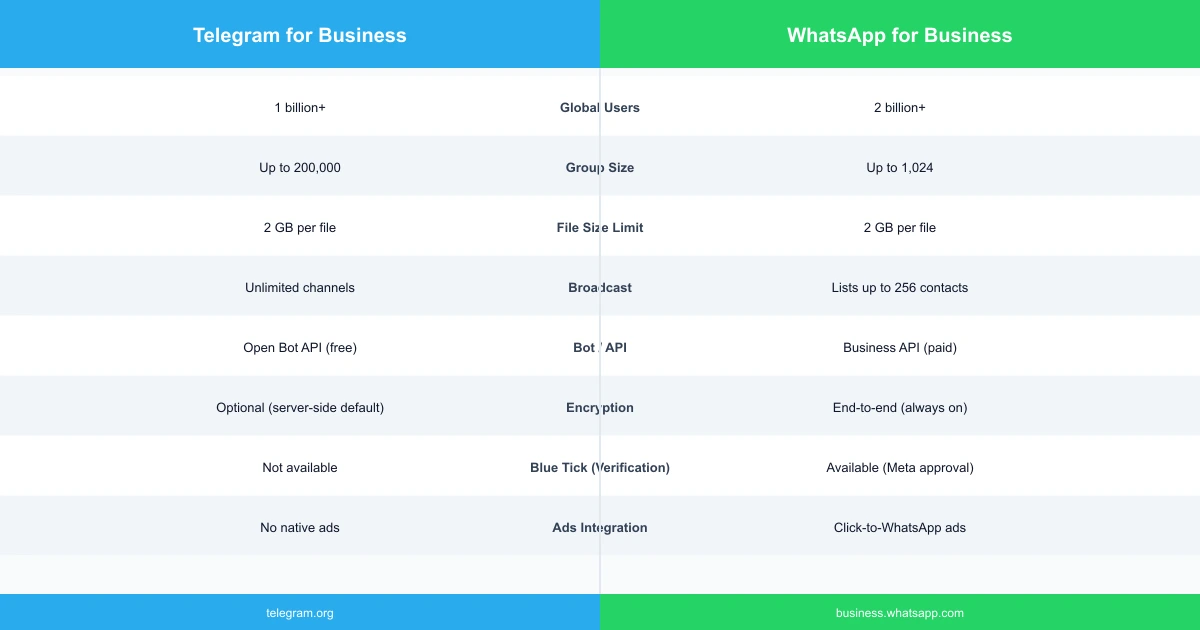
WhatsApp has approximately 2 billion monthly active users. Telegram crossed 1 billion users in 2025. Raw user counts matter less than where your specific customers are concentrated. WhatsApp dominates consumer messaging in South Asia, Latin America, the Middle East, North Africa and most of Western Europe. Telegram has stronger penetration in Eastern Europe, Central Asia and among internationally mobile, tech-literate audiences.
For most ecommerce businesses selling to general consumers in the UK or Europe, WhatsApp is where customers already are. For businesses with a more globally distributed or technically engaged audience, Telegram is a meaningful part of the picture.
Broadcast and group scale
This is the most practical difference for businesses that want to reach a large audience simultaneously. Telegram channels have no size limit and are designed for one-way broadcasts to any number of subscribers. Groups support up to 200,000 members. WhatsApp broadcast lists are capped at 256 contacts, and standard groups max out at 1,024 members.
If you want to send a promotion, stock update or announcement to tens of thousands of opted-in contacts without the cost of the WhatsApp Business API, Telegram’s channel model does it for free. WhatsApp’s equivalent capability, sending personalised messages at scale to opted-in contacts, requires the Business API and per-message fees that vary by country and template type.
The Telegram model works differently in one important respect: a Telegram channel message reaches subscribers passively. WhatsApp messages arrive as direct notifications in a personal conversation thread, which means higher open rates but more regulated access. Both models have their place depending on what you are sending and how you want the recipient to experience it.
Automation and bots
Telegram’s Bot API is free, publicly documented and can be accessed by any developer or no-code tool without a business approval process. You can build a Telegram bot to handle customer enquiries, deliver digital content, manage subscriptions or trigger responses based on keywords in minutes rather than weeks. If you are evaluating the best AI chatbots for Telegram, the open Bot API makes Telegram one of the easier platforms to automate without technical resources.
WhatsApp Business automation requires going through the WhatsApp Business API, which is accessed via Meta-approved Business Solution Providers. The setup includes business verification, template message approval and costs that scale with usage. The trade-off is that WhatsApp’s automation reaches consumers in the app they already use most, while Telegram bots operate in an app your customers may or may not have installed.
It is also worth understanding how to enable AI features in Telegram if you are building a customer-facing presence on the platform. Some of Telegram’s native AI capabilities overlap with what third-party bots provide, and knowing the distinction helps you decide what to build versus what already exists.
Privacy and encryption
WhatsApp applies end-to-end encryption by default to every personal message, group conversation and call. This is not a setting to enable; it is on for everything and cannot be switched off. For businesses where customer conversations may include personal or financial details, this is a meaningful privacy baseline.
Telegram uses server-side encryption for standard chats, meaning messages are stored on Telegram’s servers in encrypted form but are not end-to-end encrypted by default. End-to-end encryption is available through “Secret Chats”, which must be started manually, do not support groups or channels and are only accessible on the device where the conversation was initiated. For businesses with compliance obligations around message privacy, this distinction matters.
If you are considering automation on Telegram, the guide on whether Telegram AI bots are safe covers the specific security and privacy considerations for business bots on the platform.
Business verification and trust signals
WhatsApp Business accounts can apply for a verified green tick through Meta. Customers across most markets associate this tick with a legitimate business. It appears in the chat header and removes uncertainty about whether an account is official.
Telegram does not offer equivalent business verification for most commercial accounts. Verified marks exist for public figures and large media channels, but a standard business account on Telegram carries no trust signal that a new customer can read. For businesses doing outreach or first-contact marketing on Telegram, this is a genuine limitation.
When Telegram is the right choice
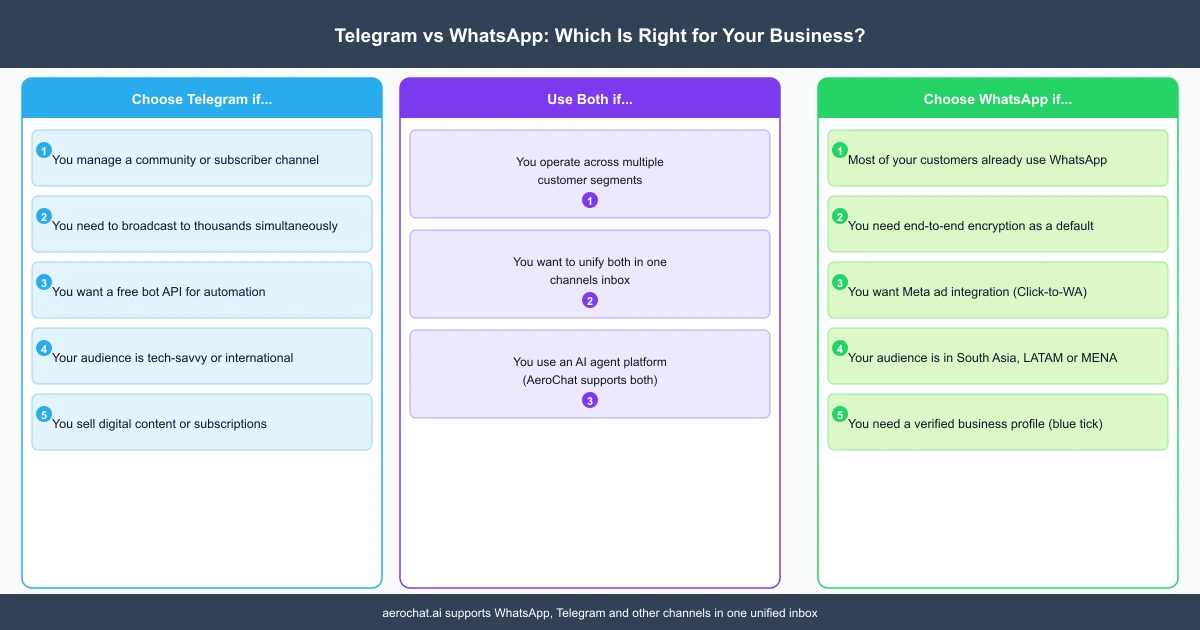
Telegram is the better fit when you need to broadcast to a large subscriber base without paying per-message fees, when you want to build a community group at a scale WhatsApp does not support, or when your audience is concentrated in a market where Telegram usage is genuinely high. It is also a strong option when you want to build automated customer service flows using the free Bot API without going through a business approval process.
Digital product sellers, subscription-based businesses and community-led brands often find Telegram’s channel and group model more natural than WhatsApp’s conversation-centric structure. If the primary use case is content delivery or community building rather than one-to-one customer service, Telegram’s architecture fits the purpose better.
When WhatsApp is the right choice
WhatsApp is the right starting point when your customers are already using it as their primary messaging app, when end-to-end encryption by default is a relevant requirement, or when you want to run Click-to-WhatsApp ads through Meta that send users from a Facebook or Instagram ad directly into a WhatsApp conversation with your business.
For most ecommerce stores selling to UK or European consumers, WhatsApp is where customers expect to receive order updates, delivery notifications and support responses. The familiarity of the platform reduces friction, and the default encryption gives customers confidence when sharing order details or personal information. The guide on how Meta AI works in WhatsApp is useful context if you are evaluating how WhatsApp’s own AI features compare to third-party automation.
How AeroChat handles both Telegram and WhatsApp
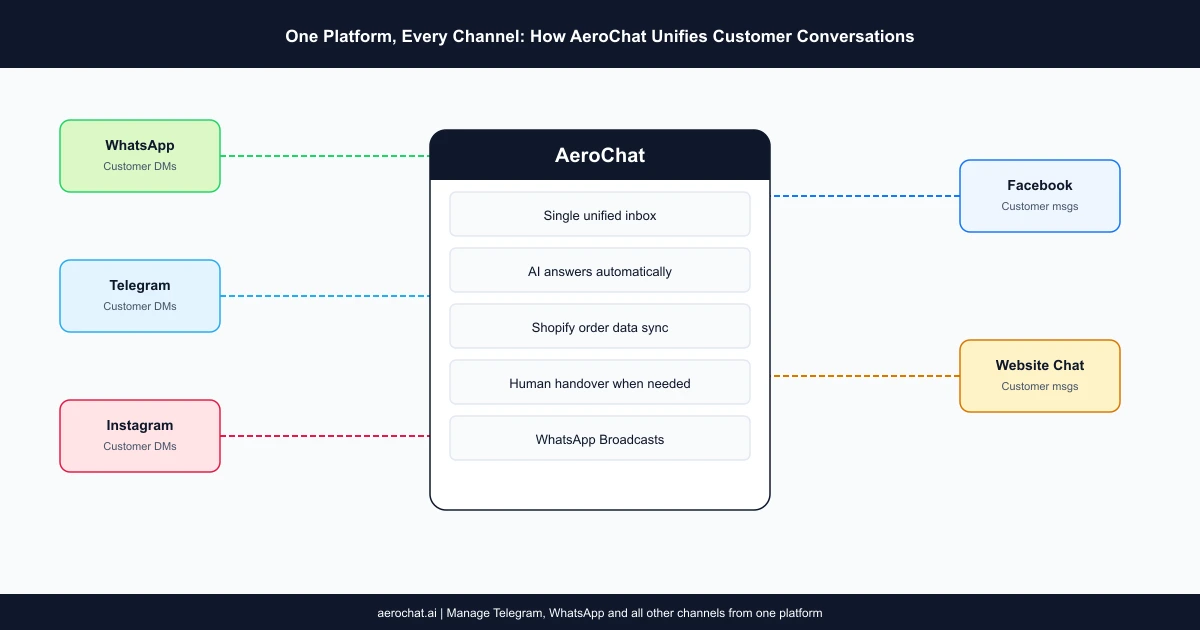
AeroChat is an AI agent platform that helps merchants run customer service on WhatsApp without the manual workload. It also supports Telegram alongside WhatsApp, Instagram, Facebook Messenger, website chat and email, so incoming conversations from any of these platforms appear in one inbox and are handled by the same AI agent using the same knowledge base and policies.
This means a business can run a Telegram channel for broadcast updates, while the same AI agent handles one-to-one enquiries arriving on both Telegram and WhatsApp, passing to a human agent when a conversation needs personal attention. The customer’s experience is consistent regardless of which platform they use, and your team manages one inbox rather than monitoring several apps separately.
For merchants considering alternatives to ManyChat for Instagram and WhatsApp, AeroChat covers both channels plus Telegram from a single interface. You can explore AeroChat’s WhatsApp automation for ecommerce before deciding whether a unified inbox is the right fit for your current stage.
The case for using both platforms
Many businesses serve customer segments that split across both platforms. A Telegram channel for a subscriber community, paired with WhatsApp for one-to-one customer support, covers different use cases without requiring you to migrate your audience from the platform they already use.
The operational challenge is managing two inboxes separately. Conversations get missed, response times vary between channels and there is no shared history when a customer who messages you on Telegram also sends a WhatsApp enquiry. A unified inbox solves this, and it removes the need to make a permanent choice between the two platforms.
The practical decision
Start with where your customers currently are. If they are already messaging you on WhatsApp, improving that channel’s response time and automation coverage will have a faster return than building a Telegram presence from scratch. If you are building a content-led community or a digital subscription business, Telegram’s channel structure may be more useful from day one.
Once the primary channel is working well, adding the second is lower-risk because you are not replacing an existing workflow but extending it. The businesses that run both channels effectively are generally those that have a clear purpose for each: WhatsApp for customer service and direct communication, Telegram for community and broadcast. When both serve distinct needs rather than duplicating the same function, the added complexity pays off.
If you are evaluating free chatbot options before committing to a paid platform, the free chatbot guide for ecommerce stores covers what is realistically available at no cost across WhatsApp and other channels.