
How to Use User-Generated Content for Ecommerce in 2026

User-generated content for ecommerce includes reviews, photographs, videos, questions and other material created by customers rather than the brand. It is useful when it shows genuine product experience, answers a buying question and is used with appropriate permission and disclosure.
The most effective programme is not a folder of attractive social posts. It is a controlled process for requesting honest content, recording rights, checking claims, selecting the right placement and measuring whether the asset helps a customer decide.
What counts as user-generated content?
“UGC” is often applied to several different types of material. They should not be presented as equivalent.
| Content type | Who creates it? | Typical arrangement | What the audience needs to understand |
|---|---|---|---|
| Organic customer content | A customer acting independently | No payment or product incentive | It reflects the customer’s own experience |
| Incentivised review or submission | A customer responding to a request or incentive | Discount, entry, sample or another benefit | The material connection and honest-review conditions |
| Paid UGC creator asset | A commissioned creator | Paid production, often for the brand’s channels | It is commissioned marketing content, not an independent review |
| Influencer endorsement | A creator with an audience | Payment, gift, affiliate commission or relationship | The commercial connection must be clear |
| Product Q&A | Customers or prospective customers | Voluntary questions and answers | Answers may require verification by the brand |
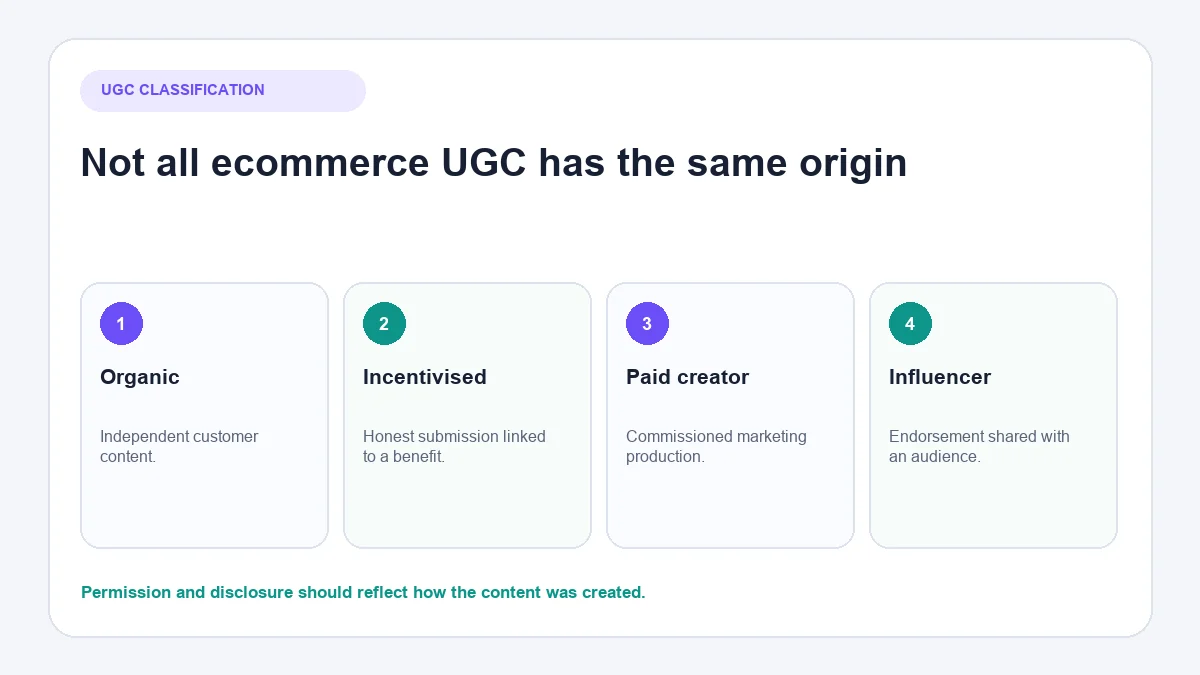
This distinction protects trust. A polished video commissioned from a creator may be useful advertising, but calling it an independent customer testimonial misrepresents its origin.
The US Federal Trade Commission provides guidance on endorsements, influencers and reviews, including disclosure of material connections and treatment of genuine reviews. Other markets have their own rules. Use the FTC endorsement and review guidance for US-facing activity and obtain appropriate advice for every market in which the campaign operates.
Where UGC helps ecommerce customers
Customer content works best when it reduces uncertainty that brand photography or product copy cannot resolve alone.
Product fit and real-world use
A brand can list dimensions. A customer photograph can show the product in a small kitchen, on a particular body shape or beside a familiar object. Both forms of information matter, but the customer context should not replace accurate specifications.
Colour, texture and variation
Customer photographs may reveal how an item appears in ordinary lighting. Display variation rather than selecting only the image that most closely resembles studio photography.
Setup and learning curve
Short customer videos can show assembly, first use or care. Review these for unsafe techniques and provide official instructions alongside them.
Delivery and packaging
Unboxing content can set useful expectations about parcel size, presentation and included items. It can also reveal avoidable waste or recurring damage. Treat it as operational feedback, not only campaign material.
Longer-term experience
Follow-up reviews can answer questions about durability and maintenance that an immediate post-purchase request cannot. Do not imply long-term evidence from a first-impression video.
Start with the questions customers already ask
A generic “share a photo and tag us” request produces unpredictable assets. Better prompts come from genuine decision barriers.
Review product questions, returns, support conversations and on-site search terms. Identify questions such as:
- How does the size compare with another familiar size?
- Does the item fit in a small space?
- What does assembly involve?
- How does the colour look in natural light?
- Which accessories are included?
- How is the product used after several weeks?
Then ask for content that may answer one of those questions without scripting the customer’s opinion. For example: “If you are comfortable sharing, show where you use the lamp and mention the room size.” This is more useful than asking customers to describe it as “perfect”.
Build a repeatable UGC workflow
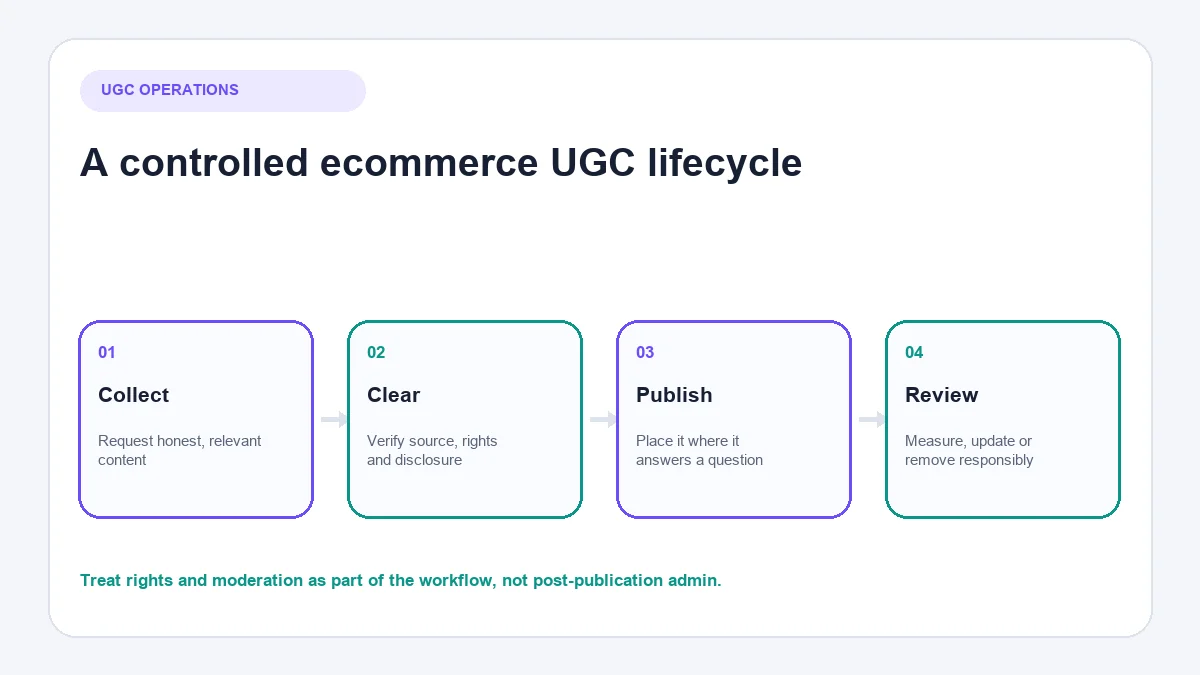
Use a visible lifecycle:
Request → receive → verify → permission → moderate → label → publish → measure → review or expire
1. Choose the right moment
Match timing to the evidence you want. A delivery-confirmation email can request an unboxing photo. A product-use review may need days or weeks. A durability claim needs longer experience.
Avoid contacting customers so frequently that the request becomes another support problem.
2. Make submission straightforward
Explain what is requested, where it may appear, acceptable formats and how to withdraw or ask questions. Do not hide material terms in an unrelated policy.
3. Ask for honest experience
An incentive should not depend on a positive rating or particular sentiment. The FTC’s Consumer Reviews and Testimonials Rule addresses fake and false reviews and other prohibited practices; consult the FTC’s current review-rule questions and answers for US campaigns.
4. Verify provenance
Record the submitter, source URL or submission channel, date, relevant order where appropriate, and whether the asset has been altered. Verification does not require exposing personal information publicly.
5. Record permission
Permission should be linked to the asset, not stored in someone’s memory or an inaccessible DM thread.
6. Moderate and label
Check privacy, claims, safety, relevance, commercial relationships and platform requirements before publication.
7. Review continued use
Remove or update content when permission expires, the product changes, instructions become unsafe or a claim no longer reflects the current item.
Get permission before reusing customer content
A public post is not automatically a library of brand-owned advertising. Shopify’s current UGC guidance also advises brands to ask for explicit permission before repurposing customer social content.
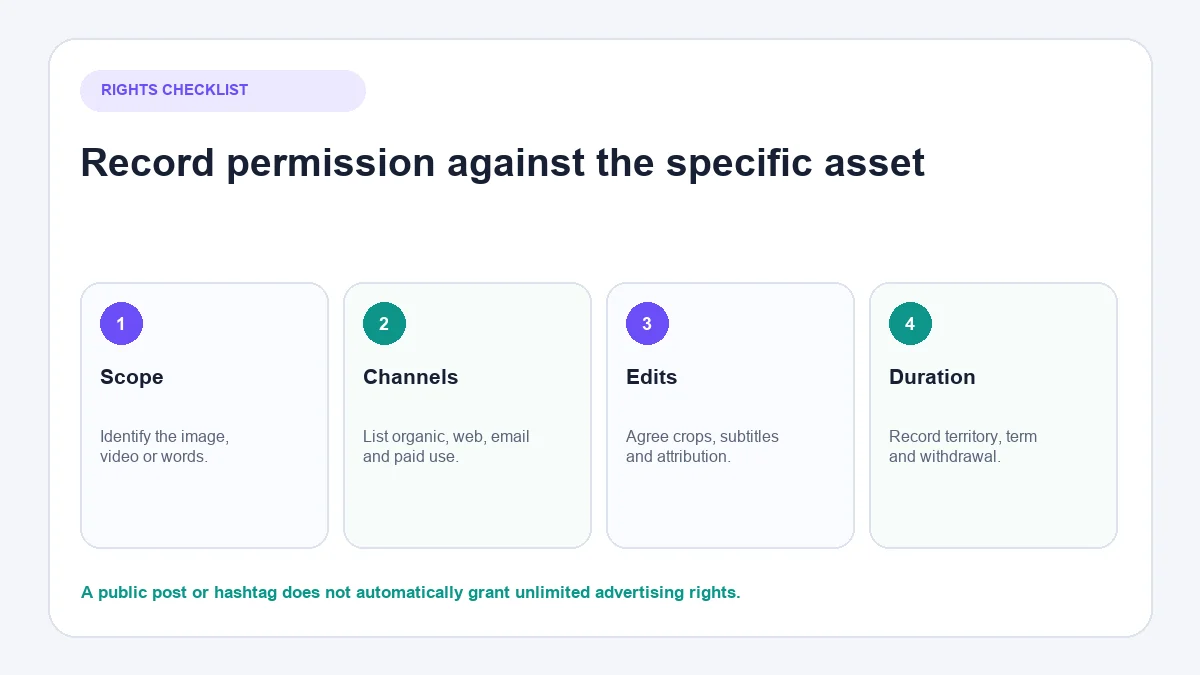
Record at least:
- the specific image, video, review or text covered;
- where the brand may use it;
- whether paid advertising is included;
- whether the brand may crop, subtitle or otherwise edit it;
- how the creator will be credited;
- the duration and territory of permission;
- compensation or incentive;
- how withdrawal requests will be handled.
A comment such as “yes, you can repost” may not cover an email campaign, product page, retail display and paid advertisement indefinitely. Use a permission process appropriate to the value and scope of the intended use.
If a child appears, sensitive information is visible or the content makes health, financial or performance claims, stop and obtain appropriate specialist review.
Moderate UGC without erasing honest criticism
Moderation is not the same as selecting only praise. A useful programme preserves an accurate picture of customer experience while preventing unlawful, unsafe or irrelevant material from being published.
Check for:
- personal information, addresses, order numbers and identifiable bystanders;
- music, artwork, logos or other material the submitter may not control;
- unsafe product use;
- medical, environmental or performance claims the brand cannot substantiate;
- incentives or commercial relationships that need disclosure;
- edits that change the customer’s meaning;
- statements about competitors or other individuals;
- content that no longer matches the current product.
Do not rewrite a mixed review into a positive quotation. If an excerpt is necessary, retain the context that affects its meaning and link or attribute appropriately where permitted.
Use UGC where it answers a real question
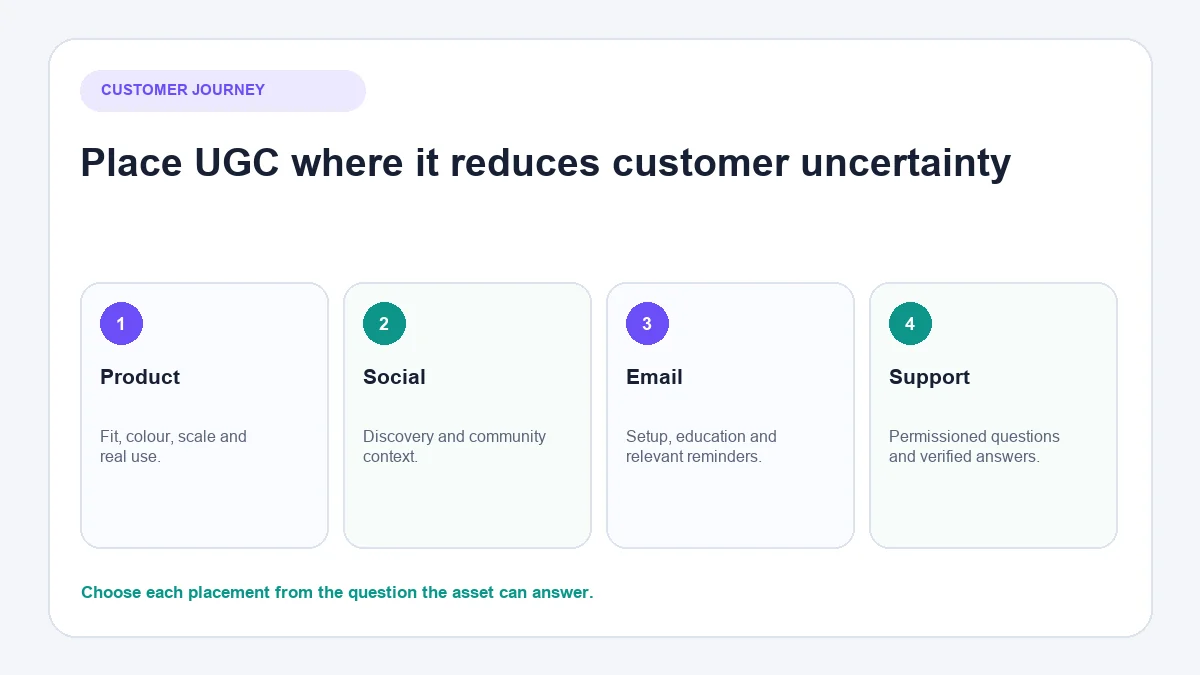
Product pages
Place assets near the relevant uncertainty. Fit photographs belong near sizing information; assembly videos belong near setup details. Give media descriptive alt text and captions that explain the context without stuffing keywords.
Do not allow a gallery to slow the page or push specifications below an unnecessary wall of media. Compress images, provide poster frames for video and test mobile performance.
Category and comparison pages
Customer content can help explain how products differ in use. Preserve product identity carefully so an image or quotation cannot be mistaken for another model or variant.
Organic social content
Reposting can acknowledge customers and demonstrate use, but credit and permission remain necessary. The wider Instagram marketing for ecommerce guide explains how customer content fits beside demonstration, education and product information.
For a formal creator partnership, use the platform’s appropriate collaboration and disclosure tools. The guide to Instagram Collab posts and Reels covers the publishing workflow; it does not replace a content-rights agreement.
Use customer content where it supports the message: a setup sequence after purchase, a real-use example for a product category or a permissioned quotation beside a product reminder. Check that the permission includes email.
Paid advertising
Paid use normally needs broader rights and more careful disclosure than an organic repost. Confirm usage duration, markets, editing rights and whether the creator’s identity or handle will appear.
Support and FAQs
Customer questions are UGC too. An edited, anonymised question may help clarify a product page or FAQ if privacy and permission requirements are met. The answer should be verified by the business rather than treated as correct because another customer supplied it.
Turn customer conversations into better content prompts
Support teams hear the language shoppers use before marketers see it in a report. Categorise repeated questions by product, journey stage and consequence.
If many customers ask whether a bag fits a particular laptop size, improve the specification first. Then consider requesting permissioned customer demonstrations showing common devices. UGC should supplement missing perspective, not excuse incomplete product data.
Do not publish private messages as testimonials without explicit permission. Anonymising a name may not remove every identifying detail.
How AeroChat can inform an ecommerce UGC programme
AeroChat is an AI agent platform that helps ecommerce brands run customer service on autopilot. In a UGC programme, its relevant role is the conversation stage: answering routine questions from approved business knowledge, keeping supported customer conversations organised and passing cases to a person when judgement is needed.
The AeroChat Instagram integration can support businesses managing inbound Instagram conversations. Teams handling a larger volume of social enquiries can also compare Instagram AI chatbots for customer conversations. AeroChat does not create genuine customer testimonials, grant content rights or replace human moderation. A customer’s private message remains a private conversation unless the business obtains suitable permission for another use.
Measure UGC without overstating attribution
Avoid treating every order after a UGC view as proof that the content caused the sale. Use several measures:
Collection health
- request delivery and submission rates;
- permission acceptance rate;
- usable assets by product and content type;
- time and cost to moderate each asset.
Content use
- product-page gallery engagement;
- video starts and meaningful completion;
- clicks from permissioned social posts;
- email interaction where UGC is a material element.
Commercial and service signals
- assisted conversion with attribution limitations stated;
- return reasons related to fit, colour or expectation;
- repeated questions before and after adding the content;
- performance of a controlled placement test where traffic permits.
Qualitative evidence matters. A customer image that prevents the wrong buyer from ordering may reduce gross conversions while improving product fit and reducing returns.
Run a 30-day ecommerce UGC pilot
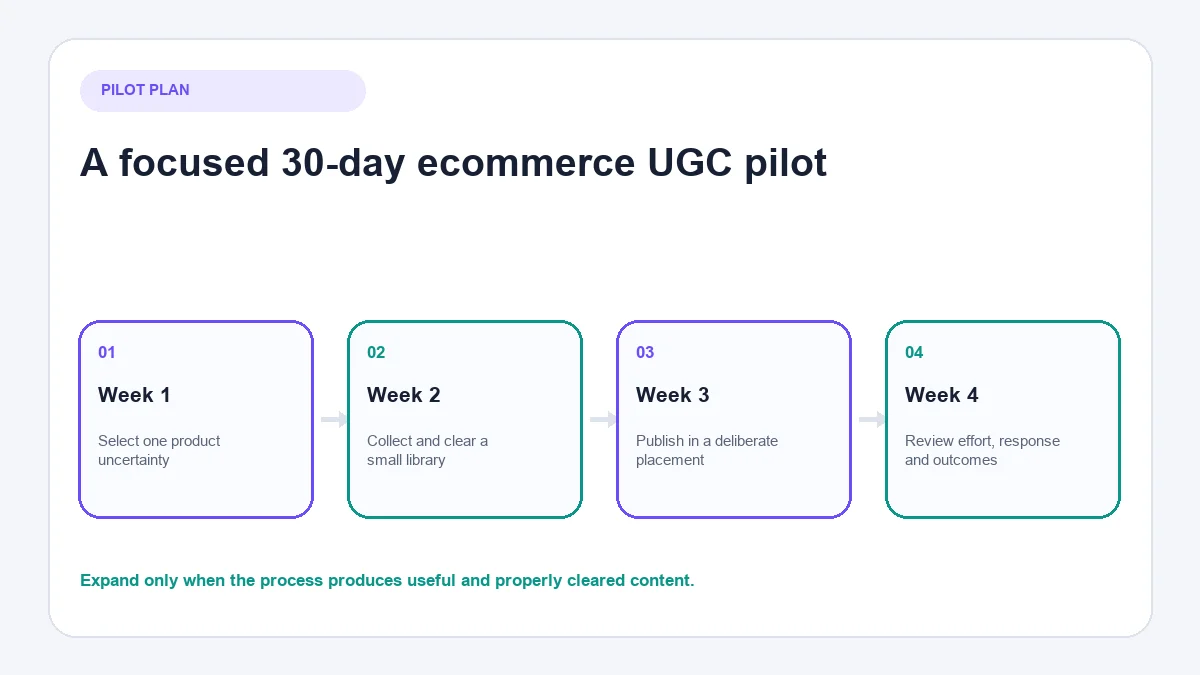
Week 1: choose one decision problem
Select a product family and one recurring uncertainty. Define the content requested, permission scope and moderation owner.
Week 2: collect a small verified library
Contact an appropriate customer group. Ask for honest experience and record every response, including refusals and unusable submissions.
Week 3: publish deliberately
Place each approved asset where it answers the selected question. Add captions, accessible text and any required disclosure.
Week 4: review the evidence
Assess collection effort, customer feedback, engagement, questions and commercial signals. Decide whether to expand, change the prompt or stop.
Common ecommerce UGC mistakes
- Assuming a tag or hashtag grants unlimited reuse rights.
- Calling commissioned creator advertising an independent review.
- Offering an incentive only for positive sentiment.
- Removing important qualifications from a quotation.
- Publishing unsafe product use because the video looks authentic.
- Using customer media without accessible alternatives.
- Filling every page with a slow, generic gallery.
- Measuring likes while ignoring product understanding and returns.
Frequently asked questions about ecommerce UGC
Is paid creator content the same as user-generated content?
Not exactly. Organic UGC is created independently by customers, while paid creator content is commissioned. Both may use a customer-style format, but payment, instructions, permission and disclosure should be recorded accurately.
Can a brand repost a customer’s public photo without asking?
A public post does not automatically grant unlimited reuse rights. Obtain permission for the specific asset and intended channels, and record any agreed edits, attribution, duration or paid-media use.
Should negative customer content be removed?
Remove content that is unlawful, abusive, fraudulent, unsafe or outside a published moderation policy. Do not remove an honest negative experience merely because it is inconvenient. A relevant criticism can expose a product, delivery or information problem that needs correction.
Does a customer’s private message count as reusable UGC?
It may contain useful feedback, but a private conversation should remain private unless the business obtains suitable permission for the proposed reuse. Anonymising a quotation does not automatically resolve every privacy or consent issue.
Is AI-generated content customer UGC?
No. Content generated by a business or an AI tool is not an independent customer experience and should not be presented as one. AI may assist with administration or formatting, but it cannot supply a genuine testimonial.
User-generated content earns its place when it adds perspective the brand cannot manufacture itself. Protect that value by preserving honesty, documenting permission and connecting every asset to a customer decision.