
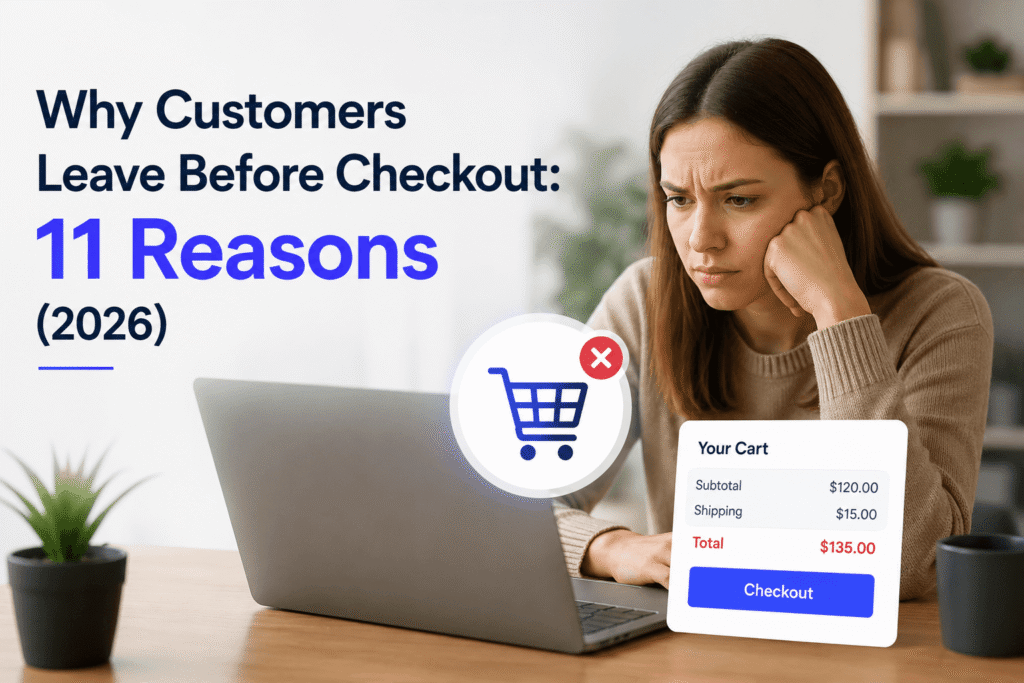
11 Reasons Customers Leave Before Checkout (And Never Return)
Getting traffic to your ecommerce store is difficult enough.
Losing customers right before checkout is even more frustrating.
A shopper browses your products, adds items to their cart, reaches the final steps — and then disappears without completing the purchase.
For most ecommerce businesses, this happens far more often than they expect.
The good news is that checkout abandonment usually follows recognizable patterns. Customers rarely leave randomly. In most cases, there’s a specific reason behind the hesitation.
In this guide, we’ll break down the biggest reasons customers leave before checkout in 2026, backed by industry research and ecommerce data, along with practical ways businesses can reduce those drop-offs over time.
Quick Answer: Why Customers Abandon Cart
-
Unexpected extra costs remain the biggest reason customers abandon checkout, with nearly 48% of shoppers leaving because of shipping fees, taxes, or additional charges.
-
Around 26% of shoppers abandon checkout when forced to create an account instead of checking out as a guest.
-
Slow websites and complicated checkout flows continue to increase drop-offs, especially on mobile devices.
-
Many shoppers leave because they can’t get quick answers to last-minute questions before purchasing.
-
The average cart abandonment rate across ecommerce remains close to 70%, according to industry research.
What Does “Leaving Before Checkout” Actually Mean?
When businesses talk about customers leaving before checkout, they’re usually referring to cart abandonment or checkout abandonment.
That happens when a shopper adds products to their cart but exits the website before completing payment.
According to industry research from Baymard Institute, average cart abandonment rates still hover around 70% across ecommerce stores.
Browse Abandonment vs Cart Abandonment vs Checkout Abandonment
These three terms often get mixed together, but they describe different stages of the buying journey.
Browse Abandonment
A visitor views products but leaves without adding anything to the cart.
Cart Abandonment
A shopper adds products to their cart but never begins the checkout process.
Checkout Abandonment
The customer starts checkout but leaves before completing payment.
Understanding the difference matters because each stage usually has different causes.
Businesses trying to improve ecommerce performance often track both abandonment and overall conversion rate improvements together, since both are closely connected.
1. Unexpected Extra Costs
Unexpected costs remain the biggest reason customers abandon carts.
According to Baymard Institute research, nearly half of shoppers leave checkout because of unexpected shipping fees, taxes, or additional charges shown too late in the process.
When customers feel surprised at checkout, trust drops immediately.
Quick Fix
Show shipping costs, taxes, and fees as early as possible instead of waiting until the final payment page.
2. Forced Account Creation
Many shoppers simply don’t want to create an account before buying.
Research consistently shows that forced registration increases checkout abandonment significantly, especially for first-time customers.
People prefer faster checkout experiences with fewer steps.
Offer guest checkout and allow customers to create accounts after completing their purchase.
3. Complicated Checkout Processes
Long checkout forms and unnecessary steps create friction.
Every extra field, page, or confirmation screen increases the chance that customers will leave before completing payment.
This problem becomes even worse on mobile devices.
Reduce checkout steps and remove anything that isn’t essential for completing the order.
4. Unclear Total Pricing
Customers want transparency before reaching the payment stage.
If pricing feels confusing or incomplete, shoppers often hesitate and leave rather than risk unexpected costs later.
That includes:
-
hidden fees
-
unclear delivery costs
-
unclear taxes
-
vague subscription pricing
Make pricing transparent throughout the shopping journey, not only during checkout.
5. Slow Websites and Slow Responses
Speed matters more than many ecommerce stores realize.
Slow-loading pages increase frustration quickly, especially during checkout. But page speed isn’t the only issue. Slow replies to customer questions can also cause shoppers to leave before purchasing.
When customers have last-minute concerns and nobody responds quickly, hesitation grows.
That’s one reason many Shopify businesses now recognize how slow replies cause drop-offs during the buying process.
Businesses also increasingly track the cost of slow replies because delayed support often impacts conversion directly.
Improve page speed and reduce customer response times wherever possible.
6. Trust and Security Concerns
Customers won’t enter payment information if the website feels untrustworthy.
Missing trust signals, unclear policies, poor design quality, or unfamiliar payment systems can all create hesitation.
For first-time visitors especially, trust plays a major role in whether checkout gets completed.
Use SSL certificates, display secure payment badges, and make return policies easy to find.
7. Limited Payment Options
Different customers prefer different payment methods.
Some want PayPal. Others prefer Apple Pay, Google Pay, Buy Now Pay Later services, or local payment providers.
When shoppers don’t see their preferred option, they often abandon the purchase entirely.
Offer multiple payment methods that match your audience and region.
8. Slow or Unclear Delivery Times
Delivery expectations influence purchase decisions heavily.
If shipping times are unclear or appear too slow, customers may decide to buy elsewhere instead.
This becomes especially important during seasonal shopping periods or time-sensitive purchases.
Show estimated delivery timelines clearly on product pages and during checkout.
9. Customers Can’t Get Answers Fast Enough
One of the most overlooked reasons customers abandon carts is hesitation caused by unanswered questions.
A shopper might want clarification about:
-
sizing
-
shipping
-
compatibility
-
refunds
-
availability
If they can’t get a quick answer, many simply leave.
This is where real-time support becomes important. More ecommerce businesses now use chat before checkout strategies to answer customer concerns while purchase intent is still high.
Make it easy for customers to get immediate answers during the buying process.
10. Mobile Checkout Friction
A large percentage of ecommerce traffic now comes from mobile devices.
Unfortunately, many checkout experiences still feel harder to use on smaller screens.
Tiny forms, difficult navigation, slow mobile pages, and awkward payment flows all increase abandonment rates.
Test checkout flows regularly on mobile devices instead of only desktop.
11. Some Shoppers Were Never Ready to Buy
Not every abandoned cart represents a lost customer.
Some people browse casually, compare prices, save products for later, or wait for discounts before purchasing.
That’s why cart recovery matters.
Businesses increasingly use retargeting, email automation, and AI-driven follow-up workflows to reconnect with shoppers after they leave.
Use recovery campaigns instead of assuming every abandoned cart is permanently lost.
How Real-Time Chat Reduces Checkout Drop-Off
Many checkout problems come down to hesitation.
Customers hesitate when:
-
pricing feels unclear
-
delivery times seem uncertain
-
product information is incomplete
-
support responses are too slow
That’s one area many large ecommerce studies still under-discuss.
Real-time chat and AI-powered support can reduce hesitation by helping customers get answers before they leave the website entirely.
Businesses increasingly use:
-
instant replies
-
AI chat support
-
automated FAQs
-
pre-checkout assistance
to reduce abandonment caused by uncertainty.
That’s also why more stores now focus on using chat systems specifically to reduce cart abandonment with instant replies instead of relying entirely on email follow-ups later.
Some businesses also use AI workflows to cut customer wait time to zero during high-intent shopping moments.
Platforms like AeroChat are increasingly being used for this type of real-time customer assistance, especially on WooCommerce and Shopify stores where hesitation-driven drop-offs happen frequently.
How to Recover Customers You’ve Already Lost
Even with a well-optimized checkout process, some customers will still leave before purchasing.
That’s why recovery strategies matter.
Many ecommerce businesses now combine:
-
abandoned cart emails
-
WhatsApp reminders
-
retargeting ads
-
AI-powered follow-ups
to bring customers back after they leave.
Businesses exploring WhatsApp cart recovery often see stronger engagement compared to email alone because messages feel more immediate and personal.
Others use AI workflows specifically designed to recover lost Shopify sales before customers disappear permanently.
For longer-term retention, businesses also focus on strategies to win back lost ecommerce customers after repeated inactivity.
Frequently Asked Questions
What is the average cart abandonment rate?
Most ecommerce stores experience cart abandonment rates close to 70%, according to Baymard Institute research. Rates vary depending on industry, device type, and checkout experience.
What is the #1 reason customers abandon carts?
Unexpected extra costs like shipping fees, taxes, and additional charges remain the biggest reason customers leave before checkout.
What’s the difference between cart abandonment and checkout abandonment?
Cart abandonment happens when shoppers add products to their cart but never begin checkout. Checkout abandonment happens after the customer starts the payment process but leaves before completing it.
How do businesses reduce checkout abandonment?
Businesses usually reduce abandonment by simplifying checkout, improving transparency, speeding up support responses, and offering better customer assistance during the buying process.
Can live chat reduce cart abandonment?
Yes. Real-time chat and AI support can reduce hesitation-driven abandonment by helping customers get answers immediately before leaving the website.
Final Thoughts
Most customers don’t abandon checkout randomly.
In many cases, they leave because something creates hesitation:
-
unexpected costs
-
unclear information
-
slow responses
-
trust concerns
-
checkout friction
Understanding those patterns is the first step toward improving conversion rates.
The second step is reducing friction before customers leave in the first place.
That’s why more ecommerce businesses are investing in faster support systems, AI-powered conversations, and real-time customer assistance instead of relying entirely on post-abandonment recovery emails later.
Related guides:
Cart abandonment is caused by a combination of unanswered questions, unexpected costs and friction in the checkout process. The what customers ask before buying guide covers the specific questions that, when unanswered, cause abandonment. For stores that want to recover abandoned carts through WhatsApp, Chatomate vs AeroChat covers cart recovery automation specifically. The converting visitors with AI chat guide covers the real-time intervention approach.