
Where to Find Shopify Chatbot Plugins for Customer Service

The safest place to find Shopify chatbot plugins for customer service is the Shopify App Store's Chat category. You can also find suitable apps through recommendations inside Shopify admin, Shopify Sidekick and the official websites of chatbot providers with a verified Shopify listing.
Shopify calls these tools apps, not plugins. Searching for “Shopify chatbot app”, “AI customer-service app” or the specific job you need will therefore produce more useful results than searching only for plugins.
Finding candidates is easy. The harder—and more important—part is separating a simple contact button from a chatbot that can answer product questions, retrieve order information and transfer difficult cases to a person.
Start with the Shopify App Store
The Shopify App Store is the best starting point because it lets you check whether an app is available for Shopify before creating another account or booking a sales call. Its Chat category currently contains live-chat tools, AI chatbots, messaging buttons, sales assistants and helpdesks.
Use the category page as a directory rather than treating the first result as a recommendation. Some placements are labelled ads. Others appear because they are popular, relevant to the category or personalised for stores like yours.
Shopify offers four useful ways to narrow the directory:
- Search by the customer-service task, such as “order tracking chatbot” or “AI product recommendations”.
- Open the Store management → Support → Chat category instead of using a broad web search.
- Apply the Built for Shopify filter when certification matters to your shortlist.
- Read the newest relevant merchant reviews, not only the average star rating.
The Built for Shopify badge is a useful quality signal, but it does not prove that an app solves your particular support problem. Shopify says the badge covers performance, design and integration standards. You still need to test answer quality, data access, pricing and handover.
Ask Shopify admin or Sidekick for a narrower shortlist
Inside Shopify admin, the Apps area can show recommendations based on characteristics such as your industry, location and existing store setup. Shopify Sidekick can also suggest apps when you describe the outcome you need.
A precise request works better than “find me a chatbot”. Try:
Find a Shopify customer-service app that can answer product questions, support order-status enquiries and transfer conversations to a human. I need website chat and Instagram support, and I want to compare total monthly costs at 500 conversations.
That request supplies the job, channels, handover requirement and expected scale. It is much less likely to return a random collection of chat buttons.
Recommendations inside Shopify are a discovery aid, not a substitute for due diligence. Open each listing and check the same criteria you would apply to an app found through search.
Use provider websites only when the Shopify connection is verifiable
Some customer-service platforms are discovered through their own websites, software directories or search results. That is legitimate, particularly for established helpdesks and omnichannel tools that support more than Shopify.
Before treating the product as Shopify-compatible, verify one of these routes:
- An active Shopify App Store listing
- Current Shopify integration documentation on the provider's official website
- A documented API or custom-app implementation suitable for your store
A logo in an old comparison article is not enough. Confirm what the connection actually accesses. A tool may embed a chat widget on a Shopify theme but have no access to products, orders or customer context. Another may provide deep order workflows but require a larger helpdesk subscription.
If you want a researched shortlist after learning where to search, use the Shopify AI chatbot comparison. Keep discovery and product comparison as two separate decisions: first define the job, then compare products that can perform it.
Consider a custom app only when standard apps cannot do the job
Shopify also supports custom apps. This route makes sense when a business has unusual workflows, a proprietary order system, strict data boundaries or an existing support platform that needs a tailored connection.
It is rarely the sensible starting point for a small store. A custom integration adds development, authentication, maintenance, monitoring and security work. Standard apps are easier to trial and remove, and their compatibility requirements are visible before installation.
Choose custom development only after writing down the requirement that available apps cannot meet. “We want more control” is too vague; “we need the bot to check a non-Shopify warranty database after authenticating the customer” is a real integration requirement.
Match your search terms to the job, not just the word “chatbot”
The Shopify chat category mixes several product types. Match your search phrase to the work you expect the tool to perform.
What to search in the Shopify App Store
Search terms to try
Product type
live chat, Shopify Inbox
Native chat or live-chat app
AI FAQ chatbot, support chatbot
Knowledge-based AI chatbot
AI shopping assistant, recommendation chatbot
Sales assistant
order tracking chatbot, ecommerce support AI
Shopify-connected AI agent
omnichannel support, shared inbox
Omnichannel customer-service platform
Shopify helpdesk, customer support desk
Ecommerce helpdesk
WhatsApp chat button
Messaging button
This distinction prevents a common buying mistake. A WhatsApp button can open a conversation, but it does not automatically answer it. Live chat gives customers access to a person, but it does not necessarily reduce repetitive work. A helpdesk organises tickets, but it may be unnecessarily complex for a founder receiving ten questions a week.
Screen each listing in ten minutes
Do the same quick review for every candidate. Consistency matters more than reading every marketing claim.
10-minute listing review
Confirm it solves the main job
Read the description and screenshots for evidence of the exact task. If order tracking is essential, find documented Shopify order connection—not a generic claim about integrations.
Check compatibility before pricing
Shopify can mark an app as incompatible for your store's location, currency, POS use or theme. Find out before investing time in evaluation.
Inspect permissions
Ask why each sensitive permission is needed, how customer data is handled, and what happens after uninstalling. A chatbot answering policy FAQs does not need broad order access.
Find the billing unit
“From $19/month” can mean per AI response, per conversation, per resolution, per ticket, per seat, or per channel. Know which before comparing prices. Use the Shopify chatbot pricing guide to compare units.
Read limitations before five-star reviews
Recent low and middle ratings often reveal practical limits: missed notifications, surprise charges, weak answers, difficult cancellation. Then read recent positives to see which store types receive value.
Verify human handover
Check whether the bot can stop answering when confidence is low, collect details an agent needs, preserve the conversation during transfer and notify the right person. Test it—don't assume.
Test the shortlist with one difficult conversation
Do not trial a chatbot using only “What is your return policy?” Copy five anonymised scenarios from real customer messages or write realistic equivalents:
- A product question with two constraints, such as size and budget
- A follow-up that depends on the previous answer
- An order-status request requiring appropriate verification
- A policy exception the bot should not approve
- A direct request for a human
Record accuracy, source data, handover behaviour, response time and any billable units consumed. Repeat the same test for every finalist.
The Shopify chatbot setup process explains what to configure after choosing an app. Selection comes first; training and launch testing come next.
Warning signs before you install
Pause when a listing or provider cannot answer basic buying questions.
- The Shopify connection is mentioned but not explained.
- The cheapest price excludes the AI feature shown in the headline.
- “Unlimited” is used without defining fair-use, channels or plan restrictions.
- The bot promises to automate refunds without explaining approvals and safeguards.
- Human handover is absent or sends customers into another disconnected inbox.
- The privacy policy or data-retention terms are difficult to locate.
- Support replies to recent reviews show recurring unresolved problems.
- The product claims it will increase sales by a fixed percentage without evidence relevant to your store.
No app should be chosen only because it appears first, has the longest feature list or uses “AI” most often.
What sets an AI agent apart from a basic chat button
Searching the App Store returns a wide range of products. A messaging button that opens WhatsApp and a full AI agent platform with Shopify data access are both listed in the chat category, but they do very different jobs.
The practical distinction matters most when a store is receiving repetitive questions or handling customers across multiple channels. At that point, a tool that can only open a conversation—but cannot answer it—creates work rather than reducing it.
Meta Business Suite is a common example of a basic messaging tool mistaken for a chatbot — see Meta Business Suite vs dedicated chatbot tools for the specific comparison.
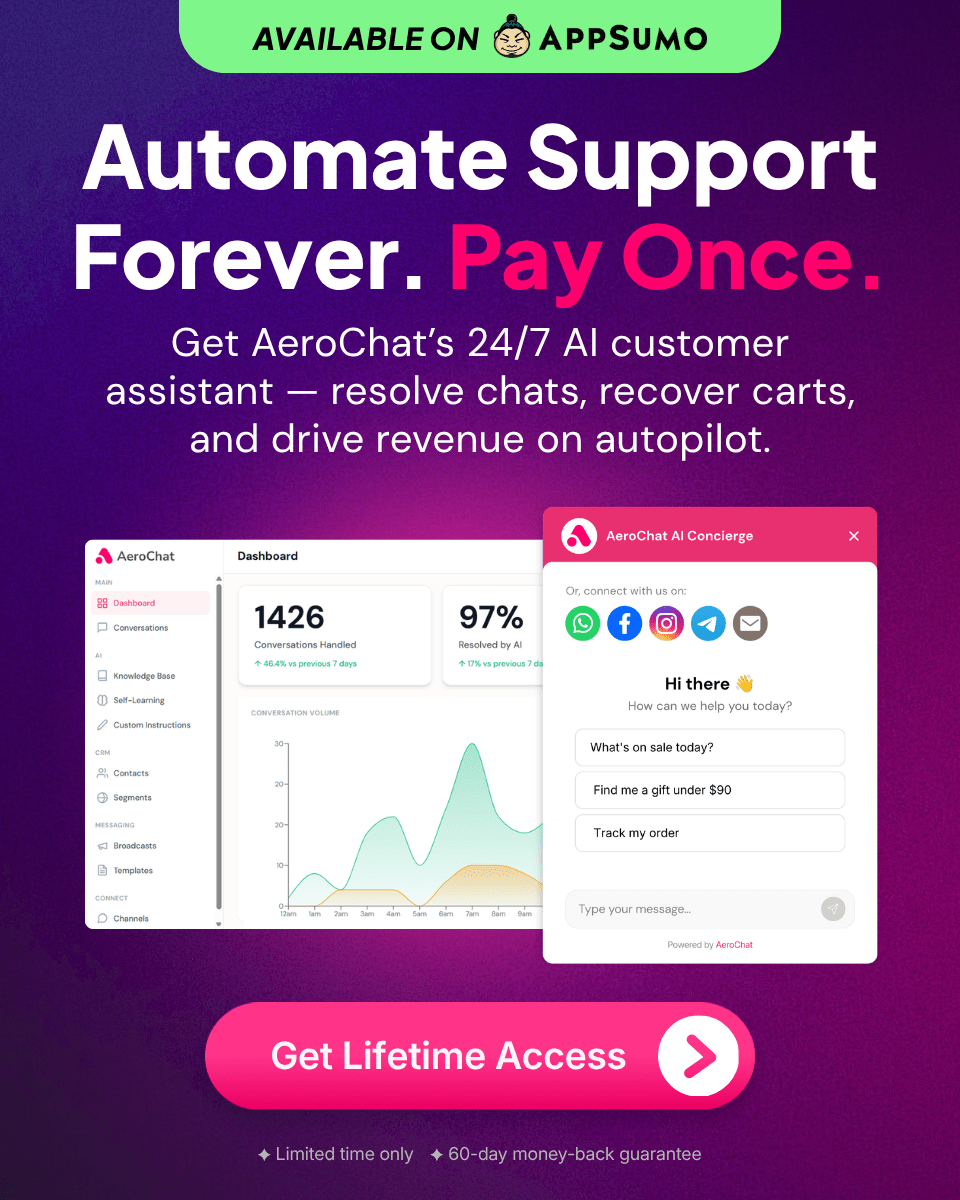
AeroChat for Shopify is in the AI agent category. Its Shopify connection can use current product, collection, order, discount and store information for customer conversations. Website chat, WhatsApp, Instagram, Facebook Messenger and email can be managed within the same customer-service environment, with human handover available when a request needs judgement.
That wider scope is not necessary for every new store. Shopify Inbox or a simpler live-chat app may be more economical when enquiries are infrequent and one person can answer them during business hours. The distinction becomes important when the volume of repetitive questions and conversations across several channels creates a meaningful workload that a basic chat tool cannot reduce.
When comparing candidates, include this question in the screening: does the tool answer questions from live store data, or does it only forward conversations to a person?
Use this shortlist worksheet
Before installing, require a clear answer in every row.
| Shortlist question | Pass condition |
|---|---|
| Is the Shopify connection current and documented? | Active listing or official integration documentation |
| Does it solve our main customer-service job? | The task appears in documentation and can be demonstrated |
| Is it compatible with our store and theme? | No unresolved App Store compatibility warning |
| Are requested permissions proportionate? | Every sensitive permission has an operational reason |
| Can it use the data needed for accurate answers? | Product, order or policy access matches the intended tasks |
| Can customers reach a person? | Handover works with conversation context preserved |
| Can we forecast the bill? | Billing unit, allowance, overage, seats and channels are known |
| Does it pass our five test conversations? | Accurate answers, safe fallbacks and correct escalation |
| Can we remove it cleanly? | Uninstall, billing and data-deletion process is understood |
The right place to find a Shopify chatbot is usually the App Store. The right way to choose one is to begin with the support job, verify the connection and test the difficult cases before paying for scale.