Can a Telegram AI Bot Understand Voice Messages?

Yes, a Telegram AI bot can understand a voice message when its connected software can download the audio, transcribe the speech and pass that transcript to an AI system. Telegram carries the voice note to the bot, but Telegram does not automatically make every bot understand what was said.
That difference matters. A bot may accept a voice note yet do nothing with it. Another may produce a transcript but fail on a product name. A well-designed customer-service bot should complete the whole journey: receive the audio, extract the meaning, answer from reliable business information and involve a person when the message is unclear or sensitive.
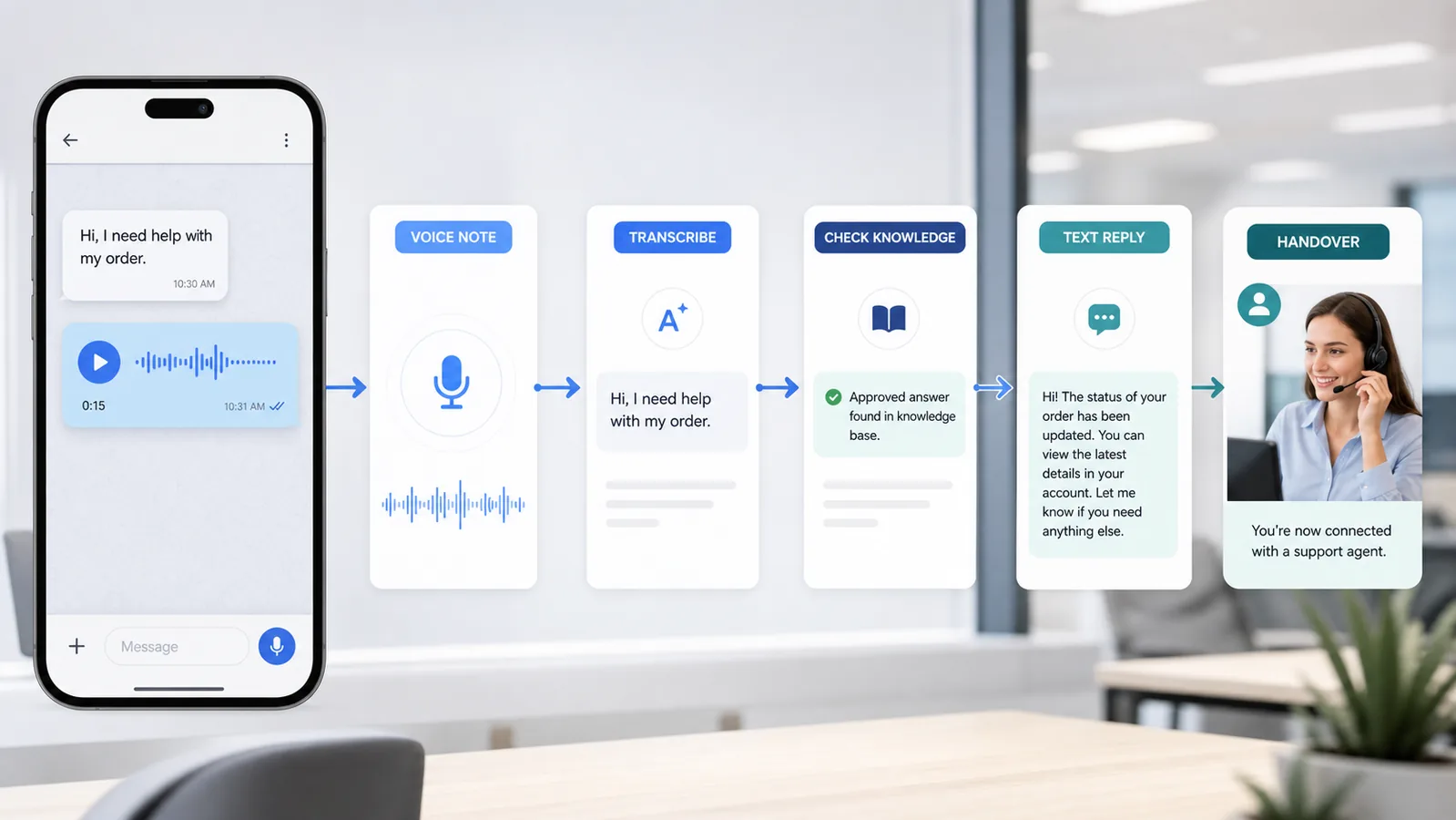
What happens after you send a voice note to a Telegram bot?
A voice-capable bot normally follows five stages.
| Stage | What happens | What can fail |
|---|---|---|
| 1. Receive | Telegram sends the bot an update containing a voice-file reference | The bot has no handler for voice messages |
| 2. Retrieve | The connected service downloads or accesses the audio | File limits, expired access or a connection error interrupts retrieval |
| 3. Transcribe | Speech recognition converts the audio into text | Noise, names, accents or codes are transcribed incorrectly |
| 4. Interpret | The AI works out the request and checks an approved knowledge source or business system | The transcript is ambiguous or the required data is unavailable |
| 5. Respond | The bot answers in text or voice, asks a clarifying question or hands the chat to a person | A weak setup guesses instead of acknowledging uncertainty |
Telegram’s current Bot API documentation represents a voice note as a file object with an identifier, duration and optional file information. That makes the audio available to a bot’s backend. Speech recognition and answer generation still have to be supplied by that backend or a connected platform.
The practical lesson is simple: “accepts voice messages” and “understands voice messages” are not the same feature.
Does Telegram transcribe the voice message for the bot?
Not by default through the ordinary Bot API. Telegram provides the message and a reference to the voice file. The bot operator then decides whether to download it, which transcription service to use, what information to retain and how to produce a reply.
This explains why two bots inside the same Telegram app can behave very differently. One may ignore audio. One may return only a transcript. Another may use the transcript as a customer question, retrieve the correct delivery policy and answer it.
It also explains why the Telegram interface cannot prove how a bot handles data. The bot’s name and profile are visible in Telegram; its speech provider, AI model, storage and business rules may sit elsewhere. Before using an unfamiliar public bot, review the guidance on Telegram AI bot permissions and data handling.
Which voice messages can an AI bot handle well?
Voice input is most useful when the spoken request maps to information the bot can verify.
Good customer-service candidates include:
- “Do you deliver to Manchester on Saturdays?”
- “Is the blue version available in a medium?”
- “How long do I have to return an unopened item?”
- “Where can I find the care instructions?”
- “Can you explain the difference between these two models?”
These questions have a defined subject and can be answered from current product details, policies or a connected store. Voice saves the customer from typing, while the underlying support process remains much the same.
The format is particularly useful on mobile. A customer may be walking, carrying a parcel or describing a problem that would take several lines to type. The business benefit is not that voice is inherently smarter; it is that the customer can use a more convenient input without creating a message the team has to play repeatedly and transcribe by hand.
Where do Telegram voice bots struggle?
Speech recognition can be impressive without being infallible. Customer-service teams should design for the mistakes that matter, not only for a polished demonstration recorded in a quiet room.
Background noise can change important words
Traffic, music, wind, other speakers and a poor microphone can remove or distort parts of a sentence. A transcript that misses “not” can reverse the meaning. A bot should ask the customer to confirm rather than quietly fill in the gap.
Names, product codes and order numbers are fragile
Speech systems often struggle with unfamiliar brand names, letter-number combinations and similar-sounding characters. “B15” may become “B fifty”; a surname may be replaced with a common word.
For a value that controls an order or account lookup, the bot should display what it heard and request confirmation. Asking the customer to type a short code is usually safer than pretending the audio was exact.
One voice note may contain several requests
A customer might ask about delivery, explain a damaged item and request an address change in a single recording. A weak bot answers only the easiest question. A better workflow identifies each request, resolves the safe one and routes the account change or complaint appropriately.
Code-switching and dialect affect results
A customer may change language mid-sentence or use local product terms. Multilingual transcription can help, but support teams still need examples from the languages, accents and vocabulary their customers actually use. A generic English test is not enough evidence for a multilingual launch.
Emotion is not reliable permission
A distressed or angry tone may indicate urgency, but tone analysis should not authorise a refund, cancel an order or make a legal judgement. The words, verified account data and business rules should control the action. Emotion can help prioritise review; it should not replace verification.
Should the bot reply in text or with another voice note?
Either design is possible, but a text reply is often more practical for customer service.
Text lets the customer check a price, address, tracking reference or return instruction without replaying audio. It is easier to search, quote and review later. A voice reply can feel natural, but it adds another speech-generation step and may be inconvenient when the customer is somewhere they cannot play sound.
Choose based on the task rather than novelty:
| Situation | Better default | Reason |
|---|---|---|
| Delivery policy or product detail | Text | Easy to scan and refer back to |
| Order number confirmation | Text with confirmation request | Reduces ambiguity around characters and digits |
| Accessibility requirement | Customer-selectable text or audio | The customer’s need should determine the format |
| Complex complaint | Human response in the agreed channel | Judgement and accountability matter more than format |
If a vendor says it supports voice, ask two separate questions: can it understand incoming voice notes, and can it generate outgoing voice replies? Those are different capabilities.
How can a business use voice notes without creating more support risk?
Treat voice as another input route into an existing support policy.
Start with low-risk informational questions. Product specifications, opening hours, delivery areas and published return rules are easier to validate than payment disputes or changes to an existing order. Keep the source material current and make the bot say when it lacks the required information.
Then define an action boundary. The bot may be allowed to explain an address-change policy, for example, without being allowed to change the address. The latter may require identity checks and a human decision.
Finally, preserve a clear route to a person. Customers should not have to record the same story again after a handover. The agent needs the transcript, the original voice note where appropriate and the surrounding conversation.
For a broader implementation path, the Telegram AI chatbot setup guide covers creating and connecting the bot. Voice handling should be tested after the basic text journey works, not used to hide an incomplete setup.
Test these voice messages before launch
A useful test pack sounds like real customers, not a voice actor reading perfect scripts.
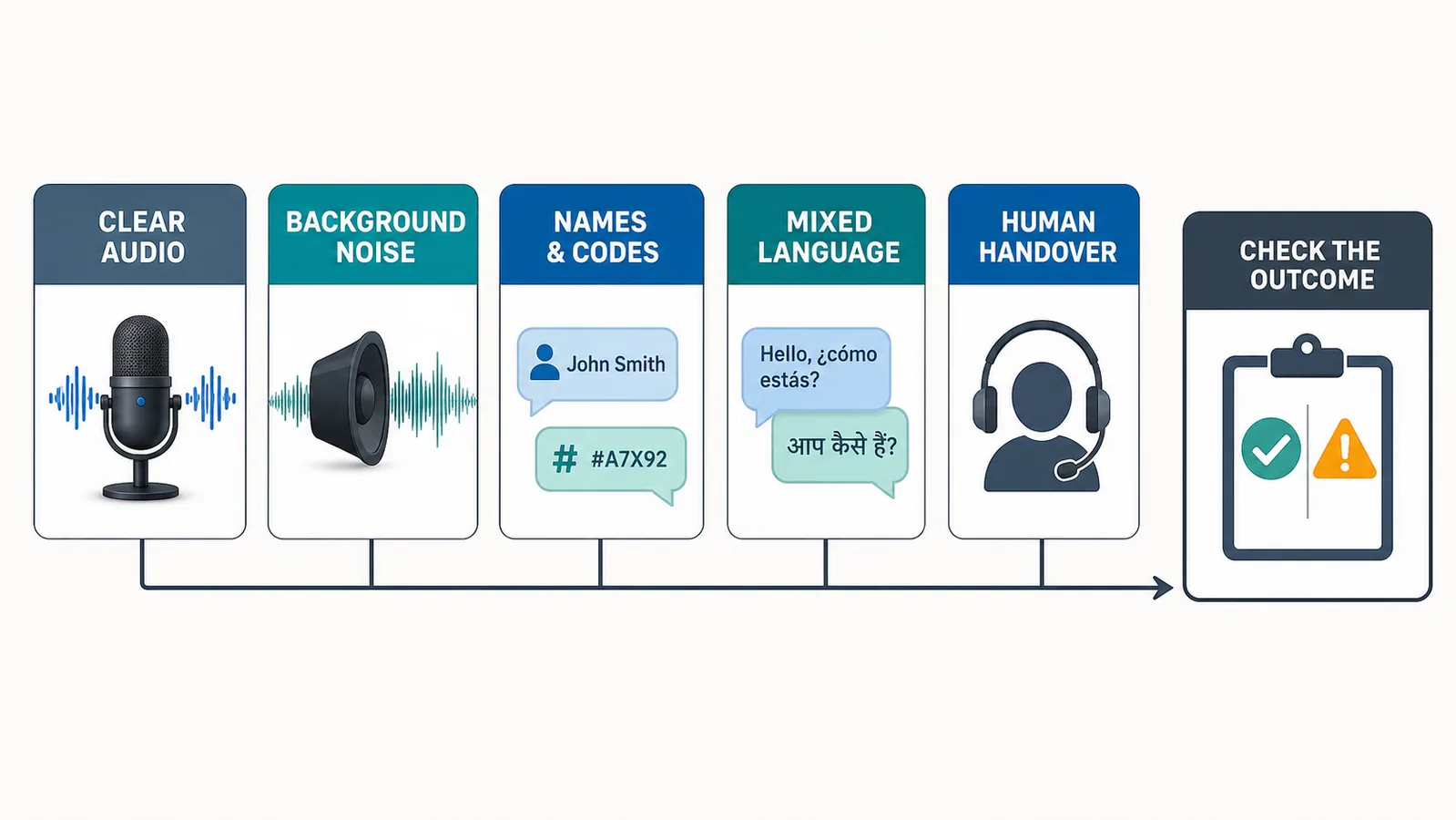
Record at least one example for each condition below:
- A clear, short product question in a quiet room.
- The same question with street or café noise.
- A product name that is easy to mishear.
- An order reference containing letters and numbers.
- A message with two separate questions.
- A speaker who pauses, restarts and corrects themselves.
- A message that changes language partway through.
- A vague request such as “I need help with my order”.
- A request to change account or delivery information.
- A complaint that explicitly asks for a person.
Do not score only whether the transcript looks plausible. Check the complete outcome:
- Did the bot preserve negation and quantities?
- Did it separate multiple intents?
- Did it answer from the correct source?
- Did it confirm uncertain codes or names?
- Did it avoid an action it was not authorised to perform?
- Did a human receive the context when handover was required?
A pass means the outcome is safe and useful. A fluent answer based on a wrong transcript is still a failure.
What privacy questions should you ask about voice messages?
A voice note can reveal more than a typed sentence. It may contain a person’s voice, background conversations, names, addresses or account information.
Before deploying a business bot, document:
- who operates the bot and the connected AI services;
- where the original audio and transcript are processed;
- whether either is stored and for how long;
- who on the business team can access them;
- how a customer can request deletion where applicable;
- which sensitive information the bot must reject; and
- whether customers are told that automated transcription is being used.
Do not ask customers to speak passwords, authentication codes, full payment details or other secrets. If the conversation moves into a sensitive account action, use an appropriate secure process rather than treating an ordinary voice note as identity verification.
How does AeroChat handle voice messages on Telegram?
AeroChat is an AI agent platform that helps online businesses run customer service on autopilot.
For supported Telegram customer conversations, AeroChat can transcribe an incoming voice message and answer it in text. The transcript is handled like a typed customer question, so the reply can use the business’s approved knowledge rather than producing a generic transcription alone.
This is useful when customers ask routine product, delivery, return or business questions by voice. Telegram conversations can sit alongside other supported channels through the AeroChat Telegram integration, reducing the need for the team to operate another isolated inbox.
The limitation is just as important: a voice message can be unclear, and not every request should be automated. When the AI is uncertain or the customer needs personal attention, human handover with conversation context keeps the customer from being trapped in an automated loop.
Best for: merchants receiving Telegram customer enquiries who want voice notes handled alongside typed messages without making staff listen to every routine recording.
How do you choose a Telegram bot with useful voice support?
Ask the provider to demonstrate an imperfect voice note, not only a prepared one. Confirm:
- which languages and channels support inbound voice;
- whether the reply is text, audio or configurable;
- how unclear speech is handled;
- whether names, codes and numbers can be confirmed;
- which knowledge source grounds the answer;
- whether audio and transcripts are retained;
- how a person takes over; and
- whether the full conversation remains visible after handover.
If you are comparing providers, use these criteria alongside the broader Telegram AI chatbot comparison. Voice should be one evaluated capability, not the sole reason to choose a customer-service platform. For the broader question of whether Telegram fits your store at all, see Telegram AI chatbots for ecommerce.
Frequently asked questions
Can every Telegram bot listen to voice messages?
Telegram can deliver voice-message information to a bot, but the bot’s connected software must be built or configured to retrieve and process the audio. Many bots do not include transcription.
Can a Telegram bot understand different languages in voice notes?
Some can. The result depends on the speech-recognition service, audio quality, language and vocabulary. Test the actual languages and accents your customers use instead of relying on a general multilingual claim.
Can a bot understand an order number spoken aloud?
It may transcribe it, but letter-number combinations are easy to mishear. A safer design repeats the value in text and asks the customer to confirm or type it before an account action.
Does AeroChat reply with a voice message?
Its current voice-message feature documentation states that incoming voice notes are transcribed and answered in text. Do not assume that inbound voice support also means outgoing voice generation.
Is a voice transcript enough for a sensitive request?
No. A transcript is an interpretation of audio, not proof of identity or permission. Account changes, payments, legal threats and other high-risk requests need the business’s normal verification and escalation process.