
Instagram Bio Optimisation for Business: What to Include and How to Test It

Your Instagram bio is 150 characters. A visitor reads it in under three seconds and either stays or scrolls. For a business, that short block of text is less a personal profile and more a routing layer that sends the right visitor toward an action and lets everyone else move on. The businesses that treat the bio as a conversion asset get different results from those who treat it as a place to describe themselves.
This guide explains how to write, structure and improve an Instagram bio for a business, with specific guidance on what each element should do and how to measure whether it is working. If you already have a following but are not converting visitors into customers or enquiries, the bio is often the first place to look.
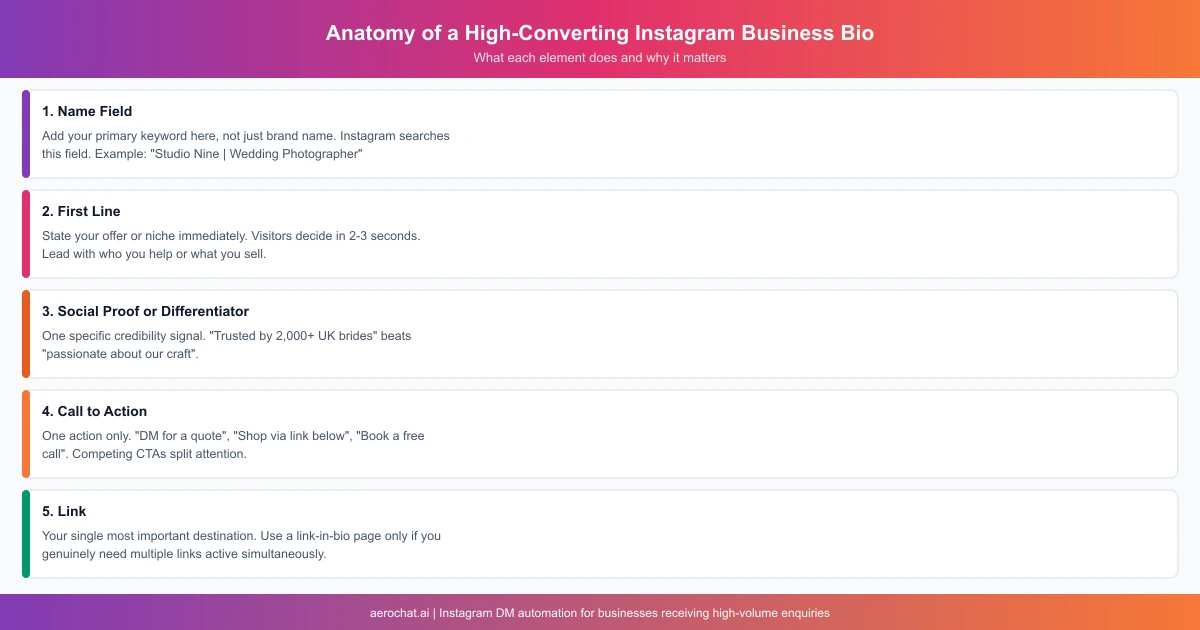
The five elements of a business Instagram bio
| Element | Typical space | Primary job | Example |
|---|---|---|---|
| Name field | ~30 characters | Discoverability in Instagram search | “Bloom Floral | Manchester Florist” |
| Opening line | ~50 characters | State the offer before the visitor taps away | “Handmade soy candles for UK homes” |
| Differentiator | ~40 characters | Give a specific reason to trust or follow | “3,000+ orders shipped” |
| Call to action | ~30 characters | Direct the visitor to one specific action | “DM QUOTE for a custom estimate” |
| Link | 1 primary URL | Convert the profile visit into a click | Direct product or booking page |
The name field is not just for your brand name
Instagram’s search algorithm reads the name field, the bolded text that sits directly below your profile photo, as part of your account’s relevance for search queries. Most businesses put only their brand name there and leave discoverability on the table.
Adding a keyword or category alongside your name means Instagram can surface your profile when someone searches for what you do rather than who you are. A florist in Edinburgh might use “Thistle Bloom | Edinburgh Florist” rather than “Thistle Bloom” alone. A B2B consultant might use “Kate Hartley | LinkedIn Growth Coach”. The format varies; the principle stays the same. Put at least one searchable term in the name field that describes what your business actually offers.
The opening line has to earn its place
Instagram shows three lines of bio text before a visitor has to tap “more”. In practice, most visitors never tap more. The opening line of your bio is therefore the highest-value space you have, and it should answer the visitor’s immediate question without requiring any effort on their part.
The mistake most businesses make is opening with something that describes their values or story rather than their offer. “Passionate about helping businesses grow” requires the visitor to infer what the business actually sells or does. “Shopify email marketing for DTC brands” does not. Lead with the specific offer or niche before anything else.
If your opening line describes your brand’s personality without naming your product category, rewrite it to name the category first and let personality come through in the detail and tone of what follows. The visitor who recognises themselves in your opening line is more likely to read the rest of the bio and take an action.
Social proof works when it is specific
The second or third line of your bio is usually the right place for a differentiator or credibility signal. This might be a customer count, a geographic note, an accreditation relevant to your industry, or a characteristic that distinguishes your offer from what else is available. The critical condition is specificity.
A claim like “quality products you can trust” provides no information a visitor can act on. They have seen it in hundreds of other bios and it carries no weight. A claim like “over 3,000 orders shipped” or “stocked in 40 independent UK retailers” names a concrete fact that a visitor can weigh. Choose the most honest and specific signal you have rather than the most flattering phrasing you can invent.
If you do not have a strong proof point yet, leave the space for your offer description. A clear two-line bio with a specific offer and a single call to action outperforms a three-line bio where the third line is a vague superlative.
One call to action, not several
Every business bio should contain exactly one primary call to action. When two competing instructions appear in the same bio, visitors take longer to decide and more of them take no action at all. Three or more CTAs is worse than one, not better than one.
The CTA should name the action and be honest about where it leads. “Shop the current collection via the link below” is more effective than “check out our link” because it tells the visitor what they will find before they click. “DM QUOTE to receive a custom estimate” creates a specific, repeatable enquiry flow that is easier to track and respond to than “send us a message for more info”.
Match your CTA to the one goal that matters most right now. If you are currently focused on sales, the CTA should point at a product or collection. If you are growing a service business, it should direct people to DM or book. If you change your primary goal, update the CTA to match.
The link should go somewhere specific
Professional Instagram accounts can add up to five links, but the number of links is less important than where each one goes. If you have five link options, the visitor has to make a decision. If you have one clear link that matches your call to action, the decision is already made for them.
The link destination should be the most commercially important page you have right now, connected directly to what the CTA promises. If the CTA says “explore our new arrivals”, the link should open the new arrivals collection, not your homepage. The further a visitor has to navigate after clicking, the more of them leave before completing an action.
Review the link every time you update a promotion, launch a new collection or change your primary CTA. A link that points to an out-of-stock collection or an expired offer actively undermines the bio.
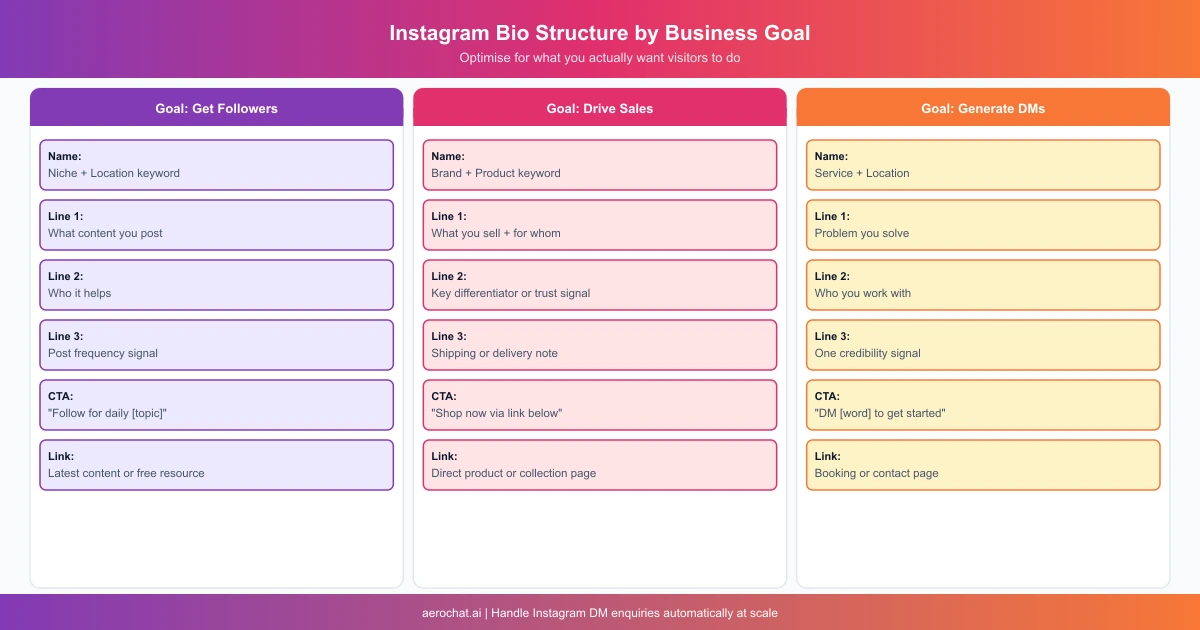
Structure the bio around one primary goal
The right structure depends on what you want visitors to do. A business building a content audience needs a different bio from one driving product sales or service enquiries, and trying to serve all three goals in 150 characters typically means serving none of them well.
If your goal is follower growth, describe what you post and who it is for rather than what you sell. A content-based signal such as “weekly tutorials on ceramics glazing” tells a potential follower what they will receive in exchange for following, which is a more compelling reason to follow than a sales message. The guide to growing Instagram followers for business covers how to align your content and profile to attract the right audience rather than just more followers.
If your goal is product sales, front-load the category and key differentiator. Include a shipping or availability note if that is a genuine advantage. Link directly to the product or collection page that is most likely to convert a first-time visitor. For businesses actively selling on the platform, the guide to selling on Instagram and the Instagram shop setup guide cover the practical steps beyond the bio itself.
If your goal is to generate enquiries or DMs, state the problem you solve and who you work with. A keyword-triggered DM CTA creates a simple enquiry flow that is easy to manage and easy to automate. When enquiry volume grows to the point where you cannot respond manually within a reasonable time, AeroChat is an AI agent platform that helps Instagram business owners automate and scale customer conversations. It handles common DM enquiries automatically using your product and service information and passes conversations to a person when the situation requires it. You can explore how it works for Instagram DM automation before deciding whether it fits your current stage.
Keywords and discoverability
Instagram’s internal search uses the content of your name field and bio text to determine relevance for user queries. The name field carries more weight, but terms in the bio body still contribute to how the platform categorises your account.
The most useful keywords are the ones your ideal customer would type when looking for a business like yours. For a food business, “sourdough bakery Manchester” is more searchable than “artisan baking with a passion for craft”. For a service business, “HR consultant for UK startups” is more findable than “helping businesses build great teams”. Use the language your customer uses rather than the language your industry uses internally.
Do not force multiple keywords into the bio at the expense of reading naturally. A bio that contains one or two relevant search terms and reads like something a person wrote will outperform one that has been keyword-stuffed at the cost of clarity.
What to test and how to read the results
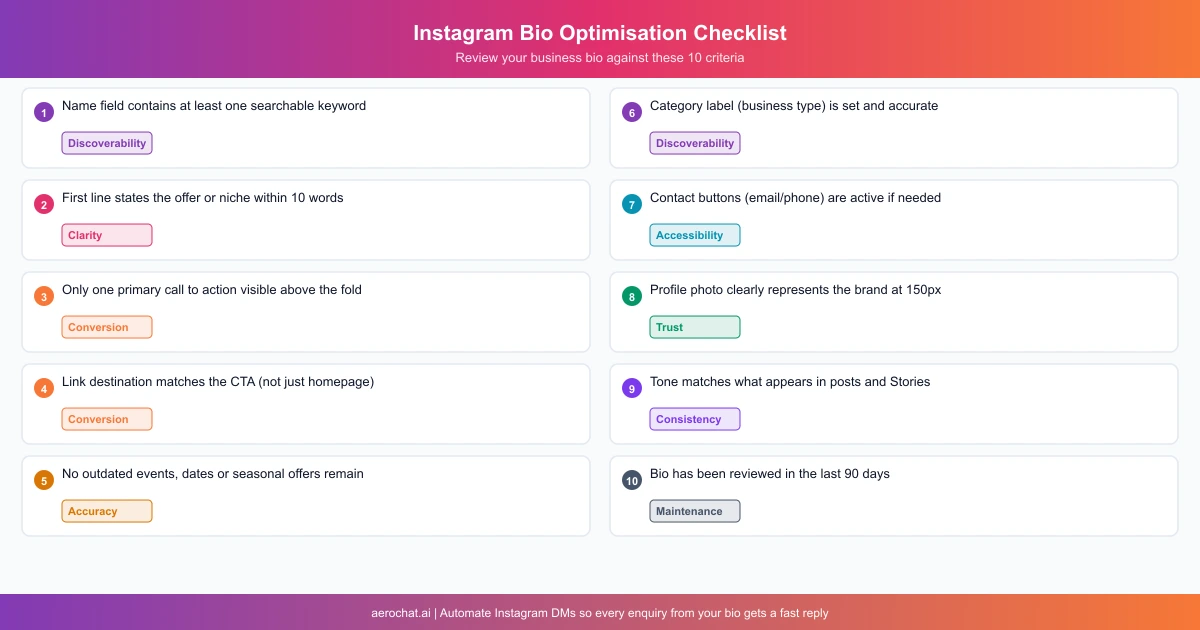
The bio should be treated as a variable to test rather than a fixed profile. If you have a goal that can be measured, such as link clicks, DM volume, or follower growth rate, test one element of the bio at a time over two to four weeks and compare the result against your baseline in Instagram Insights.
The opening line and the CTA are usually the highest-leverage elements to test, because they carry the most weight in the visitor’s decision. Test two different ways of describing your offer in the opening line and see which one produces more link clicks or enquiries. Test two different CTAs, one generic and one specific, and measure the difference. Change one thing per test period and keep the surrounding elements constant so the result is interpretable.
Review the full bio every quarter at minimum. Instagram’s features change, promotional offers expire, product ranges update and CTAs that worked during a launch period become stale when the launch is over. A bio that was accurate and effective six months ago may now be pointing at the wrong destination or describing a product you no longer sell.
Connecting the bio to your wider Instagram strategy
The bio is the entry point to everything else your Instagram account does. If your posts are driving profile visits but those visits are not converting to followers, customers or enquiries, the bio is usually the first place to audit. If you are setting up an Instagram shop, the bio link should reflect where you want customers to browse. If you are running content to build an audience, the bio should explain why following you is worthwhile.
For businesses actively selling on Instagram, the guide to Instagram captions that sell covers what to say in posts once the bio is doing its job. If DM volume is your primary metric, the guide on turning Instagram followers into customers explains the conversation and follow-up approach that connects a profile visit to a purchase.