

How Much Does Your Ecommerce Customer Support Stack Really Cost?

The real cost of an ecommerce customer support stack is the sum of software subscriptions, seats, usage charges, channel fees, setup, integrations, administration, quality review, duplicated work and eventual switching costs. Adding the prices shown on three vendor websites normally captures only part of the bill.
Use one consistent monthly or annual period. Then calculate:
Support stack cost = visible software costs + operating costs + allocated change and exit costs
This gives the cost of owning the stack. It does not yet tell you what each resolved customer problem costs.
Rebuild the bill from four places
Support tools rarely appear on one invoice. Reconstruct the cost before deciding whether the stack is expensive.
Shopify billing
Export the relevant Shopify bills and identify recurring subscriptions, usage charges and one-time purchases. Shopify explains that third-party app subscriptions can have independent billing cycles and that usage charges can appear on a later bill. Some apps also charge outside Shopify, so the platform invoice is not a complete register. The official Shopify app-charge guidance explains these categories and timing differences.
Card and bank statements
Search for direct SaaS, messaging, telephony, AI usage, automation and contractor payments. Annual subscriptions are easy to miss when reviewing a single month, so divide them across the service period.
Direct vendor invoices
Collect charges for onboarding, premium support, additional channels, API use, implementation and overages. Record the billing unit beside each amount: seat, ticket, conversation, resolution, message or contact.
Staff and contractor time
Estimate hours spent configuring tools, maintaining knowledge, fixing integrations, reviewing automated answers, managing access and reconciling reports. Use an appropriate loaded hourly cost, not a guess about what the time feels worth.
The nine costs in an ecommerce support stack
The nine categories below can be grouped into visible, operating and change costs. This makes it easier to see which costs scale with volume and which exist simply because the tool is present.
Visible software costs
1. Base subscriptions. Include the helpdesk, AI support tool, social inbox, returns portal, tracking tool, knowledge base and any automation connector used primarily for support.
2. Seats and plan upgrades. A low entry price can change when managers, seasonal agents or multiple stores need access. Record unused as well as active paid seats.
3. Usage charges. These may be based on conversations, messages, tickets, AI resolutions, contacts, tokens or another unit. Use actual billing data and model a peak month separately.
4. Channel and infrastructure fees. Include messaging, telephony, email delivery, API consumption and middleware required to keep support channels working.
Operating costs
5. Setup, migration and training. Allocate one-off work across the period in which the business expects to use the system. Include internal time, not only the vendor's invoice.
6. Integration maintenance. Connections need monitoring when permissions, field mappings or APIs change. Include the connector subscription and the people who diagnose failures.
7. Administration and quality review. Someone maintains users, policies, knowledge, routing and reporting. AI support also needs sampling and correction, especially after product or policy changes.
8. Duplicate and fragmented work. Two tools may store the same contact, trigger duplicate replies or require agents to copy order details manually. Measure the repeated minutes where possible rather than assigning a vague "inefficiency" percentage.
Change and exit costs
9. Contract overlap, export and replacement. A store may pay for both systems during migration, clean data before export and retrain the team. Include a monthly provision when a tool would be costly to leave.
The FinOps Foundation's SaaS guidance similarly treats SaaS cost as a combination of inventory, subscription and usage charges, support and internal operating dependencies. The exact amounts remain specific to the merchant.
A worked monthly example in USD
The following figures are hypothetical. They demonstrate the calculation and are not current prices for AeroChat or any other vendor.
| Cost item | Illustrative monthly amount |
|---|---|
| Support platform subscriptions and seats | $240 |
| AI automation add-on | $300 |
| Messaging and usage charges | $125 |
| Returns and tracking apps | $145 |
| Integration connector | $60 |
| Six administration hours at $35 | $210 |
| Four quality-review hours at $35 | $140 |
| Two integration-maintenance hours at $50 | $100 |
| Allocated migration and contract-overlap provision | $80 |
| Real monthly stack cost | $1,400 |
The visible recurring software and usage lines total $870. The complete illustrative ledger is $1,400 after operating and change costs are included.
This does not prove that the stack is overpriced. The additional work may protect revenue, customer trust or staff capacity. It does show the amount that should be compared with outcomes.
Allocate the cost to the jobs it serves
Create one row per tool and mark the support jobs it performs: receiving email, social messaging, live chat, order lookup, returns, knowledge, automation, human ticketing or reporting.
A shared tool can be allocated using a reasonable driver. If half of an automation connector's tasks support customer service, allocate half of its subscription and maintenance time. Document the rule so next quarter uses the same method.
This map also exposes gaps. A store may pay for three inboxes but have no dependable owner for escalated refunds. More software spend does not necessarily mean complete coverage.
Find duplicate spend without breaking the workflow
Do not cancel a tool because two vendors both advertise "automation". Compare the exact job and customer journey.
| Decision | Use it when | Evidence required |
|---|---|---|
| Keep | The tool owns a necessary, distinct job | Completed outcomes and a named owner |
| Combine | Two tools handle the same conversation or data | A tested replacement covers both routes |
| Replace | The job matters but the current tool creates avoidable cost or failure | Migration, export and rollback plan |
| Retire | The tool has no active owner or measurable use | Access and dependency check confirms safe removal |
The guide to customer service app categories can help identify tools that sound similar but perform different jobs. If fragmented channels are the main cost, review the operating model for omnichannel Shopify support before replacing individual apps.
Where AeroChat enters the stack-cost calculation
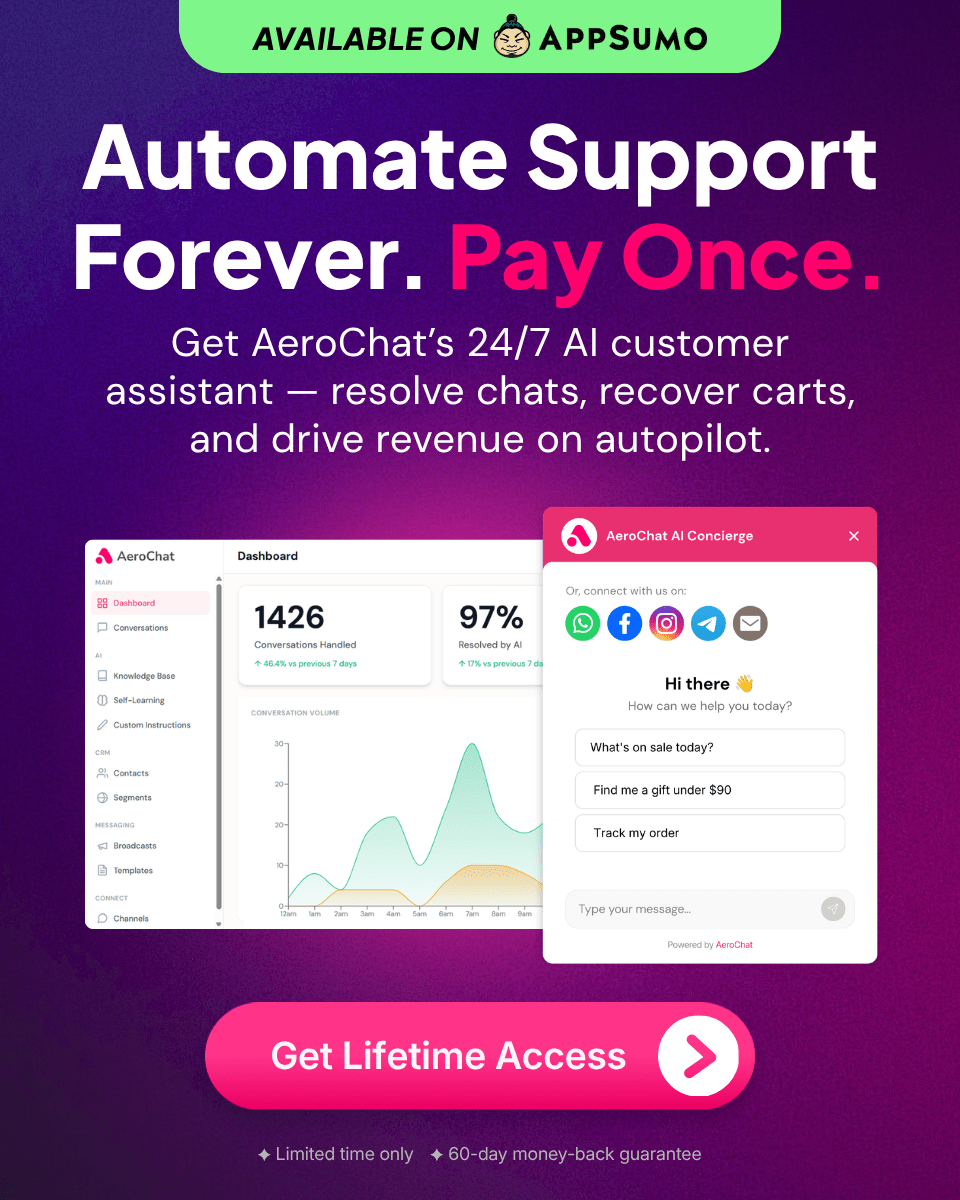
AeroChat is an AI agent platform that helps ecommerce brands run customer service on autopilot. If it is part of the support stack, count it under the same rules as every other product: subscription, relevant channel or integration costs, setup, knowledge maintenance, review and human handling after escalation.
The AeroChat ecommerce platform can bring supported customer conversations and suitable automation into one operating layer. Its AI-powered chat insights report measures such as conversations handled, AI resolution rate, time saved, common topics and escalations. These are useful operational inputs, but they are not a complete financial ledger.
Payroll, external messaging charges, helpdesk costs, integration work and staff administration may sit elsewhere. A merchant should combine those costs with the product data, then use the existing method to calculate cost per resolved ticket.
Do not treat a displayed time-saving estimate as cash automatically saved. Released time becomes financial value only when the business avoids spend or uses the capacity for measurable work.
Questions finance and support teams should settle together
Should support-team salaries be included in the stack cost?
Include time spent operating, maintaining and reviewing the tools in stack TCO. Include frontline handling time when calculating the full cost of customer support or cost per resolution. Keep the two views separate so software ownership is not confused with the entire support function.
How often should an ecommerce store audit support subscriptions?
Review the register at least before major renewals and after material changes in volume, channels or team size. A quarterly review is practical for many growing stores, with a separate peak-period check for usage-based plans.
What is the difference between stack cost and cost per resolved ticket?
Stack cost is the total cost of owning and operating the tools. Cost per resolved ticket divides the relevant support cost by genuine completed resolutions. The first supplies part of the numerator; the second connects spending to outcomes.
Turn the result into a 90-day renewal plan
Give every tool an owner, renewal date, cancellation window and decision date. For questionable tools, name the journey that must be tested before renewal.
The objective is not the cheapest possible stack. It is a support operation in which every recurring cost has a clear job, a responsible owner and evidence that the customer journey still works.