
Can AI Replace a Human Personal Assistant?
AI can automate parts of a personal assistant’s workload, but it cannot reliably replace the whole role. It is strongest on structured digital tasks such as drafting, summarising, data entry, reminders and routine enquiries. A person is still needed for judgement, accountability, sensitive relationships, ambiguous priorities and physical work.
The practical decision is therefore not “AI or a human?” It is which tasks can be automated, which need human review and which should remain human-led.
For many businesses, the best model is a combination: AI handles clearly defined repetitive work, while a personal or executive assistant manages exceptions, relationships and decisions.
What does a human personal assistant actually do?
Personal-assistant work is broader than calendar booking and email drafting.
The UK National Careers Service lists responsibilities such as responding to enquiries, arranging meetings and travel, preparing documents, maintaining records and organising events. Executive assistants may also manage projects, use judgement to prioritise work, support decision-making and manage client relationships.
That range explains why an AI tool may replace a task without replacing the job. Booking a meeting from three available times is a structured action. Deciding whether an important client should displace a private commitment requires context, discretion and responsibility.
Which personal-assistant tasks can AI automate?
The safest candidates are frequent, repeatable tasks with clear inputs, rules and a reversible outcome.
| Task | Suitable role for AI | Human involvement |
|---|---|---|
| Transcribing a meeting | Automate | Check names, figures and decisions |
| Formatting a standard document | Automate | Review before external use |
| Moving structured data between approved systems | Automate | Monitor errors and permissions |
| Sending routine reminders | Automate | Define timing and escalation rules |
| Answering approved FAQs | Automate within a knowledge base | Maintain sources and handle exceptions |
| Suggesting meeting times from calendar availability | Automate | Resolve sensitive or strategic conflicts |
| Drafting a routine email | Assist | Approve tone, facts and recipient |
| Summarising a long document | Assist | Read the source for material decisions |
| Researching travel or suppliers | Assist | Verify terms and approve bookings |
| Prioritising an unfamiliar request | Assist cautiously | A person owns the final priority |
| Managing a dispute or important relationship | Human-led | AI may prepare context only |
| Handling confidential judgement calls | Human-led | Keep accountable decision-makers involved |
| Attending an event or completing an errand | Human-led | Requires physical presence |
This table is a starting point, not a universal rule. A meeting reminder may be low risk in one organisation, while a reminder sent to a regulated client could require additional review.

Why is automating a task different from replacing a role?
Jobs consist of many tasks with different levels of structure and risk.
The International Labour Organization’s 2025 research found that clerical occupations have high exposure to generative AI. It also concluded that most affected jobs are more likely to be transformed than made redundant because human input remains necessary. ILO generative AI and jobs update
An ILO review published in June 2026 found real but uneven productivity gains. It also noted that worker-reported time savings had not consistently translated into higher measured output, earnings or employment.
These findings support a task-level approach. They do not support a claim that AI replaces a fixed percentage of every personal assistant’s work or pays for itself within a set period.
What can AI do well without pretending to be a person?
AI is useful when the required output can be checked against a reliable source.
Draft and reorganise information
An AI assistant can turn notes into a draft agenda, rewrite a routine email or organise information into a template. This reduces blank-page work, but the person sending the document remains responsible for names, dates, commitments and tone.
Summarise for orientation
A summary can help someone identify the parts of a long document that deserve attention. It should not replace the original when the decision involves a contract, financial commitment, personnel issue or other material consequence.
Operate defined administrative workflows
Automation can move information, create a reminder or trigger a standard response when the required rules are explicit. The workflow should record what happened and allow a person to correct it.
Handle routine customer questions
Customer-service questions are often repetitive and source-based: delivery times, return conditions, product details and order status. A connected AI system can handle approved enquiries while escalating disputes or unusual cases.
This is customer-service automation, not general personal assistance. Keeping that boundary clear prevents businesses from buying one type of tool for a different problem.
Which responsibilities still need a human?
Some PA responsibilities are difficult to define as a stable set of rules.
Judgement under changing priorities
A skilled assistant does more than identify a diary conflict. They understand which commitment can move, which relationship needs care and what the wider consequences will be. AI can surface options, but it should not own a consequential decision without clear authority and review.
Relationship and reputation management
Senior assistants often represent an executive or organisation in conversations. They remember history, recognise subtext and adjust their approach to the person involved. A plausible draft is not the same as trusted representation.
Confidentiality and discretion
Personal assistants may handle financial, personnel, legal or private information. Adding an AI tool introduces questions about access, retention, subprocessors and international transfers. Approval should depend on the information involved, not merely on the convenience of the feature.
Accountability
Software cannot accept professional responsibility for a missed deadline, inappropriate commitment or harmful message. A named person still needs to approve important actions and respond when something goes wrong.
Physical and situational work
An AI service cannot attend a meeting in someone’s place, inspect a venue, greet a visitor or complete an errand. It may help plan those activities, but the execution remains human.
What hidden work comes with an AI assistant?
Automation removes some tasks and creates others.
A business still needs to:
- choose which systems the AI may access;
- keep source information current;
- define actions the AI may and may not take;
- review incorrect outputs;
- monitor failed integrations;
- control employee permissions;
- investigate security or privacy incidents; and
- provide a fallback when automation is unavailable.
If these responsibilities are ignored, the apparent time saving can become correction work. Start with a narrow workflow whose outcome is easy to verify.
How should you compare the cost of AI and a human assistant?
Avoid comparing a full salary with the cheapest advertised software subscription. They provide different capabilities.
The National Careers Service currently gives an annual UK executive-assistant salary range of £28,000 for a starter to £60,000 for an experienced worker. Actual employment cost also depends on location, experience, working hours, benefits, equipment, recruitment and employer obligations.
The cost of AI may include:
- the main subscription;
- usage or message allowances;
- additional user seats;
- integrations and automation tools;
- setup and data preparation;
- employee review time;
- security and compliance work; and
- the human support still required for exceptions.
Use a workload calculation instead of a headline comparison:
- Record the tasks performed for two to four representative weeks.
- Separate repeatable tasks from judgement-heavy work.
- Estimate the volume that a specific tool can handle after testing.
- Include setup, checking and exception-handling time.
- Compare the full monthly cost with the value of time genuinely released.
- Review quality as well as cost.
Do not count an automated answer as a saving if an employee has to correct it later or the customer repeats the request through another channel.
When does a hybrid model work best?
A hybrid model works well when the business has both repeatable volume and meaningful exceptions.
For example:
- AI prepares a morning email summary; the assistant chooses priorities.
- AI proposes meeting times; the assistant resolves important conflicts.
- AI drafts a travel comparison; the assistant checks terms and books.
- AI answers routine customer questions; a person handles complaints and approvals.
- AI records agreed actions; the assistant confirms ownership and deadlines.
The system should make escalation easy. A person needs enough context to continue the work without reconstructing everything from the beginning.
How does AeroChat reduce the customer-service work a PA handles?
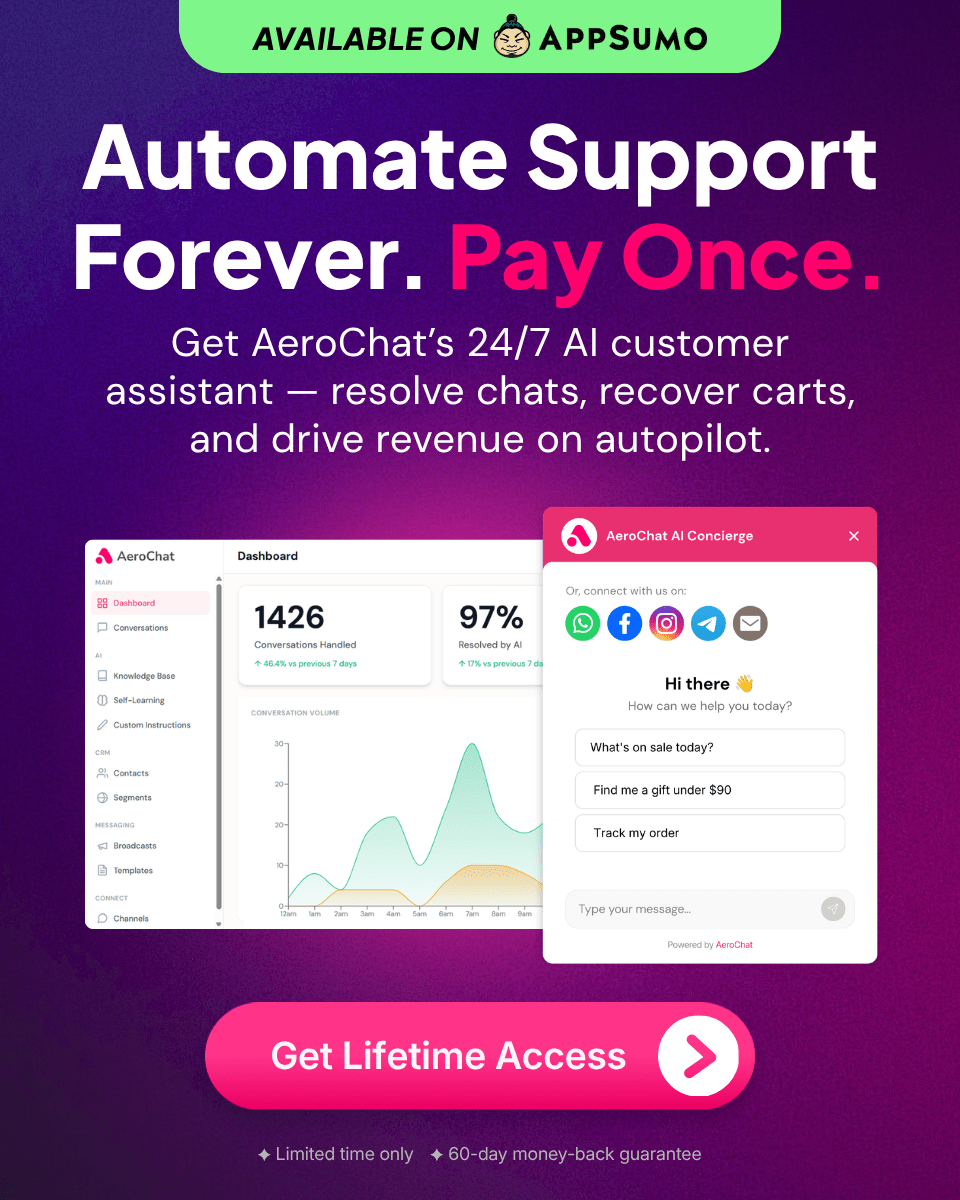
AeroChat is an AI agent platform that helps online businesses run customer service on autopilot.
AeroChat does not replace a human personal assistant. It reduces one specific part of the workload: repetitive customer conversations across supported channels, especially ecommerce enquiries involving products, delivery, returns and orders.
Through the AeroChat Shopify integration, the AI can use current store information for supported customer questions. Businesses can manage approved sources through knowledge-base training and transfer cases requiring personal attention through human handover.
Best for: online businesses losing sales to slow or unanswered customer queries.
AeroChat may reduce the customer-service portion of an owner’s, assistant’s or support team’s workload. It does not manage an executive’s diary, travel, confidential relationships or physical tasks, and it should not be presented as a complete PA replacement.
This makes it most relevant when customer conversations are the measurable bottleneck. A business whose main problem is calendar management or executive administration needs a different category of tool.
Merchants can review practical Shopify customer-support automation before deciding whether the workload is suitable. Current plan costs, channel availability and usage allowances should be checked on the AeroChat pricing page during the evaluation.
How should a business introduce AI responsibly?
Start with one workflow that is frequent, bounded and easy to check.
- Define the task and the outcome that counts as complete.
- Identify the source of truth.
- Limit the data and system permissions.
- Test normal, ambiguous and failure cases.
- Require human approval for consequential actions.
- Tell affected staff and customers when automation materially changes their experience.
- Monitor errors and maintain a manual fallback.
- Expand only when the first workflow performs reliably.
The aim is not to remove a person from every process. It is to use automation where consistency and speed help, while keeping human judgement where the cost of misunderstanding is higher.
Whether AI can replace a human personal assistant depends on the tasks in question. For AI on consumer messaging platforms, Telegram AI bot safety and reliability covers how well AI assistants function on one of the most-used platforms for this purpose. The guide to enabling AI in Telegram covers the practical setup, and Meta AI in WhatsApp covers the equivalent feature on the world’s most used messaging app.