
Best Zendesk Alternatives in 2026: Honestly Compared for Online Businesses

Zendesk Support Professional costs $115 per agent per month billed annually. A 10-agent team pays $13,800 per year before adding the AI add-on, which runs an additional $50 per agent per month and brings the total closer to $19,800. Most “best Zendesk alternatives” articles skip those numbers and compare feature lists instead. This one starts there, because the cost is usually what triggers the search in the first place.
The alternatives below were chosen based on what they actually solve — not because they have a similar feature set on paper. Some are significantly cheaper. Some trade agent tooling depth for AI automation. One is worth considering only if ecommerce is your context. None of them are drop-in replacements for a mature Zendesk configuration, and this guide does not pretend otherwise.
What Makes Zendesk Hard to Leave
Zendesk has been refined for nearly two decades. The ticket routing, SLA management, macro system, and reporting depth are genuinely mature. If you run a 30-agent support operation with complex escalation paths, multiple support tiers, and deeply embedded third-party integrations, the workflow engine is difficult to replicate at a lower price point without a meaningful transition cost.
Where it shows its age: AI that feels bolted on rather than built in, pricing that scales against you as headcount grows, and setup complexity that requires dedicated admin time to maintain. Those three pressure points are where the alternatives below find their opening.
Who Should Stay on Zendesk
Teams with 20+ agents, complex escalation logic, deep Salesforce or Jira integrations, and a dedicated CX operations function to manage the platform. The switching cost for a well-configured Zendesk account — triggers, automations, macros, ticket views, integrations — is real and should factor into any evaluation. If those conditions describe your operation, the alternatives below will feel like a downgrade in workflow depth even if they are a meaningful saving on paper.
The Best Zendesk Alternatives in 2026
1. AeroChat — Best for Ecommerce Teams That Want AI to Handle the Volume
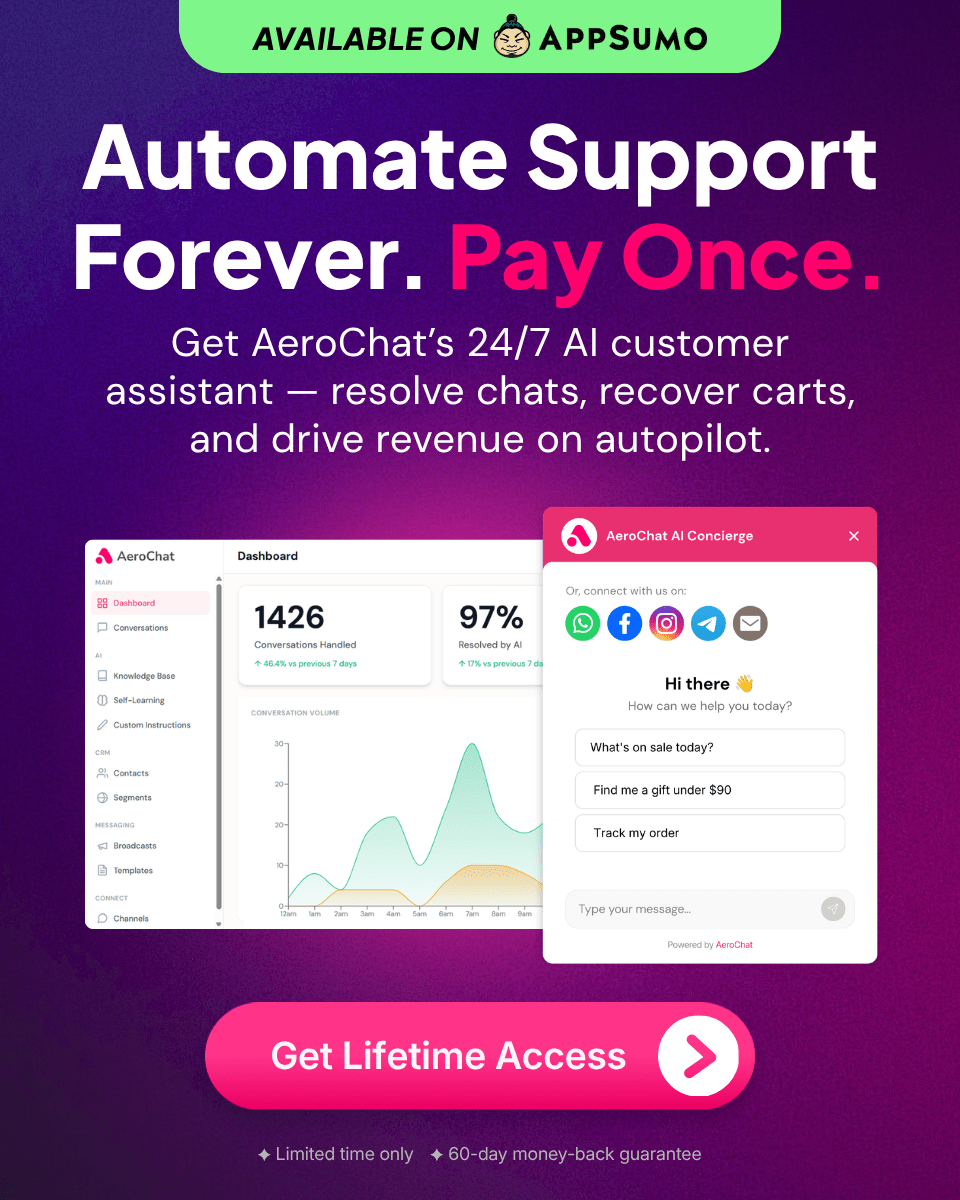
AeroChat is not a helpdesk that added AI features. It operates the other way: an AI agent that resolves customer conversations autonomously, backed by a shared inbox for the conversations that genuinely need a human. For Shopify merchants and ecommerce teams where the majority of support queries are order status, returns, sizing, and product questions, that distinction matters significantly.
Where Zendesk routes a ticket to an agent and the agent replies, AeroChat resolves the conversation before a ticket exists. It trains on your actual Shopify product catalogue, order data, return policies, and FAQs, then handles WhatsApp, Instagram, web chat, and Messenger from a single inbox. When a conversation needs a human, the handover passes full context so agents do not start from scratch.
Pricing is flat — Basic at $49 per month, Growth at $149, Advanced at $349. No per-agent fees. A team that scales from 3 agents to 12 pays the same subscription, which changes the economics significantly compared to Zendesk’s model. See how it compares in the best AI chatbots for ecommerce roundup.
What you give up: Zendesk’s depth in SLA tracking, macro libraries, and agent workflow tooling. AeroChat is the right switch when AI resolution rate matters more than agent workflow depth.
2. Gorgias — Best for Shopify Stores Needing Helpdesk Depth
Gorgias was purpose-built for ecommerce on Shopify, BigCommerce, and Magento. Order data, refund history, and purchase records surface directly inside the support ticket. The macro system lets agents handle repeat queries in seconds. For Shopify stores at volume where human agents handle most conversations, it is the most natural Zendesk alternative in the ecommerce context.
The pricing model is ticket-based rather than per-agent. Starter covers 50 tickets per month at $10. Basic covers 300 at $60. Pro covers 2,000 at $360. AI resolution is charged separately at $0.90–$1.00 per resolved conversation. If you are switching from Zendesk to escape per-agent pricing, model your monthly ticket volume carefully — during high-traffic periods, ticket-based billing can produce a higher bill than Zendesk’s fixed model would have.
3. Freshdesk — Best for Teams Wanting Traditional Helpdesk at Lower Per-Seat Rates
Freshdesk Growth starts at $19 per agent per month — compared to Zendesk Suite’s $69 entry point and Professional’s $115. For a 15-agent team, that is a potential saving of $10,800 to $14,400 per year on the subscription alone.
Core helpdesk functionality is comparable: ticket management, SLA rules, canned responses, team routing, and reporting. The gap appears in advanced workflow automation, the AI layer (Freddy AI is a paid add-on), and integration depth for enterprise-grade third-party tools. Freshdesk suits teams that want Zendesk-style structure at lower per-seat cost without the need for Zendesk’s highest-tier features.
4. Intercom — Best for SaaS Companies and Product-Led Teams
Intercom has a stronger fit for SaaS than for ecommerce. Its strength is lifecycle-aware messaging — reaching customers at specific points in their product journey, running targeted in-app messages, and connecting support to product usage data. For teams that need to blend sales, onboarding, and support in one platform, Intercom does this better than Zendesk.
Pricing starts at $29 per seat per month on the Essential plan. The platform’s full value appears in higher tiers where proactive messaging and the Fin AI agent become available. Fin charges $0.99 per resolved conversation on top of the platform subscription, so model the AI resolution cost separately when evaluating.
5. Re:amaze — Best for Mid-Market Shopify Teams
Re:amaze combines a shared inbox with live chat, CRM-style customer timelines, and native Shopify integration — pulling order data and purchase history into every conversation. For teams of 5 to 25 agents wanting Zendesk-style structure without Zendesk’s price, it is a practical alternative. Per-agent pricing starts at $29 per month. AI resolutions are capped monthly per user (20 on Basic, up to 100 on Plus), so high-volume automation needs are limited without the highest-tier plan.
6. Tidio — Best for Smaller Teams Moving Off Zendesk’s Complexity
Tidio is the right alternative for teams that want to escape Zendesk’s setup and maintenance overhead more than its price. Live chat, a visual bot builder, and the Lyro AI (sold separately from $39 per month for 50 conversations) are all included or available as add-ons. Setup is significantly faster than Zendesk and the learning curve is shallow. It falls short on ticket management depth, SLA tracking, and team routing for larger operations.
7. Richpanel — Best When Self-Service Is the Primary Deflection Strategy
Richpanel reduces inbound volume before it reaches agents by giving customers a self-service portal to check order status, initiate returns, and manage subscriptions. For Shopify brands where WISMO queries make up a large share of inbound tickets, this deflects a meaningful proportion without any AI involvement. Pricing starts at $29 per month. The limitation is that the self-service model handles predictable tasks well but does not replace conversational AI for nuanced or channel-specific queries.
Real Cost Comparison at Different Team Sizes
| Tool | 5 Agents / Year | 15 Agents / Year | Pricing Model | AI Cost |
|---|---|---|---|---|
| Zendesk Professional | $6,900 | $20,700 | Per agent | +$50/agent/mo add-on |
| AeroChat Advanced | $4,188 | $4,188 | Flat monthly | Included |
| Gorgias Pro (2,000 tickets) | $4,320 | $4,320 | Per ticket | +$0.90–$1.00/resolution |
| Freshdesk Growth | $1,140 | $3,420 | Per agent | Freddy AI add-on extra |
| Intercom Essential | $1,740 | $5,220 | Per seat | +$0.99/resolution |
| Re:amaze Basic | $1,740 | $5,220 | Per agent | Capped at 20–100/mo |
Pricing verified July 2026. Confirm current rates on each tool’s pricing page before committing. Gorgias ticket-based costs scale with volume — high-growth periods will push annual cost above the figures shown.
How to Choose the Right Zendesk Alternative
Is your goal to automate more conversations or equip agents to work faster? If automation rate is the priority — fewer conversations reaching agents, more resolved by AI — AeroChat is the most direct answer. If agent efficiency is the priority — faster responses, better ticket routing, cleaner macros — Gorgias or Freshdesk are stronger operational fits.
What share of your queries come through WhatsApp or Instagram? Verify that the alternative you choose manages those from the same inbox as website chat. Zendesk handles WhatsApp through integration; some alternatives have native omnichannel built in, others treat it as a separate tool.
What does your team look like in two years? Per-agent pricing models produce manageable costs at small team sizes and painful ones at scale. Flat-rate models invert that relationship. If you are planning to grow headcount, the pricing structure matters as much as the current monthly figure.
How much migration complexity can your team absorb? Moving a mature Zendesk configuration — triggers, automations, macros, integrations, ticket views — takes real time. Factor four to eight weeks of transition for a team that is actively using Zendesk’s full feature set.
Why Shopify Merchants Choose AeroChat Over Zendesk
Most Zendesk alternatives still route conversations to agents faster. AeroChat resolves them before agents are involved. It connects directly to your Shopify store — product catalogue, live order data, return policy, inventory — so the AI can answer specific customer questions accurately, not just generic FAQs. WhatsApp, Instagram, web chat, and Messenger all run from one shared inbox at a flat monthly rate that does not change when your team or your ticket volume grows.
Frequently Asked Questions
What is the most affordable Zendesk alternative with similar capabilities?
Freshdesk Growth at $19 per agent per month is the closest to Zendesk’s helpdesk feature set at a lower per-seat price. For ecommerce teams where AI automation rate matters more than agent tooling depth, AeroChat’s flat pricing becomes more cost-effective as team size grows beyond five or six people.
Can I migrate my Zendesk tickets and configuration to an alternative platform?
Most alternatives support ticket migration through tools like Help Desk Migration or their own import utilities. Ticket fields, workflows, and macros typically need rebuilding rather than importing directly. Realistic migration timelines for a team actively using Zendesk’s full feature set range from four to eight weeks, not days.
Does Gorgias work for ecommerce platforms other than Shopify?
Gorgias integrates with Shopify, BigCommerce, Magento, and WooCommerce. The depth of the Shopify integration — order data, refund controls, and customer history surfacing directly inside the ticket — is meaningfully stronger than its integrations with other platforms. For non-Shopify ecommerce, Freshdesk or Re:amaze are often more balanced alternatives to Zendesk.
Is there a free alternative to Zendesk?
Freshdesk has a free plan covering up to 10 agents with basic ticketing. Tidio has a free live chat tier. Neither matches Zendesk’s workflow depth, but both provide a functional starting point for teams at an early stage. AeroChat offers a 7-day trial on its full AI platform without requiring a credit card.
What Zendesk alternative works best for WhatsApp customer support?
AeroChat manages WhatsApp, Instagram, web chat, and Messenger from a single inbox, with AI trained on your store data handling conversations autonomously. Gorgias handles WhatsApp through integration. Freshdesk includes WhatsApp via its Freshdesk Omni product at a higher per-agent cost. If WhatsApp is a primary support channel, verify native integration rather than assuming — the inbox management experience differs significantly between tools.
Freshdesk is the closest Zendesk alternative by feature set and price tier at the mid-market level. The Freshdesk migration guide covers the specific configuration differences that come up most in that switch. For teams with a significant Intercom dependency, the Intercom alternatives page is worth reading alongside this one, and Gorgias for Shopify stores covers the ecommerce-specific branch of this comparison.