
Best Wati Alternatives in 2026: Honestly Compared for WhatsApp Customer Service

Wati is a solid WhatsApp Business API platform. If WhatsApp is the only channel your customers use to reach you, it does the job well. The problem for most ecommerce brands in 2026 is that WhatsApp is one channel — not the whole picture. Your customers are also reaching out on Instagram DMs, sending emails, and starting conversations through your website. Wati’s Growth plan adds a shared inbox for Instagram DMs, but customer email is not part of that inbox.
If you are specifically looking for a Wati alternative that supports Instagram, email, and WhatsApp in one inbox — that is a distinct requirement, and not every tool on the standard “Wati alternatives” list actually delivers it. This guide focuses on exactly that: which platforms give you WhatsApp plus the other channels your customers are already using, without managing four separate tools.
What Wati Covers and Where It Stops
Wati connects to the WhatsApp Business API via Meta’s official partner network. You get broadcast messaging, chatbot flows, team inbox, automated replies, and WhatsApp catalogue integration. For markets where WhatsApp is the dominant customer communication channel, particularly South Asia, Southeast Asia, the Middle East, and Latin America, it handles that channel competently.
Channel coverage depends on the plan. Growth includes a shared inbox for Instagram DMs, while customer email, Facebook Messenger and website chat are not part of the Wati inbox. Each of those requires a separate tool with its own login, its own conversation history, and its own setup. For a business receiving customer messages across three or four channels, that means agents switching between platforms throughout the day — and no single view of what any given customer has said across all their touchpoints.
The Wati Alternatives That Cover Multiple Channels From One Inbox
1. AeroChat — WhatsApp, Instagram, Messenger, Email and Web Chat in One Inbox
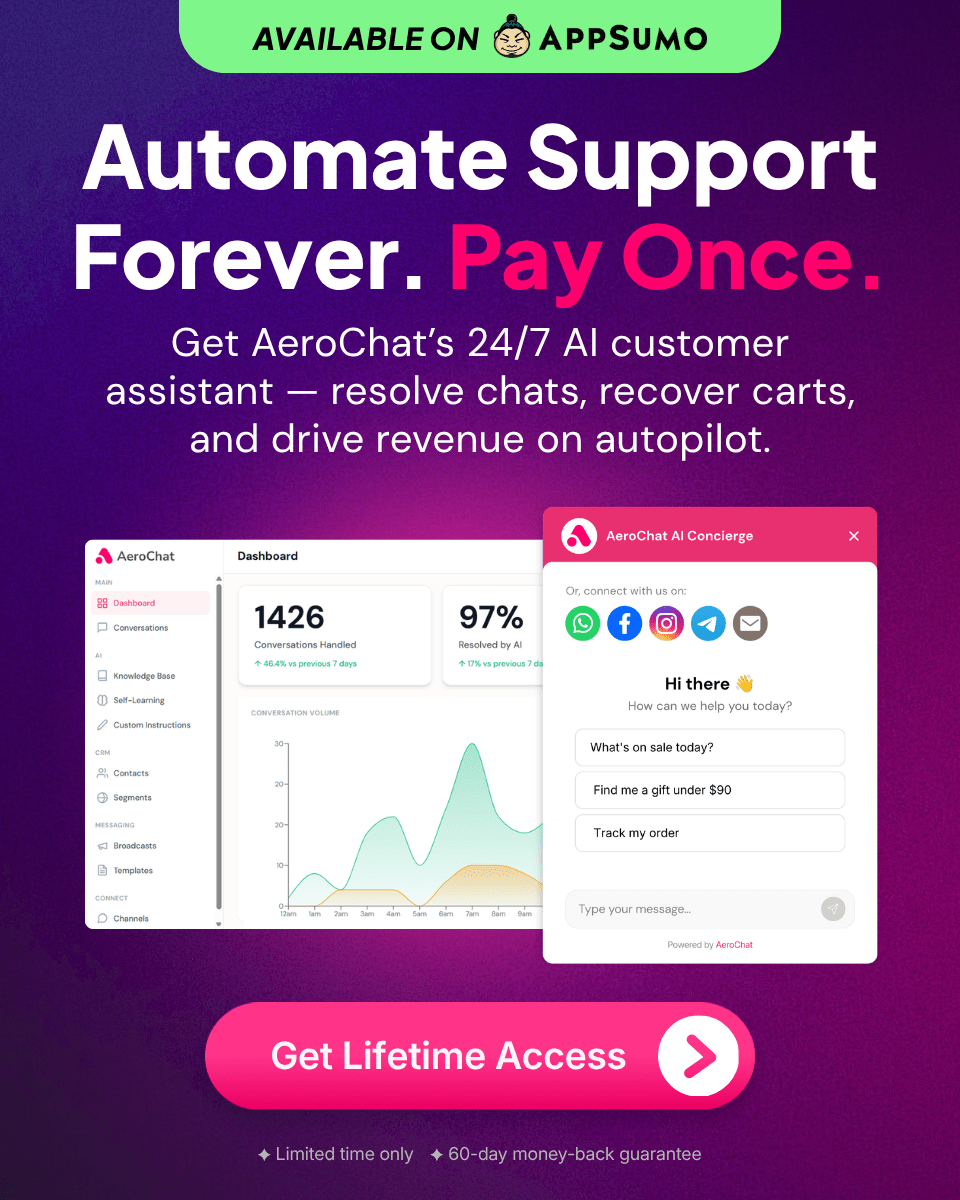
AeroChat is the most direct answer to the specific gap Wati leaves. It manages WhatsApp, Instagram DMs, Facebook Messenger, Telegram, and website chat from a single shared inbox — with AI handling the majority of conversations autonomously before they reach an agent. For ecommerce brands on Shopify, the integration pulls live order data, product inventory, and return policies so the AI can answer specific customer questions accurately rather than generic scripted responses.
The omnichannel inbox means a customer who messages on WhatsApp on Monday and follows up on Instagram on Wednesday is recognised as the same person, with full conversation history visible to the agent if escalation is needed. That continuity is impossible when WhatsApp and Instagram are managed in separate tools.
The AI on AeroChat does not work from decision trees or flowcharts. It learns from your actual product data and improves from every conversation it cannot answer, so the knowledge base grows without manual maintenance. For a brand managing customer communication across WhatsApp and Instagram simultaneously, this is a meaningful difference from Wati’s rule-based bot builder.
Pricing: Basic $49 per month (WhatsApp, web chat, Shopify integration, 500 AI responses), Growth $149 per month (adds Instagram, Messenger, Telegram, WhatsApp Broadcasts, 2,000 AI responses), Advanced $349 per month (self-learning AI, conversion tracking, API access, 5,000 AI responses). No per-message fees. The Instagram AI chatbot for business guide covers how the Instagram channel works in detail.
2. Respond.io — Best for WhatsApp-Focused Business Communication Teams
Respond.io connects WhatsApp Business API, Instagram, Facebook Messenger, Telegram, email, and website chat in a shared team inbox. Unlike Wati, it is designed from the ground up as a multi-channel platform rather than a WhatsApp-first tool with additions. For sales and customer service teams handling complex, high-touch conversations across channels, the conversation assignment, routing, and CRM integration capabilities are strong.
Pricing starts at $99 per month for 10 users on the Starter plan. Growth at $249 per month covers 25 users. The platform is priced for team use rather than small-operator use — at lower team sizes, the per-user economics are less favourable than Wati or AeroChat. If the primary driver is WhatsApp at scale with team inbox features rather than AI resolution, Respond.io covers the channel breadth effectively.
3. ManyChat — Best for Instagram and Facebook Automation
ManyChat started as a Facebook Messenger automation platform and has expanded to cover Instagram DMs and WhatsApp. For brands where Instagram is the primary channel and automated story-reply flows, keyword-triggered DMs, and comment-to-DM automation are the main use cases, ManyChat handles those well.
The WhatsApp integration on ManyChat is functional but less central to the platform’s design than it is on Wati or AeroChat. Pricing starts at $15 per month for the Pro plan, scaling by number of contacts. For Instagram-first automation, it is a strong tool. For WhatsApp-first with a need for Instagram as a secondary channel, the platform weighting means WhatsApp features are less developed.
4. Interakt — Best WhatsApp-First Alternative for Indian Markets
Interakt is a WhatsApp Business API platform with a strong focus on Indian ecommerce and D2C brands. It covers WhatsApp catalogue, broadcast campaigns, order notifications, and team inbox — similar to Wati’s feature set but with pricing and support infrastructure designed for the Indian market. Starter plans begin around $15 per month.
Interakt is also primarily WhatsApp-focused. If you are switching from Wati specifically to add Instagram and email, Interakt does not solve that problem. It is an alternative for teams that want Wati’s functionality at a different price point, not for teams that need omnichannel coverage.
5. WATI’s Direct Competitor: 360dialog
360dialog provides WhatsApp Business API access at a lower cost than most BSP resellers, typically with direct API pricing rather than a per-message or per-conversation markup. For technically capable teams that want to build their own WhatsApp experience or integrate WhatsApp into an existing CRM rather than use a pre-built inbox, 360dialog provides API access without the SaaS layer on top.
This is not a drop-in Wati replacement for teams that want a managed inbox. It is worth noting for teams where the primary frustration with Wati is cost rather than channel coverage.
Channel Coverage Comparison
| Tool | Instagram DMs | Web Chat | AI Included | ||
|---|---|---|---|---|---|
| AeroChat | ✅ Native | ✅ Native | ✅ | ✅ Native | Yes — self-learning |
| Respond.io | ✅ Native | ✅ Native | ✅ | ✅ | Basic automation |
| ManyChat | ✅ | ✅ Native | ❌ | ❌ | Flow-based |
| Wati | ✅ Native | ✅ Growth plan | ❌ Customer email | ❌ | Rule-based bot |
| Interakt | ✅ Native | ❌ | ❌ | ❌ | Basic |
| 360dialog | ✅ API | ❌ | ❌ | ❌ | None (API only) |
Pricing Comparison
| Tool | Starting Price | Pricing Model | Best For |
|---|---|---|---|
| AeroChat | $49/month | Flat, unlimited contacts | Ecommerce, omnichannel AI |
| Respond.io | $99/month (10 users) | Per user | Sales & support teams |
| ManyChat | $15/month | Per contacts tier | Instagram-first automation |
| Wati | Check current plan | Plan + messaging charges | WhatsApp-first; Instagram DMs on Growth |
| Interakt | ~$15/month | Per plan | India WhatsApp market |
Pricing verified July 2026. WhatsApp Business API messaging costs (Meta conversation fees) apply on top of platform pricing for all tools listed.
How to Choose Between Wati Alternatives
If you need WhatsApp, Instagram, and email in a single inbox: AeroChat and Respond.io are the two platforms that cover all three channels natively. The distinction is that AeroChat includes AI resolution as a core feature, while Respond.io is primarily a team inbox and conversation routing tool where agents handle most conversations.
If Instagram automation is your primary need and WhatsApp is secondary: ManyChat is the stronger tool. Its Instagram flows — story replies, comment triggers, keyword-activated DMs — are more developed than AeroChat’s automation for that channel. AeroChat is stronger for AI-driven conversational resolution; ManyChat is stronger for broadcast and campaign automation on Instagram.
If you want to stay WhatsApp-only but at lower cost: Interakt or 360dialog’s API pricing are the most direct Wati alternatives for that use case.
If AI handling conversations without flowcharts matters: Wati and ManyChat both use rule-based bot builders where every conversation path must be manually mapped. AeroChat’s AI reads the customer’s message and responds from your product data without a pre-defined flow. For stores with large, variable product catalogues, that distinction is operationally significant. Explore what AI chatbots available without sign-up requirements look like before committing to a platform.
AeroChat: The Wati Alternative for Omnichannel Ecommerce
Wati centres on WhatsApp and adds Instagram DMs on its Growth plan. AeroChat supports WhatsApp, Instagram, Messenger, Telegram, email and web chat — from the same inbox, with the same AI handling all of them. The AI trains on your Shopify data: product catalogue, order status, return policy, inventory. A customer asking about their order on WhatsApp and a different customer asking a sizing question on Instagram both get accurate, immediate answers from the same AI, without your team managing two separate platforms.
Basic plan from $49 per month. 7-day free trial, no credit card required. Start your trial →
Frequently Asked Questions
Is there a Wati alternative that handles both WhatsApp and Instagram in the same inbox?
Yes — AeroChat and Respond.io both manage WhatsApp and Instagram DMs from a unified inbox. AeroChat also includes AI that handles conversations across both channels autonomously, while Respond.io is primarily a team inbox where agents manage conversations manually with automation rules.
Does Wati support Instagram DMs?
Yes, on Wati’s Growth plan. It provides a shared inbox for Instagram DMs with assignment, quick replies, tags and conversation-management features. PAYG does not include Instagram. If you need both WhatsApp and Instagram managed from one place, you need an omnichannel platform rather than a WhatsApp-specific BSP like Wati.
Is AeroChat a WhatsApp Business API partner?
AeroChat connects to WhatsApp Business API through Meta’s official BSP partner network. This means the WhatsApp channel on AeroChat is the same API-connected WhatsApp that Wati uses — with the difference being that AeroChat also manages Instagram, Messenger, Telegram, and web chat from the same inbox.
What is better than Wati for ecommerce?
For ecommerce brands on Shopify, AeroChat’s combination of Shopify data integration, multi-channel inbox, and AI resolution is designed specifically for the customer support patterns that ecommerce generates — order status queries, product questions, return requests, and sizing questions across WhatsApp and Instagram. Wati handles WhatsApp broadcasts and chatbot flows and supports Instagram DMs on its Growth plan. Confirm the Shopify data and order actions available on the intended plan before comparing it with an ecommerce support platform.
How does ManyChat compare to Wati?
ManyChat is stronger for Instagram automation — story replies, comment-to-DM flows, and keyword triggers on Instagram are more developed than on Wati. Wati is stronger for WhatsApp — broadcast campaigns, WhatsApp catalogue, and team inbox on WhatsApp are Wati’s core design. ManyChat’s WhatsApp features exist but are secondary to its Instagram and Facebook focus.
Respond.io is one of the most common next steps when merchants outgrow Wati’s automation limits. The Respond.io alternatives comparison covers how its broadcast and flow-building capabilities compare with other WhatsApp tools. For teams also running Instagram and Facebook Messenger alongside WhatsApp, ManyChat alternatives for multi-channel shows how the tooling changes as channel count grows, and broader helpdesk options in the Zendesk alternatives guide cover how some teams centralise all of this.