
15 Best Knowledge Base Software to Check Out In 2026

Customer expectations have shifted. People no longer want to wait in a queue to get an answer to a question they could find themselves in 30 seconds — if the information was organised well enough to find. Knowledge base software solves that problem. It gives your customers a self-service resource, reduces the repetitive workload on your support team, and creates a foundation for AI chat tools to pull accurate answers from.
But the category has expanded significantly. In 2026, knowledge base software is not just a collection of FAQ pages. The best tools combine structured documentation with AI-powered search, live chat integration, and automation that means your knowledge base actively answers questions rather than sitting passively on a help centre page. Choosing the wrong tool means paying for features you will never use, or worse, investing in a setup that still requires your team to manually answer the same questions every day.
This list covers the 15 best knowledge base software options available in 2026, starting with the strongest choice for ecommerce and Shopify stores, and working through the full range of tools suited to different business types and team sizes.
Knowledge Base Software in 2026 Comparison
|
Tool |
Best For |
Free Plan |
AI-Powered |
Starts From |
|---|---|---|---|---|
|
AeroChat |
Shopify and ecommerce stores |
Yes |
Yes |
Free |
|
Zendesk |
Enterprise support teams |
No |
Yes |
$55/agent/mo |
|
Intercom |
SaaS and tech companies |
No |
Yes |
$39/seat/mo |
|
Freshdesk |
SMBs and growing teams |
Yes |
Yes |
Free |
|
HelpScout |
Small customer-first teams |
No |
Yes |
$22/user/mo |
|
Notion |
Internal team knowledge |
Yes |
Yes |
Free |
|
Confluence |
Engineering and dev teams |
Yes |
Limited |
Free |
|
Document360 |
Large documentation projects |
Yes |
Yes |
$149/project/mo |
|
Guru |
Internal knowledge for agents |
No |
Yes |
$10/user/mo |
|
Tettra |
Slack-first internal teams |
No |
Limited |
$4/user/mo |
|
Helpjuice |
Standalone help centres |
No |
Yes |
$120/mo |
|
ProProfs Knowledge Base |
Simple external help centres |
No |
Limited |
$49/mo |
|
Slite |
Remote and async teams |
Yes |
Yes |
Free |
|
Bloomfire |
Mid-market knowledge sharing |
No |
Yes |
Custom |
|
Nuclino |
Lightweight internal wikis |
Yes |
Limited |
Free |
Best Knowledge Base Software in 2026
1. AeroChat — Best for Shopify and Ecommerce Stores
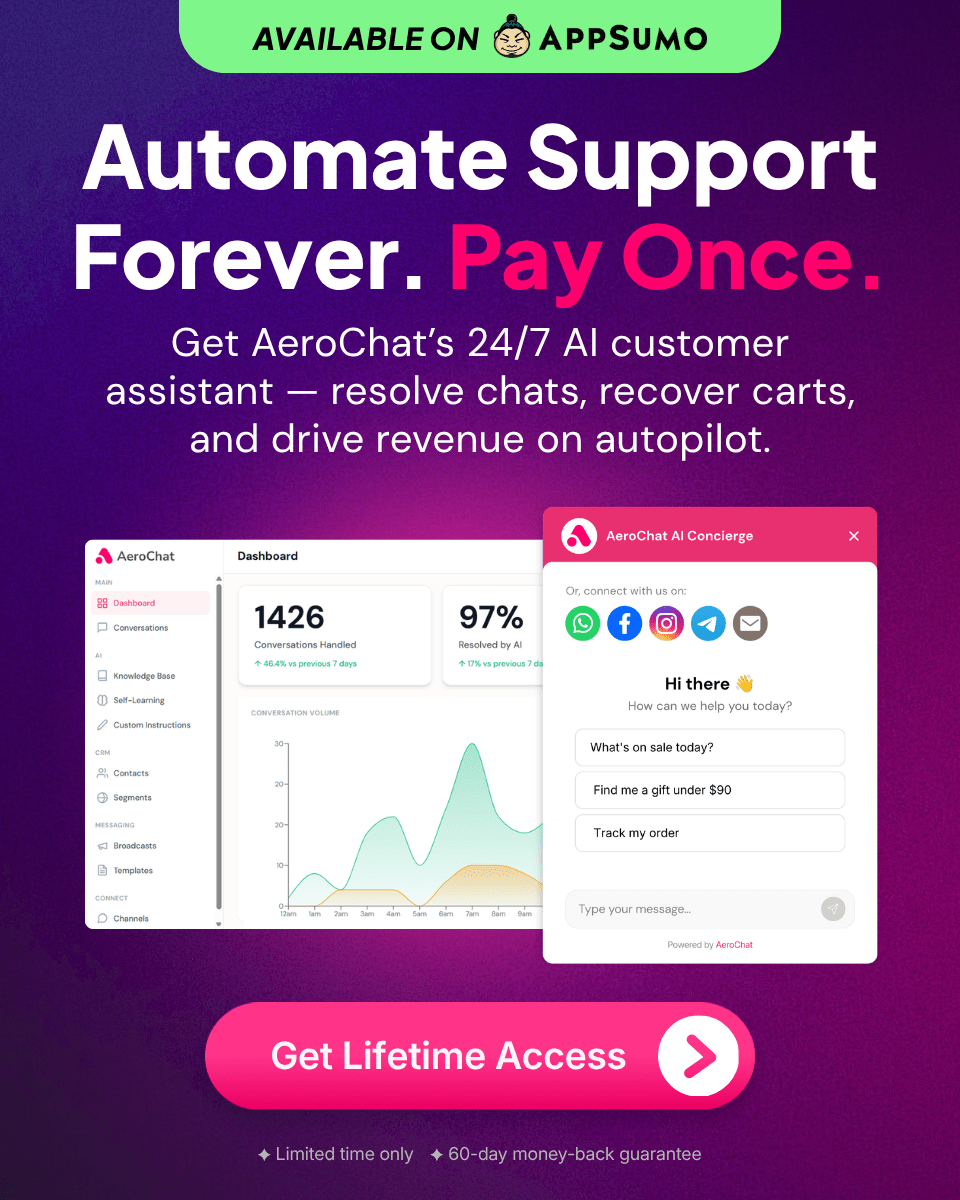
AeroChat is the strongest knowledge base and AI chat solution for ecommerce businesses, particularly those running on Shopify. Where most knowledge base tools require customers to search through a help centre and find the answer themselves, AeroChat goes further: it puts an AI chatbot in front of your knowledge base and delivers the answer directly in the conversation, without the customer ever having to navigate away from your product page or cart.
This distinction matters more than it might seem. A traditional help centre asks customers to do work. They have to go to a separate page, search, read through an article, and hope they found the right answer. AeroChat eliminates all of that. The AI is trained on your store data — your product catalog, your FAQ, your shipping policy, your returns policy, and any other documentation you provide — and it answers questions conversationally, in real time, on your website, on WhatsApp, and on Instagram.
For Shopify stores specifically, this means your knowledge base is not a static resource sitting on a help centre URL that most customers never visit. It is an active layer inside every customer conversation, available 24 hours a day, capable of answering sizing questions, shipping queries, return requests, order status checks, and product comparisons without a human agent needing to be involved.
Key features:
AeroChat’s AI is trained directly on your store data. You upload your product information, policies, and FAQs, and the chatbot learns from them. When a customer asks a question that your knowledge base covers, the AI retrieves the relevant answer and delivers it in a natural, conversational response. It does not serve a link to an article. It answers the question. This is the core difference between a FAQ chatbot and a static help page.
The platform supports omnichannel deployment. Your knowledge base powers conversations across your Shopify website chat, WhatsApp, Instagram DMs, and Facebook Messenger from a single setup. This means you maintain one set of accurate information and it serves customers across every channel they use to reach you.
AeroChat also handles the pre-purchase questions that most knowledge base tools are not designed for. While traditional help centres focus on post-purchase support, AeroChat’s AI engages shoppers on product pages, answers questions about compatibility, ingredients, sizing, and availability, and contributes directly to conversion rather than just to post-sale satisfaction.
The escalation logic is clean. When a customer question genuinely requires a human, the AI hands off the conversation smoothly and with full context, so the agent does not need to ask the customer to repeat themselves.
Best for: Shopify stores, ecommerce businesses, D2C brands, and any online retailer that wants their knowledge base to actively drive sales rather than just deflect support tickets.
Pricing: AeroChat offers a 7-day free trial that covers the core knowledge base and AI chat functionality. Paid plans unlock additional channels, advanced automation, and higher conversation volumes.
Verdict: If you run an ecommerce business, AeroChat is the clearest recommendation on this list. It is the only tool that treats your knowledge base as a sales asset rather than a support cost, and its integration with Shopify, WhatsApp, and Instagram makes it the most complete solution for stores selling online in 2026.
2. Zendesk Guide
Zendesk Guide is the knowledge base component of the broader Zendesk customer service platform. It is one of the most mature tools on the market, with a clean article editor, multi-language support, and a search function that pulls relevant content accurately. For teams already using Zendesk for ticketing, Guide is the natural companion because content created in Guide automatically becomes available to both customers on the help centre and agents handling tickets in the same interface.
The AI component, called Zendesk AI, can suggest relevant knowledge base articles when agents are composing replies, surface content automatically when customers describe their issue, and deflect common questions before they reach the ticket queue.
Zendesk Guide works well at enterprise scale. It handles large documentation sets, multiple brands, and complex permission structures for teams where different agents manage different knowledge areas. The reporting is thorough — you can see which articles are being searched, which ones customers read before submitting a ticket, and where your content has gaps.
The limitation is cost. Zendesk is not a tool for small or growing businesses. The pricing is built for enterprise teams with established support operations, and the platform’s complexity means there is a meaningful setup investment before you see value from it. For a broader look at what Zendesk is used for beyond the knowledge base component, see our dedicated guide to what Zendesk is used for.
Best for: Enterprise support teams with existing Zendesk infrastructure and high ticket volumes.
Pricing: Starts at $55 per agent per month. Knowledge base features are included across Suite plans.
Verdict: Excellent for large teams already inside the Zendesk ecosystem. Too expensive and complex for businesses that do not need the full suite. For a direct comparison with AeroChat, see Zendesk vs AeroChat.
3. Intercom Articles
Intercom’s knowledge base product sits inside the broader Intercom customer messaging platform. Articles, as the feature is called, lets you create a searchable help centre that connects directly with Intercom’s live chat and AI tools. The integration is the key selling point: when a customer opens the chat widget, they are also shown relevant articles before they type a message, which deflects a portion of contacts before they become conversations.
Intercom’s AI assistant, Fin, can be trained on your knowledge base and answer customer questions autonomously. When it cannot answer confidently, it passes the conversation to a human. For SaaS companies that want both a structured help centre and an AI chat layer on top of it, Intercom is a mature and well-integrated solution.
The pricing structure is a consistent criticism. Intercom’s costs can escalate quickly as your team and conversation volume grows, and the per-seat pricing model means growing teams pay significantly more without a proportional jump in capability.
Best for: SaaS companies, tech startups, and product businesses that want knowledge base, live chat, and AI in a single platform.
Pricing: Starts at $39 per seat per month. Fin AI agent is an additional cost.
Verdict: Strong integration between help centre and chat. Best suited to SaaS businesses that can absorb the pricing. See how it compares in our Intercom vs AeroChat breakdown.
4. Freshdesk
Freshdesk is one of the most popular customer support platforms for small and mid-sized businesses, and its knowledge base functionality is included on even the free plan. You can create solution articles, organise them into categories, and publish a help portal that customers can search independently.
The AI layer, Freddy AI, can suggest articles to customers based on their search terms, recommend content to agents during ticket resolution, and automatically resolve simple tickets by pointing customers to the right article. The interface is approachable for teams that are not deeply technical, and the setup time is relatively low.
Freshdesk’s knowledge base is functional rather than exceptional. It does what most teams need from a help centre — organised articles, search, and basic analytics — without pushing into the more sophisticated territory that Document360 or Guru occupy. For teams that primarily need ticketing and want a knowledge base included, it is a practical and cost-effective choice.
Best for: SMBs that need a combined ticketing and knowledge base platform without enterprise pricing.
Pricing: Free plan available. Paid plans start at $15 per agent per month.
Verdict: A solid all-in-one choice for growing support teams. The knowledge base is adequate, not outstanding. Read our Freshdesk vs AeroChat comparison for a closer look.
For a head-to-head against its closest ticketing competitor, see Freshdesk vs Zendesk.
5. Help Scout Docs
Help Scout is a customer support platform built for smaller teams that prioritise the quality of customer relationships over the volume of tickets processed. Its knowledge base product, Docs, is a clean, fast-loading help centre builder with a good editor, category organisation, and a search function that surfaces relevant articles accurately.
Docs integrates with Help Scout’s inbox, so when a customer submits a ticket, the agent sees which help articles the customer viewed before reaching out — which gives useful context and often explains what was missing from the documentation. The AI features in Help Scout are newer and less developed than competitors like Zendesk or Intercom, but the platform compensates with a user experience that is genuinely pleasant to work in.
Help Scout is not designed for large documentation projects or complex multi-brand setups. It is a tool for small teams that care about providing a genuinely helpful support experience and want a knowledge base that feels like a natural extension of that approach.
Best for: Small teams and customer-first businesses that want a clean, well-integrated help centre without the complexity of enterprise tools.
Pricing: Starts at $22 per user per month. No free plan.
Verdict: Excellent for small teams that prioritise quality. Limited for large-scale documentation needs. If you are weighing Help Scout against an AI-first option, read through our breakdown of the best customer success tools to compare approaches.
6. Notion
Notion occupies an unusual position on this list because it was not designed specifically as knowledge base software. It is a flexible workspace tool that teams commonly adapt into internal knowledge bases, documentation hubs, and wiki systems. Its flexibility is both its strength and its limitation.
A Notion workspace used as a knowledge base can be genuinely excellent — well-organised, fast to navigate, easy to update, and collaborative in a way that purpose-built knowledge base tools often are not. Teams that already live in Notion find it natural to keep product documentation, onboarding guides, internal processes, and support resources in the same tool they use for project management and notes.
The limitations become apparent when you try to use Notion as a customer-facing help centre. It is not optimised for public search, the URL structure is not ideal for SEO, and there is no native chat or ticketing integration. Notion AI can help search and summarise content within the workspace, but it does not serve customer-facing queries the way a purpose-built tool does.
Best for: Internal team knowledge bases, documentation for remote teams, and companies that already use Notion heavily for operations.
Pricing: Free plan available. Paid plans start at $10 per user per month.
Verdict: Excellent internal knowledge base. Not suitable as a customer-facing help centre.
7. Confluence
Confluence is Atlassian’s team knowledge and documentation platform, and it is the most widely used internal knowledge base in engineering and product organisations. Its integration with Jira makes it the natural home for technical documentation, product specs, engineering runbooks, and internal process guides in software companies.
The editor is flexible, the permission system is thorough, and the search within large Confluence spaces is reasonably effective once content is well-organised. Atlassian Intelligence, the AI layer, can summarise pages, answer questions based on space content, and help users find information faster.
Confluence is not designed for customer-facing knowledge bases. It is an internal tool, and its interface and structure reflect that. Trying to use it as a customer help centre is technically possible but produces a poor customer experience compared to tools built specifically for that purpose.
Best for: Engineering teams, product organisations, and companies already using Atlassian tools.
Pricing: Free for up to 10 users. Paid plans start at $5.16 per user per month.
Verdict: The standard for internal technical documentation in tech companies. Not appropriate for customer-facing support.
8. Document360
Document360 is a purpose-built knowledge base platform designed for teams that need to create and maintain large, complex documentation projects. It has one of the most capable article editors on the market, a strong versioning system that lets you track changes and restore previous versions, and a category structure that scales well to hundreds or thousands of articles.
The AI features include smart search that understands natural language queries, article suggestions for agents, and an AI writing assistant that helps authors draft and refine content faster. The analytics are detailed — you can see article performance, search terms that return no results, and content gaps identified through failed searches.
Document360 is priced for teams that treat documentation as a serious investment. The starting price is higher than most tools on this list, which puts it out of reach for small businesses. But for companies with complex products and large documentation needs, it is one of the most complete solutions available.
Best for: Large documentation projects, technical products, and teams that need advanced versioning and analytics.
Pricing: Starts at $149 per project per month.
Verdict: The most complete standalone knowledge base for complex documentation. Priced for teams that take documentation seriously.
9. Guru
Guru is an internal knowledge base designed specifically for customer-facing teams — support agents, sales teams, and account managers who need quick access to accurate information while they are in live conversations with customers. It sits as a browser extension or app integration alongside the tools agents already use and surfaces relevant knowledge cards based on the context of the current conversation.
The AI in Guru, called Guru AI, can answer agent questions directly, suggest knowledge cards when a conversation matches a known topic, and flag content that may be outdated or inaccurate. This makes Guru particularly effective in high-volume contact centres where agents manage customer chats across a wide range of topics and need reliable information retrieval without breaking the flow of a conversation.
Guru is not a customer-facing tool. Customers do not browse or search Guru directly. It is designed to make agents faster and more accurate, which indirectly improves the customer experience.
Best for: Support teams and contact centres that need an internal knowledge layer their agents can query in real time.
Pricing: Starts at $10 per user per month.
Verdict: Excellent for agent-facing knowledge management. Not a customer self-service tool.
10. Tettra
Tettra is a lightweight internal knowledge base built primarily for teams that operate heavily in Slack. It integrates directly with Slack to let team members ask questions in Slack and receive answers pulled from the Tettra knowledge base without leaving the messaging app. It also identifies questions that are asked repeatedly in Slack and prompts team members to create knowledge base articles that answer them, which builds the knowledge base organically from real team needs.
Tettra works well for early-stage companies and small teams that want to capture institutional knowledge without a complicated setup. The interface is simple, the Slack integration is tight, and the process of building and maintaining content is low-friction.
The limitations show at scale. Tettra does not have the advanced analytics, versioning, or AI capabilities of tools like Document360 or Guru, and it is not suitable for customer-facing knowledge bases.
Best for: Small teams, startups, and Slack-first organisations that need lightweight internal documentation.
Pricing: Starts at $4 per user per month.
Verdict: Practical and affordable for small internal teams. Outgrown quickly as complexity increases.
11. Helpjuice
Helpjuice is a standalone knowledge base platform focused entirely on building and maintaining customer-facing help centres. It does not include ticketing, live chat, or CRM features. Its value proposition is that it does one thing — knowledge base management — and does it well.
The editor is clean, the search is effective, and the customisation options let you match the help centre to your brand without technical expertise. The analytics track article views, search terms, and content performance in enough detail to identify gaps and prioritise improvements. The AI features include search suggestions and a basic question-answering capability based on your content.
Helpjuice works well for companies that already have a ticketing or chat system they are happy with and simply want a better dedicated knowledge base. It integrates with Zendesk, Intercom, Freshdesk, and Slack, so it can sit alongside existing tools rather than replacing them.
Best for: Teams that want a dedicated, high-quality customer-facing knowledge base without a full platform switch.
Pricing: Starts at $120 per month for up to four users.
Verdict: One of the cleanest standalone knowledge base options. Worth considering if you want to separate your knowledge base from your ticketing platform.
12. ProProfs Knowledge Base
ProProfs Knowledge Base is a straightforward tool for creating customer-facing help centres and internal wikis. It is one of the more affordable standalone options on the market and has a simple editor that non-technical team members can use without training.
The feature set covers the basics well: article creation, category organisation, search, and access controls for internal versus external content. The AI and automation features are limited compared to the more advanced tools on this list, which makes ProProfs better suited to teams with simpler needs than those running complex support operations.
It integrates with ProProfs Chat and ProProfs Help Desk if you want to stay within the same ecosystem, but these integrations are not compelling enough to drive a platform decision on their own.
Best for: Small businesses and teams that need a simple, affordable customer-facing help centre.
Pricing: Starts at $49 per month.
Verdict: An accessible entry point for teams new to knowledge base software. Limited ceiling for growing support operations.
13. Slite
Slite is an AI-powered knowledge base designed for remote and distributed teams. Its core promise is that it helps teams maintain a single source of truth for internal documentation without the content becoming stale or difficult to navigate. The AI layer, called Ask, allows team members to query the knowledge base in natural language and receive a summarised answer rather than a list of links to read through.
Slite’s interface prioritises simplicity and speed. Creating and updating content is fast, and the organisation structure is flexible enough to adapt to different team needs. The verification system lets document owners mark content as verified and flag articles that need review, which addresses one of the most common problems with internal knowledge bases: content that becomes outdated and is then trusted incorrectly.
Slite is an internal tool. Like Notion and Confluence, it is not built for customer-facing help centres or for integrating with chat and ticketing systems.
Best for: Remote teams and async-first organisations that need an accurate, searchable internal knowledge base.
Pricing: Free plan available. Paid plans start at $8 per user per month.
Verdict: A strong option for distributed teams that struggle with documentation staying current and findable.
14. Bloomfire
Bloomfire is a knowledge management platform aimed at mid-market and enterprise organisations that need to share knowledge across large teams, departments, or partner networks. It has a strong search function that indexes video, audio, and document content, which makes it useful for organisations where knowledge is captured in formats beyond written articles.
The AI features include automatic content tagging, search summarisation, and an assistant that can answer questions based on uploaded content. Bloomfire is particularly popular with sales enablement and customer success teams that need to share research, competitive intelligence, and best practice guides at scale.
Bloomfire is not a customer-facing help centre tool and is priced for mid-market and enterprise budgets. The value is in knowledge sharing across internal teams rather than automating ecommerce support or deflecting customer tickets.
Best for: Mid-market and enterprise teams that need to manage knowledge across departments, including non-text formats like video and audio.
Pricing: Custom pricing based on team size and requirements.
Verdict: A strong enterprise choice for cross-functional knowledge sharing. Too complex and expensive for smaller teams. For enterprise teams evaluating AI-first options, our guide to enterprise chatbot solutions covers the broader landscape.
15. Nuclino
Nuclino is a lightweight wiki and knowledge base tool built around speed and simplicity. It has a minimal interface, a fast editor, and a graph view that lets teams visualise how their content connects — which is useful for understanding the structure of a knowledge base as it grows. The AI assistant can answer questions based on workspace content and help write or summarise articles.
Nuclino suits teams that find tools like Confluence or Notion too heavy for their needs. It is genuinely quick to set up and quick to use, which means documentation actually gets written and maintained rather than becoming a project in itself. The limitation is that it is designed for internal use and does not have the customer-facing features, search optimisation, or AI chatbot integration that external help centre tools require.
Best for: Small to mid-sized teams that need a fast, lightweight internal wiki without the overhead of more complex platforms.
Pricing: Free plan available. Paid plans start at $5 per user per month.
Verdict: The cleanest option for teams that want simplicity above all else. Grows out of it faster than you might expect.
How to Choose the Right Knowledge Base Software
The right tool depends on what you are primarily trying to solve.
If you run an ecommerce or Shopify store and want your knowledge base to actively reduce support workload, answer pre-purchase questions, and integrate with WhatsApp and Instagram, AeroChat is the clear choice. It is the only tool on this list that treats knowledge base content as a sales and conversion asset rather than purely a support cost reduction mechanism.
If you run an enterprise support operation with hundreds of agents and thousands of tickets per day, Zendesk Guide or Intercom Articles give you the depth and integration your team needs — though the cost reflects that.
If you need an internal knowledge base for your team rather than a customer-facing help centre, Notion, Confluence, Guru, or Nuclino each serve different team types and working styles. Guru is the strongest choice if your agents need real-time knowledge retrieval during live conversations. Notion and Nuclino are better for teams building their first structured documentation.
If your primary need is large-scale documentation with advanced versioning, analytics, and AI-powered search, Document360 is the most complete dedicated tool available.
The category mistake most businesses make is choosing a knowledge base tool based on feature lists rather than on how their customers actually seek answers. In 2026, the best knowledge base is not the one with the most articles. It is the one that gets the right answer to the customer fastest, with the least friction, through the channel they are already using. Stores that scale customer support successfully do it by connecting their knowledge to every channel their customers use — not by publishing more articles and hoping people find them. That is the standard AeroChat is built to meet for ecommerce, and it is the standard every other tool on this list is working toward in their respective categories.
Frequently Asked Questions
What is knowledge base software?
Knowledge base software is a platform that lets businesses create, organise, and publish information that customers or team members can use to answer questions without needing to contact support directly. For online stores, it forms the foundation of AI customer service — giving an AI layer accurate, structured information to pull from when answering shoppers in real time. It can be customer-facing (a public help centre), internal (for agents or employees), or both.
What is the best knowledge base software in 2026?
The best knowledge base software depends on your business type. For ecommerce and Shopify stores, AeroChat is the strongest option because it combines AI-powered knowledge delivery with omnichannel chat across WhatsApp, Instagram, and website — making it the most capable ecommerce chatbot software in the category. For enterprise support teams, Zendesk Guide is the most established. For internal documentation, Notion or Confluence suit most teams.
What is the difference between a knowledge base and a help centre?
A help centre is typically the customer-facing version of a knowledge base — the public set of articles customers can search. This is closely tied to self-service support, where customers find answers independently rather than contacting an agent. A knowledge base can also be internal, used only by support agents or employees. Many platforms support both from a single content source.
Can AI knowledge base software reduce support tickets?
Yes, significantly. AI-powered knowledge base chatbot tools like AeroChat can answer customer questions automatically before they become tickets. When the AI is trained on accurate, complete information, a meaningful proportion of contacts that would have gone to a human agent are resolved automatically instead.
How long does it take to set up a knowledge base?
Setup time varies by tool and how much content you have. Simple tools like AeroChat, Nuclino, or Slite can be functional within a day if your core policies and FAQs are already written — see our guide on the best content types to train your chatbot on to get started quickly. Enterprise tools like Zendesk Guide or Document360 typically require a more structured implementation process.
What should a good knowledge base include?
A good knowledge base should cover the questions customers ask most frequently, broken into clear categories. For ecommerce stores this typically includes shipping policies, return procedures, sizing guides, product FAQs, order tracking information, and payment and billing details. The best knowledge bases are kept up to date and are written in language that matches how customers actually phrase their questions.
Is free knowledge base software good enough for small businesses?
For many small businesses, yes. AeroChat’s 7-day free trial covers AI-powered chat and knowledge base functionality for ecommerce stores. Freshdesk’s free plan covers basic knowledge base and ticketing. Notion and Nuclino both have free plans suitable for internal documentation. The decision to upgrade to a paid plan is usually driven by conversation volume, the number of agents, or the need for advanced analytics and integrations.