
Customer Success for Ecommerce: Best Tools and How It Differs from Support in 2026

Most ecommerce brands treat customer success and customer support as the same thing. They use the terms interchangeably, measure them with the same metrics, and fund them from the same budget. That conflation is expensive.
The two functions operate differently, measure different outcomes, and break down at different points as a store grows. Understanding the distinction changes how you staff, which tools you invest in, and which numbers you actually track. This guide covers what customer success means specifically for online stores, how it differs from support, and which tools are worth using in 2026.
Why most customer success content does not apply to ecommerce
Search “customer success tools” and most of what appears is written for SaaS companies. That world has dedicated customer success managers, health score dashboards, quarterly business reviews, and renewal pipelines. The tools built for that model are designed around software subscriptions and annual contracts.
Ecommerce customer success looks entirely different. There are no account managers, no renewal calls, and no health scores. The question is simpler: did the customer receive what they expected, and is the experience good enough that returning feels natural?
For Shopify stores, customer success is the set of actions and systems that ensure customers get real value from their purchase, have issues resolved without friction, and leave each interaction more likely to buy again. That does not require an enterprise SaaS platform. It requires clarity about what drives repeat purchases and the right tools to support both reactive and proactive customer engagement.
What is customer support?
Customer support is a reactive function. It responds to problems after they occur: a customer sends a message about a missing parcel, a damaged item, an incorrect order, or a sizing question before checkout. Support resolves that issue and closes the interaction.
Good support is necessary, but it is the floor rather than the ceiling. A customer who receives fast, accurate support after a problem is not necessarily more likely to return than if the problem had never occurred. They are less likely to leave a negative review or dispute a charge. Support prevents downside; it does not reliably generate upside on its own.
The primary support metric is response time by channel. Customers have clear expectations about how quickly they should hear back, and slow replies carry a direct cost in abandoned purchases and lost repeat business before the customer ever contacts you.
What is customer success in ecommerce?
Customer success is a proactive function. It reaches customers before they have a problem, keeps them engaged after their purchase, and creates the conditions for a second order without waiting for the customer to initiate contact.
In ecommerce, this means: post-purchase communication that confirms delivery and addresses common follow-up questions, loyalty mechanics that give returning customers a reason to choose you again, proactive updates during delays so customers do not need to chase, and product recommendations based on what the customer has already bought.
The distinction matters because customers who never contact support are not necessarily satisfied. They are often indifferent, and indifferent customers do not return. The proactive layer is what turns a one-time transaction into a relationship.
Customer support vs customer success: the differences that affect revenue
| Customer support | Customer success | |
|---|---|---|
| Trigger | Customer reaches out with a problem | No trigger needed |
| Approach | Reactive | Proactive |
| Goal | Resolve the immediate issue | Ensure the customer gets value and returns |
| Interaction type | Transactional with a clear start and end | Ongoing while the customer relationship continues |
| Revenue impact | Indirect: prevents churn from bad experiences | Direct: drives repeat purchases and lifetime value |
| Ecommerce example | Customer contacts you about a delayed parcel | Automatic shipping update sent before the customer notices the delay |
| Primary metrics | Response time, resolution time, CSAT, ticket volume | Repeat purchase rate, LTV, churn rate |
Neither function replaces the other. Fast support prevents the damage that slow or absent support causes. Proactive success work prevents the need for support in many cases, and creates the engagement that brings customers back between orders.
What metrics belong to support and which belong to customer success?
Customer support metrics tell you how well you handle problems after they happen:
- First response time: how quickly the first reply reaches the customer
- Average resolution time: how long a full issue takes to close
- CSAT score: customer rating of the support interaction
- Ticket deflection rate: proportion of queries handled without human involvement
- WISMO volume: “Where is my order” queries as a proportion of total orders despatched
Customer success metrics tell you whether customers are getting lasting value:
- Repeat purchase rate: the proportion of first-time buyers who place a second order
- Customer lifetime value (LTV): total revenue per customer over the relationship
- Churn rate: the proportion of customers who do not return within a defined period
- Net Promoter Score: likelihood of customers recommending the brand
- Time between purchases: how quickly customers return after their first order
The single most useful starting metric for most Shopify stores is repeat purchase rate. If a large proportion of first-time buyers are not placing a second order, that is the gap to address before anything else.
How support and success work together in practice
The most effective ecommerce operations treat these as two layers rather than two separate departments. Support is the reactive layer that handles what goes wrong. Success is the proactive layer that runs regardless of whether anything goes wrong.
Here is what that looks like in a single customer journey:
A customer orders a pair of trainers. Three days in, a carrier delay pushes the delivery back by two days.
Support layer: If the customer contacts the store about the delay, they receive an immediate response via chat with the updated delivery window. No waiting, no frustration.
Success layer: Before the customer notices the delay, an automated message goes out with the revised date and a discount code for the inconvenience. The customer feels looked after without ever having to ask.
Two weeks after delivery, an automated post-purchase message checks that the order arrived correctly and recommends a complementary product. Six weeks later, the customer enters a loyalty sequence with a reward for their next purchase.
The support interaction only fires if something goes wrong. The success layer runs automatically every time. Together, they convert a single transaction into an ongoing relationship.
For a broader look at the approaches businesses use to reduce customer waiting time across channels, those principles apply at any order volume.
The best customer success tools for ecommerce in 2026
The right stack depends on current order volume and where the biggest gap sits. These tools serve ecommerce customer success specifically, organised by what they solve.
Which tool handles real-time customer support automation?
AeroChat
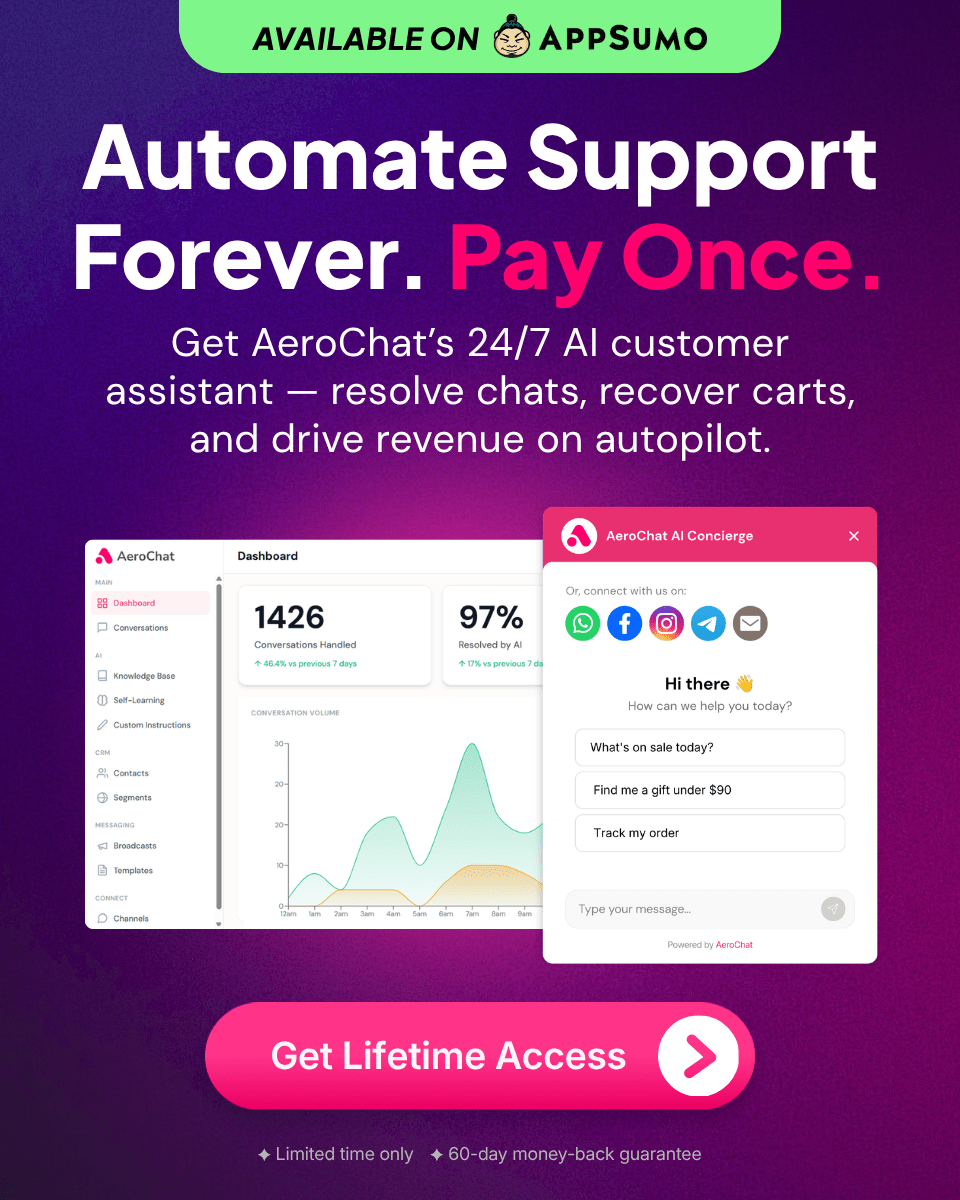
AeroChat is an AI agent platform that helps Shopify merchants run customer service on autopilot. It connects directly with Shopify product and order data to answer delivery questions, track orders, handle return queries, and respond to pre-purchase enquiries accurately and immediately, without a team member needing to be available.
For customer success outcomes, speed at the support layer matters more than most merchants realise. A customer who asks a question and receives an instant, accurate answer is more likely to complete that purchase. A customer who receives immediate post-purchase help is more likely to return. AeroChat handles conversations across website chat, WhatsApp chat, Instagram chat, and Facebook Messenger from one platform, removing the context-switching that causes messages to go unanswered as volume increases. Managing customer messages across multiple channels from a single inbox is one of the most reliable ways to reduce both missed messages and average response time.
When a conversation requires a person, AeroChat passes it to a human agent without the customer losing context or having to repeat themselves.
Best for: Shopify merchants who want to automate and scale customer service without extra manpower and costs.
Which platform drives post-purchase engagement and retention?
Klaviyo
Klaviyo is an email and SMS automation platform built for ecommerce. For customer success, the most relevant capabilities are post-purchase sequences, win-back campaigns for customers who bought once and have not returned, and behaviour-triggered flows that respond to customer actions rather than a fixed calendar. It does not handle real-time chat or support ticketing: its role is the proactive engagement layer that keeps customers connected between purchases.
Best for: Stores with a customer database they want to activate through email and SMS for repeat purchase and retention.
What is the best dedicated helpdesk for ecommerce support teams?
Gorgias
Gorgias centralises support across email, live chat, social media and messaging apps in a single interface, with a direct Shopify integration that surfaces order data inside each ticket without switching tools. It is the most focused helpdesk for ecommerce support teams handling high ticket volume who need structured workflows, SLA tracking, and team-level reporting. It handles the reactive support layer cleanly, built around ecommerce data rather than adapted from a generic enterprise system.
Best for: Shopify stores with a support team handling significant daily ticket volume who need a structured helpdesk with Shopify data built in.
Zendesk
Zendesk is enterprise-grade helpdesk software with extensive multi-channel support and a large integration ecosystem. It is considerably more complex and expensive than Gorgias and is designed for large organisations with multiple support teams. For most growing Shopify stores, Gorgias is the more practical starting point.
Best for: Enterprise retailers with large dedicated support teams and multi-department Zendesk usage already in place.
Which tools handle loyalty, reviews and subscription retention?
Yotpo
Yotpo handles product reviews, loyalty programmes and referral systems. All three connect directly to customer success outcomes: a customer who writes a review is more engaged with the brand; a customer enrolled in a loyalty programme has a concrete reason to return; a referral system converts satisfied customers into a source of new buyers. These are proactive success mechanics rather than reactive support tools.
Best for: Stores wanting to formalise loyalty and reviews as structured retention levers.
Recharge
Recharge is purpose-built for subscription ecommerce. It manages recurring billing, gives customers tools to skip, pause or modify subscriptions without contacting support, and tracks voluntary versus involuntary churn from payment failures. For subscription-based stores, churn rate is the single most important customer success metric, and Recharge provides the tooling to manage it actively. It sits within a broader Shopify customer retention strategy for brands building recurring revenue models.
Best for: Ecommerce brands with a subscription or recurring order model where churn management is a primary operational concern.
How do you choose the right tool stack?
Not every store needs all of these tools at once. The right starting point depends on current order volume and where the most significant gap sits.
| Current situation | Start here |
|---|---|
| Messages are arriving faster than your team can respond | AeroChat: automate the reactive layer before adding anything else |
| Response times are acceptable but customers are not returning | Klaviyo: build post-purchase and win-back flows to activate your existing customer base |
| You have a team handling tickets across multiple disconnected inboxes | Gorgias: centralise before automating to avoid duplication and missed handoffs |
| First-time buyers convert well but loyalty is low | Yotpo: formalise rewards and reviews to make returning feel worthwhile |
| You run subscriptions and cancellations are increasing | Recharge: address churn mechanics directly through subscription tooling |
For most growing Shopify stores, the practical starting stack is AeroChat for real-time support automation and Klaviyo for lifecycle marketing. That covers both the reactive and proactive layers without overcomplicating the setup before volume justifies a more extensive stack.
Frequently asked questions
Is customer success relevant for a small Shopify store?
Yes, though the tools and investment level differ by scale. A store doing 50 orders per month does not need a formal customer success stack. It needs to respond to messages quickly and follow up after delivery. That is customer success at its simplest. As volume grows, the same principles get systematised through automation and dedicated tooling. The practical entry point is fast support response and a basic post-purchase email sequence.
What is the difference between customer success and customer experience?
Customer experience describes everything a customer perceives about a brand: the website, the product, the packaging, the checkout, the support interaction. Customer success is a specific function within that broader experience, focused on ensuring the customer achieves the outcome they purchased for and remains engaged after the transaction. Customer experience is the full picture; customer success is the deliberate strategy and tooling that shapes the post-purchase part of it.
Do ecommerce stores need a dedicated customer success manager?
Not at most scales. The CSM role exists in SaaS because software subscriptions require active human management to prevent cancellation. In ecommerce, most of the equivalent work is handled through automation: post-purchase emails, loyalty programmes, proactive support triggers, and AI chat. Most ecommerce brands get more value from better tooling than from hiring a dedicated customer success role until order volumes are large enough to justify a full retention team.
How do you measure whether customer success efforts are working?
The clearest signal is repeat purchase rate. If customers who received proactive post-purchase communication return at a measurably higher rate than those who did not, the proactive layer is working. Secondary signals include growth in average LTV across successive customer cohorts, improvement in NPS over time, and reduction in churn rate for subscription products. Tracking changes in these metrics after introducing a new tool or flow gives more useful information than comparing against any single external benchmark.
What is the difference between churn rate and repeat purchase rate?
Both measure retention, but from opposite directions. Repeat purchase rate measures the proportion of customers who order more than once. Churn rate measures the proportion who stop buying within a defined timeframe. Improvements in one do not always show up immediately in the other, so tracking both gives a clearer picture of where retention is improving and where gaps remain.