

How to Scale Customer Support Without Hiring More Staff

Growing a Shopify store usually means more conversations, more questions, and more pressure on the team. Most businesses assume the only way to keep up is to hire more agents. But support capacity is not determined by headcount. It is determined by how efficiently your system handles customer demand.
Scaling support without hiring is possible when you redesign the architecture of how customer communication works. Instead of adding more people, you increase the elasticity of the system.
10 Principles to Scale Shopify Support Without Hiring
1. Remove Support Tasks Hidden Inside Other Jobs
Support becomes unscalable when founders or team members handle communication “in between” other tasks.
This slows down the entire business.
Create a single, dedicated support window in the day where communication is handled in batches.
Batching increases efficiency and ensures messages don’t pile up.
This approach alone increases capacity because it removes context switching — the biggest hidden support expense.
2. Replace Case-by-Case Replies With Support Standards
Small teams waste time making decisions from scratch for every customer.
Scaling requires support standards, not case-by-case judgement.
Examples:
-
Consistent rules for return exceptions
-
Clear guidelines for size exchanges
-
Standard wording for refund conversations
-
Predictable handling of out-of-stock issues
Standards reduce decision fatigue and make each reply faster and more predictable, even during busy seasons.
3. Identify the “Friction Points” in Your Customer Journey
Support load grows when your customer journey leaves gaps.
Walk through the journey from a buyer’s perspective:
Browse → Add to Cart → Checkout → Order Confirmation → Tracking → Delivery → Post-delivery
Where are the friction points?
Where does confusion happen?
Where do customers pause and need reassurance?
Fixing friction reduces the total volume of conversations — which increases scalability without hiring.
To understand which questions slow shoppers down, study Reduce repetitive customer questions on Shopify
(used here as a research resource, not a support section).
4. Build a Single Source of Truth for All Customer-Facing Info
A scalable support system requires consistency, not memory.
Centralise:
-
shipping rules
-
cut-off times
-
exchange instructions
-
size guidance
-
packing and dispatch times
-
product-specific notes
When information lives in one master source and feeds every touchpoint (store, chat, order confirmations), your team spends less time searching — and more time resolving.
5. Adopt Asynchronous Support Logic Instead of Live Back-and-Forth
Most Shopify stores treat support like a live chat conversation, even on platforms that don’t require real-time responses.
Slow systems break because they rely on synchronous communication.
Scale increases when you shift to asynchronous replies:
-
Clear responses that do not require follow-up
-
Template-based explanations
-
Pre-emptive instructions
-
Context-rich replies
This reduces the number of back-and-forth messages, dramatically increasing how many customers one person can handle.
6. Use Structured Replies Instead of Personalised Paragraphs
A major reason support does not scale is because each agent writes in their own style.
This leads to long responses and inconsistent communication.
Move to structured reply formats:
-
direct answer
-
short supporting detail
-
next step
-
optional link
This format reduces typing time and cuts message length without reducing clarity.
To improve product-page clarity, see Shopify product questions and FAQ guide.
7. Introduce Automated Load Absorption
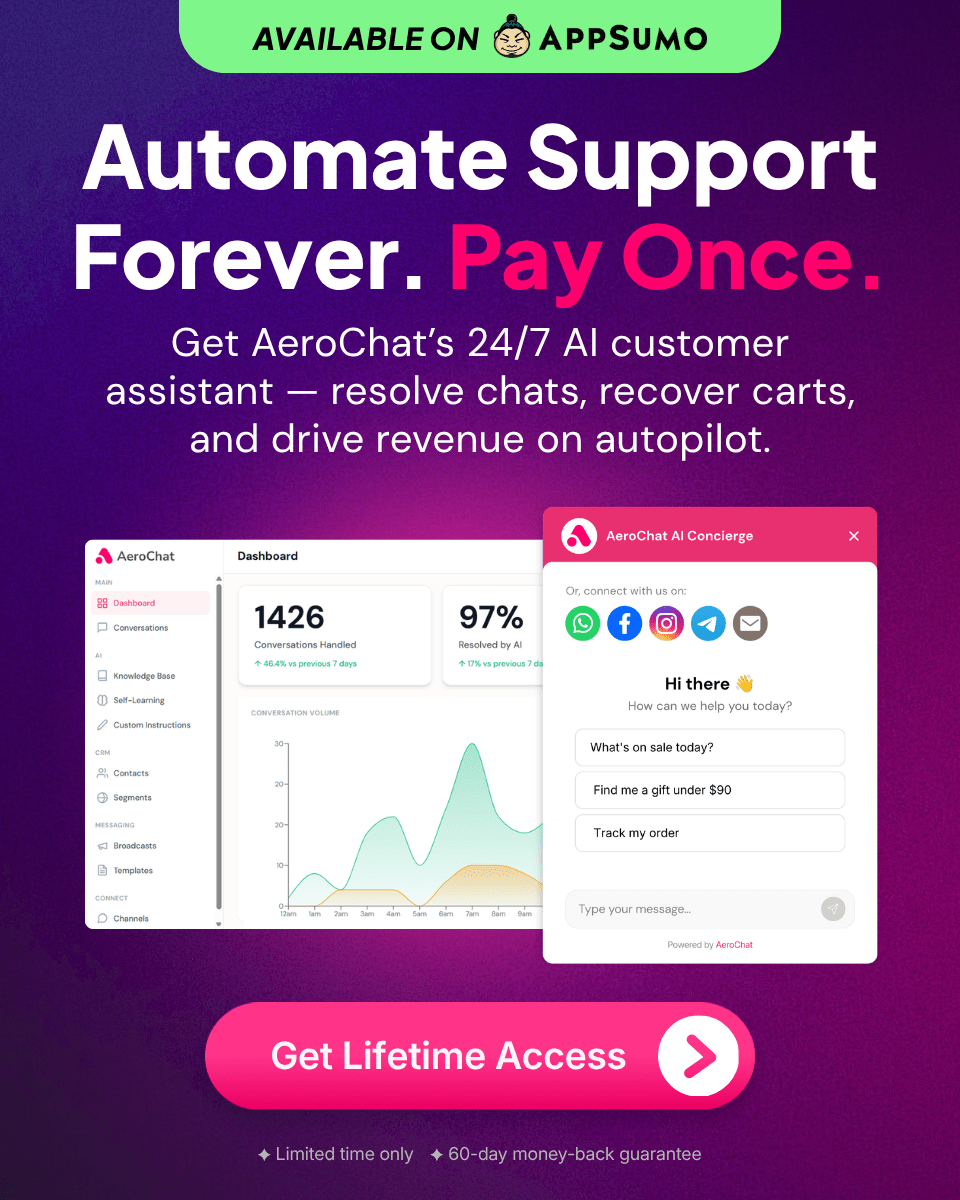
Instead of replacing staff, automation becomes the buffer that absorbs low-value, repetitive tasks.
AeroChat acts as the elasticity layer of your system by handling:
-
product information
-
delivery expectations
-
size and fit guidance
-
simple order checks
-
post-purchase answers
This frees your team to focus only on complex or high-value customers.
Automation becomes the capacity multiplier, not the replacement.
Learn how automation fits into a scalable support system in Shopify AI chatbot solutions.
8. Reduce Message Volume by Improving Post-Purchase Visibility
Support overload often comes from uncertainty after checkout.
Enhance post-purchase visibility:
-
clearer order confirmations
-
dispatch estimate messages
-
simple tracking access
-
proactive updates
-
packaging instructions
-
delivery expectations
The more predictability you provide, the fewer customers need to chase answers.
Reference implementation strategies: Shopify customer support automation.
9. Build “Support Layering” Instead of a Single Queue
High-performing support systems use layers:
Layer 1: automated answers
Layer 2: templates and structured replies
Layer 3: specialist human review
This means:
-
AI answers basic questions instantly
-
templates speed through medium complexity
-
humans only handle unique or emotional issues
Layering eliminates bottlenecks and greatly extends capacity.
10. Scale Through Data, Not Guesswork
Capacity grows when you measure the right things:
-
messages per order
-
repeat question frequency
-
peak hours
-
time spent per conversation
-
resolution rate
-
volume by channel
Data reveals exactly where to optimise.
Scaling becomes systematic, not reactive.
Takeaway
Scaling customer support is not about hiring more staff.
It is about reducing load, tightening workflows, creating standards, improving visibility, and adding AI as an elasticity layer.
When you:
-
remove friction from the customer journey
-
adopt structured communication
-
use asynchronous replies
-
centralise information
-
introduce AI-operated layers
-
design predictable, proactive experiences
your support capacity expands dramatically without adding people.
To build a scalable support architecture for your Shopify store, explore Shopify AI chatbot solutions powered by AeroChat.ai.