
AI Customer Support vs Outsourced Customer Service: Which Is More Reliable?

Neither AI customer support nor an outsourced team is automatically more reliable. AI can be consistent and continuously available for well-defined work. A well-managed outsourced team can investigate ambiguity, coordinate with people and apply judgement. Either can fail when its knowledge, authority, quality controls or escalation path is weak.
For ecommerce, reliability means producing a correct and recoverable customer outcome during normal demand, peak demand and failure. A fast reply that creates another contact is not reliable. Nor is a friendly agent who has no authority to resolve the issue.
Merchant discussions show why the comparison is not simple. One Reddit thread about outsourcing support argued that direct customer contact protects brand understanding; comments described both poor outsourced experiences and dedicated agents who worked well. Another merchant worried about training and continuity if a remote hire disappeared. These are qualitative accounts, but they expose the right questions: who knows the policy, who owns exceptions and what happens when the normal process breaks?
Reliability has five observable parts
Judge both options against the same definition:
- Correctness: Did the customer receive an answer or action supported by current information?
- Repeatability: Would the same case receive comparable treatment on another shift or channel?
- Availability: Can the operation keep working during peaks, absence or system trouble?
- Safe escalation: Does a case reach someone with the context and authority to continue?
- Recovery: Can the business identify, correct and learn from a wrong answer or missed case?
Response speed matters, but it is only one input. Reliability is the ability to finish suitable work and recover visibly when the first route cannot.
AI and outsourced teams have different failure signatures
| Failure | AI support risk | Outsourced-team risk | Control to require |
|---|---|---|---|
| Policy changed | Old source continues to shape answers | Some agents use the old script | Named policy owner and change confirmation |
| Order data missing | AI fills the gap with an unsupported explanation | Agent guesses or gives a generic reply | Required fallback and investigation route |
| Seasonal spike | Integration or usage limit becomes a bottleneck | Queue grows before staffing catches up | Capacity test and priority rules |
| Complex exception | System lacks commercial authority | Agent follows a script without discretion | Escalation to an authorised owner |
| Staff or vendor change | Configuration knowledge is undocumented | Trained people leave or move accounts | Exportable procedures and backup ownership |
| Handoff failure | Case enters an unmonitored queue | Agent forwards the case without ownership | Transfer-completion tracking |
Consistency should not be confused with correctness. AI can repeat the same wrong interpretation at scale. An outsourced agent can be individually capable while the wider team produces inconsistent decisions. Both models need evidence beyond a polished sample conversation.
Use ten tests instead of trusting the sales claim
Score each option on the evidence it can show for these ten areas. Use the same anonymised conversations and operating assumptions for both.
| Reliability test | Evidence to request |
|---|---|
| 1. Source accuracy after a change | Show how a new returns rule reaches every answer and how old material is removed |
| 2. Use of live order information | Demonstrate a normal order, a split shipment and a missing tracking event |
| 3. Consistency across channels and shifts | Compare the same request on website chat, email or messaging and across different agents |
| 4. Judgement for exceptions | Show where authority stops and who approves an unusual remedy |
| 5. Continuity during peaks and absence | Explain capacity limits, backup staffing and queue priorities |
| 6. Access control | List which people or systems can view and change customer or order information |
| 7. Escalation completion | Show the receiving queue, context package, acceptance state and failed-transfer route |
| 8. Quality review | Provide the sampling method, correction process and named reviewer |
| 9. Feedback into operations | Show how recurring product, fulfilment or policy issues reach the responsible team |
| 10. Incident recovery | Explain how wrong answers are found, corrected, communicated and prevented from recurring |
The NIST AI Risk Management Framework is broader than ecommerce support, but its emphasis on mapping, measuring, managing and governing AI risk supports a practical lesson: an AI tool needs ongoing testing and monitoring, not a one-time demonstration.
Outsourced operations need an equivalent discipline. Training completion, sampled tickets, corrections, escalation failures and queue age should be visible to the merchant rather than left entirely inside the provider.
Three incidents reveal more than a feature list
A return policy changes on Friday afternoon
A reliable AI operation identifies the source that changed, retrains or refreshes it, tests affected questions and confirms that the old answer is no longer used. A reliable outsourced team updates the playbook, confirms that active agents have received the change and checks early conversations.
The weak AI continues answering from an old document. The weak outsourced team updates one shift while another keeps using the previous script.
A carrier delay creates hundreds of order questions
AI can be dependable when it retrieves the last confirmed event, avoids inventing a delivery date and routes genuine exceptions. An outsourced team can investigate unusual cases and coordinate with the warehouse or carrier, but its queue may grow if priority rules and backup coverage are unclear.
Test both models with the expected peak, not the normal Tuesday volume. Ask what happens when tracking data itself is late.
A high-value customer reports a damaged delivery
AI can collect the order, affected item, evidence and requested outcome. A person with authority should normally decide an exceptional replacement, compensation or recovery response.
An outsourced team is only more reliable here if the agent has adequate product knowledge, access and authority. Passing the customer through several polite but powerless people is not a stronger outcome than an AI escalation.
AI is dependable when the work has firm boundaries
AI customer support is a strong fit for questions that are frequent, verifiable and governed by a stable next step. Examples include current product information, standard policy explanations and authenticated order status.
The operating conditions matter:
- the source is current and traceable;
- the AI has only the access it needs;
- unsupported facts trigger clarification or fallback;
- money-moving actions have separate authority;
- a person owns exceptions;
- conversations are sampled after launch.
This is also where cost comparisons can become misleading. Software price or agent cost means little without the number of durable outcomes. The detailed cost-per-resolved-ticket framework separates genuine resolution from work that merely touched the customer before returning to a person.
Outsourcing is dependable when the operation is managed, not merely staffed
An outsourced team can be the stronger option for phone conversations, supplier coordination, unusual returns, technical products and relationship-sensitive complaints. People can investigate across incomplete systems and seek clarification without every path being predefined.
That advantage disappears if agents lack stable training, permissions, escalation access or account continuity. Ask whether the proposed team is dedicated or shared, who coaches it, who covers absence and what authority agents have without waiting for the merchant.
Outsourcing a managed team is also different from hiring one individual. Merchants comparing AI with a single remote hire should use the separate guide to AI support versus a virtual assistant.
A combined model can fail at the join
Using AI for bounded first-line work and people for exceptions can reduce the largest weaknesses of each model. It does not become reliable simply because both are present.
The handoff needs one owner, useful context and an honest queue state. Track whether the transfer was completed, not just offered. The practical AI chatbot handover workflow covers triggers, context and failure states in detail.
An AI-first rather than AI-only model also keeps human access available without sending every routine question directly to a paid agent.
Ask for evidence before signing either agreement
| Due-diligence question | Why it matters |
|---|---|
| Which source controls each answer? | Reveals stale knowledge and conflicting systems |
| Who can view or change Shopify data? | Exposes unnecessary access and unclear accountability |
| What happens when confidence or information is low? | Tests whether the model guesses or stops |
| Who owns a transferred case? | Prevents escalation into an unattended queue |
| How are policy changes confirmed? | Tests change management across software or shifts |
| Which conversations are reviewed? | Shows whether quality control is systematic |
| What is the backup during absence or outage? | Tests continuity rather than normal operation |
| Can records and knowledge be exported? | Reduces dependence on one provider |
If the business is still choosing the wider technology stack, the customer-service app comparison covers product categories. Keep that buying decision separate from the question of who operates and governs the support process.
Using AeroChat as the bounded automation layer
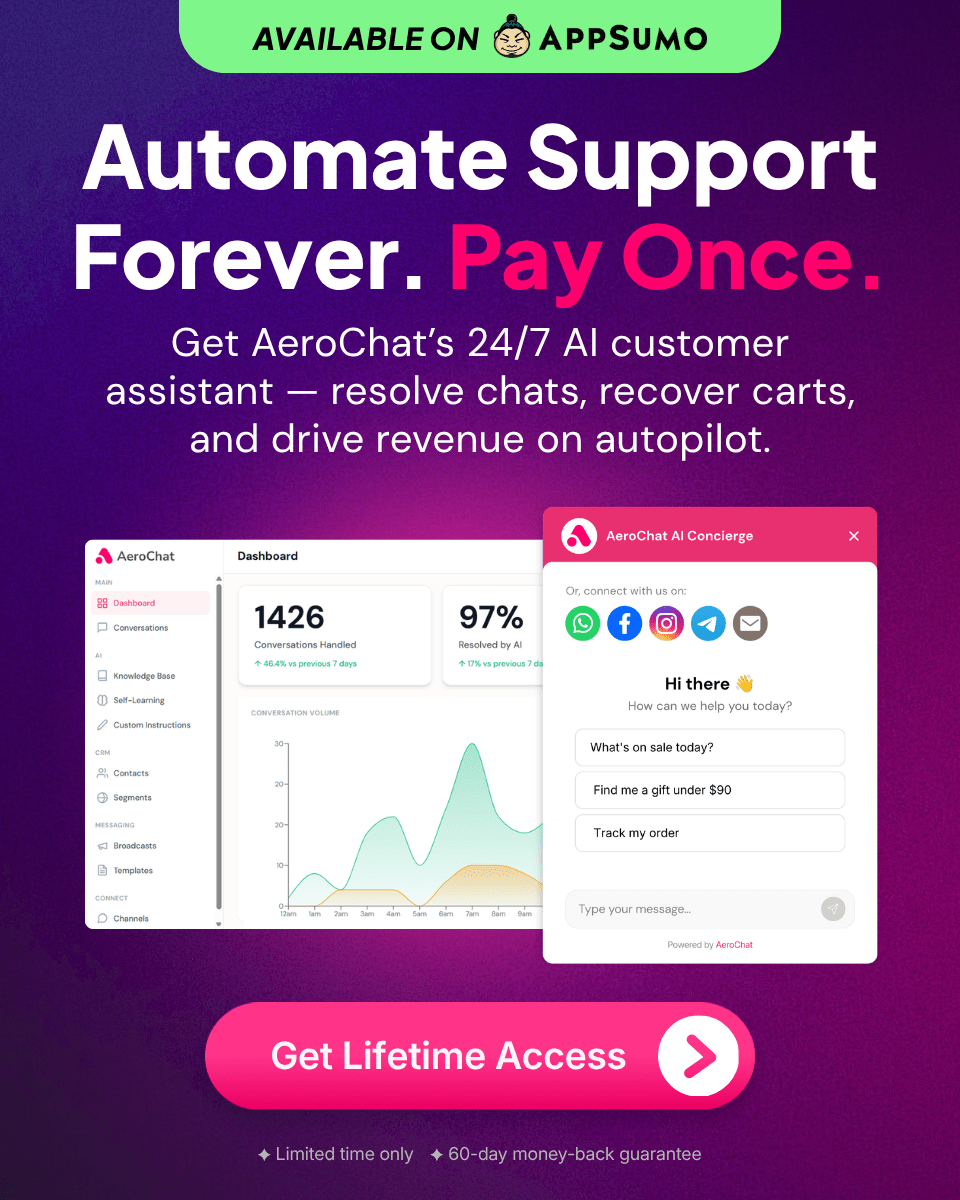
AeroChat is an AI agent platform that helps ecommerce brands run customer service on autopilot. It can answer suitable product, policy and Shopify order questions across supported channels, then use human handover with conversation context when a case needs personal attention.
That makes AeroChat relevant for the repeatable part of the reliability model. It is not an outsourced staffing agency and does not supply the merchant's refund authority, service commitment or queue supervision. If an internal or outsourced person receives the handoff, the business still needs to confirm that its actual inbox, permissions and staffing arrangement support that route.
The honest comparison is therefore not AeroChat versus people in every conversation. It is whether a bounded AI layer can complete suitable work more consistently while the chosen human team retains ownership of exceptions.
Test the operating system, not the polished example
Take a sample of real enquiries, remove personal information and add failure cases. Give the same set to the proposed AI workflow and outsourced operation. Compare factual corrections, completed handoffs, repeat contacts and cases that nobody owned.
Choose the model that can show how it remains correct and how it recovers when it is not. Reliability comes from controlled work, visible ownership and effective recovery, regardless of whether the first answer came from software or a person.