
Cost per Resolved Ticket: How to Measure AI Support ROI

Cost per resolved ticket is the total cost of providing support during a period divided by the customer issues genuinely resolved in that same period. To measure AI customer-support ROI, count durable AI-only resolutions instead of every conversation the AI touched. Include software, implementation, maintenance, quality review and human escalation costs.
The monthly subscription is therefore only one part of the decision. A $100 tool that creates unresolved contacts and extra human work can cost more per outcome than a $500 system that resolves the right questions reliably. Equally, a capable platform may not be economical for a store with very little support volume.
This guide provides a vendor-neutral calculation for ecommerce teams. It separates support-unit economics from broader chatbot returns such as conversion and cart recovery, which are covered in AeroChat’s guide to Shopify chatbot ROI drivers.
What does cost per resolved ticket mean?
Cost per resolved ticket measures the average resources used to solve a customer issue. The basic formula is total support operating cost divided by the number of issues resolved during the same period.
For an ecommerce team, “total operating costs” can include:
- agent wages, employer costs and contractors;
- team leads, quality review and training;
- helpdesk, messaging and AI software;
- channel or usage charges;
- implementation and integration work;
- knowledge-base maintenance;
- the time other teams spend resolving escalations.
The denominator needs equal care. A chat session, ticket record and resolved customer issue are not always the same unit.
Cost per contact, ticket and resolution are different
A contact is one interaction, such as a chat, email or WhatsApp message. A ticket is the support record that may contain several contacts. A resolution is the outcome: the customer’s underlying issue has been dealt with.
One late order can create a web chat, an email and an Instagram message. Counting three contacts as three successful outcomes would make cost appear artificially low. Where possible, group repeat contacts about the same issue before comparing performance.
Closed does not always mean resolved
A system may close a conversation because the customer stopped replying. That does not prove the answer worked. The customer may have given up, tried another channel or returned later.
Define a confirmation window appropriate to the issue. The window should be long enough for a repeat contact, reopen or failed action to become visible. Use the same rule before and after introducing AI so the comparison remains fair.
Define a genuine AI resolution first
A genuine AI resolution is a customer issue completed without human intervention and without a related reopen or repeat contact inside the chosen confirmation window.
This definition is stricter than “AI sent a reply”. It is also more useful for financial decisions.
AI-resolved versus AI-touched
An AI-touched ticket includes any conversation where AI classified, drafted, answered or collected information. Some of those uses still save agent time, but they are not autonomous resolutions.
The dedicated breakdown of AI-resolved versus AI-touched tickets covers all five outcome states in more depth, including how to reclassify reopened and human-corrected cases.
Report at least four groups:
| Outcome group | What happened | How to treat it financially |
|---|---|---|
| AI-only durable resolution | AI completed the issue and it stayed resolved | Count in the AI-resolution denominator |
| AI-assisted human resolution | AI gathered or drafted; a person completed the issue | Measure time saved, but not as AI-only resolution |
| Handoff or escalation | AI transferred the case for human judgement | Include the human cost |
| Abandoned or unknown | Customer stopped without a confirmed outcome | Keep separate; do not assume success |
Some support platforms separate conversations resolved from start to finish by automation from those handed to an agent. Others count a wider set of outcomes. Merchants therefore need to inspect the definition behind a dashboard percentage rather than assuming every reported resolution represents the same event.
Deflection, containment and resolution are not interchangeable
Deflection often means the contact did not enter a human queue. Containment means it remained within the automated experience. Resolution should mean the customer’s problem was solved.
A customer who abandons an unhelpful bot is contained and deflected in a technical sense, yet the business has not created value. They may later open a second case, leave a complaint or initiate a chargeback.
Ask each vendor what evidence marks an outcome as resolved and what happens if the customer returns. Definitions differ, so two products displaying “resolution rate” may not be reporting an equivalent event.
Calculate AI support ROI in five steps
Use one consistent period. It should cover a complete operating cycle, ordinary support volume and enough time for follow-up contacts to appear.
1. Establish the human-support baseline
Add the fully loaded cost of the existing support operation and divide it by genuinely resolved issues:
Baseline cost per resolved ticket = total support operating cost ÷ durable resolved issues
Include the tools and management required to deliver the service rather than counting frontline wages alone. If chat, email and voice have materially different costs, calculate them separately as well as in a blended total.
Record the intent mix during the baseline. A month dominated by simple order-status enquiries is not directly comparable with a month dominated by a product recall or courier crisis.
2. Add every AI programme cost
Create an all-in monthly figure containing:
- base subscription and usage charges;
- remaining helpdesk and channel costs;
- implementation amortised across a sensible period;
- integration monitoring;
- knowledge and instruction maintenance;
- conversation sampling and quality review;
- training and change management;
- incremental human work caused by escalations or corrections.
Use the Shopify chatbot billing-model comparison when estimating vendor charges, but replace published examples with your actual conversation volume, seats and channels.
3. Count durable AI-only resolutions
Start with conversations marked AI-resolved. Remove:
- related reopens during the confirmation window;
- repeat contacts on another channel;
- cases later corrected by an agent;
- unresolved actions despite a confident message;
- test, spam or duplicate conversations.
The result is the denominator for the AI-only calculation:
AI cost per durable resolution = all-in AI pathway cost ÷ durable AI-only resolutions
Keep AI-assisted tickets separate. They may deliver meaningful savings through shorter handling time, but they require a different calculation.
4. Include escalation and double-handling costs
An escalation is not automatically waste. It may be the safest and fastest path for an exception. The economic problem appears when the AI consumes customer time, gives unusable answers and then sends a cold case to an agent who must begin again.
Measure:
- agent time after an AI handoff;
- repeated questions or identity checks;
- corrections to inaccurate AI responses;
- supervisor involvement caused by the failed automation;
- refunds, credits or operational recovery where attributable.
Do not charge the AI with every cost of the final human resolution; some cases would always need a person. Compare the post-AI cost with the equivalent baseline case and allocate only the relevant pathway cost.
5. Compare net benefit, ROI and payback
For the support-cost portion of the business case:
Avoided baseline cost = durable AI-only resolutions × baseline cost per resolved ticket
Net monthly benefit = avoided baseline cost − all-in AI pathway cost
ROI percentage = net monthly benefit ÷ all-in AI pathway cost × 100
Payback period = one-off implementation cost ÷ monthly net benefit
If the project also affects conversion or retention, show those benefits separately. Mixing estimated revenue lift into the support-cost line makes it harder to see whether the service operation itself became more efficient.
A worked ecommerce example
Consider a hypothetical growing store. The figures below illustrate the method; they are not industry benchmarks.
Before AI, the store resolves 2,000 customer issues a month at a fully loaded support cost of $12,000:
Baseline cost per resolution = $12,000 ÷ 2,000 = $6
After deployment, the AI dashboard initially marks 720 conversations as resolved. During the store’s confirmation window, 60 customers reopen the issue and 30 need later human correction. The store therefore counts 630 durable AI-only resolutions.
The monthly AI pathway costs are:
| Cost | Amount |
|---|---|
| Software and usage | $900 |
| Allocated implementation | $150 |
| Knowledge maintenance and QA | $300 |
| Integration monitoring | $100 |
| Additional human work on failed or escalated cases | $450 |
| Total | $1,900 |
The resulting unit cost is:
AI pathway cost per durable resolution = $1,900 ÷ 630 = $3.02
At the $6 baseline, 630 human resolutions would have cost $3,780. The illustrative net benefit is therefore $1,880 for the month:
$3,780 avoided baseline cost − $1,900 AI pathway cost = $1,880
Using the formula above, the illustrative support-cost ROI is approximately 99%.
Now reduce the volume while keeping most fixed costs. At 200 initially marked resolutions with the same failure proportions, the unit cost could rise enough to remove the saving. A low monthly price does not guarantee positive ROI, so the calculation needs to be tested at different support volumes.
Why deflection can overstate savings
Deflection is useful when it represents demand genuinely satisfied through self-service or automation. It becomes misleading when it records only that no agent joined the original conversation.
For the full gross-versus-net methodology behind that adjustment, see this guide to measuring customer support deflection rate.
Abandonment is not proof of resolution
Review a sample of deflected conversations. Look for unanswered final questions, repeated attempts, negative sentiment and customers who return through another channel.
If the measurement system cannot connect those contacts, report the limitation rather than assigning every abandoned conversation to the success column.
One issue can be paid for twice
When the AI gives an incorrect answer and a person later repairs it, the business pays the automation cost and the human cost. The agent may also spend longer correcting expectations than they would have spent answering correctly from the beginning.
This is why human handover with conversation context matters economically as well as experientially. A complete history can reduce repeated discovery work, although merchants still need to measure what happens in their own queue.
Vendor outcomes may serve billing, not your accounting
A billable outcome is a contract definition. A durable customer resolution is an operating definition. They may align, but do not assume they do.
Before comparing vendors, ask:
- What event creates a billable resolution?
- Does a handoff count?
- What if the customer reopens the case?
- How are multi-question conversations treated?
- Can outcome-level data be exported and audited?
Calculate ROI by support intent
An overall average can hide where automation earns or loses money. Calculate resolution rate, reopen rate and pathway cost for the main conversation groups.
A broader framework for tracking resolution rate and the other underlying support KPIs sits in this guide to ecommerce customer service metrics.
WISMO and standard product questions
“Where is my order?” questions can be strong automation candidates when the system retrieves current, customer-specific information. AeroChat’s guide to reducing WISMO tickets covers the underlying workflow.
Product questions also work well when the catalogue contains the required attributes. If compatibility, material or sizing information is missing, the apparent automation opportunity may actually be a data-quality project.
Returns, cancellations and policy exceptions
Standard policy explanations can be inexpensive to automate. Exceptions may need human approval. Report these separately so a large volume of easy policy answers does not conceal expensive corrections on unusual cases.
Complaints and complex orders
Multi-order problems, disputed charges and emotionally charged complaints may have lower AI-only resolution but still benefit from AI-assisted context collection and routing. Their value may appear as reduced agent handling time rather than autonomous resolution.
The intent mix also changes during campaigns and fulfilment incidents. When Shopify support volume becomes unusually high, compare the same intent categories instead of treating the spike as equivalent to an ordinary month.
When AI support may not be economical yet
AI support can be useful without being the right investment today. It may not produce a favourable cost per resolution when:
- message volume is low or irregular;
- few questions are repetitive and verifiable;
- product or policy information is incomplete;
- the store has no one to maintain knowledge and review failures;
- most cases require judgement from the start;
- the new tool duplicates an existing helpdesk without replacing work.
For a low-volume founder-operated store, a free inbox and clearer product information may have better economics. Recalculate when support demand begins displacing higher-value work or requires another hire.
How AeroChat supports AI customer service ROI measurement
AeroChat is an AI agent platform that helps ecommerce brands run customer service on autopilot. For ROI analysis, its role is to automate suitable customer conversations and provide operational data that merchants can combine with their own support costs.
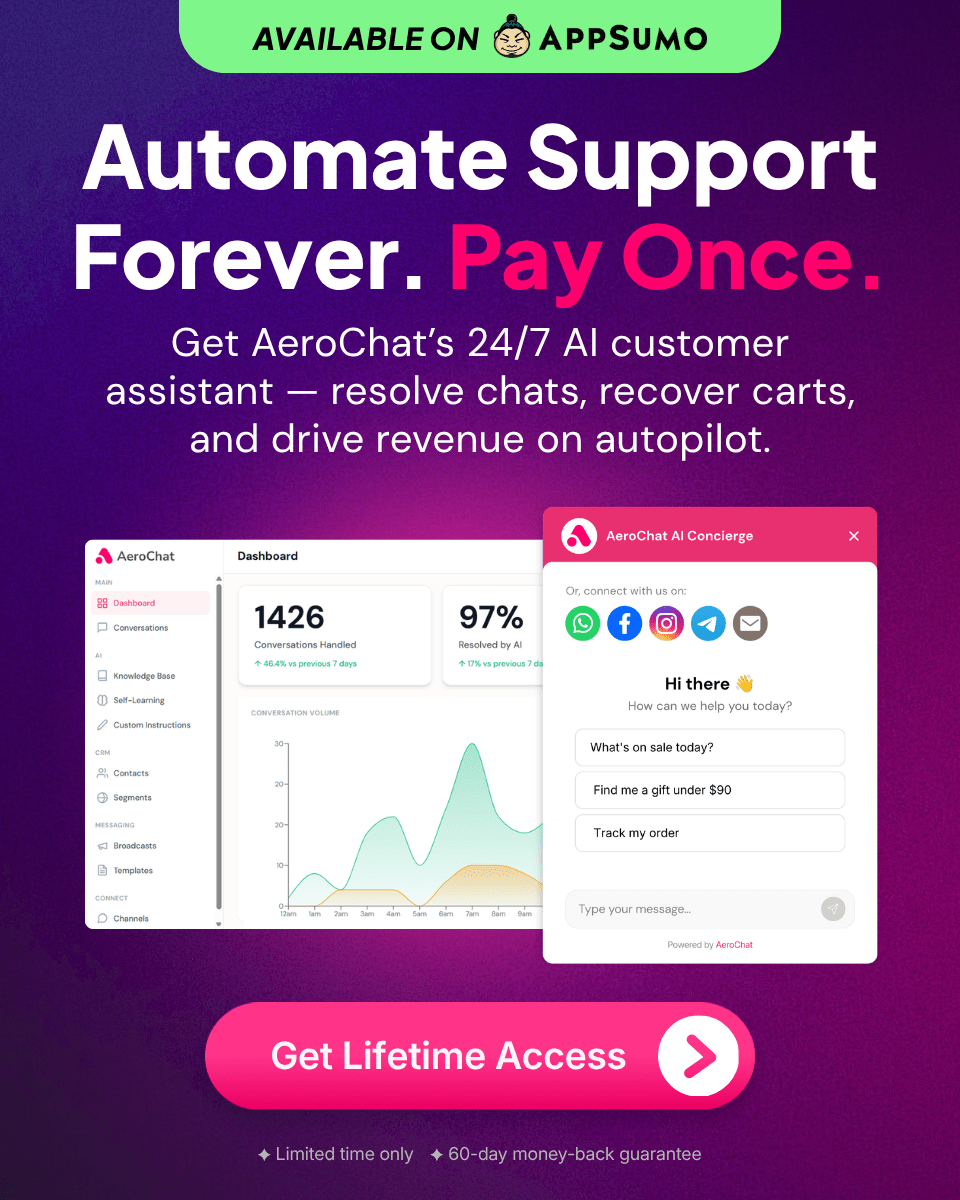
The AeroChat AI chat insights dashboard reports conversations handled, the share resolved by AI without human intervention, estimated time saved, common customer topics and topics that are frequently escalated. These measures help a support team see which questions automation is resolving and where human work is still required.
AeroChat does not replace the merchant’s financial calculation. Labour, implementation, channel, helpdesk and knowledge-maintenance costs still need to be added separately. The business must also decide how reopened conversations, repeated contacts and AI-assisted human cases affect its durable-resolution count.
Use AeroChat data to compare performance by topic instead of relying on one overall automation percentage. For example, order-status questions may produce a different cost per resolution from refund exceptions or complex complaints. Do not turn a displayed time-saving estimate directly into cash savings: released staff time becomes a financial return only when it avoids spending or creates measurable additional value.
AeroChat is generally a growth-stage support investment rather than a required launch expense. The ROI calculation becomes more relevant when enquiry volume increases, support work begins affecting other operations or the business manages customer conversations across several channels.
Run a 30-day baseline before buying
Before introducing a tool, record one consistent period of:
- customer issues received and genuinely resolved;
- repeat contacts and reopens;
- fully loaded support-stack cost;
- agent handling time where available;
- major conversation intents;
- escalations and policy exceptions;
- customer satisfaction or complaint signals.
Run the same measurement after launch and retain the original definitions. Measure whether the combined support system resolved the right problems at a lower cost without shifting effort or risk somewhere the dashboard does not show.