
12 Product Marketing Strategies for Ecommerce Brands

Product marketing strategies connect a product with the people most likely to need it. They determine who the product is for, which problem it solves, how its value is explained, where buyers encounter that explanation and what the business learns after launch.
For an ecommerce brand, this work sits between product development, merchandising, marketing and customer service. It is not simply a list of promotion channels. More traffic will not repair an unclear product, weak evidence or a mismatch between an advert and the product page.
The twelve strategies below follow the order in which the decisions usually become useful: understand the customer, establish a defensible message, build the buying path, launch deliberately and learn from real behaviour.
Build the foundation before selecting channels
Three questions should be answerable before a campaign receives a budget:
- Who is making the decision? Describe the situation and need, not only age or location.
- What progress does the product help them make? State a concrete outcome without inventing a guarantee.
- What evidence makes the promise credible? Product specifications, demonstrations, policies and verified customer evidence serve different purposes.
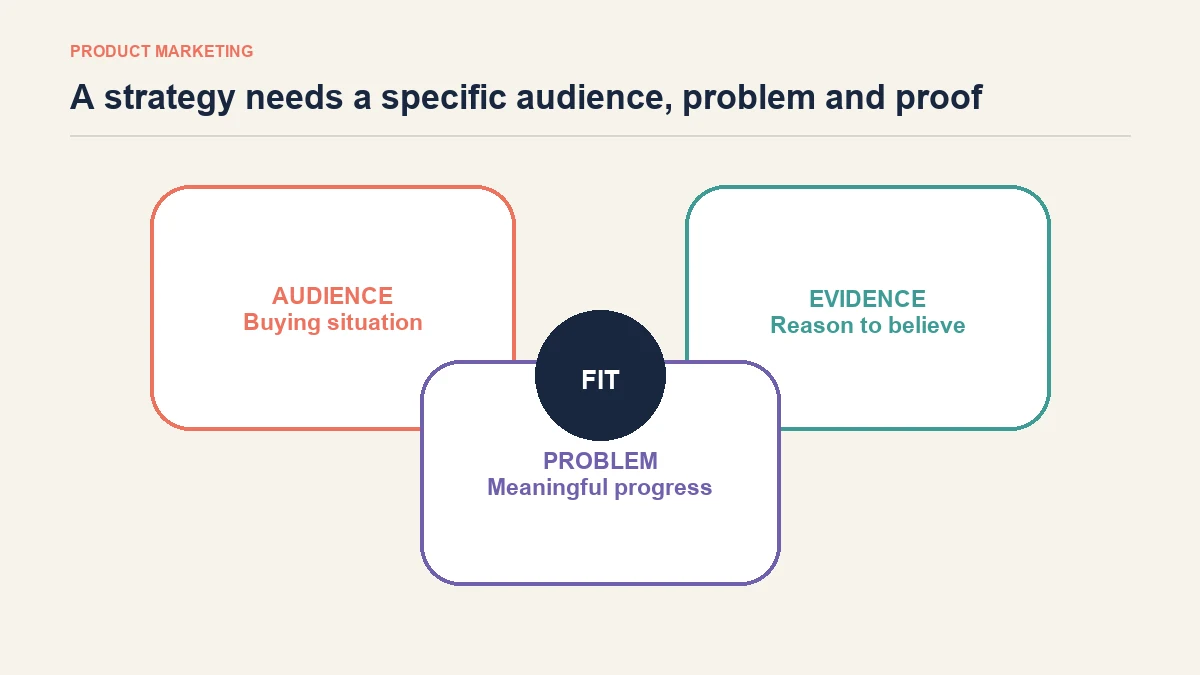
If these answers are vague, channel tactics tend to create inconsistent claims. A product is described one way in an advert, another way on the product page and a third way by customer service.
1. Segment by buying situation, not only demographics
Two customers of the same age can want the same product for different reasons. One may need a dependable replacement immediately; another may be comparing a premium upgrade for later.
Build segments around observable needs such as:
- the job the buyer is trying to complete;
- the problem with their current solution;
- urgency and purchase stage;
- experience with the category;
- constraints such as size, compatibility, delivery or budget;
- the evidence required before they feel comfortable buying.
This produces usable messages. “First-time buyers who are unsure about compatibility” is more actionable than “people aged 25–34”.
2. Define the product's position against the real alternative
The alternative is not always a named competitor. It may be keeping an existing product, using a manual workaround, buying a cheaper substitute or doing nothing.
Write a working positioning statement for internal use:
For [specific buyer in a specific situation], [product] helps with [important outcome] because [credible difference], unlike [real alternative].
Treat this as a decision tool, not website copy. Every part should survive scrutiny. If the difference depends on unverified superiority, return to product evidence before building the campaign.
3. Create a message hierarchy
A product page and a short social post cannot carry the same amount of information, but they should draw from the same hierarchy.
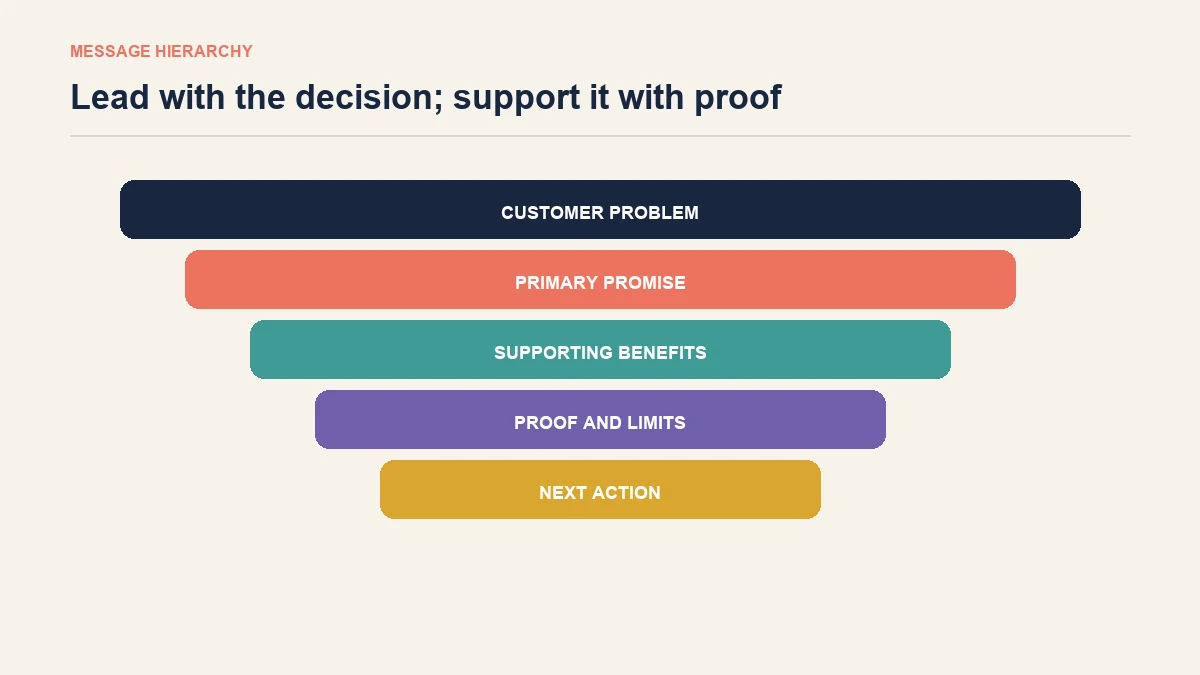
Use five levels:
- Customer problem or desired progress.
- Primary product promise.
- Two or three supporting benefits.
- Proof, specifications and limitations.
- A next action appropriate to the buying stage.
This hierarchy prevents a common error: listing features before the buyer understands why they matter. It also gives support teams a consistent source when answering product questions.
4. Turn product pages into decision pages
A useful product page helps the right customer decide, including when the correct decision is not to buy.
Include the information that changes the decision:
- intended and unsuitable use cases;
- dimensions, materials and compatibility;
- what is and is not included;
- delivery and return conditions;
- care or setup requirements;
- photographs that answer scale and detail questions;
- evidence connected to specific claims;
- access to help when an important question remains.
Do not hide a material limitation in an FAQ simply to protect the main sales message. A prevented return is usually more valuable than an unsuitable order.
The existing Shopify conversion article explains how to diagnose product-page and checkout barriers after traffic begins arriving.
5. Build content around buying questions
Generic traffic is not the same as product demand. Content becomes commercially useful when it helps someone understand the problem, compare approaches, choose a specification or use the product successfully.
Map content to four stages:
| Stage | Useful content |
|---|---|
| Problem recognition | Explanations, diagnostic checklists and common mistakes |
| Approach comparison | Method comparisons, trade-offs and buyer criteria |
| Product evaluation | Compatibility, demonstrations, sizing and policy details |
| Adoption | Setup, care, troubleshooting and realistic use examples |
Avoid publishing multiple near-identical articles for every keyword variation. One strong resource can often satisfy a cluster when its sections answer distinct questions clearly.
6. Design the launch as a sequence
A launch is a coordinated learning period, not one announcement.
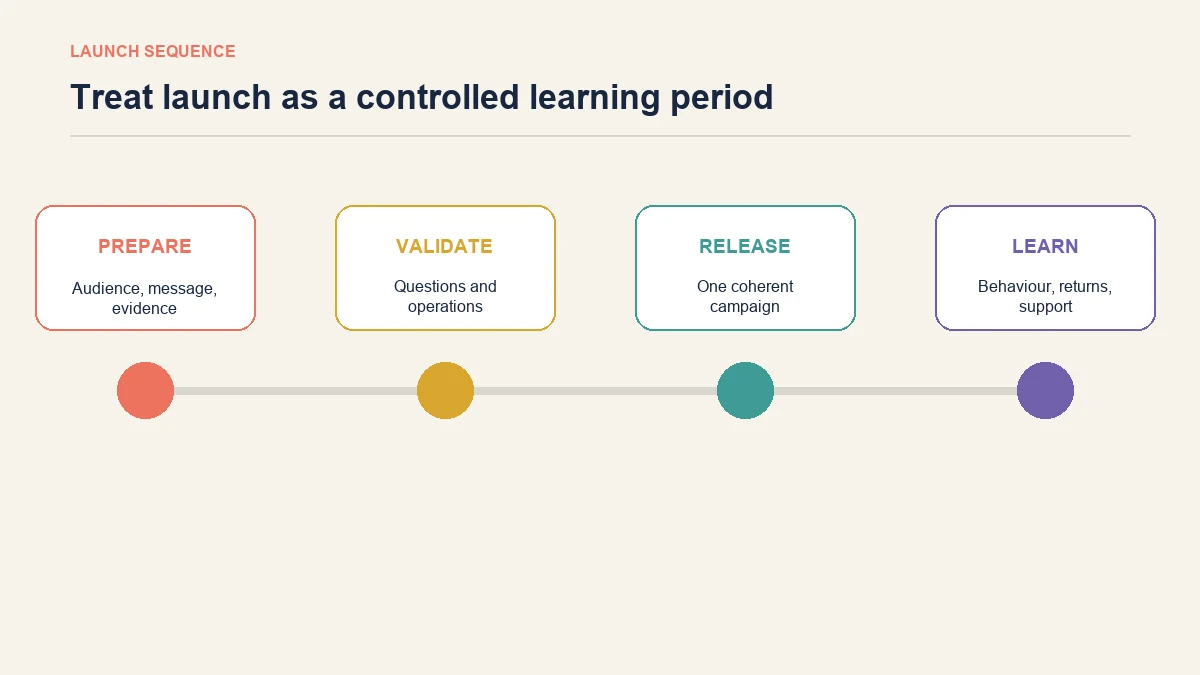
Before launch
- Confirm the audience and message.
- Recruit a relevant test or early-access group where appropriate.
- Prepare product information and support answers.
- Test fulfilment, returns and escalation paths.
- Create channel assets from one message hierarchy.
- Define what would count as useful evidence, not only revenue.
During launch
- Keep claims consistent across adverts, product pages and conversations.
- Record unanswered questions and objections.
- Watch for inventory, payment and delivery failures.
- Avoid changing several major variables at once.
After launch
- Separate product objections from operational failures.
- Update weak explanations.
- Review returns and support themes.
- Decide which channel or audience deserves another test.
The broader ecommerce website launch marketing plan can support scheduling without duplicating the product-positioning work here.
7. Use demonstrations that prove one thing clearly
A demonstration should resolve a real uncertainty. Instead of a polished montage of a product being used, show the detail a buyer needs to evaluate: scale, setup time, material movement, compatibility, cleaning or the before-and-after state of a task.
Choose one claim per demonstration. State the test conditions when they affect the result. Avoid editing that hides delays or awkward steps the buyer will experience.
Demonstrations can appear on product pages, marketplace listings, social posts, sales conversations and support material. Reusing the evidence is sensible; repeating the same promotional caption everywhere is not.
8. Match channel choice to the decision
Do not use a channel simply because competitors are visible there. Ask what role it can play.
- Search can capture an existing question or comparison.
- Email can support consideration, launch access and post-purchase education.
- Social content can demonstrate use and reveal objections.
- Paid media can test a message or reach a defined audience.
- Creators can supply context and credible demonstrations when the fit is genuine.
- Customer conversations can resolve individual uncertainty near purchase.
The channel should carry an appropriate next step. A cold social viewer may need a clear demonstration, while a returning product-page visitor may need one missing compatibility answer.
9. Equip customer-facing teams with product truth
Marketing fails when customers receive a better answer from a random comment than from the business. Maintain a product information source covering specifications, suitable use, limitations, policies and approved claim evidence.
The team should know:
- which questions have a fixed factual answer;
- which depend on customer circumstances;
- which require specialist or human judgement;
- which claims cannot be made;
- how product changes are communicated internally.
This is also part of a coherent ecommerce customer communication strategy, not just launch preparation.
10. Use customer questions as product-marketing evidence
Repeated presales questions are signals. They can reveal missing product information, language customers do not understand, unexpected use cases or an advert attracting the wrong audience.
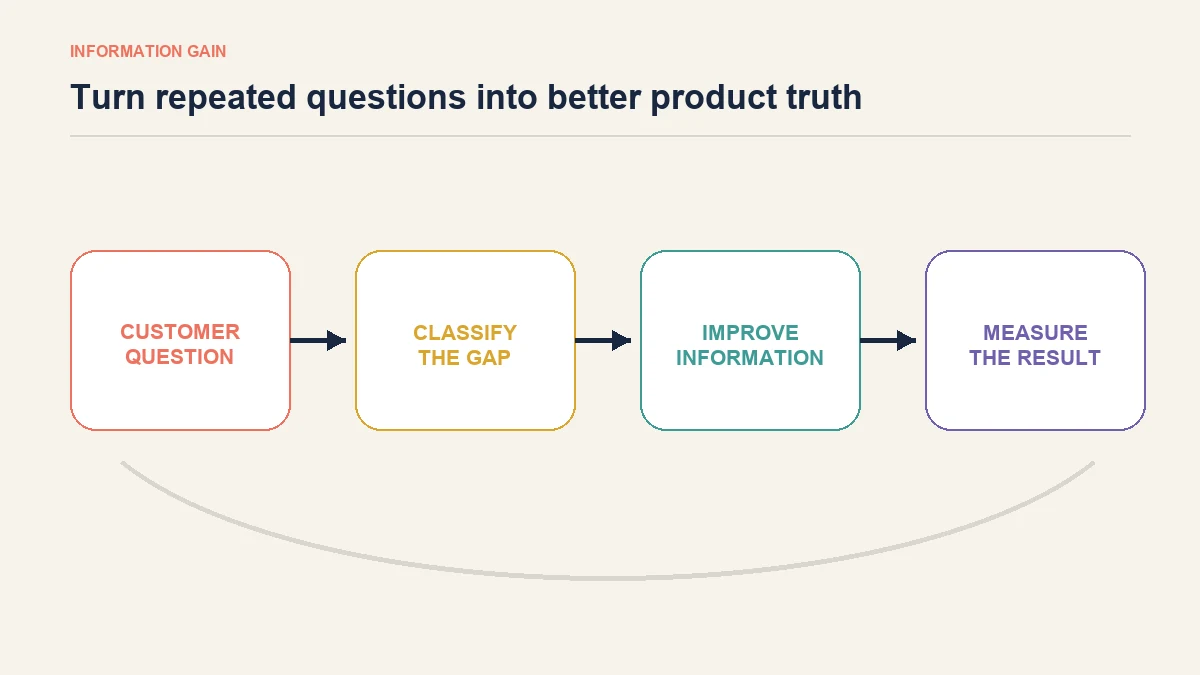
Classify questions by decision impact:
- Missing fact: dimension, material, stock or delivery information is absent.
- Unclear fit: the buyer cannot tell whether the product suits their situation.
- Trust gap: the claim lacks enough evidence.
- Policy risk: returns, warranty or subscription terms are unclear.
- Product gap: the requested capability does not exist.
Only the first four can usually be improved through messaging. Do not disguise a product gap with more persuasive copy.
11. Build retention into the product story
Product marketing continues after checkout. Good post-purchase communication helps the customer reach the value they expected and gives the business better evidence about adoption.
Useful work includes:
- setup and care guidance timed to delivery;
- reminders based on real use cycles rather than arbitrary frequency;
- replenishment information where repeat use is natural;
- compatible accessories presented when they solve a known need;
- requests for feedback after enough time to use the product;
- win-back messages grounded in prior purchase context.
Avoid treating every service update as an upsell opportunity. The customer should be able to distinguish necessary information from promotion.
12. Measure the decision path, not one headline number
A conversion rate can change because of traffic mix, availability, price, device experience or campaign targeting. Pair commercial outcomes with the behaviour that explains them.
Review:
- qualified product-page visits by source;
- engagement with important specifications or demonstrations;
- add-to-basket and checkout progression;
- product questions by theme;
- returns and cancellations by reason;
- repeat purchase where the category supports it;
- margin after discounts, returns and channel costs.
AeroChat's conversion tracking can connect supported conversations with completed sales, but attribution should still be interpreted carefully. A conversation may assist a decision without being its only cause.
How AeroChat contributes to product marketing
AeroChat is an AI agent platform that helps ecommerce brands run customer service on autopilot. Its role in product marketing is specific: it can answer suitable product and policy questions using the business's approved information, recommend products based on customer intent and preserve customer conversations across supported channels.
The information gain comes from the questions around the answer. If buyers repeatedly ask whether a product works with a particular device, the team can improve the product page and campaign message instead of relying on chat forever. When a question requires judgement or the available information is insufficient, a person should take over.
AeroChat is not a substitute for audience research, positioning, creative direction or product evidence. It helps make product information available in conversation and gives the business another source of customer-language insight.
Prioritise strategies by product stage
| Product stage | First priorities | Avoid |
|---|---|---|
| Before validation | Audience problem, alternative, evidence and small message tests | Scaling paid traffic around an untested promise |
| Preparing to launch | Message hierarchy, decision page, support truth and launch sequence | Producing unrelated channel assets in isolation |
| Early sales | Question analysis, funnel diagnosis and operational fixes | Treating every objection as a copy problem |
| Established product | Segment refinement, retention, new evidence and channel economics | Changing the core position without supporting data |
A practical 30-day implementation sequence
Week 1: collect evidence
Review product questions, returns, reviews, search terms and competitor alternatives. Write the current audience, problem and evidence in plain language.
Week 2: repair the message
Create the hierarchy and update one important product page. Check that customer service uses the same product facts and limitations.
Week 3: run one controlled channel test
Choose one audience, one message and one next action. Record traffic quality and decision behaviour rather than changing several campaigns at once.
Week 4: close the learning loop
Review commercial outcomes, questions and operational failures together. Keep the strongest evidence, improve unclear information and document the next test.
Frequently asked questions
What is the difference between product marketing and general marketing?
Product marketing concentrates on a particular product's audience, position, message, launch, adoption and competitive context. General marketing can also cover the wider brand, corporate reputation and demand across several products.
Which product marketing strategy should a small ecommerce brand start with?
Start with the audience's buying situation, the real alternative and credible evidence. Channel selection becomes easier once the business can explain why the product is relevant and why the claim should be believed.
Are discounts a product marketing strategy?
Pricing and promotion can support a strategy, but a discount does not repair unclear value or poor fit. Measure margin and customer quality, not only the temporary increase in orders.
How do customer-service conversations improve product marketing?
They reveal the language, missing facts and objections customers encounter while deciding. Aggregate themes rather than exposing personal conversations, then verify whether a content, policy or product change is needed.
Make every tactic answer the same strategic question
Strong product marketing strategies do not require a brand to appear everywhere. They require the product, message, evidence and buying experience to make sense together.
Build that foundation first. Then use channels and customer conversations to test it, learn from it and improve the next decision.