
How to Use Customer Segmentation in Ecommerce

Customer segmentation means grouping existing customers or contacts by characteristics that matter to a specific business decision. An ecommerce store might separate opted-in VIP customers from inactive contacts, distinguish first-time buyers from repeat buyers, or group customers by the country it can serve. The purpose is not to create more lists. It is to make a message, service decision or analysis more relevant.
Useful segmentation starts with an action: who needs different information, treatment or timing, and why? Define that first, then use the smallest amount of reliable data needed to identify the group. This approach produces segments a team can actually use and reduces the temptation to collect personal information simply because it is available.
What is customer segmentation?
Customer segmentation is the process of dividing a customer base into groups using shared, defined criteria. Those criteria might include location, purchase activity, lifecycle stage, support needs, communication consent or a tag added through a known business process.
A segment should answer three questions:
- Who is included and excluded?
- What will the business do differently for this group?
- How will it know whether that action was useful?
If the only answer is “send more marketing”, the segment is probably too vague. A stronger example is “customers who explicitly opted in, bought a consumable product 60 to 90 days ago and have not repurchased”. That group has a clear reason to exist: a timely replenishment reminder, subject to the business having the necessary data and permission.
Shopify describes its customer segments as dynamic, rule-based lists: customers enter or leave a segment when they meet or stop meeting its criteria. That is an important distinction. A useful segment is usually a maintained rule, not a spreadsheet exported once and forgotten. Shopify explains the model in its customer segmentation documentation.
Customer segmentation and market segmentation are not the same
Market segmentation helps a business decide which parts of a wider market it may serve. Customer segmentation organises people who already have a recorded relationship with the business, such as customers, subscribers or support contacts.
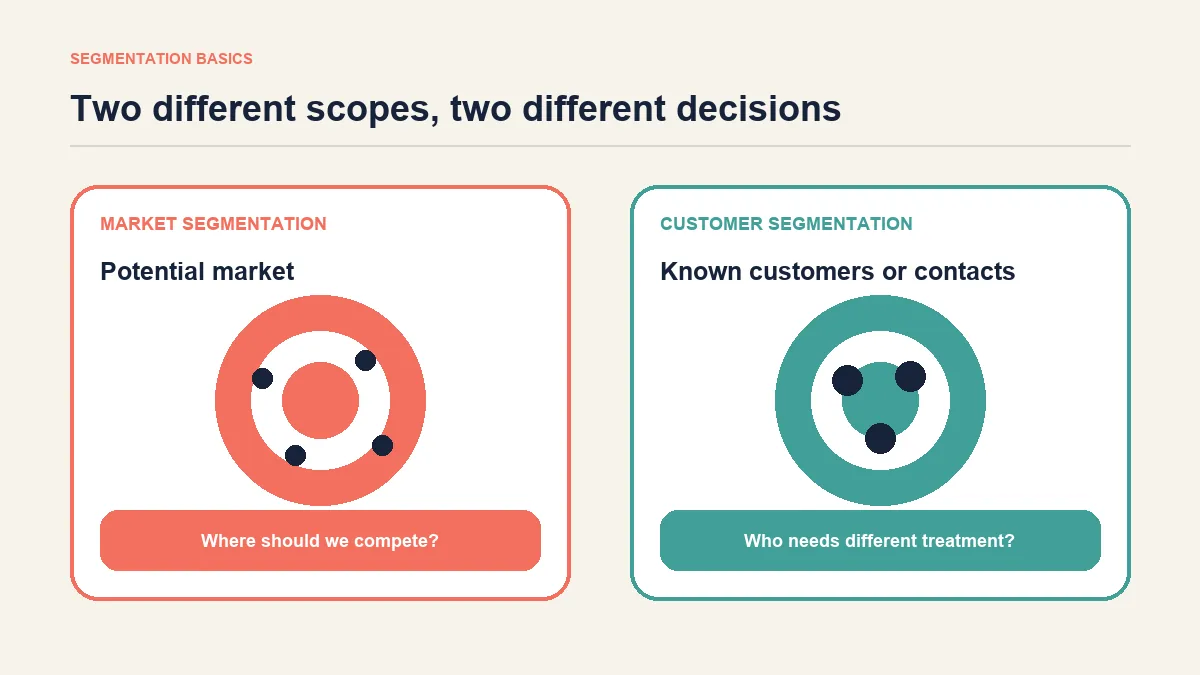
| Question | Market segmentation | Customer segmentation |
|---|---|---|
| Starting population | A wider potential market | Known customers or contacts |
| Typical decision | Which audience or market should we pursue? | How should we serve, analyse or contact this group? |
| Common evidence | Market research, category demand, geography | Consent records, orders, conversations and account activity |
| Example | Independent skincare retailers in Canada | Canadian customers who opted into delivery updates |
The two can inform each other, but they should not be treated as interchangeable. A market hypothesis is not proof that every customer in that market shares the same motivation.
Start with a business decision, not a customer type
Many segmentation projects begin by listing age bands, locations and spending tiers. This creates data work before anyone has defined what the business will do differently.
Begin with one decision instead:
- Retention: which customers need a replenishment, education or renewal message?
- Customer service: which conversations require a different queue, response or human review?
- Broadcasting: which opted-in contacts should receive a particular announcement?
- Product improvement: which group repeatedly raises the same product question?
- Analysis: which lifecycle stage or channel needs to be compared with another?
Then write a one-sentence segment brief:
We need to identify [group] so that we can [action], because [evidence or customer need]. We will judge it using [measure].
For example: “We need to identify recently contacted, opted-in VIP customers so that we can send a relevant early-access announcement. We will review delivery, replies, opt-outs and attributable orders.” The brief exposes missing logic before a tool turns it into a campaign.
Five useful types of ecommerce customer segmentation
The familiar categories are useful when they support a real decision. They are not a checklist every store must complete.
1. Lifecycle segmentation
Lifecycle segments reflect the customer’s current relationship with the business: new subscriber, first-time buyer, repeat buyer, inactive customer or returning VIP. These groups can support onboarding, post-purchase education, replenishment and re-engagement.
Define each stage with observable rules. “Loyal” may mean three completed orders in twelve months for one store, but a current subscription for another. A label without a threshold will be applied inconsistently.
2. Behavioural segmentation
Behavioural segmentation uses recorded actions such as purchases, product-category orders, returns or account activity. It can be helpful because it describes what happened rather than assuming who the customer is.
Context still matters. A high return count could indicate misuse, but it could also reveal unclear sizing, a damaged batch or a product-description problem. Do not turn a behavioural signal into a judgement without investigation.
3. Needs-based and support segmentation
This approach groups customers by the problem they are trying to solve or the assistance they require. Examples include customers asking for compatibility advice, trade buyers needing invoices, or shoppers waiting for an order exception to be resolved.
Conversation themes can reveal needs that a purchase record cannot. The broader guide to customer intelligence platforms explains how conversational, behavioural and feedback signals differ.
4. Value-based segmentation
Value segments distinguish customers using an agreed commercial measure, such as completed revenue, contribution margin or a verified VIP tag. Revenue alone can mislead: frequent discounts, refunds, fulfilment cost and support workload may change the economics.
Use value segmentation to decide service or retention investment, not to make lower-value customers feel unimportant. VIP customer detection and chat routing is a narrower Shopify service use case.
5. Geographic and communication segmentation
Country, region, language, time zone, preferred channel and opt-in status can make a message more useful or determine whether it should be sent at all. A delivery update relevant to one country may be wrong in another. A promotional WhatsApp message needs a different permission and operational process from a routine service reply.
Geography should be used because it changes fulfilment, availability, timing or regulation—not as a shortcut for assumptions about people.
Use the minimum reliable data needed
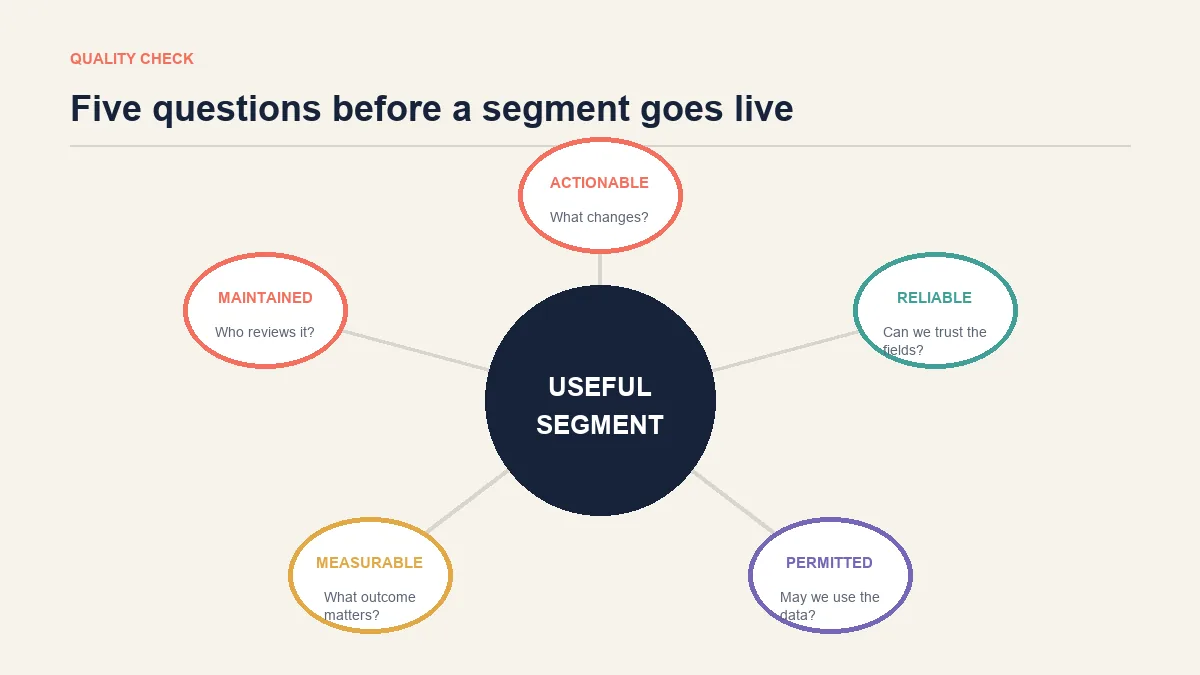
Segment quality depends more on data meaning than data volume. Before using a field, document:
- where it comes from;
- what event updates it;
- how current it is;
- whether customers were told how the data would be used;
- whether consent or another lawful basis is required;
- who can correct or delete it;
- which system is authoritative when records disagree.
Marketing permission is not a decorative field. It can determine whether a contact should be excluded regardless of how attractive the commercial opportunity looks. Rules differ by country, channel and message type. For UK activity, the ICO’s direct-marketing guidance is a useful starting point; businesses should obtain advice for their own markets and circumstances.
Avoid sensitive or inferred personal characteristics unless there is a clear, lawful and proportionate reason. A technically possible segment can still be intrusive, unfair or commercially unwise.
A six-step customer segmentation workflow
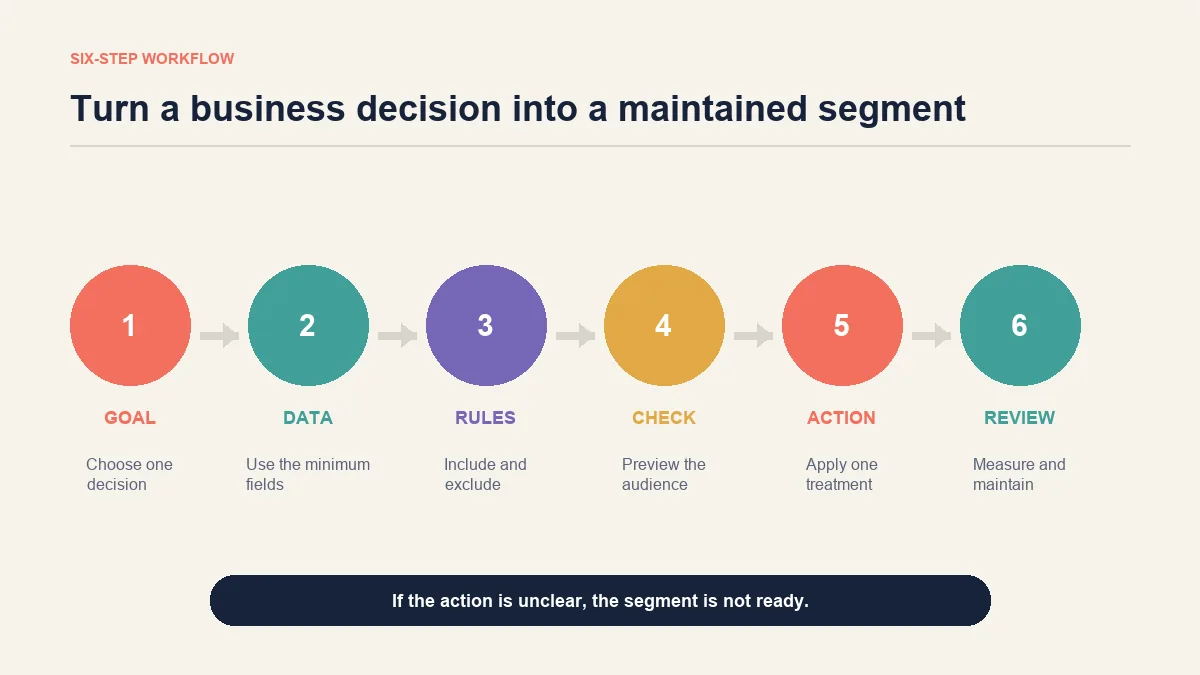
1. Define one goal and one action
Choose a customer problem or business decision. State what will change for the segment: content, timing, support route, offer, product education or analysis.
2. Choose the minimum useful fields
Select fields that directly support the action. Prefer observed, current data over weak assumptions. If the required data is not dependable, fix the collection process before building the segment.
3. Write inclusion and exclusion rules
Write the logic in plain English before configuring it. Include opt-outs, unresolved complaints, recent recipients or other groups that should not receive the action.
4. Preview and inspect the result
Check the count, then sample records if your process permits it. A segment of zero may contain a broken field. An unexpectedly large segment may use OR where AND was intended.
5. Apply one relevant treatment
Change one meaningful element for the group. If the audience, message, channel, timing and offer all change at once, it becomes difficult to explain the result.
6. Measure, review and retire
Record what happened, including negative signals such as opt-outs, complaints and support volume. Set a review date. Delete or revise segments whose definitions no longer match the business process.
Practical customer segmentation examples
The best segment depends on available data and the action. These examples are starting patterns, not universal campaign instructions.
| Business need | Example inclusion rule | Important exclusion | Possible action | Useful measures |
|---|---|---|---|---|
| Welcome new contacts | Imported or captured recently, with the necessary permission | Existing customers already in an onboarding flow | Explain what messages to expect and how to get help | Delivery, replies, opt-outs |
| Re-engage inactive contacts | Last meaningful contact older than a defined period | Opted-out contacts and unresolved complaints | Ask whether the information is still relevant | Replies, opt-outs, qualified return visits |
| Recognise VIP customers | Verified VIP tag and contactable status | Disputed or refunded orders under review | Early notice or a priority service route | Response, resolution and retained revenue |
| Reduce product confusion | Customers linked to a recurring product question | People whose issue is already resolved | Send or improve a specific guide | Repeat-question rate and support demand |
| Localise an operational update | Customers affected by a country-specific delivery change | Unaffected regions | Explain the change and available options | Delivery, replies and related enquiries |
Do not build a segment merely because a competitor recommends it. Each rule should be possible in your actual systems, supported by suitable permission and connected to a useful customer outcome.
AND and OR rules can change the audience completely
Rule logic is one of the easiest ways to make a serious segmentation mistake.
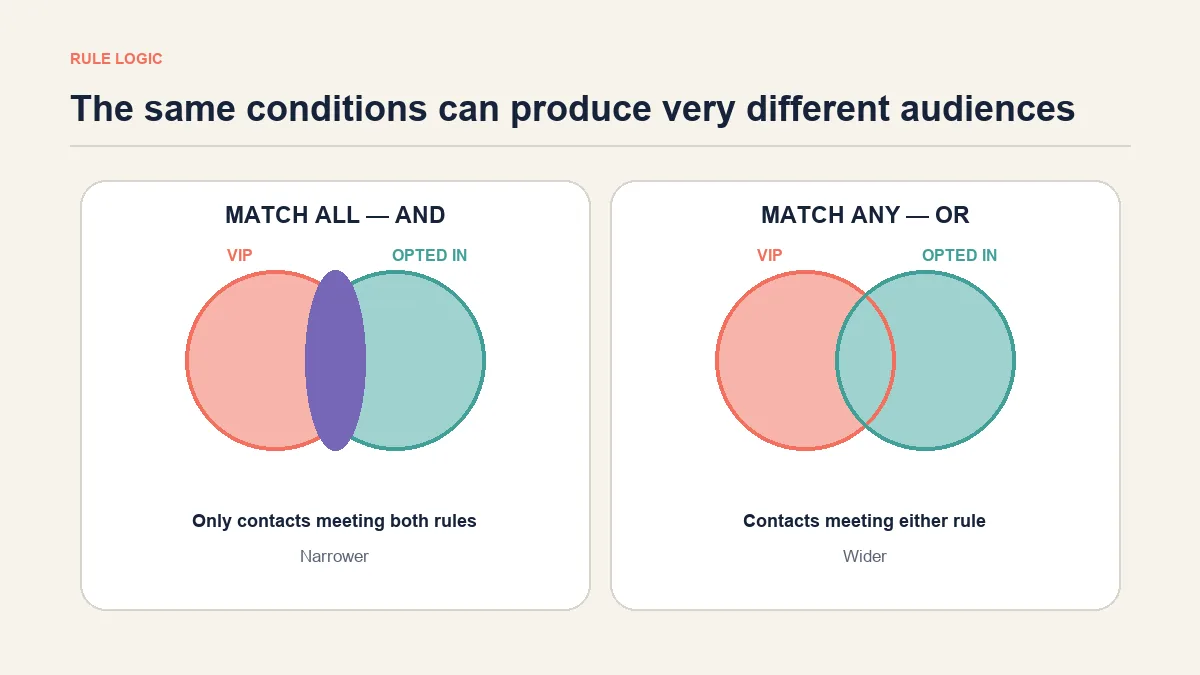
- AND, or Match ALL: every condition must be true. “Tagged VIP and opted in” produces a narrower group of reachable VIP contacts.
- OR, or Match ANY: at least one condition must be true. “Last contacted more than 60 days ago or imported more than 90 days ago” produces a wider re-engagement pool.
Read the final rule as a sentence. If it cannot be explained clearly to another team member, it is too complicated to launch safely. Split it into smaller segments or simplify the conditions.
Control overlap, exclusions and contact pressure
A person can qualify for several segments at once. A repeat buyer might also be a VIP, an inactive contact and a member of a country-specific group. Without coordination, that person can receive several campaigns in a short period.
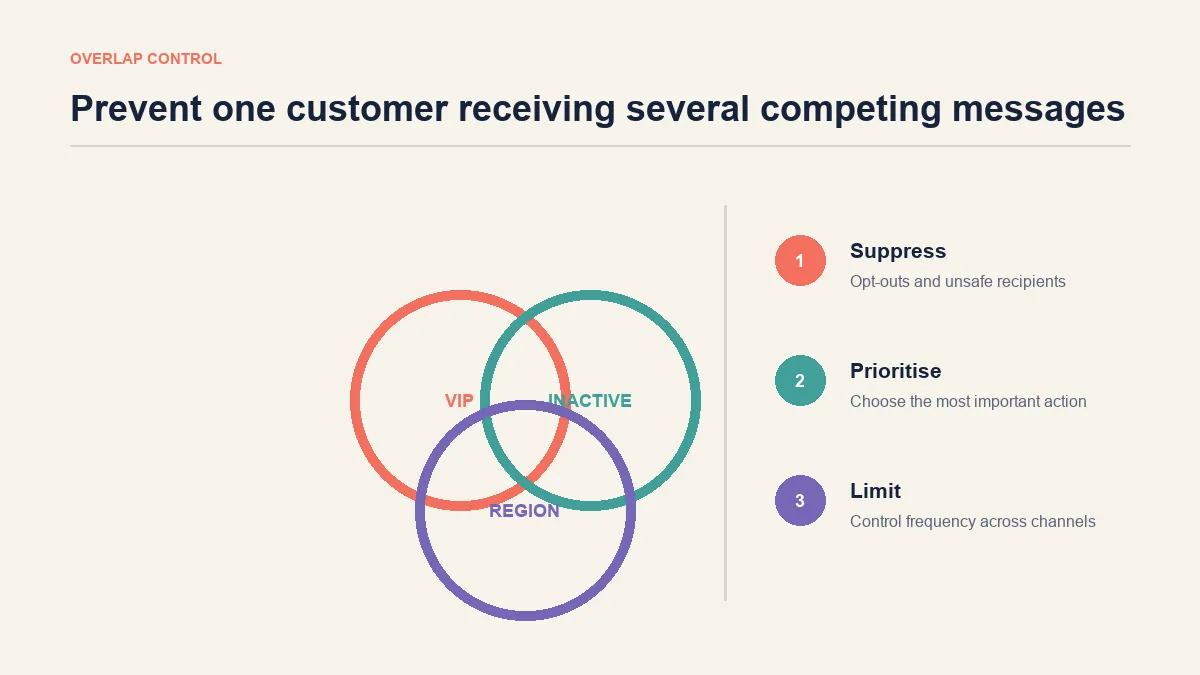
Create a priority and suppression policy:
- Exclude people who cannot or should not receive the message.
- Suppress contacts already included in a higher-priority action.
- Set a sensible contact-frequency rule across channels.
- Decide which team owns conflicts.
- Record why an exception was made.
Segmentation makes sending more selective; it does not automatically make every message welcome.
How AeroChat turns contact rules into targetable segments
AeroChat is an AI agent platform that helps ecommerce brands run customer service on autopilot. Its role in this workflow is specific: it can organise known contacts and create rule-based groups for targeted broadcasts. It is not a replacement for a store’s full customer-data model or an analytics platform.
The AeroChat contact-management tools bring contact details from supported conversations into one list. Within AeroChat Segments, a business can currently filter using four verified fields: opt-in status, tags, last contacted and date imported. Multiple conditions can use Match ALL or Match ANY, and Preview Count shows the matching audience before the segment is saved.
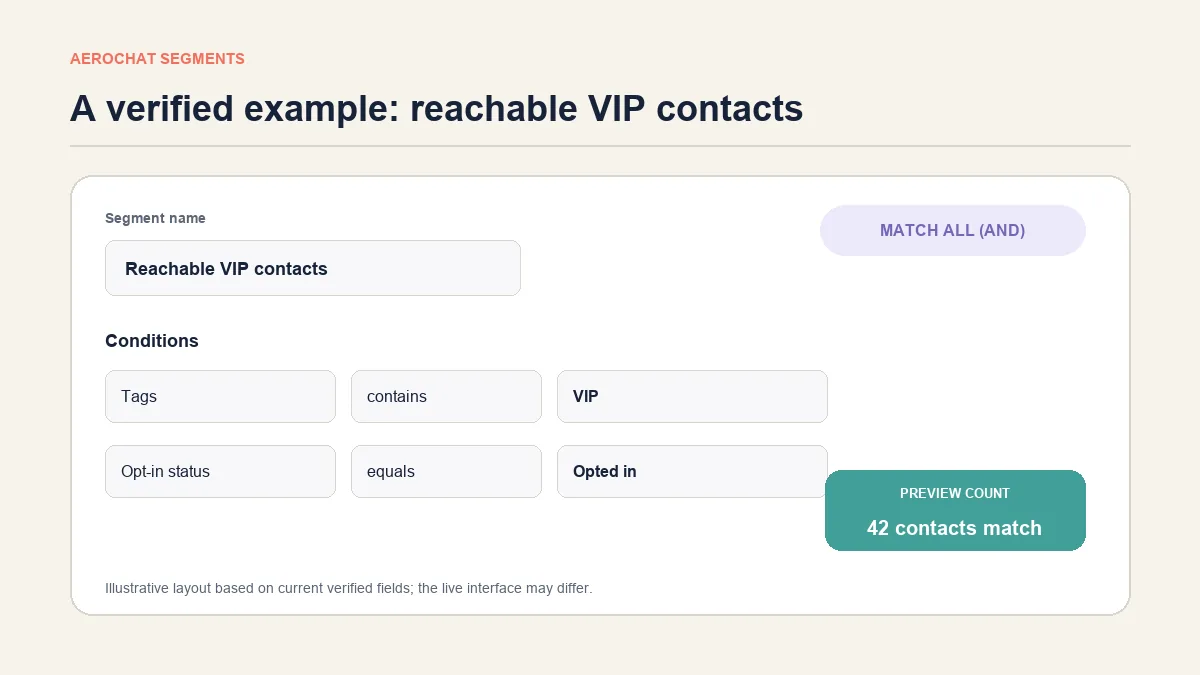
For example, a team could create “reachable VIP contacts” using a VIP tag and opted-in status. It could create a broader re-engagement audience using last-contacted or date-imported thresholds. These saved groups can then target broadcasts rather than sending the same message to the entire contact list.
That scope matters. AeroChat should not be described here as predicting lifetime value, detecting purchase behaviour automatically or building demographic profiles. Businesses that use WhatsApp can also review the practical guide to sending a WhatsApp broadcast message. The message still needs suitable permission, content and timing; a segment does not supply those decisions automatically.
Measure whether a segment improves the decision
Do not assess segmentation by list size alone. Choose measures that reflect the action:
- Reach and delivery: did the intended group receive the communication?
- Response quality: did replies show that the message was relevant?
- Customer outcome: was the question resolved, task completed or useful action taken?
- Commercial outcome: were attributable orders, renewals or retained customers affected?
- Negative signals: did opt-outs, complaints, blocks or support contacts rise?
- Operational cost: how much work was required to build, check and maintain the segment?
Compare like with like where possible, and avoid claiming that the segment caused an outcome when several factors changed. A modest segment that prevents irrelevant messages can be valuable even if it does not produce the highest immediate revenue.
Common customer segmentation mistakes
Creating too many tiny groups
Micro-segments sound precise but can become impossible to maintain or measure. Start with the smallest number that changes a meaningful decision.
Using labels with no definition
Terms such as “engaged”, “at risk” and “high value” need thresholds, time periods and data sources. Otherwise teams interpret them differently.
Treating correlation as motive
A purchase or support pattern tells you what happened. It does not necessarily reveal why. Use customer questions, research or feedback to test the explanation.
Forgetting exclusions
Opt-outs, recent recipients, active complaints, refunded orders and internal test records can all require suppression. Inclusion rules are only half of a usable segment.
Leaving segments permanently active
Products, policies, permissions and customer behaviour change. Give every important segment an owner and review date.
Personalising without helping
Inserting a first name does not make an irrelevant message relevant. The value comes from selecting a useful message for a genuine need or context.
A 30-day segmentation plan for an ecommerce team
Week 1: Audit goals and data
Choose one use case. List the fields it needs, their source, their owner and any consent or privacy requirements. Remove fields that do not change the decision.
Week 2: Build and inspect one segment
Write the rule in plain English, configure it, add exclusions and inspect the resulting count. Ask a colleague to explain who qualifies without seeing your notes.
Week 3: Run a limited action
Use a controlled audience and one clearly relevant message or service treatment. Monitor replies and negative signals while the action is live.
Week 4: Review and document
Compare the result with the original goal. Record what should change, who owns the segment and when it will be reviewed. Expand only after the rules and operating process are dependable.
Frequently asked questions about customer segmentation
How many customer segments should an ecommerce store start with?
Start with the smallest number that changes a meaningful decision. One dependable segment with a clear action is more useful than ten overlapping groups nobody maintains. Add another only when it needs different treatment or measurement.
Can a small ecommerce store use customer segmentation?
Yes. A small store can begin with simple, observable rules such as communication permission, lifecycle stage, location or a verified tag. It does not need predictive modelling or a large data team to make one message more relevant.
How often should customer segments be reviewed?
Set the interval from how quickly the underlying data and business process change. Campaign-specific segments may need checking before every send, while a stable operational group may be reviewed monthly or quarterly. Every important segment should have an owner and review date.
What is the difference between AND and OR in a customer segment?
AND requires every condition to match and therefore narrows the audience. OR includes a contact when any listed condition matches and therefore widens it. Preview the count and read the rule as a sentence before using the segment.
Which contact fields can AeroChat currently use for segments?
AeroChat currently documents four segment fields: opt-in status, tags, last contacted and date imported. Conditions can use Match ALL or Match ANY, and the matching count can be previewed before saving.
Build fewer segments and make each one useful
Customer segmentation works when each group has a clear definition, a legitimate data basis and a specific action. Start with the decision, not the software. Use explicit rules, inspect who is included, protect people who should be excluded and measure customer as well as commercial outcomes.
For ecommerce teams managing growing conversation volumes, AeroChat’s ecommerce customer-service platform can connect routine support with contact management and targeted communication across supported channels. It becomes most useful when the team already understands which customer questions and contact groups need different treatment.
Customer segmentation is most valuable when it informs messaging, pricing and support prioritisation. The ecommerce content strategy guide covers how segmentation shapes content decisions, and customer lifetime value is the metric that makes segmentation most actionable. For stores using WhatsApp or email as segmented outreach channels, email newsletter examples shows what segmented campaigns look like in practice.